
Choosing between Revolut and Wise can make a noticeable difference to how much you spend when travelling abroad, exchanging currencies or sending money internationally.
Both platforms offer multi-currency accounts, international payments and debit cards, but their pricing structures and additional features are different.
Revolut is generally a stronger option for customers who want everyday spending features, budgeting tools and travel benefits.
Wise is particularly attractive for international transfers, transparent currency conversion and receiving payments in different currencies.
However, the cheapest option depends on the amount being exchanged, the destination currency and when the transaction takes place.
For example, Revolut’s free Standard plan offers currency exchange without an additional exchange fee for many weekday transactions within its monthly allowance.
Wise charges a transparent conversion fee but uses the mid-market exchange rate and does not impose a separate weekend markup.
Our comparison examines UK pricing, foreign exchange costs, ATM withdrawal allowances, banking protection and practical situations where each service may offer better value.
Revolut vs Wise: What Are the Main Differences?
Although Revolut and Wise compete in international money services, they serve somewhat different customer needs.
Wise began as an international money transfer service, previously known as TransferWise, before expanding into multi-currency accounts and debit cards.
Revolut has developed into a broader financial platform offering everyday payments, savings features, budgeting tools and additional products. Some services and benefits depend on the customer’s subscription plan.
The following table compares their principal features for UK personal customers as of November 2026.
| Feature | Revolut | Wise |
| Account subscription | Free Standard plan and paid options | No monthly personal account subscription |
| Exchange rate | Revolut’s own variable exchange rate | Mid-market exchange rate |
| Currency conversion fees | Depend on the plan, currency and timing | Transparent currency-dependent fees |
| Weekend exchange fees | Additional charges may apply on Standard and Plus | No separate weekend markup |
| Standard monthly exchange allowance | £1,000 before a 1% fair usage fee | No equivalent monthly fair usage threshold |
| ATM fee-free allowance | £200 or five withdrawals per rolling month on Standard | £250 per month for UK-issued cards |
| ATM charges above allowance | 2%, minimum £1 | 2.69% of the excess |
| First physical debit card | Free on Standard; delivery fee applies | £7 |
| International transfers | Local, SEPA and international payment options | International transfers with upfront pricing |
| UK banking status | Licensed UK bank; account migration status matters | Electronic money institution |
| Additional features | Budgeting, savings, investments and paid travel benefits | Multi-currency payments and international account details |
| Business services | Revolut Business | Wise Business |
The comparison shows that neither provider is automatically cheaper across every transaction.
Customers considering Revolut as their everyday financial account may also find our Revolut vs Monzo comparison useful for assessing alternatives available in the UK.
Which Has Better Exchange Rates: Revolut or Wise?
Exchange rates are one of the most important considerations because a seemingly small difference can become expensive when converting larger amounts.
How Wise Calculates Currency Exchange?
Wise uses the mid-market exchange rate, commonly described as the midpoint between the buying and selling prices for a currency pair.
Instead of adding a hidden margin to that rate, Wise displays a separate conversion fee.
The conversion fee depends on the currencies involved, the amount being exchanged and other transaction details.
For some popular currency pairs, fees can start at approximately 0.33%, although this should not be treated as a universal rate.
One advantage is that customers can normally see the exchange rate, fees and expected recipient amount before confirming a transfer.
Wise also does not apply an additional fee simply because an exchange takes place on Saturday or Sunday.
How Revolut Calculates Currency Exchange?
Revolut uses its own variable exchange rate, rather than guaranteeing the exact mid-market rate on every transaction.
For UK Standard customers, Revolut provides a monthly exchange allowance of £1,000 before a 1% fair usage fee applies to the amount exceeding that allowance.
An additional weekend fee of 1% generally applies when Standard customers exchange money during the applicable weekend period.
For example, if someone exchanges £1,500 during a weekday after making no earlier qualifying exchanges in their monthly allowance period, the final £500 exceeds the Standard plan’s £1,000 allowance.
The additional fair usage fee on that £500 would be £5. The exchange rate and any other applicable fees would still need to be considered.
Revolut’s allowance also counts qualifying exchanges involving cryptocurrencies and commodities, not just traditional currencies. This can matter for customers who use multiple financial features within the same app.
Customers should review the official Revolut Standard fees before making larger exchanges.
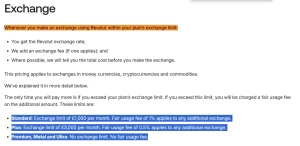
Revolut Standard currency exchange limits and applicable fees for UK customers.
Is Revolut or Wise Cheaper for International Money Transfers?
For international transfers, it is important to compare the amount received by the recipient rather than focusing exclusively on the advertised exchange rate.
A transfer may involve more than one cost, including conversion charges, payment fees or charges imposed by intermediary banks.
Wise generally displays the transfer fee, exchange rate and expected recipient amount before payment confirmation.
Revolut allows customers to make transfers in supported currencies, with different charges depending on the destination and payment route.
Transfers to another Revolut customer are generally free, as are qualifying domestic payments and SEPA transfers.
Other international payments may carry a fee, which Revolut shows before confirmation. Intermediary bank charges can also affect some transfers.
Jo Thornhill, the former Forbes Advisor UK staff writer who authored its Wise vs Revolut comparison, highlighted how the cost difference can depend on transaction size and destination.
Her September 2026 comparison found that smaller transfers could deliver similar recipient amounts, while larger international payments could produce more noticeable differences because of transfer charges.
This reinforces an important point: the best provider is the one that delivers the most money to the recipient after all relevant charges, not necessarily the one advertising the lowest conversion fee.
For customers transferring money back to an ordinary UK account, our guide on how to transfer money from Revolut to a bank account explains the process and key considerations.
How Should You Compare the Cost of a Transfer?
Before sending money, enter the same amount into both services and ensure the destination and payment method are identical.
Compare these five factors:
- The amount you intend to send in pounds.
- The exchange rate offered at that moment.
- Any currency conversion and international transfer fees.
- The final amount the recipient is expected to receive.
- The estimated delivery time and possible intermediary charges.
A provider charging a higher stated fee could still offer a better total outcome if its exchange rate or payment route results in a larger recipient amount.
For frequent payments, it is also worth examining whether additional fees apply after reaching a monthly exchange allowance.
Revolut vs Wise for Travel: Which Card Is Better Abroad?
Both Wise and Revolut can be useful alternatives to traditional bank cards when travelling internationally.
Their debit cards allow customers to spend in supported currencies and withdraw cash at overseas ATMs. However, the way exchange fees are calculated can affect the overall cost of a holiday.
Revolut can be attractive to travellers who exchange currency during weekdays and remain within their plan’s allowance.
Wise may be more convenient for travellers who prefer transparent conversion pricing without having to plan around weekend exchange charges.
For example, imagine a traveller visiting Spain who expects to spend €800 over a weekend.
With Revolut Standard, converting enough pounds into euros before the weekend could avoid a weekend exchange fee on those pre-converted euros.
If the traveller instead makes purchases requiring new currency conversions during the weekend, additional charges may apply.
With Wise, the customer can spend directly from a euro balance or allow the card to convert money when required, with the applicable conversion fee.
The difference is therefore not just the headline exchange rate. It is also how much preparation each card requires to avoid unnecessary charges.
What Happens When You Pay in Pounds Instead of Local Currency?
A common mistake when travelling abroad is choosing to pay in pounds when a card machine offers a choice between GBP and the local currency.
This is known as dynamic currency conversion.
When the merchant or ATM performs the conversion, its exchange rate may be less favourable than the rate offered by Wise or Revolut.
For most foreign-currency transactions, choosing the local currency allows your card provider to handle the conversion.
For example, when paying for a meal in France, choosing euros rather than pounds will generally be the better option.
This consideration applies beyond Wise and Revolut. Our article explaining whether Monzo charges abroad examines another popular UK travel banking alternative.
How Do Wise and Revolut ATM Withdrawal Fees Compare?
ATM withdrawal limits are particularly important for travellers visiting destinations where cash remains widely used.
Under the current UK pricing, Wise offers a larger fee-free cash withdrawal allowance than Revolut Standard.
| ATM withdrawal feature | Revolut Standard | Wise UK card |
| Fee-free cash withdrawal amount | £200 | £250 |
| Withdrawal count restriction | Five withdrawals or £200, whichever comes first | No equivalent two-withdrawal restriction shown in current UK card pricing |
| Additional withdrawal fee | 2%, minimum £1 | 2.69% of the amount exceeding £250 |
| ATM operator fees | May apply | May apply |
Consider a customer making one cash withdrawal equivalent to £300, assuming no previous withdrawals have used the allowance.
With Revolut Standard, £100 exceeds the £200 allowance. A 2% charge on that excess would equal £2.
With Wise, £50 exceeds the £250 allowance. A 2.69% charge on that excess would be approximately £1.35.
In this illustrative case, Wise would charge about 65p less in provider ATM withdrawal fees.
These examples exclude currency conversion fees and any additional charges imposed by the ATM operator. The exact cost may also depend on the applicable allowance period.
Readers can check the current limits through Wise’s official UK card pricing page.
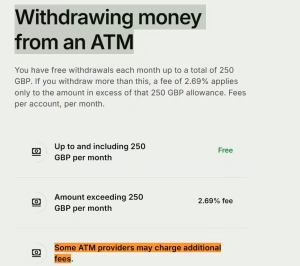
Wise UK debit card ATM withdrawal allowances and fees, November 2026.
Which Is Better for Weekend Spending and Currency Conversion?
Weekend exchange pricing is one of the clearest differences between the two services.
Revolut Standard generally applies an additional 1% weekend exchange fee when a currency conversion is required.
Wise does not apply a separate weekend markup, although its normal currency conversion fee still applies.
Consider a hypothetical £600 GBP-to-EUR conversion.
| Example | Illustrative conversion charge |
| Revolut Standard weekend fee at 1% | £6 |
| Wise conversion fee assumed at 0.33% | £1.98 |
The Wise figure is an illustration using a 0.33% fee assumption, not a guaranteed live quote. Additional route-specific charges, exchange-rate differences and other relevant fees may change the outcome.
The example shows why Wise can be more competitive for spontaneous weekend exchanges.
However, someone using Revolut who already converted their pounds into euros during the week may not need a further currency conversion when spending the euro balance at the weekend.
This makes Revolut’s weekday exchange planning particularly useful for people who regularly travel to the same destination.
Which Offers Better Account Features for Everyday Banking?
Revolut offers a wider range of financial management features than Wise.
Its app supports everyday transactions, spending analysis, budgeting, virtual cards and access to additional financial products. Some features and benefits are restricted to particular subscription plans.
Wise focuses more heavily on international currency management.
Customers can hold and manage balances in supported currencies, obtain local receiving details for selected currencies and make international payments.
For someone working with customers in the United States or Europe, these international account features may be more useful than a broad selection of lifestyle benefits.
For someone primarily using a financial app for UK shopping, recurring payments and budgeting, Revolut may offer the more complete experience.
Nevertheless, the availability of features does not necessarily mean every customer needs them. Paid subscriptions should be assessed against their actual benefits.
Is Wise or Revolut Safer for Holding Money in the UK?
Security and customer protection should be part of any financial comparison, particularly when an account may be used to hold substantial balances.
Both providers operate within UK financial regulation, but their legal structures and customer protection arrangements differ.
Is Revolut Covered by FSCS Protection?
Revolut launched its fully licensed UK bank on 11 March 2026.
Eligible deposits held with Revolut Bank UK Ltd are covered by the Financial Services Compensation Scheme, subject to the scheme’s rules and the applicable £120,000 per-person protection limit.
However, the migration of existing UK customers from Revolut’s electronic money entity to the banking entity has been taking place in stages.
Customers should therefore check which legal entity currently provides their particular account.
This information is available in the account details within the Revolut app.
It is also important to remember that FSCS deposit protection does not automatically extend to investments, cryptocurrency holdings or every financial product accessible through Revolut.
For a more detailed examination of customer safeguards, see our guide on whether Revolut is safe in the UK.
Is Money Held With Wise FSCS Protected?
Wise operates as an authorised electronic money institution rather than a UK deposit-taking bank.
Ordinary balances held in a Wise UK e-money account are not protected by the FSCS deposit guarantee.
Instead, Wise must safeguard relevant customer funds in accordance with its regulatory obligations.
Safeguarding involves separating protected customer money from the company’s operating funds through permitted arrangements.
Although safeguarding provides an important form of protection, it is not identical to FSCS deposit insurance.
If an electronic money institution becomes insolvent, recovering safeguarded funds can involve an administration process, possible delays and associated costs.
This does not automatically make Wise unsuitable, but customers should understand the distinction before using either provider to hold significant sums.
Wise vs Revolut for Freelancers and Businesses: Which Is More Practical?
Wise and Revolut also provide business accounts, although their business pricing is separate from the personal account fees discussed above.
Wise Business may appeal to freelancers, consultants and companies receiving payments from international clients.
Its features are particularly relevant to businesses that invoice overseas customers, receive money in multiple currencies or make regular international supplier payments.
Revolut Business may be attractive to companies that need a wider combination of payment tools, team spending controls, business cards and financial integrations.
A UK-based consultancy receiving frequent euro and dollar payments might prioritise conversion costs and receiving details.
A company with several employees making international purchases might place greater value on corporate spending tools and account administration.
Neither business account should be selected purely because the provider’s personal travel card performs well.
Businesses should compare supported payment routes, account charges, transfer limits, accounting integrations and international receiving fees.
Our comparison of UK business bank accounts provides additional context for businesses considering alternative banking arrangements.
Can You Use Revolut and Wise Together?
Yes. There is generally no need to choose only one of the two services.
Using both can be practical for customers who make several types of international transactions.
For example, someone could use Wise to receive freelance income in foreign currencies and Revolut for everyday card spending and travel-related budgeting.
A frequent traveller might also retain both cards to provide an alternative payment method if one is temporarily unavailable.
However, managing multiple accounts requires monitoring balances, card security, exchange costs and transaction records.
It also makes sense to avoid converting the same money unnecessarily between accounts, as each new conversion can introduce further costs.
Maintaining two services is most useful when their distinct features justify the additional administration.
What Are the Main Disadvantages of Wise and Revolut?
Neither platform is without limitations.
Wise’s key disadvantages include currency conversion charges, a fee for ordering a physical debit card and the absence of FSCS deposit protection for ordinary UK e-money balances.
It also offers fewer everyday banking and lifestyle features than Revolut.
Revolut’s limitations include plan-dependent exchange allowances, potential weekend fees, charges on certain international transfers and subscription costs for additional benefits.
Customers should also understand the distinction between Revolut’s different legal entities and financial products.
Some users may encounter account reviews, temporary restrictions or requests for additional verification when carrying out transactions.
Such checks can occur at regulated financial service providers and do not necessarily indicate misconduct or a problem with the customer’s funds.
For readers assessing potential drawbacks, our article on why Revolut may be unsuitable for some UK customers explores additional account limitations and customer concerns.
Revolut vs Wise: Which Should You Choose?
The most appropriate choice depends on how frequently you use foreign currencies and what you expect from your financial account.
| Customer requirement | Potentially better choice | Main reason |
| Everyday UK spending and budgeting | Revolut | Broader financial management tools |
| Frequent international bank transfers | Wise | Transparent transfer pricing and currency handling |
| Small weekday currency conversions | Revolut Standard | May avoid a separate exchange fee within the allowance |
| Unplanned weekend currency conversion | Wise | No separate weekend exchange markup |
| Overseas ATM withdrawals within £250 | Wise | Higher fee-free allowance than Revolut Standard |
| Premium travel-related benefits | Revolut paid plans | Additional benefits depending on subscription |
| Receiving international freelance income | Wise | Multi-currency receiving capabilities |
| Business team expense management | Revolut Business | Business-focused spending and administration tools |
| Eligible UK bank deposit protection | Revolut Bank UK | FSCS protection on qualifying bank deposits |
These are general recommendations rather than guaranteed cost rankings.
A different payment route, currency or subscription plan could change which provider offers better value.
For anyone transferring larger amounts, obtaining a fresh quote from both platforms remains the most reliable approach.
Conclusion: Is Revolut Better Than Wise in the UK?
Revolut and Wise both provide competitive international payment services, but each has different strengths.
Revolut is particularly appealing to customers looking for a broader financial app, convenient everyday spending and the option of premium travel-related features.
Its Standard plan can also be cost-effective for weekday currency exchanges within the relevant allowance.
Wise offers transparent currency conversion using the mid-market rate, straightforward international transfers and a higher current UK fee-free ATM withdrawal allowance.
For many UK customers, Wise may be the more convenient choice for regular overseas payments and unplanned weekend currency conversions, while Revolut may be more suitable as a broader daily spending account.
The deciding factor should always be the actual transaction cost, the required account features and the protection arrangements applicable to the funds involved.
Frequently Asked Questions About Revolut vs Wise
Is Revolut Better Than Wise for International Transfers?
Wise is often more suitable for international transfers because it uses the mid-market exchange rate and transparent fees. Revolut may be cheaper for certain transfers, depending on the currency, amount and account plan.
Is Wise or Revolut Better for Travelling Abroad?
Revolut offers useful travel features and competitive weekday currency exchange. Wise is a convenient alternative for travellers who want transparent conversion fees without additional weekend exchange charges.
Which Is Cheaper, Revolut or Wise?
Revolut can be cheaper for smaller weekday currency exchanges within its free plan allowance. Wise may offer better value for larger exchanges or weekend transactions, depending on the live rates and fees.
Can I Use Wise and Revolut in the UK?
Yes, both services are available to eligible UK customers. They offer debit cards, multi-currency services and international transfers, although their account features and protections differ.
Is Wise Safer Than Revolut?
Both providers are regulated, but they offer different protections. Eligible Revolut UK bank deposits may qualify for FSCS protection, while ordinary Wise account balances are protected through safeguarding arrangements.
Does Revolut Charge More Than Wise on Weekends?
Revolut Standard generally applies an additional 1% fee for weekend currency exchanges. Wise does not charge a separate weekend markup, although its normal currency conversion fees still apply.
Can I Transfer Money From Revolut to Wise?
Yes, you can generally transfer money from Revolut to Wise using supported bank account details. Transfer fees, processing times and currency conversion costs depend on the payment route.