
Revolut has become one of the UK’s best-known digital financial platforms, attracting millions of customers with international transfers, competitive currency exchange, virtual cards and convenient money management.
However, its rapid expansion has also raised questions about customer service, account restrictions, fraud protection and unexpected fees.
So, why is Revolut bad according to some customers? The biggest concerns involve restricted accounts, difficulties resolving complex complaints, fraud disputes, limited cash banking and additional charges that can reduce the value of its free account.
Our financial review examined Revolut’s published terms, independent banking assessments, Financial Ombudsman complaint information and regulatory developments. We also considered how its services compare with the practical needs of UK employees, travellers and business owners.
Importantly, Revolut became a fully licensed UK bank in March 2026. That improvement changes its regulatory position, but it does not automatically eliminate every concern about how customers access, protect and manage their money.
Why Do Some People Think Revolut Is Bad?
Revolut is not inherently a bad financial provider. Its international banking features are competitive, and many customers use the platform successfully for everyday payments and overseas spending.
The criticism becomes more significant when customers encounter problems that cannot be resolved through normal app functions.
From our analysis, the most important disadvantages are:
- Account restrictions: Customers may temporarily lose access to certain services while compliance checks are conducted.
- Customer support: Digital-first support may be frustrating when a complicated financial problem requires human assistance.
- Fraud disputes: Published complaint data raises questions about how effectively fraud cases have been resolved.
- Foreign exchange fees: Standard and Plus customers can incur additional charges.
- Limited physical banking: There are no traditional branches, and UK cash deposits have been discontinued.
- Premium subscriptions: Paid plans can cost hundreds of pounds annually.
- Product complexity: Savings, investments, cryptocurrency and banking balances have different protections.
- Credit limitations: Some traditional UK borrowing facilities remain less comprehensive than those offered by established competitors.
These concerns do not affect every customer equally.
Someone using Revolut to spend £300 during a holiday faces a different level of inconvenience from a self-employed professional relying on the platform to receive £20,000 from an overseas client.
| Main Concern | Potential Impact | Our Concern Rating |
| Account restrictions | Temporary disruption to access | High |
| Fraud complaints | Possible financial loss and dispute delays | High |
| Customer support | Difficulties resolving unusual problems | High |
| Foreign exchange charges | Increased international spending costs | Medium |
| Cash banking | Inconvenient for cash users | High |
| Paid subscriptions | Benefits may not justify the price | Medium |
| Banking protection | Depends on the account entity and product | Medium |
| App dependence | Reduced access during technical or authentication problems | Medium |
The ratings above represent our editorial assessment of the potential impact of each issue, not the percentage of Revolut customers experiencing it.
Why Does Revolut Restrict or Freeze Customer Accounts?
One of the most serious complaints associated with Revolut involves customers reporting that their accounts have been restricted or temporarily frozen.
Financial institutions must monitor transactions to comply with anti-money-laundering regulations, sanctions requirements and fraud prevention obligations.
As a result, Revolut may request further information before allowing particular transactions or account functions to continue.
Common Reasons for Account Restrictions
A review may involve:
- Large or unusual transfers.
- Payments inconsistent with a customer’s normal activity.
- Incomplete identity verification.
- Questions about the source of deposited funds.
- Missing or outdated customer information.
- Transactions associated with suspected fraud.
- Activity requiring additional regulatory checks.
None of these circumstances automatically proves wrongdoing.
A legitimate customer receiving money from a property sale, a freelance contract or an international business transaction could be asked to provide supporting documents.
The problem is that the financial consequences of restricted access can be significant, even where the customer has done nothing improper.
For example, somebody expecting a £6,000 international payment may need that money immediately for rent, mortgage instalments or supplier invoices.
A temporary restriction could disrupt those commitments.
The Problem With Automated Compliance
Modern financial platforms use automated monitoring systems to identify unusual transactions and potential criminal activity.
These systems are important for fraud prevention, but a transaction that differs from a customer’s previous behaviour can require further investigation.
Our assessment is that the main concern is not whether Revolut should conduct compliance checks. It is whether customers receive sufficiently clear information and effective assistance when their access is restricted.
Customers should keep invoices, payslips, contracts and evidence of where significant payments originated.
Maintaining a separate account for essential expenses can also reduce the financial disruption caused by an unexpected review.
Is Revolut Customer Service Good Enough When Something Goes Wrong?
Customer support is another important reason some people develop negative opinions about Revolut.
Unlike traditional high-street banks, Revolut operates without a network of physical branches where customers can discuss problems face to face.
Its main customer support channels are provided through the application, including secure chat and eligible in-app calling.
Revolut advertises 24/7 support, which is a genuine advantage for customers travelling across different time zones.
However, support availability and successful problem resolution are not the same thing.
Customers reporting suspicious payments, disputed transfers or restricted accounts may require specialised investigations that take longer than an ordinary support conversation.
Where Digital Support Can Become Frustrating?
Consider a customer who cannot access their account after changing mobile phones.
The customer may need to complete identity verification before accessing secure support services.
If the verification process fails, restoring access can become more complicated.
Similarly, someone disputing a transfer may need assistance from a dedicated fraud investigation team rather than a general customer service adviser.
We would therefore distinguish between two aspects of customer support:
| Support Measure | Revolut’s Position | Our Assessment |
| 24/7 support availability | Available through the app | Positive |
| Physical branches | Not available | Disadvantage |
| In-app calling | Available subject to support arrangements | Positive |
| Complex fraud investigations | Additional investigation may be needed | Concern |
| Formal complaint procedure | Available | Positive |
| Face-to-face assistance | Not available | Disadvantage |
Our editorial customer support score: 55%.
This score reflects our evaluation of access channels and the practical challenges of complex disputes. It is not a measured customer satisfaction percentage.
Why Are Fraud Complaints a Major Concern for Revolut?
Fraud complaints provide a more substantial basis for assessing Revolut than isolated negative online reviews.
Consumer organisation Which? obtained Financial Ombudsman Service data covering fraud and scam complaints escalated between 1 January and 31 August 2025.
The findings showed that Revolut received more referred authorised push payment fraud complaints than other firms in the comparison.
Authorised push payment fraud, commonly called APP fraud, occurs when someone is manipulated into transferring money to a criminal.
For example, a scammer may impersonate a bank employee, investment adviser or legitimate supplier.
Revolut Fraud Complaint Statistics
| Complaint Category | Cases Referred, Jan–Aug 2025 | Customer Uphold Rate |
| APP fraud complaints | 1,875 | 30% |
| Other fraud and scam complaints | 1,333 | 37% |
| Combined referrals | 3,208 | Not a single combined rate |
These figures describe complaints referred to the Financial Ombudsman, not all fraud incidents reported to Revolut.
A 30% uphold rate means the Ombudsman found in favour of the consumer in 30% of the relevant complaints resolved during the measurement period. It does not mean 30% of all Revolut fraud claims were incorrectly rejected.
For additional context, the same Which? analysis reported:
| Bank or Provider | APP Fraud Complaints | Uphold Rate |
| Revolut | 1,875 | 30% |
| Barclays | 1,161 | 31% |
| Monzo | 1,063 | 41% |
| HSBC | 1,037 | 34% |
| Santander | 884 | 27% |
The figures show that Revolut attracted the highest number of APP fraud complaints in the published comparison, although Monzo had a higher percentage upheld.
Complaint volumes are influenced by customer numbers, transaction activity, the types of fraud involved and the willingness of customers to escalate disputes.
They should not be interpreted as a direct measurement of each provider’s probability of exposing a customer to fraud.
Nevertheless, the data raises legitimate questions about fraud prevention, reimbursement decisions and the customer experience during disputes.

Financial Ombudsman complaint data and independent analysis highlight concerns over the number of fraud disputes escalated by Revolut customers.
What Has Revolut Said About Fraud Prevention?
Revolut has defended its financial crime prevention measures, stating that it uses transaction monitoring, specialist employees and advanced technology to identify suspicious activity.
The company said it prevented more than £600 million of potential fraud against customers during 2024.
This matters because the existence of fraud complaints does not mean a provider has no security controls.
Our assessment is that customers should judge Revolut on both sides of the evidence: its investment in fraud prevention and its record of resolving legitimate complaints fairly.
Is Revolut Safe Now That It Has a UK Banking Licence?
An important distinction must be made between Revolut’s earlier electronic-money business and its newer UK banking operation.
On 11 March 2026, Revolut Bank UK Ltd received approval from the Prudential Regulation Authority to exit its mobilisation phase and operate as a fully licensed UK bank.
That is a significant improvement.
It means Revolut Bank UK Ltd is authorised by the PRA and regulated by the PRA and Financial Conduct Authority under the UK’s banking framework.
However, its customer migration has been phased, so the protection attached to a particular account must still be checked.
Revolut Bank UK Ltd and FSCS Protection
Eligible deposits held with Revolut Bank UK Ltd are covered by the Financial Services Compensation Scheme.
Since December 2025, the normal UK deposit protection limit has been £120,000 per eligible person, per authorised firm.
This protection applies if an eligible bank fails and cannot repay protected deposits.
It does not guarantee compensation for every scam, investment loss or disputed transaction.
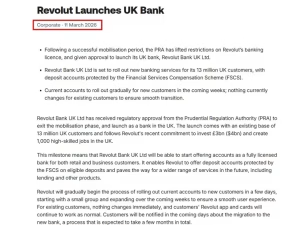
Revolut confirmed the launch of its fully licensed UK bank on 11 March 2026, allowing eligible customers to access FSCS-protected deposit accounts.
Why the Account Provider Still Matters?
Not every Revolut product represents the same type of financial arrangement.
| Revolut Product or Structure | Main Protection Consideration |
| Revolut Bank UK current account | Eligible deposits qualify for FSCS deposit protection |
| Legacy Revolut Ltd e-money account | Safeguarding rules apply rather than ordinary FSCS deposit protection |
| Partner-bank savings account | FSCS eligibility depends on the underlying authorised bank |
| Stocks and investment products | Different investment protection rules apply |
| Cryptocurrency | Not protected against ordinary investment losses |
Customers should establish which legal entity provides their account and whether their money is held as a deposit or invested through a separate financial product.
Those considering another digital bank can also examine whether Monzo is safe for UK customers, including the differences between deposit protection, fraud controls and investment risks.
Our view: Revolut’s full UK banking licence removes a major historical criticism. It would now be inaccurate to describe Revolut as simply an unlicensed UK banking platform.
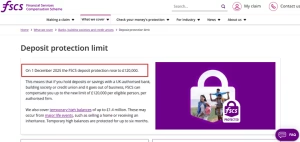
The FSCS confirms that eligible deposits with authorised UK banks are protected up to £120,000 per person, per authorised institution.
How Expensive Is Revolut for Everyday Customers?
Revolut is often promoted as a convenient way to save money on foreign currency transactions.
That advantage can be genuine, particularly for customers making international payments.
However, free accounts have limits, and their value depends on how frequently customers exchange currencies or withdraw cash.
Foreign Exchange Fees
Revolut Standard customers can normally exchange up to £1,000 within their rolling monthly allowance without an additional fair-usage fee.
A 1% fair-usage fee applies to amounts above that allowance.
Plus customers receive a £3,000 allowance, with a 0.5% fee applying to excess exchanges.
Premium, Metal and Ultra plans do not have these additional monthly fair-usage exchange limits.
Weekend exchange fees are another consideration.
| Revolut Plan | Monthly Exchange Allowance | Fee Above Allowance | Additional Weekend Exchange Fee |
| Standard | £1,000 | 1% | 1% |
| Plus | £3,000 | 0.5% | 0.5% |
| Premium | Unlimited | 0% | 0% |
| Metal | Unlimited | 0% | 0% |
| Ultra | Unlimited | 0% | 0% |
The term unlimited in this table refers to the absence of the stated additional fair-usage limit, not a guarantee that every currency exchange is completely free of other applicable costs.
Revolut uses its own variable exchange rate, and the final quote should always be checked.
Example of Revolut Exchange Charges
Suppose a Standard customer exchanges £1,500 during a rolling month, with no other relevant exchanges.
The amount above the £1,000 allowance is £500.
The additional fair-usage fee would be:
£500 × 1% = £5
Now suppose the customer makes a separate £400 currency exchange at the weekend while still within their monthly allowance.
A 1% weekend charge would equal:
£400 × 1% = £4
These examples exclude possible differences in the underlying conversion rate.
They demonstrate why Revolut’s cheapest-looking account may not always produce a completely fee-free result.
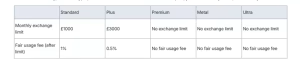
Revolut’s official UK fee schedule identifies monthly foreign exchange allowances and additional charges for Standard and Plus customers.
ATM Withdrawal Charges
Revolut Standard customers can currently make up to five fee-free ATM withdrawals or withdraw £200 per rolling month, whichever limit is reached first.
After the allowance, Revolut normally charges 2% of the relevant withdrawal amount, subject to a minimum fee of £1.
An independent ATM operator may impose separate charges.
These restrictions can make Revolut less attractive to travellers who regularly withdraw physical cash.
For comparison, the cost of using Monzo abroad depends on different withdrawal allowances and eligibility rules.
Revolut can still be competitive internationally, but customers should compare actual transaction costs rather than assuming its travel-focused reputation guarantees the lowest price.
Why Is Revolut Less Convenient for Traditional UK Banking?
Not every customer wants a financial application offering dozens of services.
For many households, the most important banking functions are straightforward: receiving wages, paying bills, depositing money and accessing help when something goes wrong.
Revolut provides many everyday banking functions, but it remains less suitable for certain traditional requirements.
One significant change occurred on 13 February 2026, when Revolut discontinued UK cash deposits.
Customers can still add money through supported electronic methods, but depositing physical notes is no longer part of the normal UK personal account service.
This matters for people who regularly receive cash, including some hospitality workers, market traders and self-employed professionals.
Other limitations may include restricted cheque-handling options, the absence of a branch network and less comprehensive UK borrowing facilities than those available from certain competitors.
It is important not to repeat outdated claims, however.
Revolut now supports the Current Account Switch Service for eligible UK bank accounts, enabling customers to move regular payments and balances through the established switching process.
That makes it a more realistic primary current account than it was under its earlier UK e-money structure.
Are Revolut Premium and Metal Plans Worth the Subscription Cost?
Revolut offers multiple paid subscription plans with additional features, higher allowances and lifestyle benefits.
The problem is that the value of those benefits depends on whether customers actually use them.
| Revolut Plan | Monthly Cost | Cost Over 12 Months |
| Standard | £0 | £0 |
| Plus | £3.99 | £47.88 |
| Premium | £7.99 | £95.88 |
| Metal | £14.99 | £179.88 |
| Ultra | £55 | £660 |
Annual figures are calculated using 12 standard monthly payments. Annual billing offers may have different prices.
Premium plans can include features relating to insurance, airport lounges, subscriptions, rewards and international banking.
But a £660 annual subscription is difficult to justify if the customer rarely travels or already pays for comparable benefits elsewhere.
An important consideration is the cancellation policy.
Depending on the applicable account and subscription terms, early downgrades may involve fees or restrictions.
Customers should check whether benefits are conditional on using a particular card, booking method, merchant or payment arrangement.
Our analysis suggests that Standard will be adequate for many occasional Revolut customers, while Premium or Metal may be worthwhile for people who can demonstrate genuine savings from higher allowances and included benefits.
Ultra requires an especially careful comparison between subscription cost and benefits actually used.
Should Revolut Customers Be Concerned About Security Incidents?
Revolut’s rapid expansion has been accompanied by regulatory scrutiny and questions about its internal controls.
In 2025, Lithuania’s central bank imposed a €3.5 million fine relating to shortcomings in transaction monitoring.
The regulatory findings should not be confused with a finding that every Revolut transaction was unsafe or that money laundering had been established.
A more recent concern emerged in October 2026.
Reports published on 7 October described an incident in which criminals used access to a compromised government-agency email account in Italy to obtain personal data relating to approximately 680 Revolut customers.
Revolut said its internal systems had not been compromised.
The company also indicated that it would cover necessary identity-document replacement costs for affected customers.
This distinction is important.
The reported incident involved the improper disclosure of customer information following a fraudulent request. It should not be described as hackers gaining access to Revolut’s core banking systems.
Nevertheless, the incident highlights how financial security depends on human procedures, identity verification and communication controls as well as software.
For customers, sensible precautions include enabling transaction notifications, reviewing unfamiliar payment requests and avoiding instructions to move money into supposed safe accounts.
Can Revolut Be Risky for Savings and Investments?
Revolut’s application brings current accounts, savings products, investments and cryptocurrency services together within a single interface.
Convenience is an advantage, but it can also obscure important differences in financial protection.
Money held in an eligible bank deposit is not the same as money invested in shares, investment funds or cryptocurrency.
An FSCS-protected bank deposit is primarily protected against failure of the authorised deposit-taking institution, subject to scheme rules.
Shares and investment funds can decline in value because financial markets fall.
Cryptocurrency can experience substantial price volatility, and ordinary market losses are not covered by bank deposit protection.
Customers should therefore ask three questions before transferring money into any product:
- Who holds the money? Identify the authorised bank, investment firm or other provider.
- What financial product is involved? Check whether it is a deposit, investment fund or cryptocurrency holding.
- What protection applies? Establish whether any relevant FSCS or other compensation arrangement covers the specific circumstances.
It would be a mistake to assume that every balance visible in Revolut’s app receives identical regulatory protection.
Is Revolut a Poor Choice for Small Businesses?
Revolut Business offers useful services for companies trading internationally, including multi-currency capabilities, team spending controls and integrations with accounting systems.
These features can make it attractive to consultants, e-commerce businesses and organisations handling overseas transactions.
However, business customers should assess operational risks more carefully than occasional personal users.
For example, a business may depend on incoming international payments to cover employee salaries, tax obligations and supplier invoices.
If a significant transfer requires additional compliance verification, the resulting delay could disrupt business cash flow.
Companies should also review transaction limits, foreign exchange allowances, subscription costs and payment approval procedures.
A business accepting substantial amounts of physical cash may find Revolut less practical than a provider offering established cash-deposit facilities.
The most important factors for businesses include:
- Cash-flow resilience: Maintain sufficient accessible funds to cover essential expenditure.
- Document readiness: Keep invoices, contracts and ownership information available for compliance reviews.
- Payment redundancy: Consider a second banking relationship for operational continuity.
- Foreign exchange costs: Compare the full conversion cost, including any charges beyond allowances.
- Team controls: Review user permissions, spending limits and payment authorisation settings.
The wider range of business bank accounts available in the UK makes it possible to compare Revolut with providers offering different combinations of UK banking facilities, international services and business support.
Our assessment is that Revolut can be a strong secondary business account for foreign currency transactions, while businesses with complex cash-handling needs should examine alternatives carefully.
Is Revolut Worse Than Monzo or Starling?
Revolut, Monzo and Starling appeal to overlapping customer groups, but their services are not identical.
Our comparison suggests that Revolut is particularly competitive for international transactions and customers wanting access to a broad collection of financial services.
Monzo is more focused on everyday UK personal banking, while Starling provides a digital banking experience with conventional banking functions.
| Feature | Revolut | Monzo | Starling |
| UK banking licence | Yes | Yes | Yes |
| Eligible FSCS deposit protection | Yes, for qualifying bank deposits | Yes | Yes |
| Traditional branches | No | No | No |
| Personal cash deposits | No | Yes | Yes |
| International currency management | Major strength | More limited | More limited |
| Everyday UK budgeting | Good | Strong | Strong |
| Personal overdraft | Limited UK availability | Available subject to eligibility | Available subject to eligibility |
| Individual share trading | Available | Different investment offering | Not a comparable core feature |
| Cryptocurrency features | Available | Not a comparable core feature | Not a comparable core feature |
This comparison illustrates why there is no single best account for every customer.
Someone paid in pounds who mainly wants to manage rent, bills and savings may prefer a straightforward UK current account.
Someone earning income from overseas clients may benefit more from Revolut’s multi-currency services.
A detailed Revolut vs Monzo comparison can help customers evaluate the differences in fees, savings, borrowing and international banking before choosing a main account.
How Can Customers Complain About Problems With Revolut?
Customers experiencing a restricted account, disputed payment or unsatisfactory support response should use Revolut’s formal complaints procedure.
An important distinction exists between contacting general support and submitting a formal complaint.
A support conversation does not always establish the same complaint-handling timeline as a properly registered formal complaint.
Customers can submit a complaint using Revolut’s official complaint form or the designated complaints email address.
A useful procedure is:
- Record the issue: Save relevant payment references, dates, screenshots and communication history.
- Contact support: Request an explanation and identify any missing documents.
- Submit a formal complaint: Explain the problem, its financial consequences and the desired resolution.
- Retain the reference: Keep the complaint number and acknowledgement.
- Review the final response: Check the reasons for the decision and any proposed remedy.
- Escalate where eligible: Contact the Financial Ombudsman Service if the issue remains unresolved or the relevant response deadline has passed.
For ordinary complaints, the usual Financial Ombudsman escalation point is after a final response or eight weeks without resolution. Certain payment-service complaints have shorter response requirements, normally 15 business days, with limited extensions.
Customers usually have six months from a final response to refer an eligible complaint to the Ombudsman.
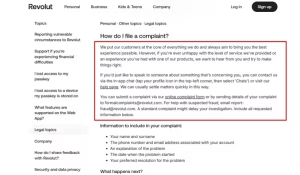
Revolut provides a formal complaints process, including an online form and instructions for escalating unresolved financial disputes.
Additional Protection for APP Fraud Victims
UK reimbursement rules introduced in October 2024 apply to many eligible authorised push payment scams involving Faster Payments and CHAPS.
For qualifying claims, the mandatory reimbursement ceiling is generally £85,000.
Eligible customers would normally expect reimbursement within five business days, although more complicated investigations can take longer, subject to the applicable rules.
There are eligibility requirements and exceptions, so a refund is not automatically guaranteed for every scam.
The key point is that customers should report suspected fraud promptly and preserve the evidence required for an investigation.
What Does Our Financial Review Rate Revolut in 2026?
We assessed Revolut across six categories that reflect the needs of UK personal and business banking customers.
Our methodology gives greater weight to the reliability of day-to-day financial access and support than to lifestyle rewards.
| Assessment Category | Weight | Editorial Score |
| UK everyday banking | 20% | 68% |
| International payments and currencies | 20% | 88% |
| Customer service and dispute resolution | 20% | 55% |
| Fee transparency and value | 15% | 65% |
| Regulatory protection and security | 15% | 73% |
| Features and financial versatility | 10% | 88% |
| Weighted Overall Rating | 100% | 72% |
These are our editorial judgement scores, not figures from a customer survey, independent testing laboratory or regulatory assessment. The weighted result is calculated from the individual scores.
Revolut receives its highest scores for international financial functionality and breadth of features.
It receives lower scores for customer service and conventional UK banking practicality because those are areas where certain customers may experience greater inconvenience.
The rating also recognises the improvement created by Revolut’s full UK banking authorisation in March 2026.
Who Should Avoid Revolut as Their Main Bank?
Whether Revolut is appropriate depends largely on how a customer earns, spends and manages money.
| Customer Type | Our Assessment | Main Reason |
| Frequent international traveller | Good option | Strong currency management |
| Freelancer receiving foreign income | Good option | International payment features |
| Customer needing regular cash deposits | Poor fit | UK cash deposits unavailable |
| Person requiring face-to-face banking | Poor fit | No branch network |
| Customer wanting an overdraft | Compare alternatives | Limited UK borrowing range |
| Investor wanting individual shares | Potentially useful | Integrated investment services |
| Customer wanting simple household banking | Consider alternatives | Other banks offer focused everyday services |
| Business receiving large overseas payments | Useful with safeguards | Maintain backup liquidity and compare FX costs |
For customers who want to minimise disruption, a sensible approach is to keep essential bill payments and emergency funds accessible through an appropriate banking arrangement while using Revolut for services where it offers a clear advantage.
This does not mean Revolut cannot function as a main account.
It means customers should make that decision based on their financial needs rather than the number of features available in the app.
Is Revolut Really Bad for UK Customers?
Revolut is not a bad provider for every customer, but it does have disadvantages that deserve serious consideration.
Its main strengths remain international payments, flexible currency management, virtual cards and a broad collection of financial services.
The biggest reasons people criticise Revolut concern account restrictions, fraud disputes, customer support, free-account limits and the absence of certain traditional banking functions.
The introduction of a fully licensed UK bank in March 2026 represents meaningful progress, particularly for customers whose deposits qualify for FSCS protection.
However, a banking licence does not automatically eliminate customer service problems or guarantee uninterrupted access to money.
Our overall editorial rating of 72% reflects that balance.
For international banking, Revolut can be an attractive option. For customers prioritising straightforward UK banking, accessible support, cash deposits and conventional lending, it is worth comparing the alternatives before relying on Revolut exclusively.
What Else Should Customers Know About Revolut?
Is Revolut a trustworthy bank in the UK?
Revolut Bank UK Ltd is a fully licensed and regulated UK bank. However, customers should check which Revolut entity provides their account and what protection applies to their funds.
Can Revolut freeze money without warning?
Revolut may restrict account access where fraud prevention, legal obligations or compliance checks require it. Some investigations may limit what information can immediately be disclosed.
Does Revolut charge hidden fees?
Revolut publishes its charges, but customers can overlook currency exchange limits, weekend fees, ATM withdrawal charges and paid-plan cancellation terms.
Is it safe to keep £50,000 in Revolut?
Eligible deposits of £50,000 held with Revolut Bank UK Ltd are within the normal £120,000 FSCS protection limit, subject to eligibility and the customer’s other balances with the same authorised firm.
Can Revolut refuse to refund stolen money?
A refund can be declined if the relevant rules do not establish liability or the claim falls outside applicable protections. Eligible customers can challenge a decision through Revolut’s complaints process and the Financial Ombudsman.
Should Revolut be used for salary payments?
It can receive UK salary payments, but customers should consider account protection, bill-payment requirements and the benefits of maintaining another accessible payment method.