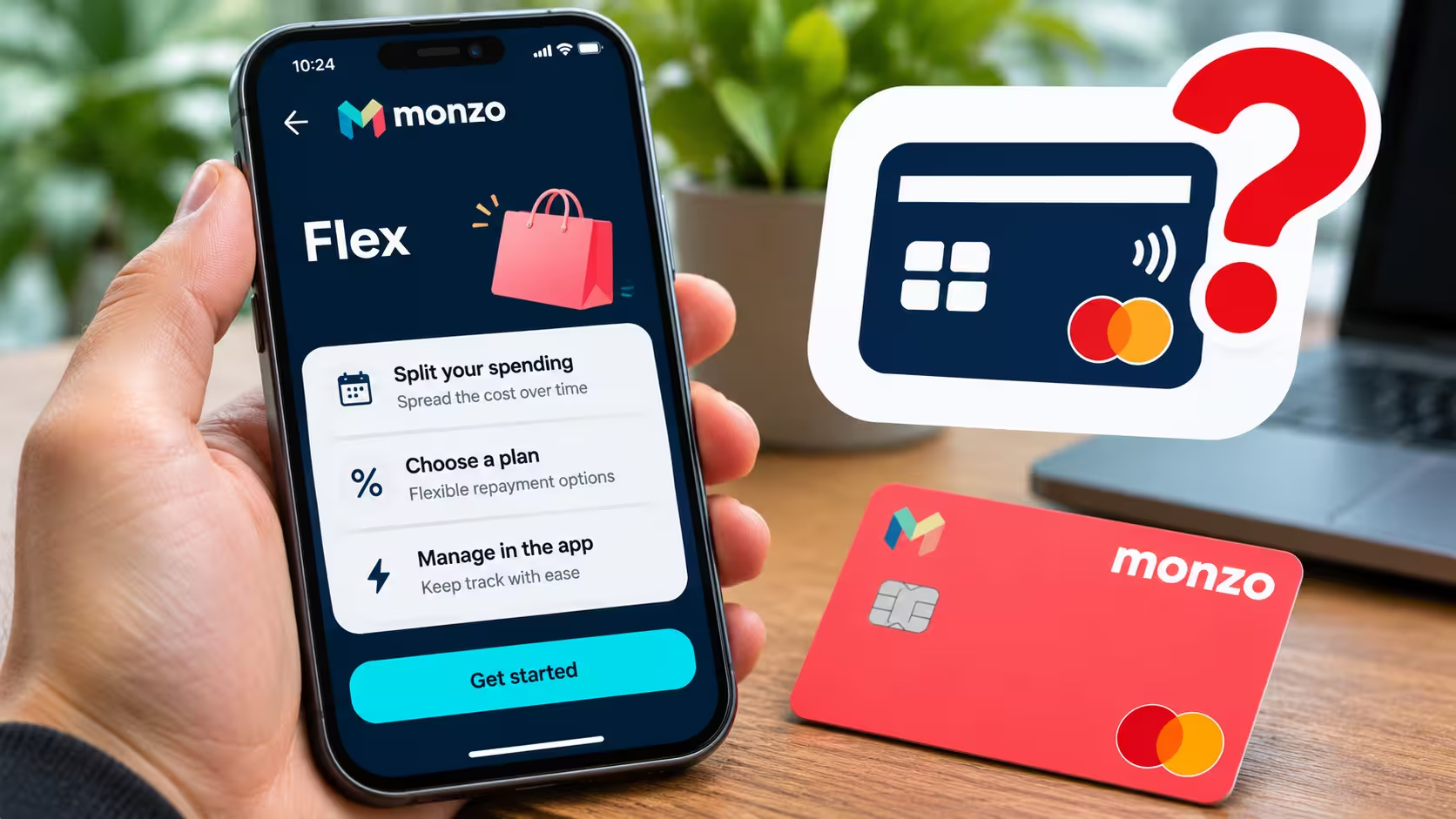
Yes, Monzo Flex is a credit card, but it works differently from many traditional UK credit cards. It combines everyday credit-card spending with flexible repayment plans, allowing customers to pay for purchases immediately or spread the cost over several months.
Unlike a standard Monzo debit card, which takes money directly from your current account, Monzo Flex allows you to borrow against an approved credit limit.
One of its biggest attractions is the ability to repay eligible purchases of £100 or more over three months without interest. However, longer repayment arrangements can involve interest charges, and using Flex can affect your credit history.
Monzo currently offers two main Flex products: Flex Purchase and Flex Build, each designed for different borrowing needs.
We examined the product features, interest rates, repayment options and potential borrowing risks to explain where Monzo Flex offers genuine value and where another credit card might be more suitable.
What Makes Monzo Flex Different From a Traditional Credit Card?
Monzo Flex operates as a regulated credit-card product, but its repayment structure gives customers more control over individual purchases.
Traditional credit cards generally allow customers to pay their statement balance in full or make monthly repayments against their outstanding balance.
Monzo Flex adds the ability to select repayment arrangements for individual purchases, making it easier to separate everyday spending from larger expenses.
For example, someone buying a £600 appliance could choose an eligible three-month interest-free repayment plan rather than placing the entire cost into a general credit-card balance.
The following comparison highlights the main differences.
| Feature | Monzo Flex | Traditional Credit Card |
| Payment method | Credit card | Credit card |
| Credit limit | Personalised, depending on product | Depends on lender |
| Repayment structure | Purchase-level plans and monthly payments | Usually statement-based repayments |
| Interest-free purchases | Eligible three-month plans or payment in full | Depends on card terms and promotions |
| Physical and digital cards | Available | Depends on provider |
| Credit reporting | Yes | Yes |
| Section 75 protection | On qualifying purchases | On qualifying purchases |
| Early repayment | No early repayment fee | Usually permitted without penalty |
Monzo Flex also shares features with buy now, pay later (BNPL) products because customers can split eligible payments into instalments.
However, Flex is not simply an unregulated instalment facility or an extension of your debit card. It is credit borrowing with a credit agreement, affordability assessment and credit reporting.
This distinction matters because an interest-free repayment plan still creates debt that must be repaid.
How Do Monzo Flex Payments and Interest Rates Work?
Monzo Flex allows customers to select different repayment arrangements based on their purchases and the options available on their account.
The most important difference is whether a repayment arrangement qualifies for 0% interest.
Paying in Full on Your Next Payment Date
Customers can choose to repay a purchase completely on their next scheduled payment date without paying interest.
For example, someone using Flex to buy £80 worth of groceries could repay the full £80 on their next payment date without interest.
This is useful for customers who prefer credit-card purchase protection while avoiding ongoing borrowing costs.
Splitting Purchases Over Three Months
Flex Purchase offers 0% interest over three months for eligible purchases costing £100 or more.
The repayment amount is divided into three instalments, meaning the original purchase price is repaid without additional interest when the plan’s terms are met.
Consider these illustrative examples:
| Purchase Amount | Repayment Option | Monthly Repayment | Total Repaid |
| £90 | Pay in full at next payment date | £90 | £90 |
| £150 | Three months at 0% | £50 | £150 |
| £300 | Three months at 0% | £100 | £300 |
| £600 | Three months at 0% | £200 | £600 |
| £900 | Three months at 0% | £300 | £900 |
These figures assume the customer qualifies for the interest-free arrangement, makes all required repayments and incurs no other borrowing costs.
An important restriction is that the three-month 0% offer does not automatically apply to purchases below £100.
Customers using Flex Build must also unlock the three-month interest-free benefit before they can use it.
Choosing Longer Repayment Plans
Monzo also offers longer repayment arrangements, including six and twelve-month options, with repayment periods potentially extending to 24 months depending on the purchase and account terms.
However, these arrangements can attract interest.
The longer the repayment period, the more important it becomes to consider the total repayment amount rather than focusing only on the monthly instalment.
For example, a £1,200 purchase spread over twelve months might appear more manageable than paying the same amount over three months.
But if interest applies, the total cost will exceed £1,200.
Monzo publishes its representative rates and repayment features on its official Flex credit card page.
The most useful figure for a customer is the total repayment amount shown in the app before choosing a plan, because the interest rate offered is personalised.
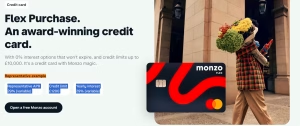
Monzo Flex Purchase’s official page showing the representative APR and interest-free repayment features.
What Is the Difference Between Monzo Flex Purchase and Flex Build?
Monzo provides two Flex credit-card products aimed at customers with different financial circumstances.
Flex Purchase focuses on flexible spending and interest-free repayment opportunities, while Flex Build is designed for customers who want to establish or improve their credit history.
| Feature | Flex Purchase | Flex Build |
| Primary purpose | Everyday credit spending and larger purchases | Building or improving credit history |
| Representative APR | 29% variable | 39% variable |
| Advertised credit limit | Up to £10,000 | Initially up to £750 |
| Interest-free payment in full | Yes | Yes |
| Three months at 0% on eligible purchases | Available | Must be unlocked |
| Credit reference agency reporting | Yes | Yes |
| Security deposit | Not normally required | May be required |
| Monthly card fee | £0 | £0 |
These are advertised representative terms. Individual offers, limits and interest rates can differ.
Flex Purchase: Designed for Flexible Spending
Flex Purchase provides access to a larger potential credit limit and allows eligible customers to spread purchases costing £100 or more over three months at 0% interest.
Customers can also make payments early without an additional early repayment fee.
The main appeal is the ability to use interest-free arrangements repeatedly on qualifying purchases rather than relying on a single introductory promotional period.
However, the absence of a fixed expiry date for the 0% feature does not mean every purchase or repayment option is interest-free.
Flex Build: Designed Around Credit History
Flex Build is particularly relevant to customers with limited or weaker credit histories.
It starts with a lower potential credit limit and may require a refundable security deposit, depending on the applicant’s circumstances.
Customers can become eligible to unlock additional benefits through responsible account management, including higher credit limits and interest-free three-month repayment options.
Monzo indicates that the three-month 0% benefit can be unlocked after meeting repayment and eligibility conditions. Customers should check the milestones displayed in their app rather than assuming the feature is available immediately.
This makes Flex Build different from a standard credit-building card, although it is still important to avoid expensive borrowing simply to establish a repayment record.
Customers comparing credit-building products may also find our Zable credit card review useful for understanding alternative credit limits, APRs and account features.
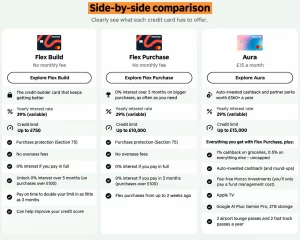
Official comparison of Monzo Flex Purchase and Flex Build, including credit limits, representative interest rates and interest-free features.
Who Can Apply for Monzo Flex and How Does Approval Work?
Monzo Flex is available to eligible UK residents aged 18 or over.
Applicants also need a Monzo current account before applying.
Meeting these basic requirements does not guarantee approval because Monzo assesses factors such as affordability, credit history and financial circumstances.
The general application process involves:
- Opening or accessing a Monzo current account: Customers must have an eligible Monzo account to apply.
- Checking eligibility: Monzo initially performs a soft credit search, which does not affect the applicant’s credit score.
- Reviewing the personalised offer: Eligible customers can see the credit limit, interest rate and card options offered.
- Accepting the credit agreement: Proceeding with the application involves a hard credit search.
- Using the approved card: Customers can add their Flex card to a compatible digital wallet and begin spending once it is available.
A soft eligibility check and a completed credit application are not the same thing.
The initial assessment helps customers explore their options without recording a hard application search.
Accepting the credit offer results in a hard search, which may temporarily affect the applicant’s credit profile.
Customers with previous borrowing difficulties should therefore consider their approval prospects and repayment affordability before completing an application.
Our analysis of getting a loan with bad credit explores how lenders assess affordability and why unnecessary credit applications should be avoided.
Does Monzo Flex Affect Your Credit Score?
Yes. Monzo Flex can affect your credit score because the lender reports account activity to credit reference agencies.
This makes Flex different from simply paying with money already held in your current account.
Monzo reports information including:
- The credit limit available on the account.
- The amount of credit currently outstanding.
- Whether scheduled repayments are made on time.
- Relevant account and repayment activity.
Responsible use can help demonstrate that a customer manages borrowing reliably.
However, the effect on a credit score depends on the individual’s wider financial circumstances.
How Responsible Repayments Can Help?
Someone who regularly uses a modest proportion of their available credit and repays on time may gradually establish a stronger credit history.
For example, a customer with a £1,000 limit who borrows £150 and repays it as agreed demonstrates a different borrowing pattern from someone repeatedly approaching their limit.
Maintaining manageable balances is particularly important when preparing for a larger borrowing application, such as a mortgage.
Why Missed Payments Can Cause Problems?
Missing payments can negatively affect a customer’s credit record.
It may also result in the loss of interest-free arrangements on existing purchases, depending on the account terms.
Although Monzo does not charge a separate late payment fee, this does not make late repayment financially harmless.
Customers should therefore treat Flex instalments like any other contractual borrowing commitment.
A useful precaution is to monitor all upcoming instalments within the app rather than considering each purchase independently.
What Fees and Purchase Protections Come With Monzo Flex?
The cost of using Monzo Flex depends on the repayment arrangement and the type of transaction.
There are several important advantages, but customers should distinguish fee-free features from interest-bearing borrowing.
| Charge or Protection | Monzo Flex Position |
| Monthly card fee | None for Flex Purchase or Flex Build |
| Interest on eligible three-month plans | 0% when conditions are met |
| Interest on longer repayment plans | Can apply |
| Early repayment fee | None |
| Separate late payment fee | None |
| Overseas card purchase fee | No additional Monzo foreign transaction fee |
| Section 75 purchase protection | Available on qualifying transactions |
| Money transfers | A 3% fee can apply |
Section 75 Protection on Eligible Purchases
One of the most important advantages of using Monzo Flex as a credit card is its potential Section 75 protection under the Consumer Credit Act 1974.
Section 75 can make a credit provider jointly liable with a retailer when qualifying goods or services are not supplied as promised or have been misrepresented.
For example, if someone purchases a £700 laptop directly from a retailer using their Flex credit card and the retailer fails to deliver it, Section 75 may provide an additional route to recover the money.
Generally, the cash price of the qualifying item or service must be more than £100 and no more than £30,000.
The £100 threshold for Section 75 is separate from the £100 threshold used for Monzo’s three-month interest-free plans.
For Section 75, a purchase costing exactly £100 does not meet the minimum value requirement.
Coverage also depends on how the purchase was made. Money transfers and certain transactions involving intermediaries may not qualify.
This additional consumer protection is one reason credit-card purchases can offer benefits beyond simply spreading payments.
Overseas Spending and Currency Conversion
Monzo Flex does not impose an additional foreign transaction fee on ordinary overseas card purchases.
Instead, eligible transactions are converted using Mastercard’s applicable exchange rate.
This can make Flex attractive for people purchasing goods abroad or travelling internationally.
However, borrowing interest may still apply depending on the selected repayment arrangement.
Customers comparing international spending options should distinguish Flex credit-card transactions from the rules explained in our article on Monzo charges abroad.
Cash withdrawals and money transfers should also be assessed separately from ordinary card purchases.
What Happens If You Miss a Monzo Flex Repayment?
Monzo says it gives customers seven days from a missed payment date to catch up.
It does not charge an additional late payment fee.
However, customers should not interpret this seven-day period as a guarantee that missed payments will have no consequences.
If the account remains overdue, possible consequences include:
- Negative information being reported to credit reference agencies.
- Losing access to interest-free repayment arrangements.
- Restrictions on making further Flex purchases.
- Changes to repayment arrangements under the applicable account terms.
- Increased borrowing costs if interest-bearing repayment terms become applicable.
This is particularly important for customers who use multiple instalment plans simultaneously.
For example, three separate £300 purchases each repaid over three months could create £300 of combined monthly repayment commitments.
Each purchase may appear affordable individually, but the combined payment obligation could place pressure on the customer’s monthly budget.
Is Monzo Flex Worth Using Instead of Another Credit Card?
Monzo Flex can be a useful option for people who want flexible repayment arrangements, integrated mobile account management and interest-free borrowing on eligible purchases.
However, it is not necessarily the cheapest credit product for every customer.
Personal finance writers Rachel Wait and Emily Herring, in their published review of Monzo Flex, identify its hybrid credit-card and buy-now-pay-later structure as an important distinction, while cautioning about the cost of interest-bearing repayment plans.
That is a relevant consideration because repayment flexibility can be beneficial without automatically making the borrowing inexpensive.
When Monzo Flex May Be a Good Choice?
Flex may suit customers who:
- Already use a Monzo current account.
- Want to manage card purchases through a mobile app.
- Can reliably repay qualifying purchases within three months.
- Value additional credit-card purchase protection.
- Prefer clear visibility over individual repayment plans.
- Want to avoid foreign transaction fees on overseas card purchases.
When Another Credit Card May Be Better?
A different product may be more suitable when someone needs to borrow a larger amount over a longer period.
For example, a traditional 0% purchase credit card with a longer promotional term could be cheaper than spreading a large Flex purchase over interest-bearing instalments.
Likewise, customers looking to move existing credit-card debt should compare dedicated balance-transfer products rather than assuming Flex is designed for that purpose.
Our comparison of the best balance transfer credit cards in the UK provides further context on interest-free transfer periods and associated fees.
The main financial consideration is whether the customer can repay the amount borrowed within the chosen timeframe without creating additional budget pressure.
Can You Change a Monzo Flex Repayment Plan After Making a Purchase?
One practical advantage of Monzo Flex is the ability to manage repayments through the app.
Customers may be able to change repayment arrangements for eligible purchases, pay additional amounts or clear their borrowing early.
Monzo also offers the ability to Flex eligible transactions from the previous 14 days, allowing customers to spread certain purchases after they have already been made.
Availability depends on transaction eligibility and the account’s terms.
This flexibility is helpful when an unexpected expense changes someone’s short-term financial plans.
However, extending a repayment period can increase borrowing costs when interest applies.
Before changing a plan, customers should check the revised monthly instalment, applicable interest and total amount repayable.
Conclusion
Monzo Flex is a genuine credit card with features that distinguish it from conventional credit cards and basic buy-now-pay-later services.
Its main strengths include flexible purchase-level repayments, interest-free options, app-based account management and Section 75 protection on eligible transactions.
Flex Purchase may particularly appeal to customers who can clear larger purchases within three months, while Flex Build provides a route for eligible customers seeking to establish a stronger credit history.
However, longer repayment arrangements can become expensive, and missed payments may damage creditworthiness.
The best way to use Monzo Flex is to select repayment plans based on affordability, understand the personalised interest rate and avoid borrowing more than can comfortably be repaid.
FAQs About Monzo Flex
Is Monzo Flex a Credit Card or Buy Now Pay Later?
Monzo Flex is a regulated credit card with buy now, pay later features. It allows eligible customers to split purchases into instalments while providing credit-card protections.
Does Monzo Flex Affect Your Credit Score?
Yes, Monzo Flex reports your borrowing and repayment activity to credit reference agencies. Making payments on time can help build your credit history, while missed payments can damage it.
Can I Use Monzo Flex Without a Monzo Bank Account?
No, you need an eligible Monzo current account to apply for Monzo Flex. You can manage your Flex credit card and repayment plans through the Monzo app.
Is Monzo Flex Interest-Free?
Monzo Flex Purchase offers three months at 0% interest on eligible purchases of £100 or more. Longer repayment plans may charge interest, depending on your personalised terms.
Can I Withdraw Cash Using Monzo Flex?
Monzo Flex is primarily designed for card purchases rather than cash withdrawals. Check your card’s current terms for any available cash transaction features, restrictions or charges.
What Is the Maximum Credit Limit on Monzo Flex?
Monzo advertises credit limits of up to £10,000 for Flex Purchase, while Flex Build initially offers up to £750. Your actual limit depends on eligibility and affordability assessments.
Can I Pay Off Monzo Flex Early Without a Penalty?
Yes, Monzo allows customers to repay Flex balances early without an early repayment fee. Paying early can also reduce interest costs on eligible interest-bearing plans.