Yes, Zable can be a good option for UK consumers who want to build their credit history, manage spending through a mobile app and avoid annual or foreign transaction fees.
However, its value depends heavily on which Zable card you qualify for and whether you repay your statement balance in full.
Zable’s advertised representative APRs range from 29.9% on Zable+ to 48.9% on its standard credit-building card. That difference is significant for anyone planning to borrow money over several months.
We analysed Zable’s published credit card terms, independent industry assessments, customer feedback, lending practices and potential borrowing costs to understand whether it offers reasonable value for UK consumers heading into 2027.
Our findings suggest that Zable is particularly competitive as a credit-building and everyday payment tool, but much less attractive as a source of long-term borrowing.
Our overall editorial rating: 82% (4.1/5)
For consumers who consistently repay their balances in full, Zable’s digital features and straightforward fee structure are useful advantages. For those relying on minimum monthly repayments, the potentially high interest charges substantially weaken its appeal.
Is Zable a Good Credit Card for UK Customers in 2027?
Zable is a legitimate UK credit card provider whose products are offered through Lendable Ltd, a Financial Conduct Authority-regulated consumer credit business.
Unlike premium credit cards that concentrate on airline miles, cashback or exclusive benefits, Zable primarily targets customers seeking accessible credit and improved credit-management tools.
It may particularly appeal to people with limited credit history, previous credit difficulties, or a preference for app-based banking.
The card’s main attraction is not a large introductory bonus. It is the combination of flexible eligibility checking, account controls and credit-building functionality.
| Zable credit card feature | Our assessment |
| Best suited to | Credit building and everyday spending |
| Representative APR | 29.9%–48.9%, depending on card |
| Annual fee | £0 |
| Foreign transaction fee | 0% on purchases |
| Cash withdrawal fee | 3%, minimum £3 |
| Late payment fee | Up to £12 |
| Interest-free purchases | Up to 35 days, subject to repayment conditions |
| Credit limits | Personalised; Zable+ advertises up to £4,000 |
| Eligibility check | Soft credit search initially |
| Mobile payments | Apple Pay and Google Pay |
| Credit-building features | Spending controls, repayment tools and credit-score monitoring |
| Our rating | 82% |
These are the advertised terms available in November 2026. They should not be interpreted as confirmed rates for the whole of 2027. Individual offers and product terms may change.
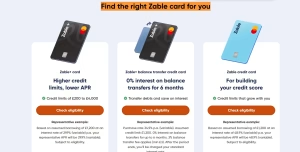
Zable’s official UK credit card comparison displaying Zable+, the balance-transfer card and the standard credit-building card, including their representative APRs.
What Is Our Overall Zable Credit Card Rating?
Our editorial assessment gives Zable 82 out of 100, based on five characteristics that matter to UK credit-card applicants.
Instead of judging the product by promotional claims alone, we considered its credit-building features, borrowing costs, digital functionality, everyday fees and customer outcomes.
| Assessment category | Our rating | Weight |
| Credit-building features | 89% | 25% |
| Interest rates and borrowing costs | 65% | 25% |
| Mobile app and account management | 94% | 20% |
| Everyday fees and overseas spending | 92% | 15% |
| Transparency and customer outcomes | 72% | 15% |
| Overall weighted rating | 82% | 100% |
The weighted score is 81.9%, rounded to 82%.
These percentages are our editorial evaluations of published product characteristics, not measured probabilities, customer survey results or independently audited performance scores.
Why Does Zable Score 82%?
Zable performs well for accessibility and account management.
Its mobile app provides spending notifications, repayment controls, credit information and potential access to a virtual credit card shortly after approval.
The absence of annual and foreign transaction fees is another advantage.
However, high borrowing costs reduce its overall score.
Someone offered the standard card at 48.9% representative APR faces a very different financial proposition from someone qualifying for Zable+ at 29.9%.
We also considered published customer-service and complaints information rather than assuming that positive app reviews automatically indicate competitive lending terms.
Our assessment is that Zable is better at helping consumers manage credit than at providing inexpensive borrowing.
What Are the Different Zable Credit Cards Available?
One important source of confusion is that Zable does not advertise a single identical card to every applicant.
Its UK range includes several credit propositions with different rates and features.
| Credit card | Advertised representative rate | Main purpose | Our assessment |
| Zable+ | 29.9% variable APR | Everyday spending and credit building | Strongest general-purpose Zable offer |
| Zable+ Balance Transfer | 34.9% variable purchase rate | Transferring existing card debt | Useful for a short repayment period |
| Standard Zable Credit Card | 48.9% variable APR | Building or rebuilding credit | Most suitable when fully repaid monthly |
Is Zable+ Better Than the Standard Zable Credit Card?
For most applicants who qualify for both products, Zable+ is more attractive because of its lower advertised representative borrowing rate.
It also offers potential credit limits of up to £4,000.
However, the headline rate is not a guarantee of the rate or limit any particular individual will receive.
Zable’s eligibility assessment determines which products and personalised terms may be available.
The standard Zable card may still have value for consumers unable to obtain a more competitive offer elsewhere.
The critical consideration is whether the applicant intends to carry an outstanding balance.
If they do, the borrowing cost should carry substantially more weight than the convenience of the app.
For a more detailed breakdown of the individual products, our Zable credit card review compares the cards, limits and borrowing features.
What Are the Advantages of Having a Zable Credit Card?
Zable has several features that make it worth considering in the UK credit-building market.
1. Soft-search eligibility checking
Applicants can check their initial eligibility without affecting their credit score.
This is valuable because it allows consumers to assess possible offers before committing to a full credit application.
A hard search is subsequently carried out during the full application process.
2. No Annual Membership Fee for the Credit Card
Zable does not currently charge an annual fee for its core credit card range.
This makes it possible to maintain an account without paying a yearly card membership charge.
However, avoiding annual fees does not mean using borrowed money is free.
3. Useful Mobile Account Controls
Cardholders can view recent transactions, check available credit and arrange repayments through the Zable app.
Transaction alerts can help consumers notice unexpected spending and manage their available credit more effectively.
4. Digital Card Availability
Eligible applicants may receive access to a virtual card shortly after approval.
This can provide faster access to purchasing facilities than waiting for a physical card.
5. No Foreign Transaction Fees
Zable currently charges no foreign transaction fee on ordinary card purchases abroad.
For people who occasionally travel internationally, this can provide meaningful savings compared with cards charging around 3% for non-sterling spending.
6. Credit-Building Opportunities
Zable can help customers establish a positive credit repayment record when they use their account responsibly.
However, the benefit depends on repayment behaviour rather than simply holding the card.
These features are particularly useful when compared with the wider risks of using credit cards, including expensive revolving balances and missed repayments.
What Are the Main Disadvantages of Zable?
Zable’s main weaknesses become clearer when we examine how the card performs as a borrowing product.
| Disadvantage | Potential financial impact |
| High representative APR on the standard card | Expensive interest when balances are carried |
| Limited cashback and rewards | Less attractive for reward-focused users |
| Cash withdrawal charges | Particularly expensive for small withdrawals |
| Late payment penalties | Additional charges and possible credit-file damage |
| App-focused account management | May not suit customers preferring traditional services |
| No guaranteed credit-limit increases | Available credit may remain limited |
| Short promotional balance-transfer period | Debt must be cleared relatively quickly |
Our biggest concern is the potential cost of carrying debt.
A customer who borrows £1,000 at a high interest rate and makes only small repayments may spend considerably more than the original purchase price.
This is why comparing Zable’s personalised borrowing terms with other available products is essential.
For someone with a weak credit history, our assessment of getting a loan with bad credit explores why affordability, total interest and repayment periods matter alongside approval chances.
How Much Interest Does Zable Charge on £500 or £1,000?
The practical cost of borrowing is arguably the most important part of deciding whether Zable is a good credit card.
To illustrate the difference between its advertised rates, we calculated approximate interest charges using the published annual purchase rates.
The following examples assume the balance remains unchanged over a notional month and apply the annual interest rate divided by 12.
| Outstanding balance | At 29.9% annually | At 48.9% annually |
| £250 | £6.23 | £10.19 |
| £500 | £12.46 | £20.38 |
| £750 | £18.69 | £30.56 |
| £1,000 | £24.92 | £40.75 |
| £1,500 | £37.38 | £61.13 |
These are simplified monthly illustrations, not actual Zable statements or repayment quotations. Real interest depends on daily balance calculations, transaction dates, repayments, any applicable interest-free period and the customer’s actual contractual rate.
Consider someone carrying a £1,000 balance.
At an annual purchase rate of 29.9%, the simplified monthly interest is approximately £24.92.
At 48.9%, it increases to around £40.75.
That is approximately £15.83 more in one month, even before considering any changes in the outstanding balance.
For consumers repeatedly relying on credit, that difference can become substantial.
Can You Avoid Zable Interest Completely?
Yes, qualifying purchases may benefit from an interest-free period of up to 35 days when the full statement balance is paid by the required due date.
For example, someone spending £150 on everyday purchases and fully repaying the statement under the applicable interest-free terms may pay no purchase interest.
That is considerably different from making only the contractual minimum payment.
We consider paying in full one of the most effective ways to make a high-APR credit-building card financially manageable.
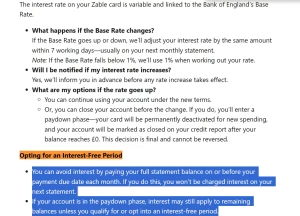
Zable’s official explanation of variable interest rates and avoiding purchase interest by paying the full statement balance.
Is Zable Good for Building Your Credit Score?
Zable can help consumers develop a positive credit history, but the improvement is not automatic.
A credit-building card works best when it demonstrates responsible borrowing and repayment behaviour.
In practical terms, lenders and credit reference agencies may consider whether consumers:
- Make their required repayments on time.
- Keep balances at manageable levels.
- Avoid defaults and repeated missed payments.
- Remain within approved credit limits.
- Maintain a sustainable borrowing pattern.
For example, someone with a £500 credit limit might spend £100 on ordinary monthly purchases and then repay the full statement balance.
That represents 20% of their available credit.
Although some credit guidance suggests keeping credit utilisation below 30%, that figure is only a general rule of thumb, not a universal requirement or guarantee of a higher score.
The most important financial principle is to borrow only what can realistically be repaid.
There is also no need to deliberately pay interest to build a credit history.
What Do Zable’s Credit Experts Say?
Chris Meurice, Managing Director at Zable, explains the company’s credit-building objective:
“We’ve designed our credit cards to help our customers build their credit rating.”
His published comments also emphasise the role of the mobile app in monitoring spending, managing repayments and accessing Equifax credit information.
The strategy is commercially understandable: giving consumers better visibility over their finances may help them manage credit more effectively.
However, our analysis distinguishes between providing credit-building tools and guaranteeing improvements in creditworthiness.
A person’s credit score can be affected by other borrowing, outstanding debts, missed payments and the policies of individual credit reference agencies.
Can Zable Help If You Have No Credit History?
Potentially, yes.
People who have recently entered the UK credit market may have limited borrowing records.
They may not have previously held credit cards or personal loans, making it harder for some lenders to assess repayment history.
Zable’s use of Open Banking information can provide additional insight into an applicant’s income and spending.
However, consumers should not assume that having no credit history automatically makes them eligible.
Other income, account-history and affordability conditions still apply.
What Do Real Customers Say About Zable?
Customer feedback provides useful information about the practical experience of using a credit card.
However, we believe review scores should be interpreted alongside independent assessments of service, pricing and transparency.
As of November 2026, Zable has a substantial volume of customer feedback across established review platforms.
| Review source | Published assessment | What it measures |
| Trustpilot | 4.8/5 from approximately 71,000 reviews | Overall customer review experience |
| Smart Money People | 4.82/5 from 123,717 credit-card reviews | Customer-submitted credit-card reviews |
| Finder UK | 7.5/10 | Editorial product assessment |
| Fairer Finance | 57.67% | Independent customer-experience assessment, autumn 2026 |
| Our editorial review | 82% | Credit-building suitability, cost, features and customer considerations |
These are different scoring systems and review populations. They should not be treated as directly comparable measurements.
Review volumes and ratings can change.
Why Are Customer Reviews So Positive?
Many positive customer reviews discuss the convenience of Zable’s application process and digital account management.
Commonly discussed advantages include accessing card details quickly, monitoring expenditure and making repayments through the app.
For borrowers who have experienced difficulty obtaining conventional credit products, receiving a manageable facility can also be viewed positively.
Finder reported that 77% of customers surveyed in 2026 would recommend Zable to a friend.
That is a useful published customer-recommendation result, although it does not mean that 77% of all Zable customers are satisfied or that the card is suitable for 77% of applicants.
What Do Negative Reviews Reveal?
Negative feedback raises different concerns.
Customers considering Zable should pay attention to complaints involving borrowing costs, application expectations, account access and customer-service difficulties.
A major distinction is that consumers may be satisfied with the initial application and app while still finding their interest charges expensive.
An easy application does not necessarily mean an affordable credit agreement.
Our review therefore gives more importance to the borrower’s long-term costs than to approval convenience alone.
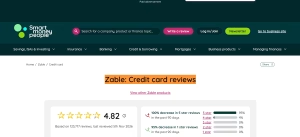
Smart Money People’s Zable credit card customer-review summary, showing its overall rating, total published reviews and recent review date.
Is Zable Trustworthy and Financially Regulated?
Zable is a legitimate financial services brand operated by Lendable Ltd.
Lendable Ltd is authorised and regulated by the Financial Conduct Authority, under firm reference number 720261.
The company is registered in England and Wales under company number 08828186.
These details provide a way for consumers to distinguish the genuine lender from possible impersonation attempts.
Nevertheless, being regulated does not mean every credit application will be approved, every transaction dispute will succeed or every borrower will receive favourable terms.
Zable is a credit provider, not a conventional savings bank.
Therefore, the Financial Services Compensation Scheme protections commonly discussed for eligible bank deposits are not the appropriate measure of whether a Zable credit card is safe.
Instead, consumers should consider the regulatory framework for consumer credit, contractual protections, card-payment rights and access to independent complaint resolution.
What Do Zable’s Official 2026 Complaints Figures Show?
We also examined Lendable’s published complaints information covering 1 January to 30 June 2026.
| Published complaints measure | Reported figure |
| Complaints opened, credit-related grouping | 23,547 |
| Complaints closed | 16,082 |
| Complaints opened per 1,000 accounts or loans | 7.6 |
| Percentage upheld | 28.40% |
These figures cover the published credit-related grouping for Lendable Ltd, including brands such as Zable, Lendable and Autolend. They are not Zable credit-card-only complaint statistics.
That distinction is important.
It would be misleading to attribute every complaint to Zable credit cards when the published figures encompass a wider business.
The information nevertheless adds useful context when examining the company’s treatment of customers.
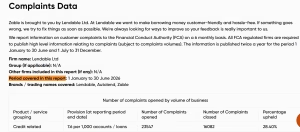
Lendable Ltd’s official FCA complaints disclosure for January–June 2026, showing complaints opened, complaints closed and the 28.40% upheld figure.
What Does Fairer Finance Say About Zable?
Fairer Finance’s autumn 2026 customer-experience assessment presents a more cautious picture than customer review platforms.
It reported:
| Customer-experience measure | Published score |
| Customer happiness | 59.53% |
| Customer trust | 60.90% |
| Complaints performance | 68.52% |
| Transparency | 41.73% |
| Overall Fairer Finance score | 57.67% |
Zable was ranked 27th out of 33 credit-card providers in that assessment.
This does not prove that customers generally dislike the card. Fairer Finance evaluates different dimensions from those represented by voluntary customer reviews.
The findings do, however, demonstrate why a decision should not rely exclusively on high star ratings.
In our assessment, the most useful approach is to consider customer satisfaction alongside interest costs, contractual clarity and independent customer-outcome evaluations.
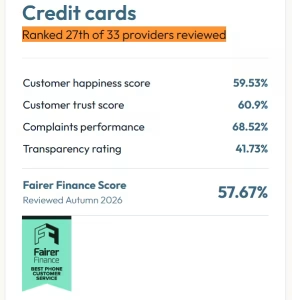
Fairer Finance’s autumn 2026 Zable customer-experience results, showing the overall score, transparency rating and ranking.
Is Zable Good for People With Bad Credit?
Zable may be worth checking for people with a less-than-perfect credit history, particularly if mainstream lenders have declined previous applications.
Unlike some conventional lenders, Zable allows applicants to provide additional banking information that can help it assess their present finances.
This can be useful where historical credit information does not fully reflect current circumstances.
However, there are several considerations.
First, a soft eligibility check is not a guarantee of final approval.
Second, applicants with weaker credit records may be offered more expensive borrowing terms.
Third, any additional credit must remain affordable alongside existing commitments.
For someone already struggling with multiple debts, another credit card may make their situation more difficult.
The objective should be affordable borrowing and sustainable repayments, rather than obtaining approval at any cost.
Is Zable Good for Self-Employed People and Small Business Owners?
Self-employed applicants sometimes face more complicated affordability assessments because their income can vary between months.
Zable’s optional Open Banking process may provide additional information about incoming payments and spending patterns.
This can help the lender assess financial circumstances, but it does not guarantee acceptance or replace the need to meet eligibility requirements.
For sole traders, freelancers and small business owners, we see three important considerations.
- Income consistency: Someone with irregular monthly earnings needs to ensure their card payments remain affordable during lower-income periods.
- Cash-flow management: Using a personal credit card to fund recurring business expenses can become costly when customer payments arrive late.
- Personal liability: A personal credit card remains the account holder’s responsibility, even when purchases relate to business activity.
Consider a freelance consultant who spends £600 on software, equipment and marketing while waiting for an invoice to be paid.
If the invoice arrives before the card repayment date and the statement can be cleared, the card may provide useful short-term flexibility.
If the customer delays payment for several months, the same transaction could generate significant interest.
Our financial assessment is that Zable is more appropriate for controlled personal spending than for financing persistent business cash-flow shortages.
Business owners requiring working capital should compare products designed specifically for business borrowing.
Is Zable Good for Spending Abroad?
Zable has a genuine advantage for overseas card purchases because it currently charges no foreign transaction fee.
Suppose a UK traveller spends the equivalent of £1,000 during a holiday.
| Card spending example | Foreign transaction fee |
| Zable overseas purchases | £0 |
| Hypothetical card charging 2.5% | £25 |
| Hypothetical card charging 3% | £30 |
These figures compare card-provider transaction fees only. They do not include exchange-rate movements, merchant conversion charges or any cash withdrawal costs.
When paying abroad, choosing the local currency instead of accepting a merchant’s sterling conversion can help avoid an unfavourable dynamic currency conversion rate.
However, a zero foreign transaction fee is not the same as free overseas cash withdrawals.
Anyone planning to withdraw substantial amounts should compare ATM and debit-card charges.
Our examination of Monzo’s overseas fees explains why foreign card purchases and cash withdrawals need to be assessed separately.
Is Withdrawing Cash From Zable a Good Idea?
In most circumstances, withdrawing cash using Zable is considerably less attractive than using the card for ordinary purchases.
Zable currently charges 3% per cash withdrawal, subject to a minimum fee of £3.
| Cash withdrawn | Withdrawal fee | Effective upfront fee |
| £20 | £3 | 15% |
| £50 | £3 | 6% |
| £100 | £3 | 3% |
| £200 | £6 | 3% |
| £300 | £9 | 3% |
The percentage cost is particularly high for small withdrawals because of the £3 minimum.
Interest may also apply from the withdrawal date rather than benefiting from the normal interest-free purchase period.
For instance, withdrawing £20 and immediately paying a £3 fee represents a 15% upfront charge before interest.
That makes routine ATM withdrawals an expensive way to access cash.
The wider financial implications are covered in our explanation of credit card cash withdrawals.
Is Zable a Good Balance Transfer Credit Card?
Zable offers a balance-transfer option with 0% interest for up to six months on eligible transfers.
A transfer fee of 3%, with a minimum of £3, applies.
The card advertises a 34.9% variable purchase rate, while the standard interest applicable after the promotional period depends on the agreement.
Six months may be useful for borrowers who can repay their debt quickly, but it is comparatively short for consumers needing longer repayment periods.
Consider transferring £1,500.
| Calculation | Amount |
| Balance transferred | £1,500 |
| Transfer fee at 3% | £45 |
| Total balance including fee | £1,545 |
| Promotional period | 6 months |
| Monthly repayment to clear within period | £257.50 |
This example assumes the full transfer qualifies for the promotional rate, the fee is added to the balance and there are no additional purchases, fees or interest during the six months.
A borrower able to pay £257.50 each month could potentially clear the balance before the promotional period ends.
However, someone who can afford only £80 or £100 per month would need a longer repayment strategy.
Our comparison of the best balance transfer credit cards examines why promotional duration, transfer fees and post-offer rates should all be considered.
We would not choose Zable’s six-month offer without first checking whether a longer and more suitable 0% deal is available.
Is Zable Easy to Get Approved For?
Zable promotes an online eligibility process that provides a preliminary decision without initially affecting the applicant’s credit score.
Its published basic requirements include being at least 18 years old, living in the UK and receiving regular monthly income above £800.
Other eligibility information also refers to holding a UK bank or building society current account and an existing credit account open for at least six months.
Applicants should consult the requirements applicable to their specific proposed card, since criteria can differ.
How Does the Application Process Work?
- Step 1: Check your eligibility: Visit Zable’s official eligibility checker and provide the required personal and financial information.
- Step 2: Review the preliminary outcome: Eligible applicants may see a proposed product, credit limit and personalised interest rate.
- Step 3: Consider linking your bank account: Zable offers an optional Open Banking process to help assess current income and spending. Its advertised approval and credit-limit benefits are not guaranteed for individual customers.
- Step 4: Examine the full agreement: Review the APR, purchase interest rate, minimum repayments and applicable fees before proceeding.
- Step 5: Complete the application: A hard credit search may be recorded when the full application proceeds under Zable’s stated process.
- Step 6: Activate and manage the card: Approved applicants may be able to use a virtual card quickly, while the physical card normally arrives later.
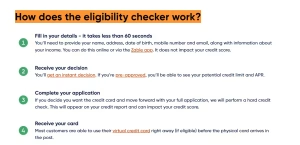
Zable’s official credit card eligibility checker showing the soft-search process, initial eligibility requirements and the distinction between the eligibility check and full application.
Can Zable Increase Your Credit Limit?
Zable automatically reviews customers’ eligibility for potential credit-limit increases.
However, customers cannot simply demand an increase whenever they choose.
Its January 2026 guidance explains that eligible accounts may be reviewed monthly, while Starter Card customers become eligible for these reviews after six months.
Accepting a limit increase also affects the timing of subsequent reviews.
Importantly, a higher credit limit is not automatically a financial benefit.
It creates additional borrowing capacity, which can either support flexibility or increase financial exposure.
We consider the repayment strategy more important than the size of the approved limit.
Can Zable Help Renters Build Their Credit History?
Another feature worth examining is Zable’s rent-reporting functionality.
Zable has described arrangements for reporting eligible rental payment information to Equifax, allowing rent payment history to appear in the relevant credit file.
This may be helpful for renters who want their regular housing payments to contribute to the information available to credit assessors.
However, three limitations matter.
First, rent reporting is associated with Equifax rather than automatic reporting to every UK credit reference agency.
Second, adding rental information does not guarantee an improvement in the consumer’s credit score.
Third, users should check current feature availability, eligibility and any applicable membership charges before activating the service.
For consumers who want to build their borrowing history, the feature can be useful, but its value should be judged separately from the card’s interest rate.
Is Zable Better Than Other Credit-Building Cards?
The right comparison depends on why the customer needs a credit card.
Someone rebuilding damaged credit may prioritise eligibility and flexible account management.
Someone with a strong credit history may obtain a lower interest rate or stronger rewards elsewhere.
| Type of credit card | Potential advantage | Main consideration |
| Zable+ | Lower advertised Zable APR and useful app features | Subject to personalised eligibility |
| Standard Zable | Credit-building focus and no annual fee | Higher advertised APR |
| Other credit-builder cards | May offer different rates or limits | Compare actual offers and fees |
| Mainstream low-rate cards | Potentially cheaper borrowing | Approval may be more restrictive |
| Cashback or rewards cards | Financial rewards on spending | Interest can outweigh benefits |
| Longer 0% balance-transfer cards | More time to repay transferred debt | Eligibility, fees and offer expiry |
Our preference would generally be the lowest-cost suitable credit card that the applicant can realistically obtain and manage responsibly.
The lender most likely to approve an application is not necessarily the lender offering the best financial outcome.
Who Should Consider a Zable Credit Card in 2027?
Zable is most attractive when its features align with the customer’s actual borrowing needs.
| Customer profile | Our assessment | Reason |
| First-time credit users | Good potential fit | Credit-building tools and app controls |
| People rebuilding credit | Worth an eligibility check | Personalised lending assessment |
| Customers paying in full | Good potential fit | Avoids qualifying purchase interest |
| Occasional overseas travellers | Good potential fit | No foreign transaction fee on purchases |
| Self-employed applicants | Depends on circumstances | Income variability and affordability matter |
| People carrying large balances | Less suitable | Potentially high interest charges |
| Frequent cash withdrawal users | Poor fit | Withdrawal fees and immediate interest exposure |
| Rewards-focused customers | Less competitive | Limited mainstream reward benefits |
| People already struggling with debt | Extra caution needed | Additional borrowing may worsen affordability |
The important distinction is between using a card to establish a positive repayment history and depending on it for ongoing financial support.
For somebody whose regular expenses already exceed their income, obtaining another credit card may not be the right solution.
What Should You Check Before Accepting Zable in 2027?
Before signing a new agreement, we recommend checking the following:
- Your actual APR: Do not assume the 29.9% headline representative rate will be your personalised rate.
- Your monthly repayment budget: Calculate whether you can clear the full statement balance.
- Your credit limit: Decide whether the limit is appropriate for your existing commitments.
- The interest-free conditions: Understand exactly when purchase interest is charged.
- Cash withdrawal fees: Avoid treating credit-card withdrawals like ordinary debit-card transactions.
- The repayment arrangement: Check the payment authority and ensure sufficient money is available.
- Alternative products: Compare at least a few suitable offers using eligibility tools where possible.
Understanding the difference between automatic payment methods is also helpful. Our explanation of cancelling a Direct Debit covers an important banking distinction, although Zable customers should follow the specific repayment-authority terms in their own agreement.
Consumers should also consider whether a credit card is necessary at all.
For everyday purchases funded from existing money, a debit card may be more suitable, although the two payment methods provide different borrowing and consumer protections.
Our discussion of debit card risks provides additional context when choosing how to pay.
Is Zable Worth Getting in 2027?
Our overall assessment is that Zable is worth considering for credit building, controlled purchases and convenient app-based account management.
The product has several useful characteristics: no annual credit-card fee, no foreign transaction fee, a soft-search eligibility process and the ability to manage borrowing through a mobile app.
However, the financial value changes substantially when customers carry outstanding balances.
At an advertised representative APR of 48.9%, the standard Zable card is not an inexpensive way to borrow for long periods.
Our 82% editorial rating therefore reflects its usefulness for the intended credit-building market, rather than claiming it is the best credit card for every UK consumer.
Customers who qualify for a lower rate, keep spending manageable and repay in full may find Zable worthwhile.
Those planning to borrow heavily, withdraw cash frequently or make only minimum repayments should compare alternatives carefully.
The final decision should always be based on the personalised credit agreement available at the time of application.
Frequently Asked Questions
Is Zable a good credit card for beginners?
Yes, it can suit beginners because of its app-based spending controls, soft eligibility checker and credit-building tools. However, applicants must meet its eligibility requirements and understand the potential interest costs.
Is Zable a legitimate credit card company?
Yes. Zable is operated by Lendable Ltd, an FCA-regulated UK consumer credit business with firm reference number 720261.
Does Zable improve your credit score?
It may help improve credit history when repayments are made on time and borrowing is managed responsibly. Improvements are not guaranteed.
What is the highest Zable credit limit?
Zable+ advertises credit limits of up to £4,000, subject to eligibility. Individual applicants may receive much lower limits.
Is Zable good for bad credit?
Zable may be worth checking for people with poor or limited credit history, but approval is not guaranteed and the borrowing rate offered may be high.
Can I use Zable without paying interest?
Qualifying purchases may avoid interest when the full statement balance is paid by the due date under the applicable interest-free terms.
Is Zable a good credit card for travelling abroad?
It can be useful for overseas purchases because Zable currently charges no foreign transaction fee. Cash withdrawals are less attractive because fees and interest can apply.
What is the biggest disadvantage of Zable?
The potentially high borrowing cost, especially the standard card’s 48.9% representative APR, is its main disadvantage for customers carrying balances.
Is Zable better than a normal bank credit card?
Not necessarily. Zable may be more accessible for certain credit profiles, while mainstream credit cards may offer lower rates, longer 0% periods or better rewards.
Should I get a Zable credit card in 2027?
Consider it if you want to build credit and can make affordable repayments. Compare your personalised offer with alternatives before applying.
Financial information disclaimer: This article provides general UK consumer finance information and an independent editorial assessment, not personalised financial advice. Product rates, eligibility and fees may change. All 2027 references describe future decision-making using information verified in November 2026, not confirmed 2027 offers. Consumers experiencing difficulty with repayments should seek free debt advice before taking on additional borrowing.