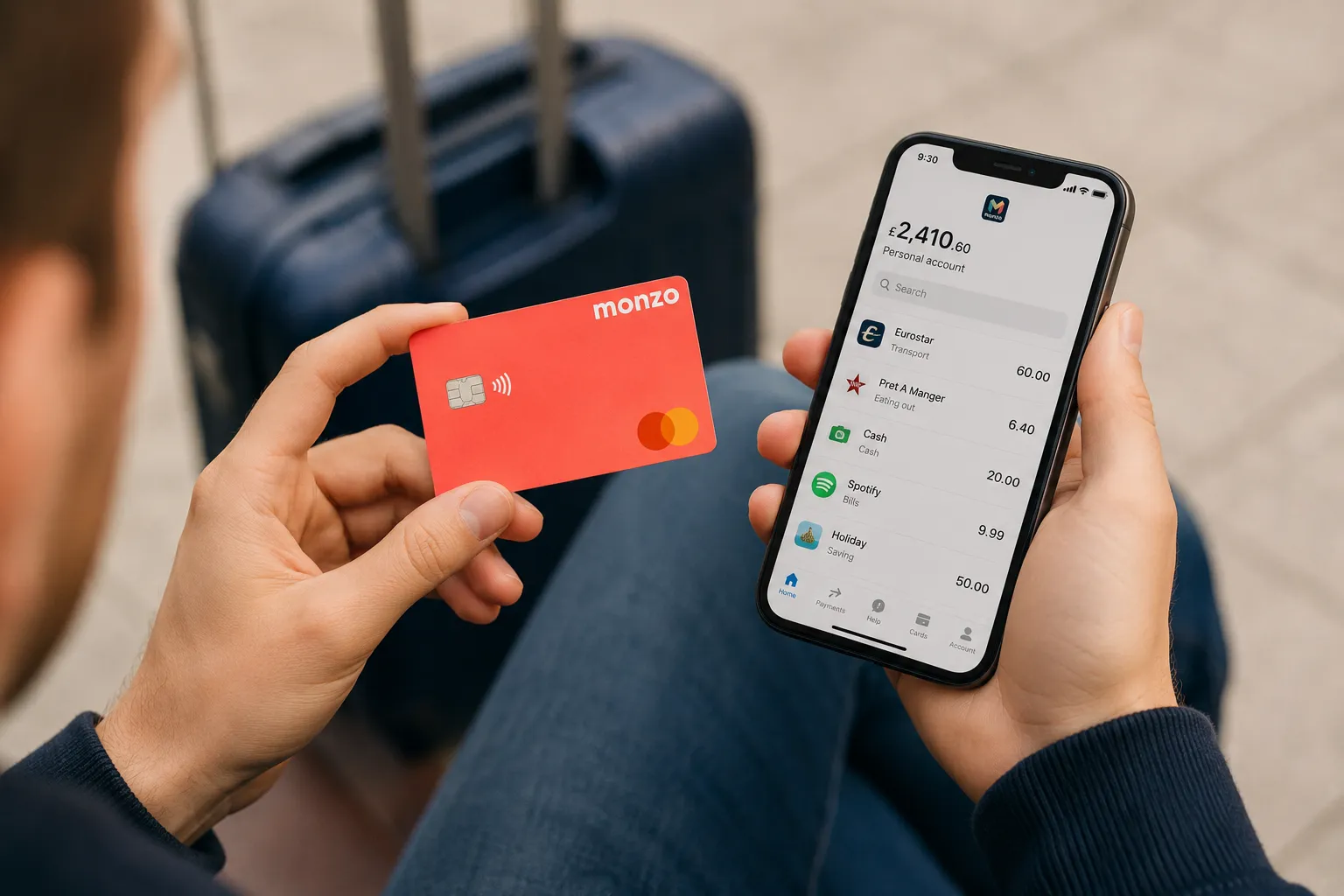
Monzo does not charge a foreign transaction fee for normal debit-card spending abroad. When a customer pays in euros, dollars, dirhams, baht or another supported currency, Monzo converts the transaction using Mastercard’s exchange rate without adding its own foreign spending fee.
Cash withdrawals are different: fee-free ATM allowances depend on the destination, account plan and whether Monzo qualifies as the customer’s main bank.
That distinction is important. A traveller could spend £1,000-equivalent on hotels, restaurants and shopping without paying a Monzo foreign transaction fee, while still being charged if they withdraw too much cash from ATMs.
Does Monzo Charge You for Using Your Card Abroad?
For ordinary card purchases, no. Monzo currently says customers can pay in any currency without a foreign transaction fee.
Rather than applying its own percentage markup, the bank passes on Mastercard’s exchange rate. This applies to normal overseas debit-card payments.
For example, if a restaurant in Spain charges €60, Monzo converts the €60 transaction into pounds using the applicable Mastercard rate. There is no additional 2.99% foreign transaction charge from Monzo layered on top.
That makes Monzo considerably different from many traditional UK debit cards, which can still add a percentage fee whenever a purchase is processed in a foreign currency.
The important exception is cash. Monzo applies separate fee-free ATM allowances, so “Monzo is fee-free abroad” should not be interpreted as meaning every possible overseas transaction is unlimited and free.
What Are Monzo’s ATM Withdrawal Fees Abroad?
Monzo divides ATM charging between the UK/European Economic Area and countries outside the EEA.
The EEA consists of EU member states together with Iceland, Liechtenstein and Norway.
| Monzo Account | UK & EEA | Outside EEA |
| Free account, not main bank | £400 fee-free every rolling 30 days, then 3% | £200 fee-free every rolling 30 days, then 3% |
| Free account, Monzo is main bank | Unlimited fee-free | £200 fee-free every rolling 30 days, then 3% |
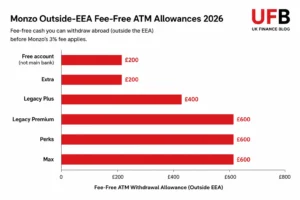
| Extra | Unlimited fee-free | £200 fee-free every rolling 30 days, then 3% |
| Legacy Plus | Unlimited fee-free | £400 fee-free every rolling 30 days, then 3% |
| Legacy Premium | Unlimited fee-free | £600 fee-free every rolling 30 days, then 3% |
| Perks | Unlimited fee-free | £600 fee-free every rolling 30 days, then 3% |
| Max | Unlimited fee-free | £600 fee-free every rolling 30 days, then 3% |
Monzo’s current help material confirms the £400, £200, £400 and £600 allowances, while its current Extra, Perks and Max fee information confirms that Extra receives £200 outside the EEA and Perks and Max receive £600.
There is another distinction travellers often miss: the fee-free allowance is not the same as the card’s daily ATM withdrawal limit.
Anyone who regularly uses cash should therefore check both figures. UK Finance Blog’s detailed Monzo cash withdrawal limit breakdown explains how the daily limit and rolling fee-free allowance interact.
An overseas ATM operator can also impose its own charge. That money goes to the ATM operator rather than Monzo and can apply even while the customer remains within Monzo’s fee-free allowance.
How Does Monzo’s Rolling 30-Day ATM Allowance Work?
The allowance does not simply reset on the first day of each month.
Monzo uses a rolling 30-day calculation. Amounts effectively become available again as earlier withdrawals move outside the relevant 30-day period. Monzo also states that applicable ATM allowances are shared across a customer’s relevant personal and joint accounts.
That means someone should not assume that reaching a new calendar month immediately restores their entire travel cash allowance.
The safest approach before travelling is to open the Monzo app and check Fees and allowances, which shows the account’s current position.
How Does Monzo Decide Whether It Is Your Main Bank?
Main-bank status matters particularly for UK and EEA cash withdrawals.
For a free personal account, Monzo currently treats the account as a main bank where one of its qualifying conditions is met.
One route is having at least £500 paid into the account over the previous rolling 35 days plus at least one active Direct Debit during the same period. Receiving qualifying Department for Work and Pensions or Department for Communities payments can also count, as can receiving a student-loan payment within Monzo’s specified eight-month period. A joint-account holder may also benefit where the other joint holder meets qualifying criteria.
Customers can check their position in the app by opening the relevant account and selecting Fees and allowances. If Monzo recognises the customer as a main-bank user, the UK and EEA allowance should show as unlimited.
Becoming a main-bank customer before a European trip can therefore make a meaningful difference for somebody expecting to use cash frequently.
It does not, however, increase the normal free-account allowance outside the EEA beyond £200.
Should You Pay in Pounds or Local Currency With Monzo?
Travellers should normally choose the local currency.
An overseas restaurant, hotel, shop or ATM may offer to convert the payment into pounds before the transaction reaches Monzo. This is called Dynamic Currency Conversion, or DCC.
Selecting GBP lets the merchant or ATM provider control the conversion rate. Monzo warns that this rate is likely to include additional costs and recommends selecting the local currency instead.
For example, imagine an ATM in Spain displays two options for a €300 withdrawal.
| Illustrative Option | Sterling Cost |
| ATM’s DCC conversion | £272 |
| Local-currency transaction using an illustrative Mastercard conversion | £258 |
| Difference | £14 |
In that purely illustrative example, accepting DCC costs £14 more, or around 5.4% relative to the £258 conversion.
The exact exchange rate will obviously change from day to day. The lesson is not that DCC always costs exactly 5.4%; it is that choosing GBP hands control of the conversion to the foreign ATM or merchant.
When the terminal asks “GBP or EUR?”, “GBP or USD?” or similar, selecting the local currency usually allows Monzo and Mastercard’s normal overseas conversion process to apply.
How Much Could a Monzo ATM Withdrawal Actually Cost?
Consider a free-account customer visiting Spain who does not use Monzo as their main bank.
Their EEA allowance is £400 every rolling 30 days.
Suppose they have already withdrawn the equivalent of £350 and then withdraw another €175 that Mastercard converts to approximately £150.
Only £50 remains inside the allowance.
That means £100 of the new withdrawal exceeds the allowance.
3% × £100 = £3 Monzo withdrawal fee.
An ATM operator charge could still be added separately.
Now consider the same customer travelling in the USA.
Outside the EEA their standard fee-free allowance is only £200.
If they have used none of it and withdraw the equivalent of £300, £200 falls within the allowance and £100 exceeds it.
Again:
3% × £100 = £3.
The customer therefore does not pay 3% on the entire £300 simply because the transaction crossed the limit; the fee applies to the amount above the relevant allowance under Monzo’s charging structure.
Does Monzo Charge in Europe After Brexit?
Normal card spending remains fee-free.
Brexit did not turn ordinary Monzo purchases in EU countries into transactions carrying a Monzo foreign-usage charge.
Countries such as Spain, France, Germany, Italy, Portugal, Greece and Ireland remain within the EEA for the purpose of Monzo’s published cash-withdrawal structure.
A standard customer who does not qualify for unlimited EEA withdrawals receives £400 fee-free every rolling 30 days before the 3% charge applies. Main-bank customers and qualifying paid-plan customers receive unlimited fee-free EEA withdrawals from Monzo.
One useful trap to remember is Switzerland.
Switzerland is in Europe, but it is not part of the EEA. A cash withdrawal there therefore falls under Monzo’s outside-EEA allowance, rather than the more generous EEA treatment.
Does Monzo Charge Fees in the USA?
Monzo does not add a foreign transaction fee when its card is used for ordinary purchases in the United States.
A purchase made in US dollars is converted using Mastercard’s exchange rate.
Cash withdrawals are treated as outside-EEA transactions.
A standard or main-bank customer normally receives £200-equivalent of fee-free ATM withdrawals every rolling 30 days, Plus receives £400 and Premium, Perks and Max receive £600. The 3% Monzo charge applies after the applicable allowance.
US ATM operators can impose their own fees, so a customer could see an ATM charge even though Monzo itself has not yet started charging.
Paying directly by card is therefore often simpler than repeatedly withdrawing small amounts of cash.
Does Monzo Charge Fees in Dubai?
Dubai is in the United Arab Emirates and therefore outside the EEA.
Normal Monzo card spending in UAE dirhams does not attract a Monzo foreign transaction fee. AED is also among the currencies Monzo supports for international payment functionality.
For cash, the outside-EEA ATM allowances apply.
That means a free or Extra customer generally receives £200 fee-free every rolling 30 days, Plus £400, and Premium, Perks or Max £600 before Monzo’s 3% fee applies.
A UAE ATM can still impose an operator charge independently.
When an ATM or payment terminal offers GBP instead of UAE dirhams, choosing dirhams generally avoids handing the conversion to the merchant’s DCC provider.
Does Monzo Charge in Thailand or Other Asian Countries?
Thailand is also outside the EEA.
Card purchases made in Thai baht carry no Monzo foreign transaction fee, while cash withdrawals fall under the outside-EEA allowance. Thai baht is among the currencies supported by Monzo’s international payment infrastructure.
The same basic structure applies in destinations such as Japan, Singapore, Hong Kong and many other Asian markets: fee-free Monzo card spending where Mastercard is accepted, but account-specific cash allowances remain relevant.
This makes card spending particularly useful in countries where cash-machine operators impose their own withdrawal charges. Making several small cash withdrawals can expose a traveller to repeated operator fees even where Monzo itself has not charged anything.
Does Monzo Work Everywhere Abroad?
Not literally everywhere.
Monzo says its card should work wherever Mastercard is accepted, but it also acknowledges occasional acceptance problems with certain merchants and locations.
Its current help page specifically identifies occasional issues in places including Cuba, Portugal, North Korea, South Korea and Bulgaria.
That does not mean every Monzo transaction in those countries will necessarily fail. It means travellers should avoid treating one card as their only source of money, particularly in destinations where acceptance can be unpredictable.
There is also a distinction between card acceptance and international replacement-card delivery. Monzo’s list of countries where it cannot reliably send replacement cards is considerably longer than its list of places where customers may encounter card-acceptance issues.
Taking a second payment card from a different bank or network can therefore provide useful redundancy.
Does Monzo Flex Charge Foreign Transaction Fees?
Monzo Flex should be considered separately from the current-account debit card because Flex is a credit product.
Monzo currently advertises ordinary purchases made abroad using the Flex Credit Card as having no foreign transaction fee, with Mastercard’s exchange rate applied. Flex can be used internationally where Mastercard is accepted.
The absence of a foreign transaction fee does not automatically mean the purchase itself is interest-free.
Flex repayment terms depend on the customer’s agreement and selected repayment option. Current Monzo information says eligible purchases of at least £100 may qualify for a three-month 0% option, while other repayment arrangements can involve interest. Customers should check the personalised terms shown in their app before using credit for holiday spending.
Eligible Flex purchases may also qualify for Section 75 protection where the statutory requirements are met.
For cash, travellers should use their Monzo debit-card ATM rules rather than assuming the Flex Credit Card provides another separate fee-free cash allowance.
Does Monzo Charge for Receiving Money From Abroad?
This is one area where the answer can be yes.
If an international payment reaches Monzo already converted into British pounds, Monzo currently says it does not charge a fee for receiving it.
If Monzo receives the payment in another supported currency and converts it into pounds, it charges a 1% currency-conversion fee, capped at £1,000 per transaction. A third party handles the currency conversion and sets the exchange rate.
For example:
| Incoming Payment | Illustrative Monzo Conversion Fee |
| Foreign currency worth £100 | £1 |
| Foreign currency worth £1,000 | £10 |
| Foreign currency worth £10,000 | £100 |
| Foreign currency worth £100,000 | £1,000 |
| Foreign currency worth £150,000 | £1,000 because of the cap |
This distinction can be particularly important for freelancers, consultants, remote workers or contractors paid in euros, US dollars or another foreign currency.
A Monzo card may be excellent for spending abroad while international income arriving into the account can still generate conversion costs.
Supported currencies should also be checked before arranging a large payment. Monzo warns that an unsupported incoming currency may be rejected or converted by an intermediary bank, potentially creating additional fees.
Does Monzo Charge for Topping Up While Abroad?
Simply being physically outside the UK does not create a special Monzo “holiday top-up fee”.
For UK personal accounts, Monzo currently describes adding money through methods such as salary payments, bank transfers and Easy Bank Transfers.
What matters is where the money is coming from and in what currency.
Adding pounds through normal UK banking channels is different from receiving an international foreign-currency payment.
If money arrives internationally already converted into GBP, Monzo says it does not charge a receiving fee. If Monzo has to convert a supported foreign currency into pounds, the current 1% conversion fee capped at £1,000 applies.
Will Monzo Tell You When You Spend Abroad?
Yes.
Monzo provides real-time transaction information and says customers can see exchange-rate information when spending abroad. It also provides instant spending notifications and can produce a travel-spending report after a trip.
That can make it easier to spot an unusually expensive conversion or unexpected ATM charge immediately rather than discovering it on a monthly statement.
Monzo also says customers generally do not need to tell the bank before travelling abroad.
What Happens If Your Monzo Card Is Lost or Stolen Abroad?
The cost that travellers often overlook is international card delivery.
Monzo currently charges £30 to send a replacement card outside the UK.
Replacement-card costs can vary by account and circumstances.
For Extra, Perks and Max, Monzo’s current fee information says international delivery is £30. Where a £5 replacement charge also applies after any relevant free replacement allowance has been used, the combined cost may be £35.
Legacy Monzo Premium can be more expensive because of its metal card. Current Premium fee information states that replacement abroad can cost £80, consisting of the £50 metal-card replacement cost plus £30 international delivery where the replacement fee applies.
Travellers should freeze a missing card through the app immediately and contact Monzo if they believe it has been stolen or used fraudulently.
How Does Monzo Compare With Starling, Chase, Revolut and Barclays Abroad?
Monzo is competitive for overseas card spending, but it is not automatically the cheapest option for every traveller, especially somebody who regularly needs large amounts of cash.
| Provider | Foreign Card Spending | Overseas ATM Position |
| Monzo | No Monzo foreign transaction fee; Mastercard rate | Allowance depends on destination and account; usually 3% beyond allowance |
| Starling | No Starling foreign transaction fee; Mastercard rate | No Starling ATM fee; £300 daily withdrawal limit currently advertised |
| Chase UK | No Chase foreign transaction fee; Mastercard rate | Chase does not charge an overseas ATM fee; account limits and ATM operator fees can apply |
| Revolut Standard | Exchange allowances apply; 1% above £1,000 monthly weekday allowance and a 1% Standard weekend exchange fee | £200 or five withdrawals per rolling month, whichever comes first; then 2% or £1 minimum, plus applicable exchange charges |
| Barclays standard debit card | Commonly 2.99% non-sterling transaction fee, subject to account exceptions | Non-sterling fee can also apply to foreign-currency ATM withdrawals, with operator fees possible |
Starling currently advertises no fee from the bank for overseas card purchases or foreign-currency ATM withdrawals, although ATM providers can still charge independently.
Chase similarly states that it does not charge customers to spend or withdraw using its debit card overseas, although local cash-machine charges can apply.
Revolut is more complicated. Standard customers currently have a £1,000 monthly exchange allowance before a 1% additional exchange fee and face a 1% weekend exchange fee. Its Standard ATM allowance is £200 or five withdrawals per rolling month, whichever is reached first, followed by a 2% charge or £1 minimum.
Barclays’ standard debit-card guidance currently states a 2.99% non-sterling transaction fee, although some account arrangements can differ.
The strongest choice therefore depends on behaviour. Monzo can be highly competitive for somebody who mostly pays by card, while Starling or Chase may appeal to travellers who expect to withdraw more cash.
How Can You Avoid Monzo Fees Abroad?
The most effective strategy is to favour card payments over cash wherever practical, because normal Monzo foreign-currency card spending does not carry the same rolling allowance as ATM withdrawals.
Always select the local currency rather than pounds where an ATM, hotel or payment terminal offers Dynamic Currency Conversion. Before travelling, check the account’s remaining ATM allowance in the Monzo app and, where appropriate, establish qualifying main-bank status before an EEA trip.
When cash is unavoidable, fewer planned withdrawals may also reduce exposure to fixed charges imposed by foreign ATM operators.
Travellers should additionally carry a backup card, particularly in countries where Monzo reports occasional acceptance issues or where receiving a replacement card could be difficult.
Is Monzo Safe to Use Abroad?
Monzo Bank Limited is a UK bank authorised by the Prudential Regulation Authority and regulated by the Financial Conduct Authority and PRA. Monzo lists its Financial Services Register number as 730427.
Eligible deposits with UK-authorised banks are currently protected by the Financial Services Compensation Scheme up to £120,000 per eligible person, per authorised firm.
That figure changed on 1 December 2025, when the previous £85,000 deposit-protection limit increased to £120,000. Articles that still quote £85,000 are therefore outdated.
FSCS protection relates to the failure of an authorised financial institution. It should not be confused with travel insurance, card-purchase protection or reimbursement rules for individual disputed transactions.
Is Monzo Good for Spending Abroad?
For many UK travellers, yes.
Its biggest advantage is straightforward: normal debit-card purchases made in foreign currencies have no Monzo foreign transaction fee.
Someone spending mainly on restaurants, accommodation, public transport and shopping by card can therefore avoid the percentage foreign-usage charges still associated with some traditional bank accounts.
The weakness is cash.
Outside the EEA, standard customers receive only £200 of fee-free ATM withdrawals every rolling 30 days before the 3% charge begins. Travellers visiting cash-heavy destinations may therefore find Starling, Chase or a suitable specialist travel card more attractive.
Monzo becomes particularly competitive when the traveller mostly pays by card, understands the ATM allowance and consistently rejects DCC.
Final Verdict
So, does Monzo charge abroad?
For normal card spending, usually no. Monzo does not add a foreign transaction fee and passes on Mastercard’s exchange rate.
Cash withdrawals require more attention. Standard customers travelling outside the EEA receive £200 of fee-free cash withdrawals during a rolling 30-day period before Monzo’s 3% fee applies. Higher allowances are available to Plus, Premium, Perks and Max customers, while qualifying main-bank status provides unlimited Monzo ATM withdrawals within the UK and EEA.
Travellers should also avoid Dynamic Currency Conversion, choose the local currency at payment terminals, check for independent ATM fees and remember that international incoming payments operate under completely different charging rules.
For someone who mainly pays by card and understands those limitations, Monzo remains one of the more straightforward UK accounts to take abroad.
Disclaimer: UK Finance Blog provides general financial information and does not provide personalised financial, credit, tax or legal advice. Bank fees, exchange arrangements, account plans and eligibility criteria can change. Customers should check the latest terms displayed by their provider and in their banking app before travelling.
Frequently Asked Questions
Does Monzo Charge a Foreign Transaction Fee?
No. Monzo currently does not add a foreign transaction fee to normal debit-card purchases made in other currencies. Mastercard’s exchange rate is used instead.
Does Monzo Charge for Withdrawing Money Abroad?
It can. Fee-free cash allowances depend on the destination and account. Outside the EEA, standard customers generally receive £200 every rolling 30 days before a 3% Monzo fee applies.
Is Monzo Fee-free in Europe After Brexit?
Normal card spending remains fee-free. EEA cash allowances also continue to apply to EU countries, together with Iceland, Liechtenstein and Norway.
What Happens if I Go Over My Monzo ATM Allowance?
Monzo normally charges 3% on withdrawals above the relevant fee-free allowance. An ATM operator may impose a separate charge as well.
Should I Choose Gbp When Using Monzo Abroad?
Usually not. When offered a choice, selecting the local currency normally avoids Dynamic Currency Conversion and lets the standard Mastercard conversion process apply.
Does Monzo Charge in America?
Normal USD card purchases do not carry a Monzo foreign transaction fee. The USA is outside the EEA, so the outside-EEA ATM allowance applies.
Does Monzo Charge in Dubai?
Normal AED card spending has no Monzo foreign transaction fee. Dubai is outside the EEA, so cash withdrawals use the outside-EEA allowance.
Does Monzo Charge in Thailand?
Normal card purchases in Thai baht are fee-free from Monzo. ATM withdrawals are subject to outside-EEA allowances, while the ATM owner may impose its own charge.
Does Monzo Flex Charge Abroad Fees?
Monzo currently advertises Flex card purchases abroad without foreign transaction fees. Flex remains a credit product, however, so interest can apply depending on the repayment plan selected.
Does Monzo Charge for Receiving Euros or Dollars?
If Monzo receives a supported non-GBP currency and converts it into pounds, it currently charges a 1% conversion fee capped at £1,000 per transaction. International payments received already converted into GBP do not attract that Monzo receiving fee.
Does Monzo Charge for Topping Up Abroad?
Being abroad does not itself create a special top-up fee. The relevant charge depends on how money reaches the account. Incoming non-GBP international payments converted by Monzo currently attract the 1% conversion fee.
Does Monzo Notify You When the Card is Used Overseas?
Yes. Monzo provides transaction notifications and exchange-rate information and can provide a trip-spending report.
Do You Need to Tell Monzo Before Going Abroad?
Normally, no. Monzo says customers do not need to notify it before travelling.
How Much Does a Replacement Monzo Card Cost Abroad?
International card delivery currently costs £30. Additional replacement charges can apply depending on the card and account; legacy Premium metal-card replacement abroad can reach £80.
Is Monzo or Starling Better Abroad?
Both currently offer fee-free foreign-currency card spending. Starling does not currently charge its own overseas ATM withdrawal fee, while Monzo applies rolling cash allowances followed by a 3% fee. Monzo may therefore suit card-heavy travellers, while Starling can be attractive where more cash is required.