Finding the best business bank account in the UK is not as simple as choosing the provider with the lowest monthly fee.
One business may receive 100 electronic payments a month but never handle cash. Another may deposit £5,000 in notes every week. An online agency may pay overseas contractors in several currencies, while a growing limited company may need six employees to have cards with different spending limits.
Those businesses can end up with very different banking costs even when they start with accounts advertised as “free”.
The strongest small business bank account therefore depends on five practical questions:
- How much money enters and leaves the account each month?
- Does the business accept or deposit cash?
- Does it make international payments or hold foreign currencies?
- Does it need overdrafts, lending or business savings?
- How many directors, employees or accountants require access?
As of 23 September 2026, Starling, Monzo and Tide remain important digital-first options; NatWest, Barclays and Lloyds combine online banking with more traditional banking infrastructure; Wise and Revolut are particularly relevant for international businesses; and Allica targets more established companies with substantial deposits.
One important distinction concerns Chase bank accounts. Chase UK currently states that its accounts are for personal use and must not be used for business purposes. It should therefore not be placed beside genuine UK business current accounts as though it were another commercial option.
Account information, rates and promotions checked: 23 September 2026.
Quick Comparison of Business Bank Accounts in 2026
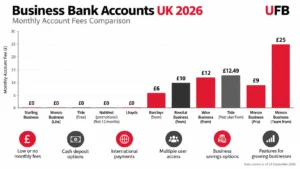
Business bank account monthly fee comparison based on account information checked on 23 September 2026.
| Provider | Standard account cost | Cash handling | Business savings/interest | Main consideration |
| Starling Business | £0 monthly fee | Post Office deposits: 0.7%, £3 minimum | No new Business Fixed Saver currently | Strong UK digital banking; new business overdraft applications currently unavailable |
| Monzo Business | Lite £0; Pro £9; Team from £25 | Cash and cheque facilities available | Business Savings Pots available | Particularly feature-rich for app-led businesses |
| Tide | Free; paid plans from £12.49 | Post Office/PayPoint options | Instant Saver, promotional rates up to 4% AER variable | Banking plus invoicing, tax and admin tools |
| NatWest | Promotional free banking available to qualifying businesses | Branch/Post Office facilities | Separate business savings products | Useful for firms wanting traditional banking infrastructure |
| Lloyds | No monthly fee for first 12 months on current proposition, then £10 | Branch and machine deposits | Separate business savings | Current joining incentives and traditional banking facilities |
| Barclays | Tariff depends on plan | Strong branch/cash infrastructure | Separate savings options | Check Mixed Payments vs e-Payments tariff |
| Wise Business | Free Essential proposition; £50 one-off fee unlocks wider receiving features | Not intended for cash-heavy businesses | Wise Interest is not a conventional bank deposit | Multi-currency payments rather than traditional branch banking |
| Revolut Business | Basic from £10; Grow from £30; Scale from £90 | Limited compared with traditional banks | Savings on qualifying paid plans | FX allowances and plan limits matter |
| Allica Business Rewards | No monthly fee subject to conditions | Targeted at established businesses | Up to 4.08% AER variable advertised | Typically aimed at firms depositing £50,000+ |
Starling confirms no monthly fee, free UK account transfers, multiple-director access and a 0.7% Post Office cash-deposit fee subject to a £3 minimum. Monzo currently lists Lite at £0, Pro at £9 and Team from £25 per month. Tide lists Free, Smart, Pro and Max plans, with paid monthly prices starting from £12.49.
Which Business Bank Account Is Best for Different Types of Business?
Rather than declaring one universal winner, it is more useful to match the account to the business model.
| Business type | Accounts worth comparing first | Why |
| Digital sole trader | Starling, Monzo Lite, Tide Free | Low or zero monthly cost and app-based administration |
| Freelancer using accounting software | Monzo Pro, Starling, NatWest | Accounting and tax integrations |
| Cash-heavy retailer | Lloyds, NatWest, Barclays | Cash facilities can matter more than monthly fees |
| International consultancy | Wise, Revolut | Multi-currency balances and international payment tools |
| Growing limited company with employees | Monzo Team, Revolut Business, Lloyds | Employee cards, permissions and approval controls |
| Established company with substantial reserves | Allica, Tide Saver, Revolut paid plans | Potential return on spare business cash |
| Business needing frequent overdraft borrowing | Compare lending separately before switching | Current account pricing alone tells little about borrowing cost |
| Start-up wanting traditional banking | NatWest Start-up, Lloyds | Introductory fee-free banking and wider banking infrastructure |
This distinction matters because a £0 account can still be expensive when cash-deposit, foreign-exchange or transaction charges are included.
Starling Business Account
Starling remains one of the clearest propositions for businesses whose transactions are mainly electronic and UK-based.
Its core business account currently has no monthly account fee, no charge from Starling for ordinary UK account transfers and free access for multiple directors. It also offers invoicing, Spaces for separating money, receipt capture, integrations with Xero, QuickBooks and FreeAgent, plus desktop and mobile access.
Cash is where the calculation changes.
Starling currently charges 0.7% of the amount deposited at the Post Office, subject to a £3 minimum. It also states a £5,000 daily and £100,000 annual cash-deposit limit for relevant business accounts.
For example:
£1,000 cash deposited:
0.7% × £1,000 = £7
£5,000 cash deposited:
0.7% × £5,000 = £35
A business depositing £5,000 every week could therefore face approximately £1,820 of Starling cash-deposit charges over 52 weeks before considering any other restrictions.
That illustrates why “no monthly fee” does not necessarily mean “cheapest”.
Starling Overdraft Position Has Changed
Older comparison pages can also be misleading here.
Starling currently says it is not accepting new applications for business overdrafts or business loans. Anyone comparing old representative EAR figures should therefore check availability rather than relying on historical rates.
This is an important gap in many existing comparisons, which continue to show “overdraft available” without checking whether new applicants can actually obtain one.
Explore Starling Business Account
Monzo Bank Account for Business
A search for a Monzo bank account can refer to either personal or business banking. Businesses should distinguish clearly between the two.
Monzo Business currently offers three principal tiers:
| Monzo plan | Monthly fee | General positioning |
| Lite | £0 | Basic business banking |
| Pro | £9 | Accounting, tax and invoicing tools |
| Team | From £25 | Employees, approvals and expense management |
Monzo says Pro includes features such as invoicing, automatic tax allocation and accounting integrations, while Team introduces employee expense cards, access levels, payment approvals and bulk payments.
That means the correct comparison is not simply Monzo vs Starling.
A one-person consultant may only need Monzo Lite. A company employing six people may have more reason to consider Team, because reducing expense administration can be worth considerably more than the additional monthly subscription.
Readers comparing Monzo with another major fintech can also see how Monzo and Revolut compare in the UK.
Monzo Business Savings
This is another area many comparison pages overlook.
Monzo provides Business Instant Access Savings Pots. Its dedicated business-savings page currently advertises rates of up to 3.25% AER variable, monthly interest, no minimum deposit and instant withdrawals.
Businesses should nevertheless check the exact rate displayed when opening the product because variable savings rates and plan-specific terms can change.
Monzo Business Overdraft Cost
Monzo publishes unusually clear business-overdraft information.
For eligible sole traders, Monzo currently publishes a 39% representative EAR variable, with offered rates of 29% or 39%. The overdraft can be up to £3,000 for eligible customers.
Its published limited-company overdraft information uses different pricing, with possible variable rates of 19%, 29% or 35.9%, plus annual arrangement fees depending on the facility size.
For limited companies, published arrangement fees are:
| Overdraft facility | Annual arrangement fee |
| £500–£1,000 | £20 |
| £1,001–£2,500 | £50 |
| £2,501–£5,000 | £100 |
An important lesson follows: EAR alone does not always represent the complete cost if an arrangement or renewal fee also applies.
Check Monzo Business Plans
Tide Business Account
Tide sits somewhere between a straightforward business current account and a broader small-business administration platform.
Its current proposition includes:
- A £0 Free plan
- Smart at £12.49 per month
- Pro at £27.49 per month
- Max at £69.99 per month
- Invoicing
- Making Tax Digital tools
- Accounting integrations
- Team-access functionality
- Expense cards on qualifying plans
- Cash deposits
- International payments
- Linked business savings
Tide’s Free plan currently includes five bank transfers each month, while higher subscriptions increase or remove that limit.
This is why a business should avoid automatically selecting the free plan. A business processing large numbers of payments may find a paid subscription more economical once transaction allowances are considered.
Tide Business Savings
Tide’s Instant Saver is one of its more interesting differentiators.
New eligible customers can currently receive promotional savings rates of up to 4% AER variable for four months, with the highest headline rate applying within its tiered structure. Standard rates after the promotional period depend on the selected Tide membership plan.
The current plan table shows ongoing Instant Saver rates of:
- Free: 1.5% AER
- Smart: 2.5% AER
- Pro: 3% AER
- Max: 3.25% AER
Rates are variable and should be rechecked before publication updates.
This creates an interesting calculation.
Paying for a more expensive plan purely to earn a higher savings rate may not make sense on a small balance. On a large reserve, however, extra interest can potentially exceed the subscription difference.
That calculation should be made using:
Additional annual interest – additional annual plan cost = net benefit
Check Tide Business Account
NatWest Online Banking and Business Accounts
The keyword NatWest online banking can refer to personal or commercial banking. Businesses should use the service associated with their business account rather than assuming personal Online Banking offers the same permissions and facilities.
NatWest has different propositions for start-ups and established businesses.
Its Start-up account currently includes free banking on everyday transactions for the first two years, as well as FreeAgent accounting software.
Its established Business Bank Account is aimed at businesses trading for more than one year, or younger businesses with turnover above £1 million. NatWest currently offers two years’ free everyday banking for eligible businesses completing a qualifying switch.
For the wider switching offer, NatWest states that qualifying businesses with turnover up to £2 million can receive the two-year fee-free period after completing the full Current Account Switch Service process.
However, “free banking” does not mean every possible service is free. NatWest specifically notes that services such as international payments, Bankline and certain overdraft-related services may still carry charges.
Who May Prefer NatWest?
It may be more relevant for a business that wants a combination of:
- Online banking
- Mobile banking
- Branch support
- Cash services
- Business credit
- Overdraft facilities
- Accounting software
- Relationship management as the company grows
This broader infrastructure can matter more than having the lowest possible monthly account fee.
Explore NatWest Business Accounts
Lloyds Business Bank Account
Lloyds is particularly relevant to businesses wanting traditional banking combined with modern digital access.
Its current standard Business Account proposition includes:
- No monthly account fee for the first 12 months for qualifying first business accounts
- £10 monthly fee afterwards
- UK electronic payments included without an additional transaction fee
- Multiple business users
- Business debit cards
- UK and international payments
- Business overdraft and credit options subject to status
Lloyds says businesses can add partners, employees and accountants with different levels of access, including full, delegate and view-only permissions.
Cash handling is separately charged.
Current published charges include 85p for every £100 paid through an Immediate Deposit Machine and £1.60 for every £100 paid over the counter.
Lloyds Business Account Offer in September 2026
Lloyds is currently advertising a time-limited offer for accounts opened by 15 October 2026.
The promotion includes a £200 activation reward where qualifying conditions are met, six months’ Xero access and the possibility of a further £200 Amazon gift card linked to qualifying Xero conditions. The £200 account reward requires £100 of debit-card spending plus two Direct Debits by 31 December 2026.
That offer should be dated prominently because it will become stale quickly.
Check Lloyds Business Account
Barclays Online Banking for Business
Barclays online banking also needs to be separated into personal and business use.
Barclays business customers can use digital banking, but permissions can depend on the account mandate. Barclays states that where more than one person manages a business account, all relevant account users may need to complete its Mobile Banking Waiver before transactional app access can be enabled.
This is a useful example of something simplistic account comparisons miss.
“Mobile app: yes” does not tell a multi-director business whether every director can independently make payments, approve transactions or simply view account information.
Barclays also uses different business pricing arrangements, including Mixed Payments and e-Payments structures. A cash-heavy shop may therefore reach a different conclusion from an online consultancy even if both have exactly the same turnover.
For businesses considering Barclays, the important questions are:
- Which business tariff applies?
- How many cash deposits are expected?
- How many electronic transactions are expected?
- Will more than one signatory operate the account?
- Are international payments frequent?
- Is branch access important?
- Will lending or overdraft facilities also be required?
Those answers are more useful than looking at a single monthly account charge.
Wise Bank Account for International Businesses
“Wise bank account” is a popular search phrase, but it is important to understand what the product actually is.
Wise Business is particularly useful for companies sending, receiving, holding or converting multiple currencies. However, Wise Payments Limited operates as an electronic-money institution rather than functioning in exactly the same way as a conventional UK deposit-taking bank account.
That means users should understand the difference between safeguarding and FSCS deposit protection.
Wise’s current UK Business pricing includes a free Essential proposition, while a £50 one-off fee unlocks wider Advanced features such as account details for receiving payments in multiple currencies. Conversion and sending fees vary by currency and currently start from 0.24%.
Wise also provides team cards.
Current UK pricing lists:
- First business card: free under the applicable proposition
- Additional team cards: £3 one-off per card
- First £250 of relevant monthly ATM withdrawals: free
- Amount above £250: 2.69% fee on the excess
Example: Why FX Fees Matter More Than Monthly Fees
Suppose a consultancy converts £20,000 a month to pay overseas contractors.
A difference of only 0.5 percentage points in the effective FX cost would equal:
£20,000 × 0.5% = £100 per month
Over one year:
£100 × 12 = £1,200
That makes arguing over a £5 or £10 monthly current-account charge relatively unimportant for an international business.
The relevant figure is the total sterling amount required to deliver the target foreign-currency amount, including exchange-rate markup and transfer charges.
Businesses with larger FX volumes should therefore compare actual live quotes rather than assuming one provider is always cheapest.
Explore Wise Business
Revolut Business Account
Revolut Business is another important option for internationally active companies.
Its current UK plans start at:
| Plan | Monthly price | FX allowance at interbank rate | No-fee international transfers | Business savings |
| Basic | £10 | £1,000 | 0 | No |
| Grow | £30 | £15,000 | 5 | 2.15% AER variable |
| Scale | £90 | £60,000 | 25 | 2.65% AER variable |
| Enterprise | Custom | Custom | Custom | 3.3% AER variable under current proposition |
Revolut currently charges 0.6% for exchange above the relevant monthly plan allowance and 1% for exchanges outside market hours under the published Business plan structure.
The company also offers extensive team-spending functionality, including employee cards, role-based access, card controls and payment approvals.
That makes it potentially more relevant for companies that have several employees spending company money.
Revolut Is Now a UK Bank
An important 2026 change should also be reflected in comparisons.
Revolut states that restrictions on its UK banking licence were lifted in March 2026 and Revolut Bank UK Ltd launched as a fully authorised bank.
Older comparisons describing Revolut’s UK operation solely according to its previous structure may therefore now be out of date.
Compare Revolut Business Plans
Allica Business Account
Allica occupies a different part of the market from Monzo Lite or Tide Free.
Its Business Rewards Account is primarily aimed at established businesses. Allica says the companies it is built for typically have been incorporated for at least 12 months and can deposit £50,000 or more, or have an eligible Allica lending relationship.
Current advertised features include:
- Up to 4.08% AER variable on instant-access savings
- Up to 1.5% cashback on qualifying card spend
- Dedicated relationship manager
- No monthly fee under the relevant proposition
- Up to 150 Faster Payments per month without additional charge
This makes Allica considerably more relevant to an established SME holding substantial cash reserves than to a brand-new freelancer looking for a simple free account.
Chase Bank Account for Business Use
A Chase bank account should not currently be used as a UK business current account.
Chase’s UK General Account Terms dated 24 August 2026 state that its accounts are for personal use only and specifically say they must not be used for a business.
This applies even where the person is a sole trader.
The fact that a sole trader and the business are not separate legal persons does not override the bank’s contractual terms.
Anyone wanting Chase for cashback or other personal-account benefits should therefore keep those transactions separate from commercial activity unless Chase launches a dedicated business product in the future.
Joint Bank Account vs Business Bank Account
A joint bank account and a business account with multiple users solve different problems.
A personal joint account usually belongs jointly to two individuals.
A limited-company business account belongs to the company, while directors, employees or accountants are given authorised access.
For example, a growing company might need:
- Director A: full payment authority
- Director B: full payment authority
- Accountant: view-only access
- Operations manager: limited payments
- Employees: individual expense cards
- Finance manager: ability to prepare payments
- Director: final approval above a particular amount
A normal personal joint account is not designed around that structure.
Businesses comparing digital providers can see the differences between Monzo and Revolut, including their broader banking and account features.
Business Bank Account for LLC Owners
The keyword business bank account for LLC requires a separate explanation because an LLC is principally a US corporate structure.
UK businesses more commonly operate as:
- Sole traders
- Ordinary partnerships
- Limited liability partnerships
- Private companies limited by shares
- Certain charities or community organisations
A UK private limited company is commonly abbreviated Ltd rather than LLC.
An American LLC looking for UK banking therefore has a different problem from a British Ltd company.
The provider may ask:
- Where is the entity incorporated?
- Where does it conduct business?
- Where do its directors or members live?
- Is there a UK trading address?
- Who are the beneficial owners?
- Which countries send or receive payments?
- What is the expected turnover?
- Does the business operate in a restricted industry?
Wise and Revolut can be particularly relevant to international companies, but eligibility remains dependent on jurisdiction, entity structure and business activity.
Applicants should never assume that “international business account” means every foreign LLC will automatically be accepted.
What Documents Are Needed to Open a Business Bank Account?
One of the biggest weaknesses in competing articles is that they say “ID required” without explaining what an applicant should actually prepare.
The exact checklist depends on the bank and company structure, but a business should be ready with the following information.
For the Person Applying
Usually:
- Full legal name
- Date of birth
- Residential address
- Mobile number
- Email address
- Passport or driving licence
- Proof of address where required
- Tax residency information
For a Limited Company
Commonly:
- Registered company name
- Companies House registration number
- Registered office
- Trading address
- Incorporation date
- SIC code
- Expected annual turnover
- Expected monthly payments
- Expected cash deposits
- Countries the business trades with
- Nature of products or services
- Source of initial capital
Directors and Beneficial Owners
Banks may also ask for details of:
- Directors
- Shareholders
- People with significant control
- Ultimate beneficial owners
- Corporate shareholders
- Overseas owners
Starling, for example, applies specific requirements around directors, PSCs, UK residency and company ownership.
NatWest says it may conduct identity checks and credit checks on people included in a business account application.
Extra Evidence Sometimes Requested
A higher-risk or newly established business may be asked for:
- Business plan
- Supplier contracts
- Customer contracts
- Website
- Invoices
- Proof of trading
- Professional licences
- Source-of-funds documents
- Forecast turnover
- Explanation of large international transfers
Preparing this evidence before applying can prevent unnecessary delays.
Why Can a Business Bank Account Application Be Rejected?
A registered company does not have an automatic right to every bank account.
Providers have different risk policies and eligibility rules.
Applications may encounter problems where:
- The business operates in an unsupported sector
- The stated SIC code does not accurately describe the activity
- Ownership is complex
- Corporate shareholders are involved
- Directors live in unsupported countries
- Source of funds is unclear
- Expected payments appear inconsistent with the business model
- High volumes of cash are expected
- The company handles client money
- Transactions involve higher-risk jurisdictions
- Verification documents cannot be matched
Starling, for example, publicly identifies several activities it does not support and places restrictions around client money, particular regulated activities and certain higher-risk sectors.
A rejection therefore does not necessarily mean every provider will reject the business.
The important step is understanding why the application failed before repeatedly submitting applications elsewhere.
Can a Bank Freeze a Business Account During KYC Checks?

Banks and financial platforms conduct ongoing customer and transaction monitoring, not just checks when the account is opened.
A provider may ask for updated information when:
- Turnover suddenly increases
- Large international payments begin
- Payment patterns change materially
- Large cash deposits appear
- Company ownership changes
- New countries become involved
- The bank needs updated source-of-funds evidence
This does not automatically mean fraud is suspected.
Banks also have anti-money-laundering and financial-crime obligations.
Businesses can reduce avoidable problems by keeping:
- Company information updated
- Invoices
- Supplier agreements
- Customer contracts
- Payroll evidence
- Tax records
- Explanations for unusual transactions
readily available.
For a business, loss of banking access can be operationally serious because payroll, suppliers and customer receipts may all depend on the same account.
That is another reason larger businesses sometimes maintain an additional account rather than relying entirely on a single provider.
Business Overdraft Comparison
The original search results for this subject often reduce overdrafts to “Yes” or “No”. That is insufficient.
The questions that actually matter are:
- Is the facility currently available to new customers?
- What is the representative EAR or APR?
- What rate might an individual business actually receive?
- Is there an arrangement fee?
- Is there a renewal fee?
- What happens if the overdraft is exceeded?
- Does opening or renewing it involve a hard credit search?
A current snapshot illustrates the problem:
| Provider | Current position |
| Monzo | Eligible sole traders may receive up to £3,000; 39% representative EAR variable |
| Monzo Ltd company facility | Published rates can be 19%, 29% or 35.9%, plus arrangement fees depending on limit |
| Starling | Not currently accepting new business overdraft or loan applications |
| NatWest | Business overdrafts available subject to status and individual pricing |
| Lloyds | Business overdraft available subject to approval |
| Tide | Finance products rather than a simple conventional overdraft proposition |
Monzo’s published figures are particularly useful because they show why “representative EAR” and “total cost” are not always the same thing.
Which Business Accounts Pay Interest?
Leaving £100,000 in a non-interest-bearing operational account can cost far more than paying a £10 monthly banking subscription.
Suppose one account pays nothing while another provides 3% AER.
Ignoring compounding and tax for a simple illustration:
£100,000 × 3% = £3,000 per year
A £120 annual bank-account subscription becomes relatively minor compared with £3,000 of potential interest.
Current products worth comparing include:
| Provider | Business savings position |
| Monzo | Business Instant Access Savings Pots; public page currently advertises up to 3.25% AER variable |
| Tide | Promotional Instant Saver rates up to 4% AER variable for new qualifying customers; ongoing rate depends on plan |
| Revolut Business | Grow 2.15%, Scale 2.65%, Enterprise 3.3% AER variable under current pricing |
| Allica | Up to 4.08% AER variable under current Business Rewards proposition |
| Starling | No longer offering its old Business Fixed Saver to new customers |
| Wise | Wise Interest is structurally different from an ordinary bank savings deposit and investment risk/fees need to be considered |
Rates are variable and can change, so this table should be reviewed regularly.
Multi-User Business Bank Accounts Compared
For an employer, user permissions can matter more than the debit-card colour or app design.
Useful features include:
- Individual employee cards
- Per-card spending limits
- Expense categories
- Receipt capture
- View-only accountant access
- Payment preparation
- Payment approval
- Dual authorisation
- Bulk salary payments
- Ability to freeze one employee card without freezing the main account
Monzo Team includes employee expense cards, payment approvals, access levels and bulk payments.
Lloyds allows multiple users and provides full, delegate or view-only access levels.
Revolut allows multiple team members and has extensive corporate-card and spend-control functionality.
Tide provides team access, with additional features available through paid subscriptions.
This area deserves far more attention than it receives in most “best business bank account” rankings.
Apple Pay, Google Pay, Virtual Cards and Card Networks
Digital-wallet support is not normally the first consideration when choosing a business account, but it matters to mobile-first companies.
Useful questions include:
- Does the business debit card work with Apple Pay?
- Is Google Pay/Google Wallet supported?
- Can virtual cards be issued immediately?
- Can employees receive individual virtual cards?
- Can spending limits be changed instantly?
- Can a lost employee card be frozen independently?
- Is the card Visa or Mastercard?
- What does a replacement card cost?
Tide currently advertises virtual cards, expense cards and Apple/Google Pay compatibility.
Monzo Team offers expense cards with configurable controls, while Revolut Business provides physical and virtual team cards.
Wise currently charges a one-off £3 for additional team cards under its UK Business pricing.
Card networks themselves can change between products or card issuance, so publishers should avoid permanently labelling an entire provider “Visa” or “Mastercard” unless the current product documentation confirms it.
FSCS Protection vs Safeguarding
This distinction is particularly important for a YMYL financial article.
From 1 December 2025, the standard FSCS deposit-protection limit increased from £85,000 to £120,000 per eligible person or company, per authorised firm.
That means an eligible limited company can have its own protection entitlement, subject to FSCS eligibility rules.
However, the limit applies per authorised firm, not necessarily per brand.
If two banking brands operate under the same banking licence, deposits across those brands may need to be aggregated when calculating protection.
Electronic-money providers can operate differently.
Safeguarding requires qualifying customer money to be kept separately under applicable regulation, but safeguarding should not be described as though it were identical to FSCS deposit protection.
Users should therefore establish:
- Who legally holds the account?
- Is the provider itself a bank?
- Which authorised bank actually holds deposits?
- Does FSCS protection apply?
- Are multiple products covered under the same banking licence?
Tide is a particularly useful example because its platform can involve different underlying arrangements. Tide states that its current business bank and savings accounts are powered by ClearBank and eligible deposits are protected up to the FSCS limit, while some older/e-money arrangements use safeguarding instead.
Current Business Bank Switching Offers
Sign-up offers change rapidly, so this section should always have a visible checked date.
Lloyds
As checked on 23 September 2026, Lloyds is promoting up to £400 of qualifying rewards plus six months of Xero for businesses opening its Business Account by 15 October 2026. Conditions apply.
NatWest
NatWest is offering qualifying businesses two years of free everyday banking when completing an eligible full CASS switch.
Revolut
Revolut currently advertises a one-month Business trial through an eligible promotional route for new customers meeting the offer conditions before 31 December 2026.
Tide
Older comparison pages referring to a £200 Tide promotion should not automatically be copied into a September 2026 article unless the live qualifying terms still support it.
A joining reward is useful only if the account remains economical afterwards.
How the Current Account Switch Service Works for Businesses?
Eligible small businesses can use the Current Account Switch Service where both institutions and the account meet the scheme requirements.
A full switch typically transfers:
- Account balance
- Direct Debits
- Standing orders
- Incoming-payment redirection
NatWest states that its qualifying CASS process completes within seven working days.
Starling similarly supports CASS and says eligible incoming payments to the old account are redirected after the switch.
Businesses should separately check:
- Continuous card payments
- Merchant-acquiring settlements
- Payroll instructions
- Marketplace payouts
- Overseas payment details
- Accounting integrations
- Card subscriptions
Companies reorganising their regular payments can also review how to cancel a Direct Debit correctly.
Does a Sole Trader Legally Need a Business Bank Account?
A sole trader is generally not legally required to maintain a separate business current account.
Government business guidance confirms that sole traders and ordinary partnerships are not generally legally required to have one, although separating business and personal finances makes accounting considerably easier.
However, two separate questions must be considered.
Legal Requirement
There may be no general legal requirement for a sole trader.
Bank’s Terms and Conditions
The person’s personal bank may prohibit business use.
Chase is a straightforward example: its UK accounts are expressly restricted to personal use.
A sole trader should therefore check both the law and the particular account agreement.
Limited Companies Should Keep Business Finances Separate
A limited company is a separate legal entity from its shareholders and directors.
Government business guidance states that limited companies are among the business types that must maintain appropriate business banking separation.
Using a proper company bank account also makes it easier to establish:
- Which income belongs to the company
- Which expenses are company expenses
- Director’s loan account transactions
- Salary and dividend payments
- Corporation Tax records
- VAT payments
- Payroll
- Creditor payments
Mixing personal and company money can create unnecessary accounting complications even where transactions can eventually be reconstructed.
Are Business Bank Account Fees Tax Deductible?
For sole traders, many normal banking costs incurred for the business can be allowable expenses.
HMRC specifically lists costs such as:
- Bank charges
- Overdraft charges
- Credit-card charges
- Interest on business loans
among potentially allowable financial costs, subject to the ordinary tax rules.
However, HMRC distinguishes interest and finance costs from repayment of the underlying capital. Repaying the actual loan or overdraft principal does not become an allowable expense merely because it is paid through the business account.
Limited companies operate under different tax rules from sole traders, so the exact treatment should be checked with appropriate company-accounting guidance or an accountant.
How to Calculate the Real Cost of a Business Bank Account?
Instead of asking:
“Which account has the lowest monthly fee?”
ask:
“What will this account cost my business over 12 months?”
A useful formula is:
Annual banking cost = monthly subscription × 12 + transaction charges + cash-deposit fees + cash-withdrawal fees + FX costs + international-transfer fees + card costs + overdraft costs + paid add-ons
Then subtract any reliable:
- Interest earned
- Cashback
- Valid joining reward
Example 1: Digital Consultant
Assume:
- No cash deposits
- Mainly UK transfers
- No overdraft
- No employees
- No international payments
A £0 digital business account may genuinely be very inexpensive.
Starling or Monzo Lite therefore becomes much more relevant.
Example 2: Cash-Heavy Retailer
Assume the business deposits £5,000 cash per week.
At Starling’s current 0.7% cash-deposit charge:
£5,000 × 0.7% = £35 per week
Over 52 weeks:
£35 × 52 = £1,820
At that point, the words “no monthly fee” become almost irrelevant.
The retailer should compare cash tariffs from Lloyds, Barclays, NatWest and other providers instead.
Example 3: International Consultancy
Assume £30,000 of currencies are converted monthly.
Even an effective FX difference of 0.4% equals:
£30,000 × 0.4% = £120 per month
Annual effect:
£120 × 12 = £1,440
That company should focus more heavily on Wise, Revolut and actual FX quotes.
Example 4: Company Holding £200,000 Cash
Suppose Account A pays no interest.
Account B pays an illustrative 3% AER.
Simplified annual difference:
£200,000 × 3% = £6,000
Even a £30 monthly account subscription equals only:
£30 × 12 = £360
A supposedly “expensive” account could therefore produce a substantially better net outcome if the savings return genuinely applies to the balance.
This is why an interactive calculator could materially improve this article.
Business Bank Account Cost Calculator: What to Include
A useful on-page calculator should ask visitors for:
- Monthly UK transfers
- Monthly incoming payments
- Monthly cash deposits
- Number of ATM withdrawals
- Average business cash balance
- Monthly foreign-exchange volume
- Number of international transfers
- Number of employee cards
- Expected overdraft balance
- Approximate number of overdraft days
The tool could then calculate:
- Estimated monthly cost
- Estimated annual cost
- Potential annual interest
- Net annual banking cost
That would provide genuine functionality rather than another static comparison table.
Independent Business Banking Service Ratings

Review-site ratings can be useful but can also fluctuate rapidly and may not use comparable customer populations.
A stronger benchmarking source is the independent business-banking service-quality survey conducted as part of the regulatory requirements for major providers.
The latest August 2026 results cover research conducted between July 2025 and June 2026, with roughly 1,200 customers surveyed for each participating provider and about 20,400 SME customers in total.
For overall service quality, the survey reported:
| Provider | Customers saying they were very/extremely likely to recommend |
| Monzo | 85% |
| Starling | 83% |
| Mettle | 82% |
| Handelsbanken | 78% |
| Tide | 69% |
For online and mobile banking, the reported leading results included:
| Provider | Online/mobile recommendation score |
| Monzo | 90% |
| Starling | 87% |
| Mettle | 84% |
| Tide | 74% |
These results should still not be interpreted as proof that the highest-scoring provider is automatically the best account for every business. A company needing branch cash deposits, for example, has different requirements from an app-only consultancy.
Methodology
This comparison does not rank accounts simply by monthly fee.
Accounts were reviewed against the following practical categories.
1. Core Banking Cost
Including:
- Monthly fee
- UK payments
- Cash deposits
- ATM withdrawals
- Card costs
2. Business Eligibility
Including:
- Sole traders
- Limited companies
- LLPs
- Overseas ownership
- Multi-director businesses
3. Business Administration
Including:
- Invoicing
- Tax Pots
- Making Tax Digital
- Accounting integrations
- Receipt capture
4. Team Management
Including:
- Employee cards
- User permissions
- Payment approvals
- Bulk payments
- Accountant access
5. Borrowing
Including:
- Whether an overdraft is actually available
- Representative rates
- Arrangement fees
- Lending options
6. International Banking
Including:
- FX allowances
- Currency accounts
- International transfers
- Transfer fees
7. Savings
Including:
- Business savings availability
- Current AER
- Accessibility of funds
- Whether a higher subscription is required
8. Protection and Regulatory Structure
Including:
- FSCS position
- Underlying bank
- Safeguarding arrangements
- Whether the provider itself is a bank
9. Customer-Service Evidence
Independent regulatory service-quality research is preferred over relying exclusively on uncontrolled review-site star ratings.
Pricing, promotions and variable interest rates should be reviewed regularly because some figures can change within weeks.
Final Considerations Before Choosing a Business Bank Account
The cheapest-looking business bank account is not necessarily the account that costs the least.
A digital freelancer may benefit most from a simple £0 account.
A retailer handling thousands of pounds in notes should focus on cash-deposit pricing.
A limited company with ten employees needs individual access controls and expense cards.
An importer or international consultancy should focus on FX spreads, currency accounts and international-transfer charges.
An established company holding a six-figure reserve should compare interest on spare cash.
And a company regularly using credit should investigate overdrafts and lending before switching its operating account.
The most effective comparison therefore starts with the company’s real transaction pattern rather than the bank’s headline marketing message.
Calculate the expected annual cost, compare protections and eligibility, check how employees will use the account, assess cash and international-payment requirements, and then examine any joining reward.
A £200 switching bonus can be attractive.
But the right account should still make financial and operational sense long after that £200 has been spent.
Frequently Asked Questions
What Is the Best Business Bank Account in the UK?
There is no universal best account. Starling and Monzo are relevant for low-cost digital banking, Tide combines banking and administration tools, Lloyds and NatWest offer broader traditional banking infrastructure, while Wise and Revolut are especially relevant for international transactions.
What Is the Best Small Business Bank Account With No Monthly Fee?
Starling Business and Monzo Business Lite currently have no standard monthly account fee. Tide also offers a £0 subscription tier. Transaction, cash and international-payment charges still need to be considered.
Is Monzo Good for a Business Bank Account?
Monzo Business offers Lite, Pro and Team plans. Its stronger features include tax management, accounting integrations, invoicing, business savings and team controls. Which plan makes sense depends on whether those extra tools justify the monthly subscription.
Can I Use My Chase Bank Account for Business?
Not under Chase UK’s current account terms. Chase states that its accounts are for personal use only and must not be used for business.
Is Wise a Bank Account?
Wise Business provides account details, cards and payment features, but its UK payment service structure should not be treated as identical to an ordinary UK deposit-taking bank account. Businesses should understand the applicable safeguarding and protection arrangements.
Is Revolut a UK Bank Now?
Revolut says Revolut Bank UK Ltd became fully operational as a UK-authorised bank after restrictions on its banking licence were lifted in March 2026.
Can an LLC Open a UK Business Bank Account?
Potentially, but a US LLC is not the same structure as a UK Ltd company. Eligibility depends on the provider, incorporation jurisdiction, ownership, directors’ locations and trading activity.
Can Two Directors Use the Same Business Account?
Yes, where the account supports multiple directors or authorised users. Providers differ substantially in permissions, payment approvals and employee-card controls.
Is a Joint Bank Account the Same as a Business Account?
No. A personal joint account belongs to individuals, whereas a company business account belongs to the company and can give directors, employees or accountants different levels of authorised access.
Does a Sole Trader Need a Business Bank Account?
Not generally as a legal requirement, but the terms of a personal bank account may prohibit business use. Separating finances also simplifies bookkeeping and tax records.
Are Business Bank Charges Tax Deductible?
Many genuine business bank charges and finance costs can be allowable expenses, depending on the business structure and circumstances. HMRC specifically recognises bank, overdraft and credit-card charges among potential allowable financial costs for self-employed businesses.
How Much Money Does FSCS Protect in a Business Account?
From 1 December 2025, the standard deposit-protection limit is £120,000 per eligible person or company, per authorised firm. Eligibility rules apply.
Can I Switch a Business Account in Seven Working Days?
Eligible businesses using the full Current Account Switch Service can generally complete the standard switch within seven working days. Individual eligibility and account restrictions still apply.