
Our overall editorial rating: 89%
Is Trading 212 Cash ISA safe? Yes, Trading 212’s Cash ISA is generally considered a safe place for eligible UK savers to hold cash, provided they understand how their money is protected and the limits of the Financial Services Compensation Scheme (FSCS).
Although Trading 212 is better known as an investment platform, its Cash ISA operates differently from its share-trading products. Savings are held with regulated partner banks, rather than being exposed to stock market fluctuations.
We analysed the platform’s regulatory arrangements, cash protection measures, interest-rate structure, withdrawal conditions and potential financial risks to understand how suitable it is for everyday savers.
Our assessment also considers an important concern: what happens if Trading 212 itself fails, or if one of the banks holding customers’ money becomes insolvent?
The answer depends on where the money is held, the applicable compensation scheme and the saver’s existing deposits with the same banking institution.
Is Trading 212 Cash ISA Safe to Use in the UK?
Trading 212’s Cash ISA has several important safeguards that make it a credible option for UK savers.
The company operates through Trading 212 UK Ltd, which is authorised and regulated by the Financial Conduct Authority (FCA), under firm reference number 609146.
Rather than treating Cash ISA balances as its own operating funds, Trading 212 holds customers’ savings separately with partner banks.
These arrangements are designed to prevent the platform from using customers’ savings to fund its business operations.
Eligible savings held with UK-authorised partner banks benefit from FSCS deposit protection of up to £120,000 per eligible person, per banking licence.
This does not mean every saver automatically receives £120,000 of protection for each account. Any other eligible deposits held with the same authorised banking institution must also be considered.
From our assessment, the platform’s strongest safety features are its regulatory oversight, segregated client money arrangements and the involvement of established banking partners.
Our Trading 212 Cash ISA Safety Ratings
| Assessment category | Our rating |
| Protection of customer funds | 93% |
| Regulatory oversight and compliance arrangements | 92% |
| Fee transparency | 96% |
| Savings accessibility and flexibility | 91% |
| Interest-rate competitiveness | 87% |
| Customer support accessibility | 75% |
| Overall editorial assessment | 89% |
These percentages represent our qualitative assessment of the account’s published features and safeguards. They are not measured customer satisfaction scores, independent security-audit results or probabilities of financial loss.
The relatively lower customer support assessment reflects the platform’s predominantly digital support model, which may be less suitable for customers who prefer traditional telephone banking.
Is Trading 212 Regulated by the FCA?
Yes. Trading 212 UK Ltd is authorised and regulated by the Financial Conduct Authority.
The FCA establishes standards that regulated investment firms must follow, including requirements concerning client money, business conduct, governance and customer treatment.
However, being FCA-regulated does not mean the regulator guarantees every financial product or prevents a company from failing.
Regulatory protection should be understood as a framework for controlling risks rather than eliminating them.
Our analysis highlights three particularly important considerations:
- Regulatory authorisation: Trading 212 UK Ltd operates under an identifiable FCA authorisation.
- Client money arrangements: Customer money is separated from funds used to operate the business.
- Compensation arrangements: Eligible customers may benefit from different FSCS protections depending on the circumstances.
Savers should also confirm that they are dealing with the genuine UK-regulated company rather than a fraudulent website or impersonator.
The FCA’s official Financial Services Register can be used to check the company’s authorisation and relevant permissions.
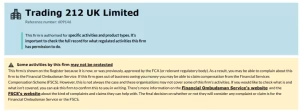
Trading 212 UK Ltd’s official Financial Conduct Authority registration, showing its regulated status and firm reference number 609146.
Is Trading 212 Cash ISA Protected by FSCS?
Yes. Eligible cash held through Trading 212’s Cash ISA with UK-authorised partner banks is covered by the Financial Services Compensation Scheme.
The FSCS is the UK’s statutory compensation scheme for eligible customers of authorised financial services firms that have failed.
An important change occurred on 1 December 2025, when the standard deposit protection limit increased from £85,000 to £120,000.
This means articles still describing the standard banking deposit limit as £85,000 are using outdated information.
Nevertheless, different FSCS protection limits apply to different types of financial claims.
How Much Money Is Protected?
| Protection arrangement | Maximum applicable protection |
| Eligible deposits at a failed UK-authorised partner bank | £120,000 per eligible person, per banking licence |
| Eligible investment-firm failure claims involving a qualifying shortfall | £85,000 per eligible person, per firm |
| Normal stock market investment losses | Not covered |
| Savings exceeding the relevant banking licence limit | Excess may be unprotected |
| Certain qualifying temporary high bank balances | Additional protection may apply |
The deposit protection limit is not the maximum amount someone can keep in a Cash ISA.
For example, an individual who has accumulated £150,000 in ISA savings over several tax years can continue holding that amount within eligible ISAs.
However, if the entire balance is held with one banking institution, some money may exceed the standard FSCS protection limit.
Savers can confirm the latest rules using the official FSCS deposit protection guidance.
Where Does Trading 212 Keep Cash ISA Savings?
One of the most important questions about Trading 212 is where customers’ money actually goes after being deposited.
Trading 212 is not itself a traditional UK deposit-taking bank. Instead, its Cash ISA uses separate client money accounts with partner banks.
Banks identified in recent independent Cash ISA comparisons include:
- Barclays
- NatWest
- JPMorgan
These institutions operate within established banking regulatory frameworks.
Trading 212 may change the institutions it uses or the allocation of funds between them, so the latest arrangements should always be checked.
The key protection mechanism is segregation.
Customer savings are held separately from Trading 212’s own business funds, helping ensure they can be identified and returned through the appropriate process if the company becomes insolvent.
Why Does the Partner Bank Matter?
An individual may already hold a savings account with one of Trading 212’s banking partners.
This can create an overlap in FSCS protection.
Consider a hypothetical example.
A saver has:
- £100,000 deposited directly with Barclays.
- £30,000 allocated to Barclays through their Trading 212 Cash ISA.
- No other eligible Barclays deposits.
Their combined exposure under the same banking licence would be £130,000.
If the relevant authorised bank failed, the standard £120,000 FSCS deposit limit could leave £10,000 outside the ordinary protection limit.
The fact that some of this money is inside an ISA does not create a separate FSCS allowance.
In our assessment, this is one of the most important considerations for savers with substantial balances.
Having money across several apps or different account providers does not necessarily mean the underlying savings are diversified across different banking licences.
What Happens if Trading 212 Goes Bust?
If Trading 212 became insolvent, customers would not automatically lose their Cash ISA savings.
The company’s client money arrangements are designed to keep customers’ funds separate from its business assets.
This distinction matters because client money should not simply become part of the company’s ordinary funds available to creditors.
However, an insolvency could still create practical difficulties.
Administrators may need to identify client entitlements, reconcile accounts and arrange the return or transfer of money.
This could temporarily delay access to savings.
There are three possible situations worth understanding.
1. Trading 212 Fails but Customer Funds Remain Intact
Segregated funds should generally be identified and returned through the administration or insolvency process.
An investor or saver might experience delays, but company failure alone does not mean their savings have disappeared.
2. Trading 212 Fails and There Is a Client Money Shortfall
If the company cannot return eligible client money and a qualifying claim arises, the FSCS investment protection arrangements may provide compensation of up to £85,000 per eligible person, per firm.
This differs from the £120,000 protection applicable when a UK-authorised deposit-taking bank fails.
3. A Partner Bank Fails
If an authorised partner bank fails, eligible deposits with that bank may qualify for compensation of up to £120,000 under the deposit protection scheme.
Any savings the customer already holds directly or indirectly with the same banking licence would need to be taken into account.
The distinction between platform failure and partner bank failure is essential. They are different scenarios, with potentially different compensation arrangements and limits.
Trading 212 explains these distinctions in its official money protection information.
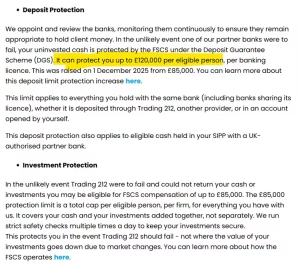
Trading 212’s official explanation of client money segregation, FSCS deposit protection and investment-firm compensation.
Does Trading 212 Invest Cash ISA Money in Money Market Funds?
No. Trading 212 states that its Cash ISA money is held with partner banks.
However, qualifying money market funds, commonly called QMMFs, are relevant to some of its other account arrangements.
This distinction is important because the platform operates several financial products that may look similar within its app but carry different underlying risks.
A qualifying money market fund invests in relatively short-term financial instruments. Although such funds are generally designed to manage risk and maintain liquidity, their value is not guaranteed.
Money held in a QMMF is not the same as an eligible bank deposit and does not benefit from the ordinary FSCS bank deposit guarantee.
Trading 212’s Cash ISA, by contrast, is designed as a cash savings product.
| Feature | Trading 212 Cash ISA | Cash held through a QMMF |
| Main purpose | Tax-free cash saving | Cash management within investment arrangements |
| Where money is held | Partner bank deposits | Investment fund |
| Market-related fund risk | No direct QMMF exposure | Yes |
| Ordinary FSCS deposit protection | Available for eligible bank deposits | Does not apply to the fund’s market losses |
| Returns | Variable savings interest | Depends on fund returns and arrangements |
Someone looking for a straightforward savings product should specifically select Cash ISA, rather than assuming all interest-bearing cash within Trading 212 is held in the same way.
We consider this distinction particularly important for first-time savers who associate the Trading 212 brand primarily with share trading.
Can You Lose Money in a Trading 212 Cash ISA?
A Trading 212 Cash ISA does not have the normal share-price risks associated with a Stocks and Shares ISA.
However, saying that a product is relatively safe is not the same as saying every possible financial risk has been eliminated.
There are several risks to consider.
- Institutional failure: The platform or an underlying bank could encounter financial difficulties. Segregation and statutory compensation arrangements help manage this risk.
- Amounts exceeding FSCS protection: Money above the relevant banking licence protection limit may be exposed to loss if the underlying bank fails.
- Fraud: Criminals may attempt to obtain account credentials, impersonate the company or persuade savers to authorise fraudulent transfers.
- Interest-rate reductions: A variable savings rate can fall, meaning the account generates less income than expected.
- Inflation: Even when the cash balance increases through interest, its purchasing power may decline if inflation exceeds the savings return.
For example, if a Cash ISA earns 3.6% annually while inflation is 4.0%, the saver receives positive nominal interest but experiences a slight reduction in purchasing power.
That is not the same as losing money because of stock market movements, but it is relevant to the real value of savings.
From a financial planning perspective, protection of capital and protection of purchasing power should be considered separately.
What Interest Rate Does Trading 212 Cash ISA Pay in 2026?
Trading 212’s Cash ISA uses a variable interest-rate structure linked to the Bank of England’s base rate.
Under its published tracker arrangement, the standard rate is currently set at 0.15 percentage points below Bank Rate.
At the time of our October 2026 review, the standard rate was displayed at approximately 3.60% AER, although this can change.
Eligible new customers may also qualify for promotional bonuses.
For example, an October 2026 promotional comparison showed a total rate of 4.83% AER, combining a 3.60% variable standard rate with a 1.23 percentage-point introductory bonus for 12 months.
This promotional rate should not be mistaken for an offer available automatically to every customer.
Eligibility may depend on using a qualifying promotional code, meeting funding deadlines and satisfying other conditions.
Furthermore, transferred savings from previous tax years may receive only the standard rate rather than the promotional bonus.
How Much Interest Could You Earn?
The following examples assume the stated annual equivalent rate remains unchanged for a full year, with no additional deposits or withdrawals.
| Cash ISA balance | At 3.60% AER | At 4.83% AER |
| £1,000 | £36 | £48.30 |
| £5,000 | £180 | £241.50 |
| £10,000 | £360 | £483 |
| £20,000 | £720 | £966 |
| £50,000 | £1,800 | £2,415 |
Illustrative annual interest only. Actual returns depend on rate changes, deposit dates, promotional eligibility and the applicable interest calculation.
Trading 212 calculates Cash ISA interest daily and normally pays it monthly.
The rate a saver receives should always be checked in the account before transferring substantial amounts.
A useful comparison is the effect of a one-percentage-point rate difference.
On £20,000, a 1% difference in annual interest represents approximately £200 over a full year.
For households managing emergency reserves, property deposits or retirement savings, that difference can become meaningful.
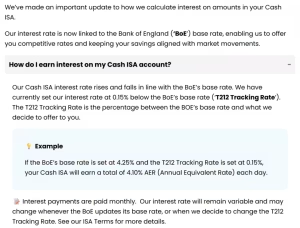
Trading 212’s official Cash ISA interest-rate tracker explanation, showing how the rate follows Bank Rate and how monthly interest is paid.
Is Trading 212 Cash ISA Better Than a Traditional Bank ISA?
Trading 212 can be attractive to savers who prefer mobile account management, flexible withdrawals and competitive variable interest.
However, traditional banks and building societies may offer advantages that are more important to certain customers.
| Feature | Trading 212 Cash ISA | Traditional bank Cash ISA |
| FCA-regulated arrangements | Yes | Depends on institution and authorisation |
| FSCS-eligible deposits | Yes, through partner banks | Yes, if held at a UK-authorised institution |
| Physical branches | No | Available with some providers |
| Interest rates | Variable tracker, potentially promotional | Fixed, variable or introductory |
| Account fees | No standard Cash ISA account fee | Depends on product |
| Access | Digital and app-based | Digital, telephone or branch, depending on provider |
| Customer service | Predominantly online | Varies |
| Fixed-rate options | Not the main Cash ISA offering | Widely available |
A traditional bank is not automatically safer simply because it has physical branches.
What matters for deposit protection is the underlying authorised institution, how funds are held and whether the saver remains within the relevant compensation limits.
Nevertheless, a bank with branches may be preferable for someone who values in-person support.
For savers comparing alternatives, Nationwide ISA rates provide a useful illustration of how fixed-rate and limited-access accounts differ from flexible variable-rate savings.
Similarly, Yorkshire Building Society ISA rates can help demonstrate why withdrawal limits, fixed periods and interest rates should be assessed together.
A higher advertised interest rate is only one factor in choosing an appropriate savings account.
Is It Safe to Keep £20,000 or £100,000 in Trading 212?
The appropriate amount to hold depends on the saver’s wider financial position and exposure to the underlying banking institutions.
Keeping £5,000 to £20,000
For someone holding relatively modest savings, the Cash ISA’s standard protection arrangements can provide substantial reassurance, assuming they remain eligible and have no significant overlapping deposits.
However, the individual should still consider accessibility, security and whether the rate is competitive.
Keeping £50,000
A £50,000 balance could have accumulated through ISA contributions made over several years.
This amount may remain within the standard £120,000 deposit protection limit at a single banking institution, provided there are no other deposits that take the total above the limit.
Keeping £100,000 or More
Larger balances require additional attention.
An individual who holds substantial savings with Barclays, NatWest, JPMorgan or other banks used by the platform should consider whether their total deposits with any shared banking licence exceed the protection limit.
Someone with £100,000 in a Cash ISA should not assume the full amount is protected without considering the actual allocation between banks and their other deposits.
Where substantial sums are involved, diversifying savings between genuinely separate authorised banking institutions may provide greater clarity over protection.
This does not mean opening several Trading 212 accounts would increase protection. FSCS deposit limits are based on the underlying banking institution, not the number of accounts or apps used.
How Safe Are Trading 212 Cash ISA Withdrawals?
Trading 212 offers a flexible Cash ISA, allowing customers to access savings without the fixed-term restrictions associated with many traditional fixed-rate accounts.
There is generally no Trading 212 fee for standard Cash ISA withdrawals by bank transfer.
However, a withdrawal request should not be confused with an unconditional guarantee that the money will arrive instantly.
Processing times can depend on bank procedures, identity checks, payment networks and security requirements.
Temporary account reviews may also occur where unusual or potentially fraudulent activity is detected.
We recommend that savers avoid keeping every pound of immediately necessary spending money in a single savings platform.
For example, someone relying on a savings balance to complete a house purchase should plan withdrawal and transfer arrangements sufficiently in advance.
The practical steps, verification requirements and common delays are explained in more detail in how to withdraw money from Trading 212.
Account accessibility is important, but a good savings plan should also include a second source of emergency liquidity.
Can You Transfer an Existing Cash ISA to Trading 212 Safely?
Yes, eligible savers can generally transfer an existing Cash ISA to Trading 212 using the formal ISA transfer process, subject to the provider’s current terms and acceptance requirements.
The important rule is to request an official ISA transfer rather than withdrawing the money to an ordinary bank account first.
A properly completed ISA transfer allows existing tax-free savings to move between providers without treating the transferred amount as a new annual subscription.
Suppose someone has £40,000 accumulated in previous tax years.
If they transfer that balance through the recognised ISA transfer process, the existing money can normally retain its ISA status without consuming another £40,000 of annual subscription allowance.
However, eligibility for promotional interest is a different question.
An introductory bonus may apply only to qualifying subscriptions from the current tax year, while transferred balances from older tax years receive the lower standard rate.
Under HMRC’s general expectations, transfers between Cash ISA providers should normally be completed within 15 working days.
Occasionally, administrative issues or delays can occur, even when an account is otherwise appropriately protected.
This is why transfer safety should include checking the receiving account details, reviewing provider correspondence and retaining confirmation of the transfer request.
Is Trading 212 Cash ISA Flexible?
Yes. Trading 212 describes its Cash ISA as flexible.
Under the flexible ISA rules, qualifying withdrawals can be replaced during the same tax year without necessarily using additional annual subscription allowance.
For example, a saver contributes £10,000 to their Cash ISA during the 2026/27 tax year.
They later withdraw £3,000 and then replace it within the relevant tax year.
If the replacement satisfies the applicable flexible ISA rules, it does not consume an additional £3,000 of the annual allowance.
However, different conditions can apply to withdrawals of money contributed in previous tax years.
Such funds generally need to be returned to the appropriate ISA within the same tax year to preserve the relevant flexible withdrawal treatment.
Savers should check their account’s current rules before moving money between different ISA providers.
It is also possible to maintain more than one Cash ISA under current UK regulations.
The rules around having two Cash ISAs with different providers can be particularly useful for people combining an accessible savings account with a fixed-rate product.
Will the Cash ISA Rules Change in April 2027?
Yes. The UK has introduced changes scheduled to take effect from 6 April 2027.
For the 2026/27 tax year, the overall annual adult ISA subscription limit remains £20,000.
From 6 April 2027, the amount that savers under 65 can subscribe to Cash ISAs will reduce to £12,000 annually.
The overall ISA subscription allowance will remain £20,000, while those qualifying for the age-65 exemption will retain a £20,000 Cash ISA subscription limit.
| ISA rule | 2026/27 | From 6 April 2027 |
| Overall annual ISA allowance | £20,000 | £20,000 |
| Cash ISA annual allowance, under 65 | Up to £20,000 | £12,000 |
| Cash ISA annual allowance, qualifying age 65+ | Up to £20,000 | £20,000 |
| Existing accumulated Cash ISA savings | Can remain within ISA | Can remain within ISA |
The changes concern new annual subscriptions, not a requirement to withdraw existing savings exceeding £12,000.
For example, someone who has built up £80,000 in Cash ISAs does not need to reduce their balance to £12,000 when the new rules begin.
The reforms also introduce restrictions affecting transfers from non-cash ISAs into Cash ISAs for investors under 65, together with changes concerning interest paid on cash held in non-cash ISAs.
These rules matter to customers using Trading 212’s Cash ISA alongside its Stocks and Shares ISA.
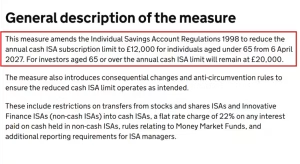
Official government guidance confirming the reduction of the annual Cash ISA subscription limit to £12,000 for savers under 65 from 6 April 2027.
What Are the Main Advantages and Disadvantages of Trading 212 Cash ISA?
Although the platform has several attractive features, it will not suit every saver.
Advantages
- Established regulatory framework: The UK entity operates under FCA authorisation, with client money segregation requirements.
- FSCS protection: Eligible deposits with authorised partner banks benefit from statutory compensation protection, subject to the applicable limits.
- Competitive savings rates: The variable tracker structure and occasional introductory offers may compare favourably with other easy-access accounts.
- No standard account fee: The Cash ISA does not ordinarily charge an account maintenance fee.
- Flexible withdrawals: Customers can access their savings and use qualifying flexible ISA replacement rules.
- Low opening amount: The account can be opened with as little as £1.
Disadvantages
- No bank branches: The service operates digitally, which may not suit customers requiring face-to-face assistance.
- Partner bank complexity: Customers with larger balances need to consider overlapping deposits and shared banking licences.
- Variable returns: Interest rates can decline when Bank Rate falls or the provider changes its tracker margin in accordance with its terms.
- Promotional restrictions: The highest advertised rates may not be available on all transferred funds or to existing customers.
- Potential administrative delays: Withdrawals, transfers or insolvency processes can involve delays.
- Exposure to other financial products: Customers also encounter investment products within the wider Trading 212 ecosystem, which have different risk characteristics.
Our view is that Trading 212’s Cash ISA is most compelling when the saver understands these differences and wants an accessible, digitally managed cash savings account.
How Can You Make Your Trading 212 Cash ISA Safer?
Regulatory protections are important, but account holders also have responsibilities when protecting their savings.
Before transferring a substantial balance, we recommend the following practical checks:
- Verify the provider. Confirm the company and its permissions through the official FCA Financial Services Register.
- Check the account type. Ensure the product selected is Cash ISA rather than a Stocks and Shares ISA or another investment account.
- Review FSCS exposure. Consider existing savings held directly or indirectly with the same authorised banking institutions.
- Secure account access. Use a strong, unique password and enable available additional authentication safeguards.
- Understand the interest rate. Distinguish the standard variable rate from temporary promotional bonuses.
- Test withdrawal arrangements. Familiarise yourself with the withdrawal process before relying on the account for time-sensitive payments.
- Keep records. Retain statements, deposit confirmations and ISA transfer correspondence.
- Review the account periodically. Check whether the interest rate and account features remain competitive.
From a risk-management perspective, concentrating every financial activity with one provider is not always necessary.
Having access to a separate current account and keeping suitable emergency funds readily available can reduce disruption if an account is temporarily inaccessible.
Who Should Consider Trading 212 Cash ISA?
Trading 212’s Cash ISA may be suitable for several types of savers.
- First-time ISA savers: The low minimum deposit and relatively straightforward digital experience may appeal to people opening their first tax-free savings account.
- Emergency-fund savers: Flexible withdrawals can be useful for money that may be needed unexpectedly, subject to normal processing times.
- People saving for short-term goals: Customers saving for a house deposit, wedding or planned major purchase may prefer cash savings to exposing the money to share-market volatility.
- Savers comparing interest rates: People willing to monitor variable savings rates may benefit from competitive introductory terms.
However, it may be less suitable for customers who need branch-based assistance, want a guaranteed fixed interest rate or require the simplicity of holding savings directly with a single named bank.
People with substantial existing balances should also assess the underlying banking licence exposure carefully.
Our Final Verdict: Is Trading 212 Cash ISA Safe?
Our overall editorial assessment of 89% reflects a Cash ISA with meaningful regulatory safeguards, competitive savings features and relatively straightforward digital access.
Trading 212’s use of segregated customer money accounts and UK-authorised partner banks makes its Cash ISA substantially different from speculative investment products.
Eligible deposits may benefit from FSCS protection of up to £120,000 per banking licence, while separate compensation arrangements may apply if the investment firm itself fails and a qualifying shortfall occurs.
The most important limitations are not necessarily the platform’s brand or its association with share trading.
Instead, savers should focus on where their money is deposited, whether they have overlapping banking exposure, how promotional interest is calculated and how readily they can access their funds.
For smaller and medium-sized cash savings balances, Trading 212 can be a reasonable option for someone comfortable with app-based financial services.
For larger balances, an additional assessment of banking licence exposure and savings diversification becomes increasingly important.
Ultimately, the best Cash ISA is not simply the product advertising the highest interest rate. It is the account that combines appropriate capital protection, accessibility, competitive returns and terms that match the saver’s financial circumstances.
Frequently Asked Questions
Is Trading 212 Cash ISA 100% Safe?
No financial institution is completely free from risk. However, Trading 212’s Cash ISA has regulatory safeguards, segregated funds and eligible FSCS deposit protection that significantly reduce certain risks.
Is Trading 212 Cash ISA FSCS Protected?
Yes. Eligible deposits held with UK-authorised partner banks are protected up to £120,000 per eligible person, per banking licence, subject to the scheme’s conditions.
Can I Lose All My Money if Trading 212 Goes Bust?
Platform failure does not automatically mean customers lose their savings. Segregated client money should generally be returned through the appropriate process, with potential FSCS compensation where qualifying shortfalls occur.
Is Trading 212 Cash ISA Safer Than Its Stocks and Shares ISA?
The Cash ISA does not expose savings directly to ordinary share-market movements. A Stocks and Shares ISA involves investment risk, including the possibility of losing capital due to market performance.
Can I Keep £100,000 in Trading 212 Cash ISA?
Yes, subject to the account’s terms. However, protection depends on the underlying banks, how the money is allocated and other eligible deposits held under the same banking licences.
Does Trading 212 Cash ISA Have Hidden Fees?
Trading 212 publishes no standard Cash ISA maintenance fee and ordinarily offers free bank-transfer withdrawals. Customers should still review current terms and any third-party charges that may apply.
Can I Withdraw Money From Trading 212 Cash ISA Anytime?
The account is designed to allow flexible withdrawals. However, payment processing times and security reviews may affect when transferred money arrives.
Does Trading 212 Cash ISA Use Money Market Funds?
Trading 212 states that its Cash ISA savings are held with partner banks. Money market funds may be used under other Trading 212 account arrangements and should not be confused with the Cash ISA.
Is Trading 212 Cash ISA Better Than a Bank ISA?
It depends on the saver’s priorities. Trading 212 may appeal to those seeking digital convenience and competitive variable rates, while traditional banks may offer fixed-rate choices or in-person support.
Will Trading 212 Cash ISA Remain Safe After the 2027 ISA Rule Changes?
The 2027 changes primarily affect annual Cash ISA subscription limits and certain ISA transfers. They do not automatically remove the existing regulatory and eligible deposit protection arrangements.