Trading 212 has become a popular investment platform in the UK, largely because of its commission-free share dealing, accessible mobile app and low minimum investment requirements.
However, its attractive pricing structure raises an important question: why is Trading 212 bad for some investors, despite offering so many low-cost features?
The answer is more complicated than its reputation suggests. Trading 212 is a legitimate, FCA-regulated investment provider, but that does not mean every account, financial product or investment strategy offered through the platform is suitable for everyone.
Our analysis of current account terms, independent financial reviews and publicly available investor experiences highlights several concerns. These include foreign-exchange charges, risky CFD products, limited investment choices, share-lending arrangements and restrictions when moving investments to another provider.
We also found that some commonly repeated criticisms are outdated. Trading 212 now offers a SIPP for eligible UK customers, supports qualifying in-specie portfolio transfers and provides flexible ISA facilities.
The real issue is therefore not whether Trading 212 is universally bad, but whether investors understand the costs, limitations and financial risks before committing their savings.
Why Is Trading 212 Considered Bad by Some UK Investors?
Trading 212 is often criticised because its simple interface and commission-free marketing can make investing appear less complicated than it really is.
Although investors can buy shares and ETFs without paying a dealing commission, their returns remain exposed to market volatility, currency movements, taxes and other transaction costs.
For some investors, the platform’s biggest disadvantages are operational rather than financial. Customers seeking complex investment research, telephone assistance or specialist retirement-planning tools may find the service restrictive.
Our assessment identified the following concerns.
| Trading 212 disadvantage | Main concern | Potential impact |
| Foreign-exchange fees | 0.15% conversion charge | Costs on international trades |
| Deposit charges | 0.7% on qualifying deposits after the free allowance | Reduced invested capital |
| CFD trading | Leveraged financial exposure | Significant financial losses |
| Limited investment products | No conventional open-ended mutual fund range | Reduced portfolio flexibility |
| Customer service | No conventional telephone support | Less convenient issue resolution |
| Share lending | Counterparty risk and voting-right restrictions | Additional complexity |
| Fractional share transfers | Fractional holdings cannot transfer directly | Potential forced sale of fractions |
| Cash protection | Different compensation rules | Risk of misunderstanding protection |
| Trading tools | Limited specialist research | More independent analysis required |
| ISA restrictions | Account-specific currency and transfer rules | Reduced flexibility |
| Market execution | Spreads and price movements | Unexpected trading outcomes |
| Automated investing | Currency conversions and allocation risks | Costs and concentration |
These disadvantages matter differently depending on an investor’s financial position, objectives and experience.
A long-term investor buying UK-listed ETFs may encounter very few significant problems. Someone frequently trading international shares or leveraged contracts could face substantially greater risks.
1. Why Is Trading 212 Not Completely Free Despite Zero Commission?
One of Trading 212’s main selling points is commission-free investing.
For ordinary Invest and Stocks and Shares ISA accounts, the platform does not normally charge standard share-dealing commissions or custody fees.
However, commission-free investing does not mean every transaction costs nothing.
Trading 212 charges a 0.15% foreign-exchange fee when an eligible trade requires currency conversion.
This can affect UK investors purchasing US-listed shares such as Apple, Microsoft, Nvidia or Amazon through a sterling-denominated Stocks and Shares ISA.
How Much Can Trading 212 Foreign-Exchange Fees Cost?
Consider an investor purchasing £5,000 worth of US shares.
| Transaction | Value | FX fee | Cost |
| Buying US shares | £5,000 | 0.15% | £7.50 |
| Selling US shares | £5,000 | 0.15% | £7.50 |
| Total | £10,000 turnover | — | £15.00 |
This example assumes the portfolio value and exchange rate remain unchanged. Actual charges depend on the value converted at each transaction.
The 0.15% fee is relatively competitive compared with many traditional investment platforms.
Nevertheless, costs can accumulate when investors repeatedly buy and sell foreign-currency assets.
For example, an investor completing 20 purchases and 20 sales of £1,000 each would incur approximately £60 in FX charges if every transaction required conversion.
Importantly, Trading 212 Invest offers multi-currency functionality that may reduce repeated conversions. Its Stocks and Shares ISA does not provide the same multi-currency order-selection flexibility.
Our assessment is that the fee itself is not excessive, but investors should avoid interpreting zero commission as zero total investment cost.
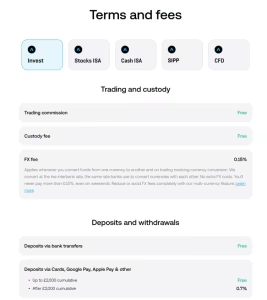
Trading 212’s official account pricing showing commission-free dealing alongside the 0.15% foreign-exchange charge.
2. Why Does Trading 212 Charge a 0.7% Deposit Fee?
Another disadvantage involves certain account-funding methods.
Trading 212 provides a cumulative fee-free allowance of £2,000 for qualifying card and other supported payment deposits into Invest and relevant ISA accounts.
After the allowance is exhausted, a 0.7% charge generally applies to further deposits using those methods.
Bank transfers and instant bank transfers remain free from Trading 212’s deposit charge.
For illustration:
| Additional deposit after allowance is used | Applicable fee | Deposit cost |
| £500 | 0.7% | £3.50 |
| £1,000 | 0.7% | £7.00 |
| £2,500 | 0.7% | £17.50 |
| £5,000 | 0.7% | £35.00 |
| £10,000 | 0.7% | £70.00 |
These amounts assume the full £2,000 fee-free allowance has already been used.
Our financial assessment suggests this charge is avoidable rather than an unavoidable reason to reject the platform.
Investors making regular deposits should compare available payment methods before funding their accounts.
One important distinction is that Cash ISA funding uses bank transfers rather than card deposits, so the card-deposit example should not be applied indiscriminately to every Trading 212 account.
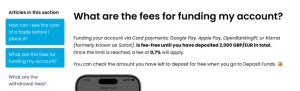
Official Trading 212 deposit-fee explanation showing the £2,000 cumulative free allowance and subsequent 0.7% charge.
3. Why Is Trading 212 CFD Trading Particularly Risky?
CFD trading is among the strongest reasons investors should be cautious about Trading 212.
A contract for difference, or CFD, is a financial derivative allowing traders to speculate on changes in an asset’s price without owning the underlying asset.
Unlike ordinary share investing, CFDs can involve leverage.
This means traders may control positions substantially larger than the cash committed.
Trading 212’s current Help Centre risk warning states that 77% of retail investor accounts lose money when trading CFDs with the provider.
This percentage applies to CFD accounts, not to everyone investing through Trading 212’s standard Invest or ISA accounts.
How Does Leverage Increase Financial Risk?
Suppose a trader opens a £5,000 position using £1,000 of available capital.
If the underlying position falls by 10%, the loss would be approximately £500 before trading costs.
That represents:
- 10% of the total market position.
- 50% of the trader’s original £1,000 capital.
The example illustrates how leverage can magnify losses relative to the amount committed.
Actual CFD exposure depends on the leverage ratio, margin requirements, position size and applicable safeguards.
CFD traders can also incur overnight financing charges, bid-ask spreads and other instrument-specific costs.
A position can be automatically closed when available margin becomes insufficient.
Financial reviewer Elizabeth Anderson, discussing Trading 212’s CFD offering, wrote:
The CFD products are the part that gives me pause
Her concern reflects an important distinction between purchasing investments outright and trading leveraged derivatives.
Our assessment is that inexperienced investors should not view CFDs as interchangeable with traditional shares or ETFs.
For most people building long-term wealth, maintaining a diversified investment portfolio is a fundamentally different activity from short-term leveraged speculation.
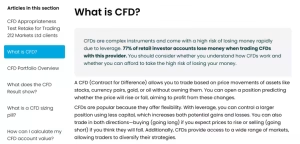
Trading 212’s official CFD risk warning showing the percentage of retail accounts losing money.
4. Is Trading 212 Safe, or Could Investors Lose Their Money?
Trading 212 is regulated in the UK, but regulation does not eliminate financial risk.
Trading 212 UK Ltd is authorised and regulated by the Financial Conduct Authority under firm reference number 609146.
This means the company operates within a regulated framework covering relevant conduct, safeguarding and operational obligations.
However, investors must distinguish between three separate risks: market losses, failure of a bank holding eligible deposits, and failure of an investment firm.
What Does FSCS Protection Actually Cover?
| Situation | Relevant protection | Important limitation |
| Eligible cash deposits at a UK-authorised partner bank | Up to £120,000 per eligible person, per banking licence | Shared with other eligible deposits under that licence |
| Eligible claim following investment-firm failure and unrecovered assets | Up to £85,000 per eligible person, per firm | Compensation depends on the circumstances and eligibility |
| Cash held in qualifying money market funds | Not ordinary bank-deposit protection | Fund value and liquidity can be affected |
| Ordinary share-market decline | No FSCS reimbursement for investment losses | Investor bears market risk |
| CFD trading losses | No protection from ordinary market losses | Leverage can amplify losses |
The UK standard deposit-protection limit increased from £85,000 to £120,000 on 1 December 2025. The ordinary investment-protection limit did not increase alongside it.
This is an important distinction because older articles may incorrectly describe every Trading 212 account as having the same £85,000 protection limit.
Why Do Qualifying Money Market Funds Matter?
Depending on account type and settings, Trading 212 may hold uninvested cash in partner banks or qualifying money market funds, commonly called QMMFs.
QMMFs generally invest in short-term, relatively low-risk financial instruments.
However, they are investment funds rather than ordinary bank savings accounts.
Their value can potentially decline, and exceptional market conditions can affect liquidity.
Trading 212 states that uninvested SIPP cash is held in banks rather than QMMFs.
Its Cash ISA also operates differently from cash balances invested in QMMFs within investment accounts.
Our view is that customers should understand precisely where their uninvested money is held instead of assuming every cash balance receives identical protection.
Readers considering the savings product separately can examine whether Trading 212’s Cash ISA is safe, including the differences between banking protection and investment risk.
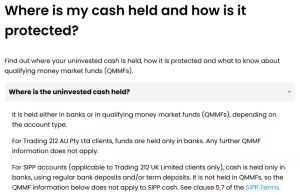
Trading 212’s official explanation of bank-deposit protection, investment compensation and qualifying money market funds.
5. Why Can Trading 212 Be Difficult for Investors Who Want to Transfer Their Shares?
Portfolio portability is another area where investors should examine the details carefully.
Trading 212 supports qualifying cash transfers and in-specie transfers, meaning eligible investments can be moved to another provider without necessarily selling them.
Therefore, it would be inaccurate to claim that Trading 212 never permits share transfers.
However, restrictions remain.
For outgoing Stocks and Shares ISA transfers, moving investments in specie requires the entire ISA portfolio to be transferred. Partial outgoing ISA transfers must instead be completed in cash.
Fractional shares also cannot be transferred directly to another broker.
For example, someone holding 10.5 shares may be able to transfer 10 whole shares but would generally need to sell the remaining 0.5 share.
This can create additional transactions, potential currency-conversion costs and possible tax implications outside an ISA.
Other restrictions depend on whether the receiving provider supports the assets being transferred.
Our assessment: Transfer limitations become particularly relevant when a portfolio grows beyond a simple collection of widely traded shares and ETFs.
An investor planning to consolidate several accounts, change provider or pursue a more complex retirement strategy should review transfer rules before accumulating significant holdings.
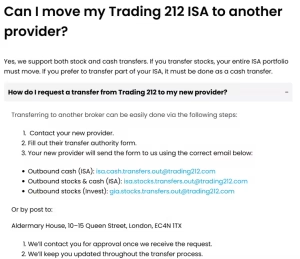
Trading 212’s official explanation of outgoing ISA transfers and the restrictions affecting partial portfolio transfers.
6. Why Does Trading 212 Have Limited Investment Options?
Trading 212 provides access to a substantial selection of listed securities.
Its available investment categories include ordinary shares, preferred shares, ETFs, exchange-traded commodities, investment trusts and real estate investment trusts.
For investors who primarily want to purchase listed shares and ETFs, this range may be sufficient.
However, the platform does not provide the same conventional open-ended mutual fund selection or direct gilt and corporate bond dealing commonly associated with some full-service investment providers.
This can matter to investors seeking specialist asset allocation.
| Investment product | Trading 212 availability |
| UK-listed shares | Available |
| US-listed shares | Available |
| ETFs | Available |
| Investment trusts | Available |
| REITs | Available |
| Traditional open-ended mutual funds | Not generally available |
| Direct UK government gilt dealing | Not generally available |
| Direct individual corporate bond dealing | Not generally available |
| Junior ISA | Not currently offered |
| SIPP | Available for eligible UK customers |
Investors should distinguish direct bond ownership from accessing bond exposure through an ETF.
A bond ETF may provide exposure to a collection of bonds, but it does not behave identically to owning a specific individual bond to maturity.
Similarly, an ETF tracking an equity index is not necessarily a direct substitute for every actively managed mutual fund.
For people building straightforward portfolios, these limitations may have little significance.
For experienced investors seeking a wider range of assets and specialist account structures, they may be material.
7. Why Might Trading 212 Encourage Too Much Trading?
The Trading 212 interface makes buying and selling securities relatively straightforward.
Its accessible design can help beginners understand basic investment transactions.
However, convenience can also encourage investors to monitor short-term price movements excessively.
Frequent market notifications, stock-price changes and investment discussions may create pressure to react to daily volatility.
Investment writer Megan Thomas observed that this:
might lead you to trade more regularly than would benefit you
This is especially relevant to newer investors who have not established a clear long-term investment strategy.
A falling share price may prompt someone to sell prematurely, while a rapidly rising stock may encourage buying after much of the increase has already occurred.
Both decisions can be driven more by emotion than financial analysis.
Why Can Frequent Trading Reduce Returns?
Consider an investor who repeatedly buys and sells international shares.
Even if the dealing commission is zero, foreign-exchange charges can accumulate.
Frequent transactions also expose the investor to bid-ask spreads, timing decisions and potential tax obligations outside an ISA.
The more frequently an investor trades, the more important execution quality and behavioural discipline become.
Our assessment is that a low-cost trading platform should not automatically be treated as an invitation to trade more frequently.
Long-term investors may benefit from setting planned contribution dates, limiting unnecessary notifications and reviewing portfolios at predetermined intervals.
8. Why Is Trading 212 Customer Support a Concern?
Customer service is another frequently discussed limitation.
Trading 212 provides digital support channels, including in-app assistance and written communication.
However, it does not offer conventional telephone-based customer support comparable with some established financial institutions.
For straightforward issues, digital support may be convenient.
More complicated cases can involve account verification, transfer delays, transaction disputes or withdrawal restrictions.
These situations may require detailed documentation and repeated communication.
The absence of a straightforward telephone support option can be frustrating for customers who prefer immediate verbal clarification.
That said, individual customer complaints should not be treated as proof that every user experiences the same problems.
Online reviews are self-selected and may disproportionately reflect particularly positive or negative experiences.
What Should Investors Do If They Have a Serious Complaint?
Customers should first contact Trading 212 through its official support channels and explain the problem clearly.
They should retain transaction records, account statements, relevant screenshots and correspondence.
If a formal complaint remains unresolved, eligible UK customers may be able to refer it to the Financial Ombudsman Service.
For most investment-related complaints, a business generally has up to eight weeks to issue its response, although shorter time limits can apply to some payment-related complaints.
Our recommendation is to distinguish ordinary support enquiries from formal complaints and preserve written evidence throughout the process.
9. Why Can Share Lending Create Additional Risks?
Trading 212 offers eligible Invest account customers the option to earn interest through share lending.
Under this arrangement, qualifying securities may be lent to another market participant.
The borrower provides collateral, while the lender receives interest.
Trading 212 states that customers receive 50% of the lending interest it collects.
The arrangement may produce additional income, but it is not risk-free.
Potential concerns include counterparty exposure, changes in collateral values and restrictions on shareholder voting rights while shares are lent.
Trading 212 states that lent shares are supported by collateral worth at least 102% of their value, with adjustments made regularly.
Nevertheless, collateral reduces risk rather than eliminating every possible loss scenario.
Do Investors Lose Ownership or Voting Rights?
Investors remain beneficial owners of their economic interest in the lent shares, meaning they continue to participate in the underlying price movements.
However, they cannot exercise voting rights attached to those shares while they are on loan.
Dividend payments may also be received as manufactured dividends rather than ordinary company dividends, potentially creating different tax considerations in some circumstances.
Share lending is available only for eligible Invest accounts, not ordinary Stocks and Shares ISA holdings.
Customers can disable participation through the relevant share-lending settings.
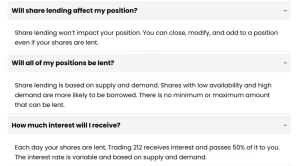
Trading 212’s explanation of share lending, the 50% interest-sharing arrangement and restrictions on voting rights.
10. Why Are Trading 212’s Research and Investment Tools Not Suitable for Everyone?
Trading 212 provides charts, basic company information, market data and tools that help customers manage investments.
These features may satisfy beginners and cost-conscious investors.
However, experienced investors may require a broader research environment.
Professional or advanced portfolio analysis can involve detailed financial forecasts, bond analytics, specialist screening, extensive historical datasets and portfolio-risk modelling.
Trading 212 does not necessarily provide the same level of research depth as a specialist investment platform.
The difference becomes important when investors begin analysing company valuations or constructing diversified portfolios across multiple asset classes.
An investor examining a company’s profitability, for example, may need to consider more than recent share-price performance.
Relevant factors include cash-flow generation, debt levels, valuation multiples, competitive advantages and earnings expectations.
Our assessment is that Trading 212 works better as a relatively straightforward investment-execution platform than as a complete replacement for independent financial research.
11. Why Can Trading 212 Pies and AutoInvest Be Misleading for Beginners?
Trading 212’s Pies feature allows investors to allocate money across selected shares or ETFs using target percentages.
AutoInvest can then support recurring contributions according to those allocations.
This makes automated investing more accessible.
However, automated allocation should not be confused with professional portfolio management.
Investors remain responsible for selecting appropriate investments and understanding their risks.
A Pie containing several technology companies may appear diversified because it holds multiple shares.
In practice, the investments could all be exposed to similar economic factors.
For example:
| Investment category | Example allocation |
| US technology shares | 50% |
| Semiconductor companies | 25% |
| Technology-focused ETF | 15% |
| Broad-market ETF | 10% |
| Total | 100% |
Although the portfolio has several holdings, its actual exposure may remain concentrated in technology-related businesses.
A broad-market ETF may also own some of the same companies held individually.
Another limitation is that Pies use the account’s primary currency. When the Pie purchases instruments denominated in other currencies, relevant FX conversion charges can still apply.
Our assessment is that automation can improve consistency, but it cannot correct unsuitable asset allocation.
12. Why Might Trading 212 Not Be the Best Platform for Long-Term Financial Planning?
Trading 212 can be useful for investors pursuing low-cost, long-term investing.
Its Stocks and Shares ISA and SIPP provide tax-efficient account options for eligible UK customers.
However, there are important limitations.
The platform does not currently offer every tax-advantaged investment account type available in the UK, including a Junior ISA or Lifetime ISA.
Its SIPP also has product-specific rules and restrictions that investors should examine before transferring substantial retirement savings.
For example, the platform does not currently facilitate transfers to a qualifying recognised overseas pension scheme.
Retirement investors should consider contribution limits, pension withdrawal rules, available investment products, beneficiary arrangements and access requirements.
Cash interest rates are another consideration.
Trading 212 announced that its SIPP uninvested-cash rate would change from 3.80% to 3.00% AER on 26 October 2026.
This demonstrates why savers should not assume that an attractive interest rate will remain unchanged.
Investors using ISAs must also monitor their overall tax-year contributions.
For the 2026/27 tax year, the general adult ISA subscription allowance is £20,000 across applicable ISA accounts.
Someone managing multiple providers may find the rules around holding two Cash ISAs with different providers particularly relevant.
For long-term financial planning, our analysis suggests that platform costs are only one part of the decision.
Tax efficiency, investment choice, withdrawal flexibility and the suitability of the underlying investments can ultimately matter more.
What Are the Biggest Hidden Costs of Trading 212?
We compared Trading 212’s core charges and the additional costs that investors may encounter.
| Cost category | Typical treatment | What investors should understand |
| Share-dealing commission | 0% for standard Invest/Stocks ISA dealing | Does not eliminate other trading costs |
| Custody charge | 0% | Product and third-party charges can still apply |
| FX conversion | 0.15% where applicable | Can apply to buying and selling |
| Qualifying card deposits | 0.7% after cumulative £2,000 allowance | Bank transfer can avoid the platform charge |
| Standard withdrawals | No Trading 212 withdrawal fee | Processing and verification can affect timing |
| UK stamp duty | Generally 0.5% on applicable UK share purchases | Government tax, not Trading 212 commission |
| ETF ongoing charges | Vary by ETF | Reflected in underlying fund performance |
| CFD spreads | Variable | Can widen during volatility |
| CFD overnight financing | Depends on instrument and position | Important for leveraged positions held overnight |
| Share transfers | No Trading 212 transfer fee | Receiving-provider restrictions and other costs may apply |
The distinction between platform fees and underlying investment costs is especially important.
An ETF charging an ongoing annual expense of 0.20%, for example, does not become free simply because Trading 212 charges no dealing commission.
Likewise, bid-ask spreads can affect the effective price received when buying or selling securities.
Investors should therefore compare total expected investment costs rather than relying exclusively on headline platform pricing.
Why Do Some Investors Experience Problems With Trading 212 Withdrawals?
Withdrawal concerns are often raised when users cannot immediately transfer their full displayed account balance.
However, several different factors can explain the delay.
For example, money may still be invested in securities rather than available as withdrawable cash.
A recently completed share sale may not yet have settled.
Customers may also have cash allocated within a Pie or require additional verification of their payment methods.
These situations are operational issues rather than automatic evidence that a platform is withholding money improperly.
Trading 212 does not ordinarily impose a standard withdrawal fee.
Nonetheless, the time required to complete a withdrawal can vary according to settlement, account verification and receiving-bank processing.
Investors experiencing problems can follow the detailed Trading 212 withdrawal process to understand the steps, possible restrictions and ways to resolve unsuccessful payments.
Our assessment is that customers should avoid treating invested portfolio value as instantly available cash.
Is Trading 212 a Scam or a Legitimate Investment Platform?
Trading 212 is not reasonably described as a scam simply because investors report complaints or experience financial losses.
Trading 212 UK Ltd is an FCA-authorised investment firm.
Its regulatory status can be independently checked through the Financial Services Register.
However, regulatory authorisation should never be interpreted as a guarantee of investment returns.
A legitimate investment provider can offer products that carry substantial financial risk.
It is equally important to distinguish the genuine platform from fraudulent advertisements, impersonation accounts or scammers using its name.
Investors should verify they are using official websites and applications before making deposits or sharing personal information.
Anyone receiving unexpected requests for bank transfers, passwords or account verification should independently confirm the request through the provider’s genuine communication channels.
How Does Trading 212 Compare With Traditional UK Investment Platforms?
Trading 212’s greatest advantage is its low-cost structure.
Traditional providers may charge annual platform fees, dealing commissions or higher foreign-exchange margins.
However, some competing platforms offer services that Trading 212 does not, including wider fund ranges, specialist retirement options or telephone assistance.
| Comparison factor | Trading 212 | Some traditional investment platforms |
| Standard share-dealing commission | Free | May charge per trade |
| Annual platform fee | Generally none on core investing accounts | Often percentage-based or fixed |
| Foreign-exchange charges | 0.15% on applicable Invest/ISA conversions | Varies considerably |
| Conventional mutual funds | Limited/not generally offered | Often available |
| Fractional shares | Available | Depends on provider |
| Junior ISA | Not available | Available from some |
| SIPP | Available | Available from many |
| Specialist research | Comparatively limited | May offer more extensive tools |
| Telephone support | Not conventional support channel | Available from some |
| CFD products | Available separately | Not offered by every provider |
The comparison demonstrates why selecting an investment platform should involve more than comparing dealing fees.
A relatively expensive platform may provide additional facilities that are worthwhile for certain investors.
Conversely, investors with straightforward requirements may gain little benefit from paying for services they rarely use.
What Is Our Trading 212 Rating in 2026?
Based on the product features, current published terms and limitations examined, we have assigned the following editorial suitability scores.
These are our analytical ratings, not customer-survey results or measured probabilities of success. Each percentage represents our assessment of suitability for the stated purpose.
| Assessment category | Our editorial rating | Main reasoning |
| Low-cost share investing | 94% | No standard dealing commission or platform fee |
| Beginner accessibility | 85% | Accessible interface and low investment minimums |
| Stocks and Shares ISA functionality | 84% | Competitive costs, but currency and asset limitations |
| Long-term ETF investing | 89% | Suitable for many straightforward strategies |
| Advanced investment research | 59% | Limited specialist analytical tools |
| Portfolio portability | 65% | Transfers supported but subject to restrictions |
| Customer support accessibility | 62% | Primarily digital support |
| Range of investment products | 70% | Strong listed-security selection, narrower fund options |
| CFD suitability for inexperienced investors | 12% | High leverage risk and substantial retail loss rate |
| Overall suitability for straightforward, non-leveraged investing | 84% | Strong value, with important functional limitations |
How we assessed the ratings: We considered disclosed fees, product range, investor accessibility, transfer rules, support channels and financial risks. The overall 84% is a qualitative editorial judgement, not an arithmetic average or a promise of performance.
Our main conclusion is that Trading 212 can be highly competitive for straightforward investing while remaining unsuitable for customers with more specialised requirements.
The platform’s CFD offering deserves particular caution and should not be included in the same suitability assessment as ordinary unleveraged ETF investing.
Who Should Avoid Trading 212?
Trading 212 may not be the most appropriate choice for every investor.
The following groups should assess its limitations especially carefully.
- Investors requiring telephone-based assistance: Customers who prefer direct conversations about complex financial issues may find digital-only communication inconvenient.
- People seeking conventional mutual funds or direct bond holdings: The investment range may not support their preferred portfolio strategy.
- Investors wanting a Junior ISA or Lifetime ISA: These account types are not currently available.
- Frequent international-share traders: Repeated foreign-exchange conversions can increase transaction costs, particularly where multi-currency functionality is unavailable.
- People uncomfortable with digital account verification: Automated checks and identity-verification requirements may sometimes delay account activity.
- Inexperienced CFD traders: Leveraged products can cause substantial losses and require a very different approach to risk management.
- Investors requiring specialist portfolio analytics: The platform may not offer the research depth required for complex strategies.
What Should Investors Do Before Opening a Trading 212 Account?
Our financial assessment suggests that prospective customers should review several practical considerations before investing.
- Choose the appropriate account type: Understand the differences between Invest, Stocks and Shares ISA, Cash ISA, SIPP and CFD products.
- Calculate all relevant transaction costs: Include foreign-exchange fees, underlying fund expenses and applicable taxes.
- Understand asset protection: Identify whether cash is held with a bank or in qualifying money market funds.
- Evaluate investment suitability: Consider whether the selected shares or ETFs match your risk tolerance and time horizon.
- Check future transfer requirements: Confirm that holdings can be transferred if you later change providers.
- Avoid unnecessary leverage: Do not assume CFD trading is equivalent to buying investments outright.
- Maintain accessible emergency savings: Money required for short-term expenses should not depend on selling volatile assets at an unfavourable price.
These checks can help investors avoid decisions based entirely on headline marketing or short-term investment trends.
Final Verdict: Why Is Trading 212 Bad, and Is It Still Worth Using?
So, why is Trading 212 bad?
Our analysis suggests that the platform’s disadvantages are primarily connected to product complexity, operational limitations and the risks investors may overlook when focusing on commission-free trading.
Its 0.15% foreign-exchange fee can accumulate, certain deposit methods attract charges after the free allowance, specialist investment products are limited, and moving a portfolio can involve restrictions.
The separate CFD business introduces a much higher level of financial risk, particularly for inexperienced traders.
However, it would be equally misleading to ignore Trading 212’s advantages.
For eligible UK customers, the platform offers commission-free share dealing, access to numerous listed investments, fractional investing, flexible ISA facilities and a competitively priced SIPP.
Our overall editorial suitability rating is 84% for straightforward, non-leveraged investing, but this rating should not be applied to CFD trading or used as a forecast of investment returns.
We believe the strongest approach is to judge Trading 212 according to individual financial objectives rather than its popularity or low headline fees.
For investors who understand the limitations and need a simple, cost-effective platform, Trading 212 can be a reasonable option.
For those requiring extensive research, specialist investment products, complex retirement services or greater support flexibility, another provider may be more suitable.
Ultimately, the most important question is not whether Trading 212 is good or bad for everyone. It is whether the platform offers the right combination of costs, protections, products and practical features for the investor’s needs.
Frequently Asked Questions
Why Is Trading 212 Bad for Beginners?
Trading 212 is not necessarily bad for beginners, but its easy-to-use interface can encourage excessive trading. Beginners also need to understand investment risk, foreign-exchange charges and the significant differences between shares and CFDs.
Is Trading 212 Safe for Large Amounts of Money?
Trading 212 is FCA-regulated, and eligible customer assets benefit from applicable safeguarding arrangements. However, compensation depends on the type of asset, the institution involved and the circumstances of a failure. Large balances require careful consideration of concentration, custody and investment risk.
Can You Lose All Your Money on Trading 212?
Investments can lose substantial value, and an individual share could become worthless. Leveraged CFDs can create particularly rapid losses. Diversification can reduce certain risks but cannot guarantee that an investment portfolio will retain its value.
Does Trading 212 Have Hidden Fees?
Its core charges are publicly disclosed, so describing them as deliberately hidden would be misleading. Nevertheless, investors may overlook FX fees, qualifying deposit charges, spreads, government taxes and underlying fund expenses.
Is Trading 212 Worse Than Other Investment Apps?
Not necessarily. Trading 212 is competitive on standard dealing costs. However, other investment providers may offer broader asset choices, different account types, specialist research or additional customer-service channels.
Why Do Investors Complain About Trading 212?
Publicly reported concerns include account verification, transfer administration, withdrawal timing, customer support and investment losses. Individual complaints should be evaluated on their specific circumstances rather than assumed to represent every customer’s experience.
Can Trading 212 Sell My Shares Without Permission?
Trading 212 generally does not sell ordinary Invest holdings without authorisation. However, exceptional events, such as certain corporate actions, can require changes to holdings. Separate CFD accounts are also subject to automatic margin-closeout rules.
Is Trading 212 Good for Long-Term Investing?
It can be suitable for long-term investors seeking low-cost access to listed shares and ETFs. Suitability depends on investment selection, diversification, account structure and whether the investor needs services the platform does not provide.