
Disability Living Allowance (DLA) for children provides financial assistance to families looking after children with additional care or mobility needs. For the 2026/27 financial year, eligible children can receive between £30.30 and £194.60 per week, depending on the level of support they require.
The maximum award is equivalent to £778.40 every four weeks or £10,119.20 over 52 weeks. Families receiving DLA may also qualify for additional financial assistance through Universal Credit, Carer’s Allowance and other disability-related support.
For 2027, the government has announced a 3.5% increase in disability-related benefits, expected to take effect from 12 April 2027.
This could take the maximum child DLA award to approximately £201.41 per week before official rounding, although the final payment rates are still awaiting confirmation.
Our financial analysis examines current benefit rates, the April 2027 changes, how much families can receive annually and the additional support that may be available.
We also explain the financial considerations for working parents, self-employed carers and households receiving Universal Credit.
How Much Is DLA for a Child in 2026 and 2027?
DLA for children consists of two separate payments:
- Care component: Financial support for children who need substantially more attention, assistance or supervision than other children of the same age.
- Mobility component: Financial support for children who have serious difficulties walking or need additional guidance or supervision outdoors.
Children may qualify for either component or both. The award is based on their individual needs rather than the family’s income or savings.
DLA Care Component Rates
The care component has three payment levels.
| Care rate | Weekly 2025/26 | Weekly 2026/27 | Every 4 weeks 2026/27 |
| Lowest | £29.20 | £30.30 | £121.20 |
| Middle | £73.90 | £76.70 | £306.80 |
| Highest | £110.40 | £114.60 | £458.40 |
Children receiving the highest care rate may need substantial assistance during both the day and night.
DLA Mobility Component Rates
The mobility component has two payment levels.
| Mobility rate | Weekly 2025/26 | Weekly 2026/27 | Every 4 weeks 2026/27 |
| Lower | £29.20 | £30.30 | £121.20 |
| Higher | £77.05 | £80.00 | £320.00 |
The highest combined entitlement is £114.60 for care plus £80 for mobility, producing a total of £194.60 per week.
These are the confirmed figures published through the official government DLA rates.
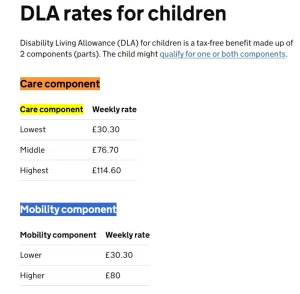
Official DLA care and mobility payment rates for 2026/27.
How Much Will DLA Increase in April 2027?
The government announced the 2027/28 benefits uprating on 28 October 2026.
In his parliamentary statement, Work and Pensions Secretary Pat McFadden confirmed a 3.5% increase for disability-related benefits, reflecting Consumer Prices Index inflation in the year to September 2026.
Most increases covered by the announcement are scheduled to take effect from 12 April 2027.
This follows an approximately 3.8% uprating applied to DLA rates in April 2026.
Estimated DLA Payment Rates for 2027/28
Using the announced 3.5% increase, we calculated the following illustrative figures.
| Component | Confirmed 2026/27 | Approximate 2027/28 projection |
| Lowest care | £30.30 | £31.36 |
| Middle care | £76.70 | £79.38 |
| Highest care | £114.60 | £118.61 |
| Lower mobility | £30.30 | £31.36 |
| Higher mobility | £80.00 | £82.80 |
| Maximum combined | £194.60 | £201.41 |
Important: The projected figures are mathematical illustrations of a 3.5% increase, not confirmed government rates. Actual weekly payments will depend on the official 2027/28 uprating tables and applicable rounding rules.
For a household receiving the maximum award, the increase would represent approximately £6.81 more per week, or £354.17 more over 52 weeks before rounding.
Our analysis suggests the 2027 uprating will provide some protection against rising household costs.
However, a 3.5% nominal increase does not guarantee that families will be financially better off in real terms. That depends on how quickly their actual expenses rise.
The official parliamentary statement on the 2027/28 benefits uprating explains the government’s decision.
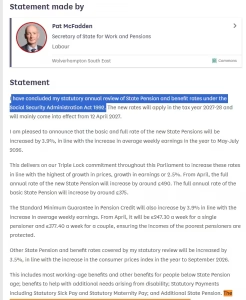
Government confirmation of the 3.5% increase in disability-related benefits for 2027/28.
How Much DLA Does a Child Receive Every Month and Year?
One aspect of DLA payments that families can misunderstand is the difference between four-weekly and monthly income.
DLA is normally paid every four weeks, rather than once per calendar month.
There are 13 four-week payment periods in a 52-week year, whereas there are 12 calendar months.
Our calculations below convert common awards into weekly, four-weekly and annual values.
| Example award | Weekly | Every 4 weeks | Annual (52 weeks) |
| Lowest care only | £30.30 | £121.20 | £1,575.60 |
| Middle care only | £76.70 | £306.80 | £3,988.40 |
| Highest care only | £114.60 | £458.40 | £5,959.20 |
| Middle care + lower mobility | £107.00 | £428.00 | £5,564.00 |
| Highest care + lower mobility | £144.90 | £579.60 | £7,534.80 |
| Highest care + higher mobility | £194.60 | £778.40 | £10,119.20 |
For example, a child receiving £194.60 weekly would have an average monthly equivalent of approximately £843.27.
However, the actual regular payment would normally remain £778.40 every four weeks.
Why Payment Frequency Matters for Budgeting?
Consider a household that spends an additional £150 per month on travel and £200 per month on specialist care and support.
Its additional monthly expenditure would be £350, equivalent to £4,200 annually.
If the child receives middle-rate care DLA alone, the annual payment is £3,988.40. That is approximately £211.60 less than the example’s annual costs.
This illustrates why calculating the annual entitlement is more useful than simply comparing the weekly payment with an average monthly bill.
Families can also check DWP bank holiday payment changes because benefit payment dates may move when they fall on public holidays.
Who Qualifies for DLA for a Child in 2027?
DLA eligibility is determined primarily by a child’s care and mobility difficulties.
For a claim in England or Wales, the child normally must:
- Be under 16.
- Have substantially greater care needs than another child of the same age without a disability, or have relevant mobility difficulties.
- Have experienced the qualifying difficulties for at least three months and be expected to continue experiencing them for at least another six months.
- Meet the applicable residence and presence conditions.
Special rules can apply to children nearing the end of life, including exceptions to the normal qualifying-period requirements.
Importantly, parents do not have to be unemployed to qualify. A child may receive DLA even when both parents work full-time.
Does a Child Need a Confirmed Diagnosis?
A diagnosis is not, by itself, the deciding factor.
Children with physical disabilities, learning disabilities, developmental conditions, mental health difficulties or long-term illnesses may qualify if they meet the relevant care or mobility criteria.
Conditions that may be associated with eligible needs include autism, ADHD, cerebral palsy, epilepsy, diabetes and substantial sensory impairments.
However, none of these diagnoses automatically guarantees DLA.
For example, a child with autism who requires extensive supervision to avoid danger may have eligible care needs even if they can communicate and attend mainstream school.
Similarly, a child with diabetes who requires substantially more supervision or assistance than other children of the same age may qualify, depending on the circumstances.
Our assessment of the eligibility rules highlights a critical distinction: the application should explain what additional assistance the child needs, how often it is needed and how it differs from ordinary age-related care.
What Are the DLA Care Rates Based On?
The amount awarded for care depends on the extent and timing of the child’s additional needs.
Lowest Care Rate — £30.30 Weekly
This is generally for children who require additional attention for a significant part of the day.
Examples may include assistance with eating, washing, dressing or other personal care tasks beyond what would ordinarily be expected for their age.
Middle Care Rate — £76.70 Weekly
Middle-rate care may be awarded where a child requires frequent attention or continual supervision during the day, or relevant attention or supervision during the night.
A child who needs repeated assistance during the day because of a medical condition may qualify.
Likewise, a child requiring significant nighttime attention or supervision may meet the criteria even if daytime needs are more limited.
Highest Care Rate — £114.60 Weekly
The highest care rate normally applies where a child meets the relevant care or supervision conditions during both the day and night.
Special rules also provide access to the highest care rate for eligible children nearing the end of life.
The difference between middle and highest care rates is £37.90 per week in 2026/27, equivalent to £1,970.80 over 52 weeks.
This is a significant financial difference. Families should therefore describe nighttime care needs accurately rather than focusing only on daytime activities.
How Much Mobility DLA Can a Child Get?
Mobility DLA supports children who experience qualifying difficulties getting around.
The payment depends on both the child’s age and their mobility needs.
| Child’s age | Care component | Mobility component |
| Under 3 | Potentially eligible | Generally not yet eligible |
| Age 3–4 | Potentially eligible | Higher rate may be available |
| Age 5–15 | Potentially eligible | Lower or higher rate may be available |
| Age 16+ | Transition to the relevant adult benefit | Child DLA transition rules apply |
The higher mobility rate becomes available from age three, while the lower mobility rate normally starts from age five.
A child receiving the higher mobility component may also qualify for additional assistance, such as the Motability Scheme, subject to scheme requirements.
Eligibility is not determined solely by whether a child uses a wheelchair. Certain severe visual, physical or mental impairments can also meet the relevant statutory conditions.
Does DLA Affect Parents’ Income, Savings or Employment?
DLA for children is a non-means-tested benefit.
This means the child’s entitlement does not depend on the parents’ salary, business profits or savings.
For example, consider two households with children who have equivalent eligible care needs.
| Financial circumstance | Household A | Household B |
| Annual parental employment or business income | £25,000 | £75,000 |
| Household savings | £2,000 | £30,000 |
| Child’s eligible DLA care rate | Middle | Middle |
| Weekly DLA entitlement | £76.70 | £76.70 |
These illustrative households could receive the same DLA award despite their different financial circumstances.
Both would still have to meet the relevant eligibility requirements.
DLA is also tax-free, meaning that receiving the payment does not itself create an Income Tax liability.
This is particularly important for self-employed parents and business owners, who may experience considerable fluctuations in their earnings throughout the year.
However, other benefits that parents claim, such as Universal Credit or Carer’s Allowance, have their own financial eligibility rules.
Can Parents Receive Universal Credit and DLA Together?
Yes. A child receiving DLA may allow an eligible household to receive additional Universal Credit support.
For 2026/27, the disabled child additions are:
| Universal Credit addition | Monthly amount |
| Lower disabled child addition | £164.79 |
| Higher disabled child addition | £514.71 |
The higher addition generally applies where the child receives the highest DLA care rate or meets certain blindness or severe sight impairment criteria.
The lower addition may apply where the child receives another qualifying DLA rate.
This additional support is separate from the child’s DLA payment, although Universal Credit remains subject to household eligibility, earnings and savings rules.
Example: Combining DLA and Universal Credit
Consider a household where a child receives the highest care and higher mobility components.
Its payments could include:
| Support | Average monthly equivalent |
| Child DLA at maximum 2026/27 rates | £843.27 |
| Higher Universal Credit disabled child addition | £514.71 |
| Potential UC carer element | £209.34 |
| Total of these components | £1,567.32 |
This calculation assumes the household qualifies for both Universal Credit additions in full. It is not a guaranteed payment or a calculation of the household’s complete UC award.
The standard Universal Credit allowance, ordinary child element, earnings adjustments and other applicable amounts have not been included.
The carer element is also subject to its own eligibility conditions.
Families already receiving Universal Credit should report a DLA award promptly rather than assuming the additional element will appear automatically.
Anyone experiencing problems with an award can check the Universal Credit contact number and the available account-journal options.
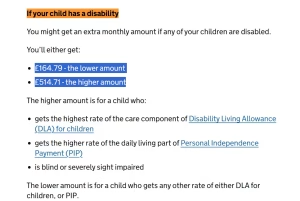
Universal Credit additional payments for disabled children in 2026/27.
How Much Carer’s Allowance Can Parents Receive?
Parents who spend at least 35 hours per week caring for a qualifying disabled child may be entitled to Carer’s Allowance.
The child generally needs to receive the middle or highest care component of DLA.
For 2026/27, Carer’s Allowance is £86.45 per week.
That is equivalent to £4,495.40 over 52 weeks.
Other eligibility conditions apply, including an earnings limit of £204 per week after tax, National Insurance and allowable expenses.
What Should Self-Employed Parents Consider?
A self-employed parent can potentially qualify for Carer’s Allowance.
However, earnings from self-employment are assessed under Carer’s Allowance rules, with specified expenses and deductions taken into account.
A parent whose income changes from month to month should not assume that being below the earnings limit during one quiet trading period guarantees continued entitlement.
This is particularly relevant to freelancers, contractors and business owners who combine caring responsibilities with irregular working hours.
A key distinction is that child DLA is not means-tested, but Carer’s Allowance is subject to an earnings test.
Parents should also be aware that Carer’s Allowance is generally deducted pound for pound from Universal Credit.
As a result, it would be misleading to simply add the full Carer’s Allowance payment to the Universal Credit amount in the earlier example.
Some households may instead qualify for the Universal Credit carer element, which is £209.34 per month in 2026/27, without receiving Carer’s Allowance.
Can DLA Help Families Receive Other Financial Support?
A successful DLA award can have a wider financial effect beyond the direct payment.
Our analysis identifies several forms of support worth checking.
| Additional support | Potential relevance |
| Universal Credit disabled child addition | Extra monthly support for eligible households |
| Carer’s Allowance | Support for qualifying carers providing at least 35 hours of care |
| Universal Credit carer element | Additional amount for eligible carers |
| Benefit cap exemption | Households including a child receiving DLA are generally exempt from the benefit cap |
| Motability Scheme | Possible access where the child receives the higher mobility rate and meets scheme conditions |
| Council Tax reductions | Disability-related reductions or means-tested local Council Tax support may apply |
| Blue Badge | Possible eligibility depending on the child’s award and circumstances |
| Local authority assistance | Support may be available through disability services and local schemes |
Families facing an essential one-off expense could also check whether they qualify for a Universal Credit Budgeting Advance.
Unlike DLA, a Budgeting Advance is repayable and is not a permanent increase in benefit income.
The most financially significant point is that a DLA decision may change more than one part of a household’s benefit entitlement.
For that reason, families should review the entire benefit position after receiving an award.
How Can Parents Apply for Child DLA in 2027?
Applications in England and Wales are handled through the Department for Work and Pensions.
The current process allows parents or people looking after the child as a parent to request a paper claim pack or download and print a claim form.
Step 1: Request the DLA Application Form
Parents can contact the DLA helpline on 0800 121 4600 to request a claim pack.
They can also obtain the relevant form through the official GOV.UK DLA for children service.
The method used to start a claim matters.
DLA cannot normally be backdated to a period before the claim begins. However, when a form is requested by telephone and returned within six weeks, the claim can start from the telephone request date.
For downloaded forms, the claim generally starts when the completed form is received.
Families should therefore avoid delaying the initial claim unnecessarily.
Step 2: Explain the Child’s Daily Needs
The application should describe how the child’s condition affects everyday activities.
Important information can include:
- How often the child needs assistance with personal care.
- Whether supervision is required to prevent accidents or harm.
- How many times parents or carers need to assist during the night.
- Whether the child needs help with medication or medical treatment.
- The extent of walking difficulties or additional outdoor supervision.
- How the child’s needs differ from those of another child of the same age.
A diary covering a representative period can help identify recurring needs and explain circumstances that may not be obvious during a medical appointment.
Step 3: Provide Relevant Evidence
Useful documents may include medical letters, therapy reports, school support records and care plans.
Evidence from a teacher, specialist nurse, occupational therapist or other professional familiar with the child’s needs may also help explain the practical difficulties.
A diagnosis letter alone may not fully demonstrate the level of additional care required.
Families should keep a copy of the application and any supporting evidence.
Step 4: Review the Decision
Once a decision is made, DWP will explain the components and rates awarded.
If the family disagrees, they can normally request mandatory reconsideration within one month of the decision date.
A later request may sometimes be accepted where there is a good reason for the delay.
Parents who need assistance can find the DLA contact number and information about making enquiries.
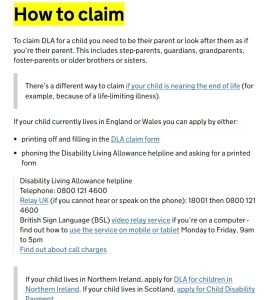
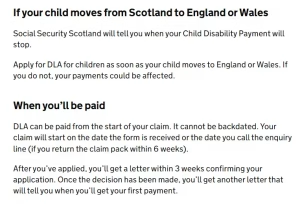
Official instructions for applying for Disability Living Allowance for a child.
Is DLA for a Child Backdated?
DLA cannot normally be backdated to a date before the claim starts.
However, there is an important distinction between backdating and receiving arrears.
If a family makes a valid claim and DWP takes time to decide it, the first payment may include money covering the period from the entitlement start date.
For example, if an award begins on 1 September and is not decided until 1 November, the family may receive an arrears payment covering the eligible period.
That does not mean the claim has been backdated to a time before 1 September.
Parents should also understand that PIP back payments follow a different benefit’s rules and should not be confused with child DLA.
What Happens to DLA When a Child Turns 16?
In England and Wales, children receiving DLA are generally invited to apply for Personal Independence Payment (PIP) when they turn 16.
PIP uses different eligibility and assessment criteria.
A child who previously qualified for the highest rate of DLA care does not automatically receive the enhanced daily living rate of PIP.
DWP normally sends a letter explaining the transition.
If the young person applies for PIP by the deadline provided, their DLA can continue while the PIP application is assessed.
Missing the deadline may interrupt payments.
Families preparing for the transition should also review the rules concerning when Child Benefit stops, because Child Benefit has different age and education requirements.
Is Child DLA Different in Scotland and Northern Ireland?
Yes. The administration of disability benefits differs across the UK.
| Country | Benefit for eligible children |
| England | Disability Living Allowance for children |
| Wales | Disability Living Allowance for children |
| Scotland | Child Disability Payment |
| Northern Ireland | Disability Living Allowance for children through the Northern Ireland system |
Scotland’s Child Disability Payment replaces DLA for children living in Scotland and is administered by Social Security Scotland.
Although the payment structures and rates can be similar, Scottish legislation and administrative procedures apply.
Northern Ireland maintains its own DLA arrangements.
Parents should therefore check the rules that apply where their child lives rather than assuming every UK benefit process is identical.
How Should Families Budget Their Child’s DLA Payments in 2027?
DLA is intended to help with the additional costs arising from a child’s disability or health condition.
However, families are not generally required to assign every payment to a specific expense category.
Our financial assessment suggests that planning around the actual additional costs is more useful than treating DLA as ordinary disposable income.
Consider an illustrative family receiving middle-rate care DLA and lower-rate mobility DLA.
Its 2026/27 entitlement would be £107 per week, equivalent to £5,564 annually.
The household estimates the following annual additional costs:
| Additional expense | Illustrative annual cost |
| Transport to appointments | £1,200 |
| Specialist clothing and supplies | £850 |
| Additional care and support | £1,800 |
| Therapy-related travel and activities | £900 |
| Additional household expenses | £600 |
| Total | £5,350 |
The DLA award in this scenario exceeds the estimated additional costs by £214 annually.
That leaves relatively little flexibility if expenses rise.
These costs are hypothetical and do not represent a surveyed family’s spending or an official estimate.
What Does a 3.5% Increase Mean for the Family Budget?
If the household’s DLA entitlement rises by approximately 3.5% in April 2027, the illustrated annual benefit amount would increase from £5,564 to around £5,758.74, before official rate rounding.
That represents approximately £194.74 in additional annual support.
However, if the household’s disability-related expenditure increases by 5%, its annual costs would rise from £5,350 to £5,617.50.
The extra expenditure would be £267.50, exceeding the illustrative benefit increase by £72.76.
This demonstrates an important financial principle: a rise in benefit payments does not necessarily mean an equivalent improvement in household spending power.
The relevant comparison is between the family’s actual cost inflation and its benefit increase.
What Are the Most Important DLA Changes Parents Should Know for 2027?
The major confirmed development is the government’s announcement of a 3.5% uprating in disability-related benefits.
Nevertheless, parents should distinguish that announcement from other rules that remain relevant.
The following points matter most:
- Higher payments are expected from April 2027: The exact component rates are subject to the final published tables.
- DLA remains based on care and mobility needs: Family income and savings do not determine the child’s award.
- The age restrictions still matter: Higher mobility may be available from age three and lower mobility from age five.
- A successful award may unlock additional assistance: Universal Credit additions and carers’ benefits can be financially significant.
- DLA does not normally replace PIP after age 16 in England and Wales: Parents must follow the transition process.
- Benefit interactions require careful calculation: In particular, Carer’s Allowance can reduce Universal Credit payments.
Families whose child’s needs have changed should also check whether their existing award needs to be reviewed and report relevant changes.
Conclusion
DLA for a child currently ranges from £30.30 to £194.60 per week, with the maximum annual entitlement reaching £10,119.20 under the confirmed 2026/27 rates.
The government’s 3.5% uprating announcement means payments are expected to increase again in April 2027, although the exact new rates are still awaiting publication.
Our financial analysis shows that families should consider more than the headline DLA payment. Universal Credit additions, carers’ support and benefit cap exemptions can materially affect household finances.
Understanding eligibility, reviewing the complete benefit entitlement and planning for four-weekly payments can help parents manage the additional costs of supporting a disabled child.
Frequently Asked Questions
How much is the highest DLA for a child in 2027?
The confirmed maximum for 2026/27 is £194.60 per week. Applying the announced 3.5% increase produces an indicative maximum of approximately £201.41 per week for 2027/28, before official rounding.
How much DLA does a child with autism get?
There is no fixed payment for autism. An eligible child may receive care and mobility components based on the additional help and supervision they require, rather than their diagnosis alone.
Can a child receive both care and mobility DLA?
Yes. A child can receive both components if they meet the separate eligibility conditions, including the mobility age requirements. The maximum combined 2026/27 award is £194.60 weekly.
Is DLA paid weekly or monthly?
DLA is usually paid every four weeks on a Tuesday. A child receiving the maximum 2026/27 award would normally receive £778.40 per four-week payment.
Can working parents claim DLA for a child?
Yes. DLA is not means-tested, so parental earnings, savings and employment status do not determine entitlement. Other benefits claimed by the parents may have separate financial rules.
Can DLA increase Universal Credit payments?
Yes. A qualifying DLA award may make a household eligible for a disabled child addition of £164.79 or £514.71 per month at 2026/27 rates, depending on the relevant eligibility criteria.
Will a child continue receiving DLA after turning 16?
In England and Wales, a young person is generally invited to apply for PIP. If they apply by the deadline stated in the letter, DLA can continue while their PIP claim is assessed.