Credit cards are often promoted as convenient financial tools that provide flexibility, purchase protection and rewards. However, their benefits can quickly disappear when borrowing becomes difficult to control.
High interest rates, minimum repayment traps, additional fees and the temptation to overspend can turn an ordinary shopping decision into a long-term financial commitment.
So, why is a credit card bad for some people but useful for others?
The difference largely comes down to repayment behaviour, affordability and how the card is used.
A person who spends £500 and repays the full statement balance every month may pay no purchase interest. Meanwhile, someone who carries a £2,000 balance, makes small repayments and continues borrowing could spend years paying interest.
The financial consequences are substantial.
The Financial Conduct Authority’s Financial Lives 2024 survey, published in May 2025, estimated that 10.1 million UK adults revolved a credit card balance, equivalent to 19% of UK adults.
It also found that approximately 2.8 million adults experienced persistent credit card debt.
Our assessment is that credit cards become most dangerous when they are used to replace income, finance recurring living expenses or support spending that cannot realistically be repaid.
This article examines the disadvantages of credit cards, the real cost of borrowing, the risks for business owners and the circumstances in which avoiding a credit card may be the better financial decision.
Why Are Credit Cards Considered Bad?
Credit cards are considered bad because they allow consumers to borrow money repeatedly without requiring the full outstanding balance to be repaid each month.
Unlike a traditional personal loan with a fixed repayment schedule, most credit cards operate as revolving credit facilities.
When customers repay part of their balance, that amount usually becomes available to borrow again.
While this flexibility is useful, it creates three financial risks:
- Borrowers can repeatedly spend money they have not yet earned.
- Interest can accumulate when balances are not cleared.
- Small minimum payments can make long-term debt appear affordable.
A credit card with a £5,000 limit does not mean its holder has an additional £5,000 of disposable income. It represents potential debt.
Our financial assessment suggests that the biggest mistake is treating available credit as money already owned rather than a liability that must eventually be repaid.
What Does the UK Data Show?
The FCA’s Financial Lives 2024 survey provides a detailed picture of credit card borrowing.
| UK credit card statistic | FCA findings |
| Adults who had used a credit card or carried an outstanding balance during the previous 12 months | 33.4 million |
| Adults revolving a credit card balance | 10.1 million |
| Percentage of all UK adults revolving a balance | 19% |
| Active credit card users/balance holders who revolved a balance | 31% |
| UK adults in persistent credit card debt | 2.8 million |
| Percentage of UK adults in persistent credit card debt | 5% |
These figures describe the survey’s 2024 findings, not a new measurement of the population in 2026.
The findings highlight the difference between holding a credit card and experiencing financial problems because of one. A credit card is not automatically harmful, but revolving expensive debt can create lasting financial difficulties.
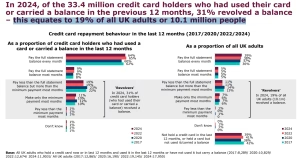
FCA Financial Lives 2024 survey, page 42 – Credit card repayment behaviour, showing that 31% of relevant credit card holders revolved a balance.
What Are the 12 Biggest Disadvantages of Credit Cards?
1. High Interest Rates Make Borrowing Expensive
One of the biggest disadvantages of a credit card is the interest charged when consumers carry unpaid balances outside any applicable interest-free arrangement.
Different credit cards charge different rates.
Mainstream cards, credit-building products and specialist cards for people with weak credit histories may have significantly different borrowing costs.
Consider an illustrative credit card balance of £2,000.
If we use a 24.9% annual interest rate, simplified to a monthly rate of 24.9% divided by 12, the first month’s interest would be approximately £41.50.
A borrower paying £50 that month would reduce the balance by only around £8.50 before considering any additional charges.
That is why the advertised minimum payment is not necessarily a sensible debt repayment target.
Our analysis of Zable credit card products also illustrates why a card aimed at building credit should not automatically be treated as inexpensive borrowing.
High-interest credit cards can still serve a purpose when balances are repaid in full, but carrying substantial debt can make them costly.
2. Minimum Payments Can Keep People in Debt for Years
Minimum repayments are designed to keep an account compliant with its contractual payment requirements. They are not necessarily designed to clear the outstanding balance quickly.
For example, MoneyHelper explains that a £2,000 balance at 22% APR could take approximately 14 years to repay when only the minimum payment is made under its illustrated 2.5% repayment assumptions.
This is particularly concerning because minimum payments often decrease as balances fall.
The borrower may feel that the debt is becoming manageable while progress towards clearing it remains slow.
Our view is that consumers should judge a credit card by how quickly they can realistically repay the balance, rather than simply whether they can afford the minimum payment.
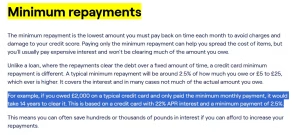
MoneyHelper’s explanation of how minimum credit card payments can extend a £2,000 debt over 14 years.
3. Credit Cards Encourage Overspending
Another major reason credit cards can be bad is that purchases may feel less immediate than payments made directly from a bank account.
Consumers see the product they want now, while the repayment obligation arrives later.
This can make it easier to justify purchases that would otherwise exceed a monthly budget.
For example, consider someone earning £2,500 a month after tax.
They spend:
| Monthly spending | Amount |
| Rent and household bills | £1,100 |
| Groceries and transport | £500 |
| Other essential commitments | £400 |
| Available after essential commitments | £500 |
| Additional credit card purchases | £750 |
| Shortfall against available income | £250 |
If the additional £750 spending is treated as a new monthly expense, the person has committed £250 more than their remaining income can support.
Repeating that behaviour each month can steadily increase the credit card balance.
The financial problem is not necessarily the purchase itself. It is the mismatch between expenditure and repayment capacity.
4. Credit Cards Can Damage Credit Scores
Credit cards are not inherently bad for a credit score.
Making repayments on time, keeping debt manageable and maintaining a positive credit history can support a person’s creditworthiness.
However, difficulties can arise when users:
- Miss payment deadlines.
- Pay less than the required minimum.
- Maintain consistently high balances relative to their credit limits.
- Make several credit applications within a short period.
- Default on their borrowing.
A missed payment can remain visible on a UK credit report for six years, although its impact may reduce over time.
This can influence future lending decisions involving mortgages, personal loans and other credit facilities.
Consumers with past borrowing difficulties should understand their financial position before applying for additional products. Our examination of loans for bad credit considers why affordability and total repayment costs matter as much as approval.
An important distinction: There is no universal rule that keeping credit utilisation below exactly 30% guarantees a good credit score. Lenders consider a range of information, and their assessment methods vary.
5. Cash Withdrawals Can Be Particularly Expensive
Using a credit card to withdraw cash can be considerably more expensive than using it for ordinary purchases.
Card providers may charge:
- A cash withdrawal fee.
- Interest from the withdrawal date.
- A higher interest rate on cash transactions.
- Additional fees for overseas withdrawals or currency conversion.
For example, a card charging 3% for cash advances would apply a £6 fee to a £200 withdrawal, before interest and any other charges.
Some providers impose minimum cash-advance fees, making smaller withdrawals disproportionately expensive.
Unlike qualifying purchases, cash withdrawals commonly do not benefit from the same interest-free repayment period.
That is why withdrawing cash from a credit card should generally be avoided unless the customer understands the full cost and has a clear repayment plan.
6. Missed Payments Can Trigger Additional Charges
A missed payment can generate several financial consequences at once.
A provider may charge a late-payment fee, report the missed payment to credit reference agencies and withdraw an introductory promotional interest rate where the agreement permits.
For example, a customer with a 0% promotional card could lose access to its most attractive feature if the contractual terms are breached.
This creates a risk for people managing several cards with different repayment dates.
A practical safeguard is to establish an affordable Direct Debit that covers at least the required minimum.
Customers can separately make additional repayments to reduce debt more quickly.
It is also important to understand how cancelling a Direct Debit works, because stopping an instruction to the bank does not cancel the underlying credit card repayment obligation.
7. Credit Card Debt Can Become a Long-Term Financial Burden
Credit card debt becomes particularly problematic when borrowers repeatedly move balances between accounts or use one source of credit to make repayments on another.
This behaviour may create the appearance of progress without reducing the total amount owed.
Balance transfer credit cards can provide genuine savings, but only when borrowers understand transfer fees, promotional deadlines and repayment requirements.
Consider a £3,000 balance transfer with an illustrative 3% fee.
| Calculation | Amount |
| Existing debt | £3,000 |
| Transfer fee at 3% | £90 |
| Total to repay | £3,090 |
| Promotional period | 18 months |
| Monthly repayment needed to clear the balance | £171.67 |
This example assumes no new spending or interest during the promotional period.
If the borrower cannot realistically afford approximately £172 each month, the outstanding balance could remain when the 0% deal expires.
Comparing balance transfer credit cards can therefore help borrowers assess whether transferring debt genuinely improves affordability.
8. Promotional Offers Can Create a False Sense of Security
An introductory 0% interest offer may appear to make borrowing inexpensive.
However, it is important to distinguish temporary promotional pricing from the rate that applies afterwards.
Consumers can make three common mistakes.
First, they assume every transaction qualifies for the promotional rate.
Second, they make only the minimum repayments without calculating whether the balance will be cleared before the offer ends.
Third, they overlook transfer fees or other account charges.
A credit card advertising 0% interest is not necessarily free for every type of transaction.
Our assessment is that the most useful question is not how long the promotional offer lasts, but whether the borrower can clear the relevant debt before that period expires.
9. Multiple Credit Cards Can Make Budgeting Difficult
Having several credit cards is not automatically financially irresponsible.
However, multiple accounts create additional administration and can make borrowing harder to monitor.
For example, someone might have:
- £1,500 on a general spending card.
- £2,000 on a balance transfer card.
- £800 on a credit-building card.
- £700 on a travel card.
Their combined outstanding debt is £5,000.
If they focus only on the individual minimum payments, the full extent of their borrowing may not be immediately obvious.
A useful approach is to review all outstanding balances, interest rates, repayment dates and available credit limits together.
This provides a clearer picture of the financial commitment.
10. Credit Cards Can Reduce Future Borrowing Flexibility
Credit card borrowing can also affect decisions made by mortgage lenders and other financial institutions.
A borrower might make every payment on time but still have substantial existing credit commitments.
When assessing a mortgage application, lenders typically consider factors such as income, regular expenditure and outstanding debts.
A large credit card balance may reduce how much the applicant can afford to borrow.
The impact is not identical across lenders. Having an unused credit limit does not automatically prevent mortgage approval, and responsible credit card use may support a positive credit history.
Nevertheless, maintaining expensive revolving debt while preparing for a mortgage can complicate affordability assessments.
11. Credit Card Rewards May Not Justify the Costs
Cashback, reward points and travel benefits can make credit cards attractive.
However, a reward is valuable only when the benefit exceeds the cost of obtaining it.
Imagine a card providing 1% cashback on purchases.
A customer spending £1,000 earns £10 cashback.
If that person then pays £30 in interest and fees, the transaction has created a net cost of £20 rather than a financial benefit.
| Spending behaviour | Cashback | Interest and fees | Net result |
| £1,000 spending, paid in full | £10 | £0 | £10 benefit |
| £1,000 spending, £15 charges | £10 | £15 | £5 cost |
| £1,000 spending, £30 charges | £10 | £30 | £20 cost |
| £1,000 spending, £60 charges | £10 | £60 | £50 cost |
These are illustrative scenarios, not advertised card offers.
Reward schemes can be worthwhile for customers who avoid interest and account fees. They are much less attractive when spending generates ongoing finance charges.
12. Credit Cards Can Become a Substitute for Emergency Savings
Perhaps the most concerning disadvantage is relying on credit cards to cover essential expenses.
The FCA’s Financial Lives survey found that 31% of a specified group of credit card balance revolvers who had taken out their card in the previous three years identified everyday essentials as a main area of card spending.
Examples included food, transport and energy bills.
That does not mean every such borrower was financially irresponsible. Unexpected income reductions, household emergencies and rising living costs can make short-term borrowing difficult to avoid.
Alison Walters, the FCA’s Director of Consumer Finance, made this distinction in her August 2025 discussion of consumer credit:
“For some, credit isn’t about luxuries – it’s about getting by.”
This observation matters because a credit card cannot permanently resolve a household budget deficit.
If essential expenses consistently exceed income, the underlying issue is affordability rather than access to additional borrowing.
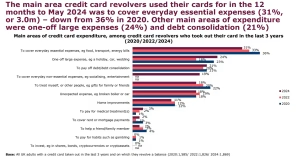
FCA Financial Lives 2024 survey, page 45 – Main uses of credit cards among surveyed balance revolvers, including 31% reporting everyday essential spending.
How Much Can Credit Card Debt Really Cost?
To understand why credit cards can become expensive, we calculated how different repayment amounts affect an illustrative £2,000 balance.
For consistency, the model assumes:
- An annual interest rate of 24.9%, applied as 24.9% divided by 12 each month.
- No additional transactions or fees.
- A fixed monthly repayment.
- Interest added monthly before repayment.
- A smaller final payment when the remaining debt is cleared.
| Monthly repayment | Approximate time to clear £2,000 | Total interest paid | Total repayment |
| £50 | 87 months | £2,314 | £4,314 |
| £100 | 27 months | £611 | £2,611 |
| £150 | 16 months | £366 | £2,366 |
| £250 | 9 months | £210 | £2,210 |
These calculations are illustrative. Actual credit card costs depend on the contractual interest rate, daily interest calculations, payment dates, fees and changes in the balance.
The difference is striking.
Increasing the monthly repayment from £50 to £150 reduces the modelled interest cost by approximately £1,948.
That is a reduction of about 84% in interest paid.
It also cuts the repayment period from more than seven years to approximately sixteen months.
From a personal-finance perspective, this demonstrates why making affordable payments above the minimum can produce substantial savings.
Are Credit Cards Bad for Business Owners and Entrepreneurs?
Credit cards present different risks for business owners because borrowing decisions can affect both operational cash flow and personal financial stability.
Small businesses sometimes experience gaps between supplier payment deadlines and customer receipts.
For example, a business might pay a £2,000 supplier invoice immediately but receive payment from its customer 45 days later.
A credit card could help bridge the short-term gap if the business can repay the balance affordably.
However, repeated use of expensive credit to fund operating expenses can create problems.
The Cash-Flow Problem
Suppose a small business uses a credit card to cover:
| Business expense | Monthly cost |
| Software subscriptions | £200 |
| Marketing | £400 |
| Equipment and supplies | £600 |
| Other operating costs | £300 |
| Total financed spending | £1,500 |
If the business repeatedly charges £1,500 while generating insufficient cash to repay earlier balances, debt can accumulate despite apparent business activity.
This is an important distinction between profitability and cash flow.
A business may record sales and still struggle to meet short-term repayment obligations.
Using a personal credit card introduces another risk: the individual remains responsible for the account under its terms, even when the purchases are intended for business purposes.
For entrepreneurs, maintaining appropriate separation between business and personal spending helps with financial control, bookkeeping and identifying the actual cost of operations.
Our review of business bank accounts explores account features that can support clearer financial management.
A business credit card can still be useful when employed for controlled expenses and settled promptly. It becomes risky when it is used as a permanent substitute for adequate working capital.
What Percentage Risk Do Different Credit Card Habits Carry?
Not every credit card holder faces the same degree of financial risk.
To illustrate that difference, we have assigned editorial risk ratings to common borrowing behaviours.
These scores are qualitative assessments, not measured probabilities of default or the findings of a customer survey. They use a 0–100 scale, with greater weight given to exposure to interest costs, repayment difficulties and affordability pressure.
| Credit card behaviour | Our editorial risk rating | Assessment |
| Paying the full statement balance every month | 10% | Low |
| Using a credit-building card for small, fully repaid purchases | 20% | Low |
| Using a planned 0% offer with a funded repayment schedule | 25% | Low to moderate |
| Occasionally carrying a balance | 50% | Moderate |
| Regularly using a card for discretionary purchases beyond budget | 75% | High |
| Making frequent cash withdrawals | 85% | Very high |
| Paying only the contractual minimum over a long period | 90% | Very high |
| Relying on revolving credit for essential costs without affordable repayments | 95% | Very high |
The ratings reflect our editorial assessment of the behaviours, not a scientific scoring model or actual loss percentages.
The critical variable is often how the cardholder repays the debt rather than the existence of the credit card itself.
For someone who already struggles with overspending, even a relatively low credit limit may represent a significant risk.
By contrast, someone with a stable budget who reliably repays in full may use a card without paying purchase interest.
Is a Debit Card Better Than a Credit Card?
Debit cards and credit cards serve different financial purposes.
Debit cards generally use money already available in the customer’s account, although an arranged or unarranged overdraft can still create borrowing costs.
Credit cards provide a separate borrowing facility.
| Feature | Debit card | Credit card |
| Source of spending | Bank account funds | Borrowed funds |
| Purchase interest | Normally none | May apply |
| Risk of building revolving card debt | No | Yes |
| Helps establish a credit repayment history | Generally no | Potentially |
| Section 75 protection | Generally not available | May apply to eligible purchases |
| Chargeback protection | May be available | May be available |
| Overspending beyond available funds | Generally restricted, subject to overdrafts | Possible within credit limit |
| Best suited to | Everyday budget-controlled spending | Managed borrowing and eligible protected purchases |
Credit cards have an important advantage under Section 75 of the Consumer Credit Act 1974.
Eligible purchases costing more than £100 and no more than £30,000 can receive protection where the supplier breaches the contract or misrepresents the transaction.
The protection can apply even where only part of the qualifying purchase is paid by credit card, provided the legal requirements are met.
Therefore, avoiding credit cards entirely is not automatically the best option for everyone.
Our discussion of the debit card warning considers why payment protection can be important for certain purchases.
For ordinary daily spending, a debit card may provide stronger spending discipline. For larger qualifying purchases, a credit card paid off in full can offer additional protection.
When Should You Avoid Getting a Credit Card?
The decision to apply for a credit card should depend on financial circumstances rather than promotional rewards or the size of the available credit limit.
A credit card may be unsuitable when:
- Essential household expenses already exceed regular income.
- Existing credit card balances are becoming difficult to repay.
- The proposed card will be used mainly to cover recurring living costs.
- There is no realistic plan for paying more than the minimum.
- The borrower frequently makes impulsive purchases.
- Several existing accounts have overdue payments.
- The applicant expects to use expensive cash advances regularly.
- Additional borrowing would put priority bills at risk.
It is also worth remembering that avoiding a credit card does not automatically solve an existing debt problem.
Someone already struggling financially may need a repayment arrangement, budget review or free professional debt advice rather than another credit product.
How Can You Use a Credit Card Without Falling Into Debt?
Credit cards do not need to be avoided in every circumstance.
For people who choose to use them, a disciplined repayment strategy can substantially reduce risk.
Pay the Statement Balance in Full Where Possible
Repaying qualifying purchases in full by the due date generally avoids purchase interest under the card’s interest-free terms.
If the full balance cannot be cleared, paying as much as is affordable above the minimum helps reduce borrowing costs.
Set a Realistic Spending Limit
A lender’s approved credit limit should not automatically become the customer’s personal spending budget.
Someone approved for £5,000 might choose to limit ordinary monthly spending to £300 if that is what they can comfortably repay.
Review Statements and Fees
Checking statements regularly helps identify fees, unexpected subscriptions and spending patterns that need attention.
It also ensures that customers understand when promotional rates end.
Avoid Cash Withdrawals
Credit card cash advances often involve interest and fees that make them more expensive than normal card purchases.
Use Repayment Reminders
A Direct Debit for at least the minimum payment, combined with additional affordable repayments, can help reduce the risk of missed deadlines.
However, the customer must ensure sufficient funds are available for the Direct Debit.
Avoid Unnecessary New Credit Applications
Applying for several cards in a short period can generate multiple hard credit searches.
Where available, soft-search eligibility tools can help applicants assess their chances before submitting a full application.
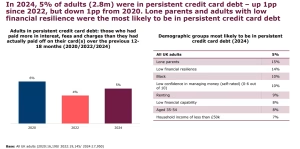
FCA Financial Lives 2024 survey, page 44 – The proportion of UK adults experiencing persistent credit card debt in 2020, 2022 and 2024.
What Are the Best Alternatives to Credit Cards?
The best alternative depends on why the person wants to borrow or make a payment.
| Alternative | Potential benefit | Main limitation |
| Debit card | Spending directly from available funds | Does not provide credit |
| Emergency savings | Avoids borrowing costs for unexpected expenses | Takes time to build |
| Personal loan | Fixed repayments and a defined repayment term | Interest applies and approval depends on affordability |
| Credit union loan | May offer an alternative to expensive credit | Eligibility, terms and availability vary |
| Budgeting and savings accounts | Helps organise spending and future purchases | Cannot fund immediate shortfalls |
| Free debt advice | Helps identify suitable solutions for unaffordable debt | Does not directly provide additional income |
Our financial assessment is that replacing high-cost borrowing with a structured, affordable repayment arrangement can be more beneficial than repeatedly opening new credit accounts.
However, debt consolidation and alternative loans should be assessed carefully. A lower monthly payment does not necessarily mean the total repayment will be lower, particularly if the borrowing term becomes longer.
Someone struggling to repay existing debt can contact a free debt advice organisation such as StepChange, National Debtline or Citizens Advice.
Priority expenses, including housing costs, utilities and essential living needs, should be considered before deciding how much can safely be paid towards unsecured credit card debt.
Can a Credit Card Ever Be a Good Financial Decision?
Yes. The disadvantages of credit cards should be weighed against their potential benefits.
A credit card can be useful for:
- Making qualifying purchases with Section 75 protection.
- Establishing a positive credit repayment history.
- Earning cashback without incurring interest or excessive fees.
- Managing planned short-term spending under affordable terms.
- Transferring expensive debt to a cheaper arrangement when suitable.
The key distinction is whether the cardholder is using the credit facility as a controlled financial tool or relying on it to fund an ongoing shortfall.
In our assessment, the best credit card strategy for many consumers is to spend only what they can afford and repay the full statement balance every month.
For someone who cannot confidently achieve that, avoiding additional borrowing may be the more sensible option.
Conclusion: Why Credit Cards Can Be Bad for Your Finances
Credit cards are not inherently bad, but they can become expensive and financially damaging when used without a realistic repayment strategy.
High interest rates, minimum repayments, missed-payment charges and ongoing borrowing can make small purchases cost significantly more over time.
The FCA’s findings show that persistent credit card debt remains a substantial issue among UK consumers.
Our overall conclusion is that credit cards are most useful when spending is controlled and repayment is affordable. People who consistently rely on borrowing to cover essential expenses may benefit more from budgeting support, alternative financial arrangements or free debt advice.
The important question is not simply whether a credit card is good or bad. It is whether the borrowing is affordable and genuinely improves the user’s financial position.
Frequently Asked Questions
Why is a credit card bad for your finances?
A credit card can be bad when interest, fees and repeated borrowing increase your debt. The risk is particularly high when you cannot afford to repay the outstanding balance.
Are credit cards bad for your credit score?
Not automatically. Responsible repayments may support creditworthiness, while missed payments, defaults and excessive borrowing can damage your credit profile.
What is the biggest disadvantage of a credit card?
High borrowing costs are among the biggest disadvantages. Paying only the minimum can make credit card debt last for many years.
Is it better to have a credit card or debit card?
A debit card is often useful for controlling everyday spending. A credit card can offer borrowing flexibility and stronger legal protection on eligible purchases, provided it is managed responsibly.
Why do financial experts warn against credit card debt?
Because interest charges and small repayments can prolong borrowing and reduce financial flexibility. The risk increases when someone repeatedly uses credit to cover normal living expenses.
Is it bad to have a credit card and never use it?
Not necessarily. An unused card does not automatically harm your credit score, although lenders may consider available credit alongside other financial information. Account fees or inactivity policies should also be checked.
What happens if I only pay the minimum on my credit card?
You may avoid an immediate missed-payment charge, but interest can continue accumulating. This can substantially increase both the repayment period and total borrowing cost.
Should I cancel my credit card if I have debt?
Not necessarily. Closing an account does not eliminate the debt, and the remaining balance must still be repaid. Consider the terms, available support and potential effect on your finances before deciding.
Can credit cards be dangerous for small businesses?
Yes, particularly when business owners use expensive revolving debt to cover recurring operating costs without sufficient cash flow. Personal cards can also expose the individual to personal repayment obligations.
Is having no credit card better than having one?
For someone who struggles with overspending or existing debt, avoiding a new card can be sensible. For someone who manages spending carefully and repays in full, a credit card can provide useful financial benefits.