When I first saw the headline “NHS to reward people who walk 30 minutes a day”, I’ll admit it sounded almost too simple.
Go for a half-hour walk, come home and get rewarded for it?
For anyone in Britain used to hearing about NHS waiting lists, prescription charges and the growing cost of healthcare, the idea of the NHS effectively saying “get your trainers on and we’ll give you something back” is certainly going to catch attention.
But there is a bit more to it than the headline suggests.
NHS England is preparing a new walking initiative commonly described as the “marathon a month” challenge, also known as Movement 26.2. The idea is to encourage ordinary people to walk roughly the distance of a marathon over the course of a month rather than attempting 26.2 miles in one go.
Participants are expected to track their walking digitally, with rewards potentially including digital incentives, discounts, vouchers and other benefits.
The scheme is expected to launch in early 2027, so people are not currently being handed cash simply for completing a 30-minute walk.
And there is another important distinction: this is an NHS England initiative. It should not automatically be described as a confirmed UK-wide scheme covering Scotland, Wales and Northern Ireland.
So, what exactly is happening, who could benefit and probably the question most people want answered how much could walking actually be worth?
NHS Walking Rewards Scheme at a Glance
| Question | What We Know So Far |
| What is the scheme? | A “marathon a month” walking challenge, also referred to as Movement 26.2 |
| Who is behind it? | NHS England, with former Olympic medallist Sir Brendan Foster involved in developing the initiative |
| When is it expected to start? | Early 2027 |
| What is the target? | Roughly 26.2 miles of walking over a month |
| Does it have to be exactly 30 minutes every day? | Around 30 minutes a day is being used as an easy way of explaining the target, but the wider objective is completing the monthly distance |
| How will walking be recorded? | Through digital tracking such as a smartphone, smartwatch or online system |
| What rewards could be offered? | Digital rewards initially, with vouchers, discounts and other incentives expected later |
| Is there an entry fee? | Reports indicate the challenge is intended to be free to join |
| Are specific retailers confirmed? | Not yet |
| Is this already available? | No. The planned launch is in 2027 |
The Government’s wider 10 Year Health Plan for England already commits to creating a digital NHS points scheme that rewards people for taking positive actions to improve their health.
So, Is the NHS Really Going to Reward People for Walking 30 Minutes a Day?
Yes, but the headline needs a little explanation.
NHS England is planning to encourage people to become more active through a rewards-based walking scheme.
Participants will aim to cover approximately 26.2 miles each month, the equivalent distance of a marathon. Walking for roughly 20 to 30 minutes on most days can help people work towards that monthly target.
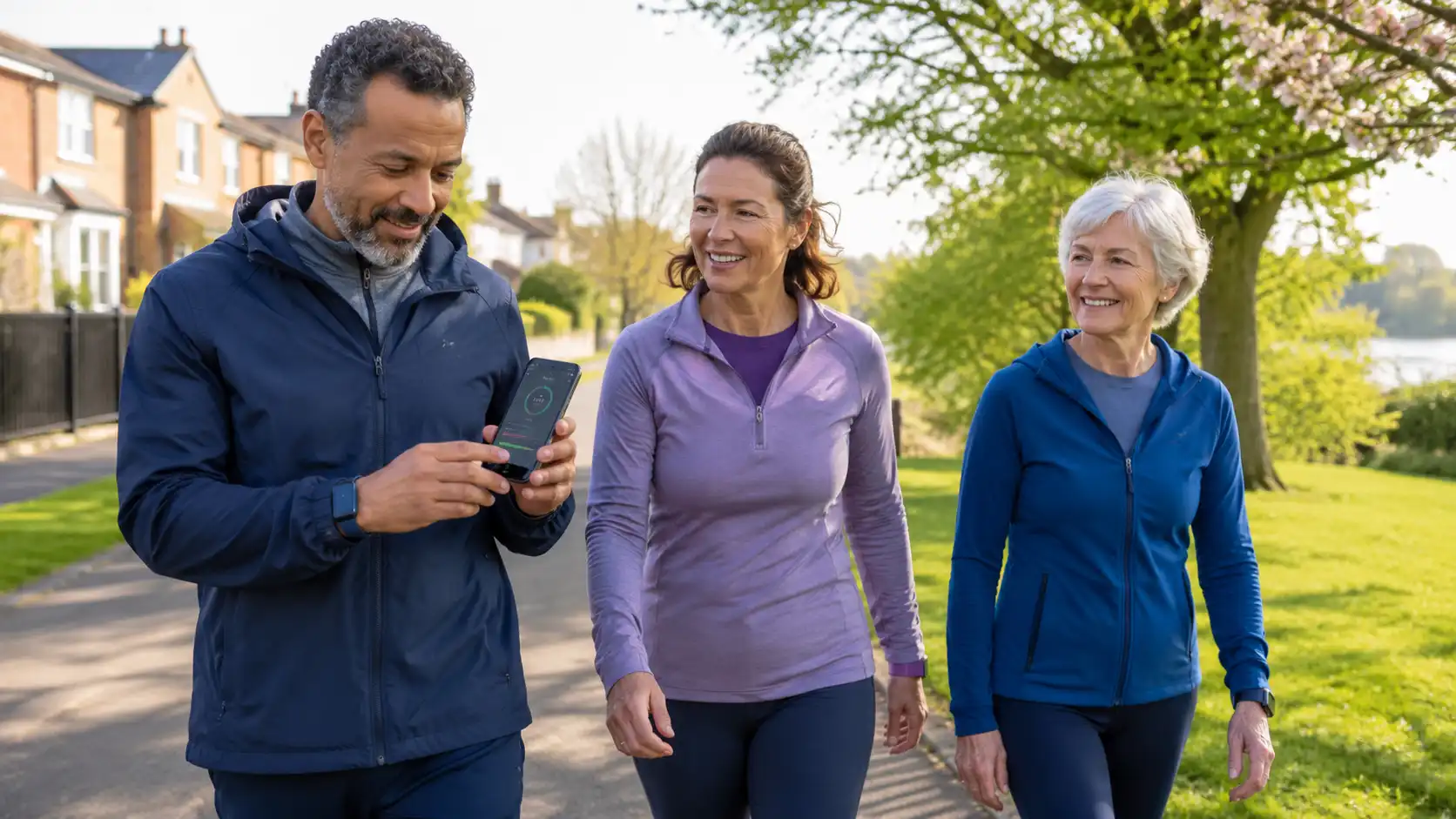
Those taking part are expected to record their activity digitally using devices such as smartphones and smartwatches.
Reports indicate that rewards could eventually include shopping vouchers, discounts, medals and other incentives, although the exact reward structure has not yet been finalised.
That distinction matters.
I would not describe the scheme as the NHS simply “paying people £X for walking every day”, because there is currently no confirmed flat cash payment for completing a 30-minute walk.
Think of it more like a health-focused loyalty programme.
Walk, record your activity, collect progress or points and potentially unlock rewards.
Why Is It Called “Marathon a Month”?
This is actually the part of the idea I think works rather well.
Tell somebody who spends eight hours a day sitting at a desk that they need to run a marathon and most of us would laugh before reaching for another biscuit.
Tell the same person to walk for half an hour after dinner and it suddenly sounds manageable.
That is essentially the thinking behind the challenge.
A marathon is 26.2 miles, or roughly 42 kilometres.
Instead of trying to complete that distance in a single day, participants spread the walking across an entire month.
What that might look like
| Walking Routine | Approximate Approach |
| 30 minutes after work | Builds activity into an ordinary weekday |
| School-run walking | Turns an existing journey into exercise |
| Walking to the shops | Replaces some short car journeys |
| Lunchtime walk | Breaks up long periods spent sitting |
| Weekend longer walk | Helps build towards the monthly distance |
| Dog walking | Existing activity may contribute towards progress |
The aim isn’t necessarily to turn everybody into athletes.
It is to make movement feel normal again.
And, frankly, that may be more useful for a large section of the population than telling everyone they ought to buy a gym membership.
Do You Have to Walk Exactly 30 Minutes Every Single Day?
This is one of the most important points because the original headline can give the wrong impression.
The challenge is being promoted around the simple idea of walking for around 30 minutes a day, but reporting on Movement 26.2 indicates the underlying goal is completing the equivalent of 26.2 miles during the month.
That means it should not necessarily be interpreted as:
Miss Tuesday and you have failed the entire challenge.
Someone might walk 20 minutes on one day, considerably longer the following day and complete a longer weekend walk.
The focus appears to be on building regular movement while eventually reaching the monthly target.
That is a much more sensible approach in my view.
British weather alone would make a rigid 30-minutes-every-single-day rule rather ambitious.
When Will the NHS Walking Rewards Scheme Start?

The current expectation is that Movement 26.2 will launch in early 2027.
The scheme attracted significant attention after details emerged in July 2026.
So if somebody sees a social-media post claiming they can currently download an NHS walking app and immediately begin earning vouchers, it is worth checking carefully before handing over personal information.
As of August 2026, important details still need to be confirmed, including:
- The final registration process.
- The exact app or digital platform.
- How points will be calculated.
- Which retailers will participate.
- What individual rewards will be worth.
- Whether there will be monthly limits.
- Exactly which activities will qualify.
The underlying Government commitment is real. England’s 10 Year Health Plan says a new digital NHS points scheme will reward positive health actions and follows earlier testing of health incentives in Wolverhampton.
But there is still a difference between a confirmed policy direction and a finished rewards catalogue.
What Rewards Could People Receive for Walking?
This is probably where most people will naturally focus.
And no, unfortunately, there is currently no confirmed announcement saying:
“Walk for half an hour and the NHS will send £10 into your bank account.”
The rewards are expected to develop in stages.
Early incentives could involve digital achievements and streak-based rewards, while physical or financial-value incentives may later include things such as:
- Shopping vouchers.
- Retail discounts.
- Digital badges.
- Medals or achievement rewards.
- Other loyalty-style benefits.
Reports have described an NHS Points Scheme, through which accumulated points could ultimately be connected with discounts or vouchers.
However, individual retailers and exact voucher values should not be treated as confirmed until NHS England or the Government publishes the final arrangements.
Could Supermarket Vouchers Be Offered?
Potentially and there is a good reason people are asking.
This would not be the first Government-backed experiment involving rewards for healthier behaviour.
A Better Health: Rewards pilot previously ran in Wolverhampton. Adults were offered personalised health challenges, with some participants earning financially valuable points.
The pilot’s reward marketplace included grocery vouchers involving supermarkets such as Sainsbury’s, Aldi, Morrisons, Tesco and Asda, alongside leisure and retail rewards.
That does not mean those same supermarkets have been confirmed for Movement 26.2.
But the earlier programme demonstrates the sort of reward model the Government has already tested.
For a household struggling with the weekly food bill, I can see why supermarket vouchers would be considerably more attractive than a digital badge.
A badge is nice.
A few quid off the shopping is something people actually notice.
Has the NHS Tried Paying People to Be Healthy Before?
In effect, yes.
The Wolverhampton Better Health: Rewards pilot provides some of the strongest clues about why a larger rewards scheme is now being pursued.
The trial ran in 2023 and tested whether financial incentives could encourage healthier eating and greater physical activity.
Participants used an app and fitness trackers, completed personalised challenges and collected points.
More than 28,000 people completed registration, while thousands were still engaging with the app towards the end of the programme.
Most importantly, the Government’s published evaluation found a small but statistically significant improvement in physical activity when broader wearable data were considered.
Compared with the control group, people in pooled reward groups recorded an increase of around:
- 256 steps per day, and
- 1.9 additional minutes of moderate-to-vigorous physical activity per day.
The results weren’t miraculous, and nobody should pretend they were.
But they suggested that incentives could nudge behaviour in the right direction.
That evidence now matters because the Government specifically referenced the Wolverhampton pilot when announcing plans for a wider digital NHS points scheme.
How Much Were People Rewarded in the Earlier Trial?
This is where the numbers become particularly interesting.
People in the Wolverhampton study were divided into different reward groups.
Among participants still engaging with the app at month five, the average value of redeemed rewards over the five-month period ranged substantially depending on the group.
The Government reported an average redeemed value of approximately £131.82 per participant in the highest-reward arm over five months.
But that figure should not be interpreted as evidence that Movement 26.2 participants will receive £131.82.
They are different schemes.
The earlier trial was experimental, different groups received different incentive levels, and its purpose was to investigate whether money could influence behaviour.
Still, it proves something important: financial-value health rewards are not merely an idea somebody scribbled down during a meeting.
They have already been tested at meaningful scale.
Why Would the NHS Spend Money Rewarding Healthy People?
I can already hear the obvious question:
Why is the NHS spending money on vouchers when hospitals need funding?
It is a fair question.
The answer comes down to prevention.
Healthcare spending often happens after a problem has developed.
A patient develops cardiovascular disease, type 2 diabetes or mobility problems. Treatment then requires GP appointments, medication, specialist care or hospital treatment.
Preventative health policy tries to intervene earlier.
If modest incentives encourage thousands — potentially eventually millions — of people to become more active, policymakers hope that improved population health could reduce some future demand on NHS services.
The Government’s 10 Year Health Plan explicitly pushes the NHS towards prevention and says it intends to use rewards to encourage healthier choices.
From a finance perspective, the basic calculation is straightforward:
Spend a smaller amount encouraging prevention today if doing so can avoid a larger treatment bill tomorrow.
The difficult part is proving that the savings actually materialise.
That is why programmes such as the Wolverhampton pilot matter.
Why 30 Minutes of Walking?
There is nothing magical about the number 30.
It is memorable, achievable for many people and broadly aligns with national physical activity recommendations when repeated across the week.
The updated UK Chief Medical Officers’ physical activity guidelines, published in July 2026, recommend that adults aim for at least 150 minutes of moderate-intensity activity each week.
Brisk walking can count towards that total.
Five 30-minute walks equal exactly 150 minutes.
That gives the NHS challenge a fairly simple public-health message:
Half an hour, five times a week, and you’ve reached the recommended weekly amount of moderate activity — assuming the walking is sufficiently brisk to count as moderate intensity.
The latest guidance also makes another point I think is particularly important: some activity is better than none.
People do not have to suddenly become fitness fanatics to benefit from moving more.
Does Normal Walking Count as Exercise?
It can.
The intensity matters.
The Chief Medical Officers use a useful “talk test”.
During moderate activity, someone should generally be able to talk but not comfortably sing.
During vigorous exercise, maintaining a conversation becomes more difficult because breathing is much heavier.
So a gentle wander around a supermarket is movement and still better than sitting still, but a purposeful brisk walk is more likely to count as moderate-intensity exercise.
The good news is that walking does not require:
- A gym membership.
- Specialist equipment.
- Expensive trainers.
- A personal trainer.
- A sports club subscription.
- A particular level of athletic ability.
For many people, the only real expense is time.
That accessibility is precisely why a walking challenge has the potential to reach people who might never engage with a traditional exercise campaign.
How Will the NHS Know Whether Someone Has Walked?
Technology will play a major role.
Participants are expected to be able to track their movement using digital tools such as:
Smartphones: Most modern smartphones already include motion sensors capable of recording steps and movement.
Smartwatches: Wearable devices can record activity, distance and other fitness information.
Online systems: Reports have also suggested an online method will be available for logging or monitoring participation.
The challenge is therefore likely to depend on digitally verified activity rather than people simply ticking a box saying they went for a walk.
That makes sense if vouchers or discounts are involved.
The moment rewards have monetary value, somebody will inevitably try attaching their tracker to the dog.
What About People Who Already Walk More Than 30 Minutes?
This is an interesting question.
A postman, warehouse worker, nurse, construction worker or someone who walks several miles commuting may already smash the target without changing their behaviour at all.
Should they still qualify for rewards?
Under the currently reported model, completing the required distance should make someone eligible regardless of whether walking is new to them.
That may sound strange from a behavioural-change perspective. Why pay somebody to do something they already do?
But designing a national system that only rewards additional walking would be considerably more complicated.
It would require establishing reliable baseline activity for everybody and calculating improvement individually.
A straightforward mileage target is much easier for the public to understand.
Will Everyone in the UK Be Able to Join?
This requires careful wording.
The scheme being discussed is an NHS England initiative.
That means people should not assume the same programme will automatically operate under:
- NHS Scotland.
- NHS Wales.
- Health and Social Care in Northern Ireland.
Indeed, the walking scheme has already prompted political interest outside England. A Northern Ireland Assembly question submitted in July 2026 asked whether officials had assessed the NHS England proposal and whether a similar incentive scheme could be introduced there.
So the accurate headline might technically be:
“NHS England to reward people for completing a new walking challenge.”
It is less catchy, admittedly, but more precise.
Will People Receive Cash?
There is currently no confirmed general cash payment for walking 30 minutes a day.
That distinction is worth repeating because social-media headlines have a habit of becoming more dramatic every time they are shared.
The scheme is being discussed in terms of points, incentives, vouchers and discounts, rather than a guaranteed direct cash transfer.
Until final terms are published, people should be cautious about claims such as:
- “The NHS will pay you £100 to walk.”
- “Everyone gets £10 per day.”
- “Walkers will receive automatic supermarket vouchers.”
- “Download this app now to claim NHS walking money.”
None of those statements should be treated as established facts without official confirmation.
Will Walking Rewards Affect Benefits or Tax?
At the moment, there is no published final reward structure substantial enough to make definitive tax or benefits claims about Movement 26.2.
If rewards take the expected form of modest discounts, digital achievements or promotional vouchers, they would be very different from receiving regular employment income.
However, until the terms and values are officially published, it would be unwise to make sweeping statements about their tax or means-tested benefit treatment.
This is an area where final Government guidance will matter.
For most households, though, the immediate question is likely to be far simpler:
What Can I Actually Redeem My Points for?
That answer is still to come.
Could the Walking Scheme Save the NHS Money?
Potentially, but this is where I would avoid the grand promises.
Walking is not going to solve every NHS problem.
It won’t clear hospital waiting lists overnight.
It won’t replace doctors, nurses, medicines or proper public-health infrastructure.
And giving somebody a supermarket voucher does not suddenly guarantee perfect health.
What it might do is encourage people who are currently inactive to move slightly more.
That matters because the latest UK physical activity guidance emphasises that some of the biggest health gains occur when people move from doing virtually no activity to doing at least some.
The Wolverhampton pilot also found that effects could be greater among some groups with lower baseline health behaviours.
From an NHS-finance perspective, that may be the real target.
The scheme does not necessarily need to turn runners into ultra-marathoners.
It needs to get inactive people off the sofa.
Could the Scheme Have Problems?
Absolutely.
Any national digital health reward system raises questions that deserve proper answers.
Privacy
People may understandably ask how their activity data is stored, who can access it and whether it will be linked with wider health records.
Participants should receive transparent privacy information before signing up.
Digital exclusion
Not everybody owns a smartwatch.
Some people do not use modern smartphones confidently either.
If participation depends too heavily on expensive technology, the scheme risks excluding precisely the groups public-health programmes often need to reach.
Accessibility
Not everybody can comfortably walk 26.2 miles a month.
Disabled people and those with long-term health conditions may require adaptable goals or equivalent activity options.
Walking charity Living Streets welcomed the initiative but also stressed that barriers such as unsuitable pavements, poor lighting and inaccessible walking environments can prevent people from being active.
Reward quality
There is little point offering incentives nobody actually wants.
If somebody walks for a month and receives a discount on something they would never buy, the motivational value disappears rather quickly.
Fraud
Whenever points can be converted into something valuable, verification becomes important.
A nationwide programme will need sensible safeguards without turning a simple walk into an administrative exercise.
What I Think Would Make the NHS Walking Rewards Scheme Work
If the NHS wants ordinary people to use this rather than download it once and forget about it, I think the formula needs to remain remarkably simple.
First, Make Joining Free.
There should be no subscription, joining fee or hidden paid tier.
Second, Don’t Require Expensive Equipment.
A normal smartphone should be sufficient.
Third, Offer Rewards People Genuinely Use.
Supermarket savings, public transport discounts, leisure-centre offers or other everyday benefits would probably have more impact than novelty merchandise alone.
Fourth, Avoid Punishing People for Missing a Single Day.
Life happens. People get ill, work late, travel, care for relatives or simply have a bad day.
Fifth, Make the Rules Transparent.
People should know exactly what information is collected, how many points they earn and what those points are worth.
And finally, keep the challenge understandable.
One marathon spread over a month is memorable.
Nobody wants to read a 27-page NHS loyalty-points handbook before going for a walk.
Why This Could Be More Important Than the Rewards Themselves?
The voucher will grab the headline.
But the habit may be more valuable.
Imagine somebody who currently drives to the corner shop beginning to walk.
Then they start walking during lunch.
Then perhaps they walk into town at weekends.
After a few months, the voucher may not be the reason they continue.
The walk itself has become part of their routine.
That is ultimately what behavioural incentives are designed to achieve: use an immediate reward to encourage behaviour whose longer-term benefits may feel too distant to motivate someone today.
Health benefits decades into the future can feel abstract.
A supermarket voucher next month does not.
NHS to Reward People Who Walk 30 Minutes a Day: What Happens Next?
For now, the best thing people can do is avoid treating every viral headline as the finished version of the scheme.
The broad policy is confirmed: the Government intends to develop a digital NHS points system that rewards positive health actions. The Movement 26.2 walking challenge is expected to form part of that prevention-focused approach.
Before launch, more information should emerge about:
- Registration.
- Eligibility.
- The official tracking platform.
- Monthly walking requirements.
- Points calculations.
- Participating retailers.
- Voucher values.
- Data protection.
- Accessibility.
- The precise launch date.
Until then, anyone promising an exact payout is getting ahead of the official information.
Final Word: Would I Walk Half an Hour for an NHS Reward?
Yes. although I wouldn’t expect the NHS to start handing out tenners at the end of the street.
The important thing about the NHS plan to reward people who walk 30 minutes a day is that it changes the usual health message.
Instead of simply telling people, “You should exercise more,” the NHS is exploring the idea of saying, “Here is a clear target, here is a way to track it, and here is something for sticking with it.”
Whether that becomes a genuine public-health success will depend on the details.
The rewards need to be useful. The technology needs to be easy. Privacy needs to be protected. Disabled and less digitally connected people cannot be forgotten. And the scheme needs to reach the inactive people it is really designed to help — rather than simply handing discounts to those already walking miles every day.
Still, there is something refreshingly British about the whole proposition.
No marathon training plan. No fancy gym. No £100-a-month membership.
Just get your coat on, go for a walk and, if the scheme works as intended, perhaps earn a little something along the way.
For once, improving your health might also come with a reward you can actually use.
Frequently Asked Questions
Is the NHS Going to Reward People for Walking 30 Minutes a Day?
Yes. NHS England is preparing a walking challenge expected to reward participants who work towards completing approximately 26.2 miles over a month. Around 30 minutes of regular walking is being promoted as an accessible way to reach the goal.
What is the NHS Marathon a Month Scheme?
It is a planned activity programme often called Movement 26.2, encouraging people to walk the equivalent distance of a marathon — 26.2 miles — over the course of a month.
When Does the NHS Walking Reward Scheme Start?
The programme is expected to launch in early 2027. A final public launch date and full registration instructions still need to be confirmed.
How Much Will the NHS Pay People for Walking?
There is no confirmed flat cash payment. Rewards are expected to involve points, digital incentives, discounts, vouchers and potentially physical rewards, but exact values have not yet been published.
Can I Get Supermarket Vouchers for Walking?
Shopping vouchers are among the rewards being discussed, but individual retailers for the new scheme have not yet been confirmed. An earlier Government health-rewards pilot did include supermarket vouchers.
Do I Need a Smartwatch to Join?
Reports suggest activity may be tracked using a smartphone, smartwatch or online system, so owning a premium wearable should not necessarily be required. Final technical requirements will be confirmed closer to launch.
Do I Have to Walk Exactly 30 Minutes Every Day?
Current reporting suggests the wider objective is accumulating approximately 26.2 miles during a month rather than necessarily completing exactly 30 minutes every calendar day.
Is the NHS Walking Scheme Available in Scotland and Wales?
The announced initiative concerns NHS England. Equivalent nationwide arrangements covering Scotland, Wales and Northern Ireland have not been confirmed as part of the same programme.
Why is the NHS Rewarding People for Exercise?
The wider policy is focused on prevention. The Government hopes incentives can encourage healthier behaviours and potentially reduce the future burden associated with preventable illness.
Is Walking 30 Minutes a Day Actually Enough Exercise?
Thirty minutes of moderate-intensity activity on five days of the week would equal 150 minutes. Current UK Chief Medical Officers’ guidance recommends adults aim for at least 150 minutes of moderate-intensity activity per week, alongside strength-building activity.