The latest DWP bank holiday payment changes mean that some people receiving Universal Credit, Personal Independence Payment (PIP), the State Pension and other benefits will receive their money earlier than usual over Christmas 2026 and New Year 2027.
Under the normal Department for Work and Pensions (DWP) rules, benefit payments due between 25 and 28 December 2026 would usually arrive on Thursday 24 December. Payments due on New Year’s Day, Friday 1 January 2027, would normally arrive on Thursday 31 December 2026.
However, different arrangements apply to certain HMRC payments and benefits administered by Social Security Scotland.
Our financial analysis examines the government payment rules, official bank holiday dates and practical implications for households managing rent, energy bills and other essential expenditure.
What Are the Latest DWP Bank Holiday Payment Changes in 2026?
The latest completed DWP bank holiday payment adjustment took place in August 2026, when payments due on Monday 31 August were brought forward to Friday 28 August.
The DWP confirmed the arrangement on 14 August 2026, covering major benefits including Universal Credit, PIP, the State Pension, Attendance Allowance and Carer’s Allowance.
The next major period requiring attention is Christmas.
The government generally pays affected benefits on the previous working day when the normal payment date falls on a weekend or bank holiday.
Key payment dates to remember:
- 28 August 2026: Confirmed early payment date for benefits due on 31 August.
- 30 November 2026: St Andrew’s Day bank holiday in Scotland, which may affect relevant payments.
- 24 December 2026: Expected DWP payment date for benefits normally due between 25 and 28 December.
- 31 December 2026: Expected DWP payment date for benefits due on 1 January 2027.
- 4 January 2027: Additional Scottish bank holiday that can affect benefit payment schedules.
These dates do not mean everybody claiming benefits will receive an early payment. Only claimants whose scheduled payment dates are affected should expect an adjustment.
When Will DWP Benefits Be Paid Over Christmas 2026?

Christmas 2026 creates an extended period when several consecutive days are weekends or bank holidays.
Christmas Day falls on Friday 25 December, while Boxing Day falls on Saturday 26 December. Because Boxing Day is on a weekend, Monday 28 December becomes the substitute bank holiday.
For most DWP benefits, Thursday 24 December is therefore the last working day before the Christmas holiday period.
Expected DWP Christmas and New Year Payment Dates
| Normal payment date | Expected payment date | Reason |
| Thursday 24 December 2026 | Thursday 24 December | Normal working day |
| Friday 25 December 2026 | Thursday 24 December | Christmas Day |
| Saturday 26 December 2026 | Thursday 24 December | Weekend |
| Sunday 27 December 2026 | Thursday 24 December | Weekend |
| Monday 28 December 2026 | Thursday 24 December | Boxing Day substitute |
| Tuesday 29 December 2026 | Tuesday 29 December | Normal working day |
| Wednesday 30 December 2026 | Wednesday 30 December | Normal working day |
| Thursday 31 December 2026 | Thursday 31 December | Normal working day |
| Friday 1 January 2027 | Thursday 31 December 2026 | New Year’s Day |
| Saturday 2 January 2027 | Thursday 31 December 2026 | Weekend after bank holiday |
| Sunday 3 January 2027 | Thursday 31 December 2026 | Weekend after bank holiday |
Important: These are expected dates calculated using the standard DWP payment rule, not a separately confirmed Christmas 2026 payment announcement. Individual payment schedules and exceptional arrangements should always be checked.
The official GOV.UK bank holiday calendar lists the public holidays affecting payment processing throughout the UK.
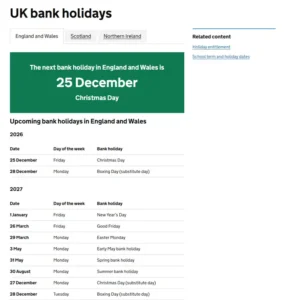
Official GOV.UK bank holiday calendar showing Christmas Day on Friday 25 December 2026, the Boxing Day substitute holiday on Monday 28 December and New Year’s Day on Friday 1 January 2027.
Which DWP Benefits Are Affected by Bank Holiday Payment Changes?
Bank holiday adjustments can apply to a wide range of benefits, but their ordinary payment frequencies are not identical.
| Benefit | Normal payment frequency | Can bank holidays affect payment dates? |
| Universal Credit | Monthly in Great Britain | Yes |
| State Pension | Usually every four weeks | Yes |
| Personal Independence Payment | Usually every four weeks | Yes |
| Pension Credit | Usually every four weeks | Yes |
| Attendance Allowance | Usually every four weeks | Yes |
| Disability Living Allowance | Usually every four weeks | Yes |
| Carer’s Allowance | Weekly or every four weeks | Yes |
| Employment and Support Allowance | Usually every two weeks | Yes |
| Jobseeker’s Allowance | Usually every two weeks | Yes |
| Income Support | Depends on payment arrangements | Yes |
| Maternity Allowance | Every two or four weeks | Yes |
Child Benefit is also affected by bank holidays, but it is administered by HM Revenue and Customs rather than DWP.
Our review identifies an important distinction: payment frequency determines when a claimant is due to receive money, while the bank holiday rule determines whether that particular date needs to move.
For example, two people receiving PIP could have different payment dates because their four-weekly cycles started at different times.
Only the claimant whose scheduled payment falls on an affected date would normally receive an adjusted payment.
Will Universal Credit Be Paid Early for Christmas 2026?
Yes. Universal Credit payments falling on Christmas bank holidays would normally be brought forward.
Universal Credit is generally paid monthly in England, Scotland and Wales, although claimants in Scotland can choose twice-monthly payments. Northern Ireland normally operates a twice-monthly payment arrangement.
Under the usual Christmas 2026 rule:
- Universal Credit due on 25 December would normally arrive on 24 December.
- Universal Credit due on 26 or 27 December would normally arrive on 24 December.
- Universal Credit due on 28 December would normally arrive on 24 December.
- Universal Credit due on 1 January 2027 would normally arrive on 31 December 2026.
Will an Early Universal Credit Payment Change the Assessment Period?
No. Receiving Universal Credit early because of a bank holiday does not ordinarily alter the claimant’s monthly assessment period.
Universal Credit entitlement is calculated using the claimant’s circumstances and applicable income during a monthly assessment period.
An early payment changes the date on which the money reaches the bank account, not the underlying assessment period.
This distinction matters for households receiving wages alongside Universal Credit.
Claimants should continue reporting changes and checking deductions in their online accounts rather than assuming that early payment creates an additional assessment period.
How Can Claimants Check Their Universal Credit Payment Date?
The most reliable method is to sign into the Universal Credit account and check the payment statement.
The statement normally includes:
- The scheduled payment date.
- The total Universal Credit award.
- Earnings and other adjustments.
- Deductions for advances or other recoveries.
- The amount expected to be deposited.
If a payment date or amount is unclear, claimants can use the Universal Credit contact number or send a message through their online journal.
Checking the statement is particularly important before Christmas because telephone helplines and other support services may have reduced availability during public holidays.
Will PIP and Disability Benefit Payments Change Over Christmas?
Yes. Personal Independence Payment and several other disability-related benefits normally follow the previous-working-day rule.
PIP is generally paid every four weeks.
For example, someone whose PIP payment is due on Monday 28 December 2026 would normally expect the money on Thursday 24 December instead.
However, a claimant whose payment is scheduled for Tuesday 29 December would not ordinarily need an adjustment.
The same general principle can affect Attendance Allowance and relevant Disability Living Allowance payments.
It is also important to distinguish normal scheduled payments from arrears.
A claimant who has recently received an award may be owed money for an earlier entitlement period. These PIP back payments are different from a regular payment arriving early because of Christmas.
An early bank holiday payment is not a PIP increase, additional award or back payment.
Will State Pension and Pension Credit Be Paid Early?
Yes. State Pension and Pension Credit payments can also move to an earlier working day when their scheduled date falls on a bank holiday.
The State Pension is usually paid every four weeks, although individual arrangements can differ.
The normal payment weekday is linked to the final two digits of the recipient’s National Insurance number.
State Pension Payment Days by National Insurance Number
| Final two NI digits | Normal payment day |
| 00–19 | Monday |
| 20–39 | Tuesday |
| 40–59 | Wednesday |
| 60–79 | Thursday |
| 80–99 | Friday |
For example, a pensioner whose payment normally falls on Friday and whose four-weekly cycle includes 25 December 2026 would generally expect the payment on Thursday 24 December.
Likewise, a payment due on Friday 1 January 2027 would usually arrive on Thursday 31 December 2026.
The pension amount does not increase merely because it reaches the bank account earlier.
Some pensioners may also receive separate seasonal support, including Winter Fuel Payment where eligible. The DWP £200 pensioner eligibility rules concern that separate winter support rather than the routine State Pension bank holiday adjustment.
Is Child Benefit Being Paid Early for Christmas 2026?
Yes, but HMRC operates a separate Child Benefit payment timetable that should not be confused with DWP arrangements.
Child Benefit is generally paid every four weeks, usually on a Monday or Tuesday. Certain claimants can receive weekly payments.
HMRC has already published specific Christmas 2026 dates.
Confirmed HMRC Child Benefit Holiday Payment Dates
| Normal due date | HMRC payment date | Applies to |
| Monday 28 December 2026 | Thursday 24 December 2026 | UK-wide |
| Tuesday 29 December 2026 | Wednesday 30 December 2026 | Northern Ireland only |
The Northern Ireland arrangement is particularly important.
While most claimants associate bank holidays with earlier payments, some HMRC arrangements can result in a later payment date.
Therefore, families should check the official Child Benefit bank holiday schedule rather than assuming that every payment is made on the previous working day.
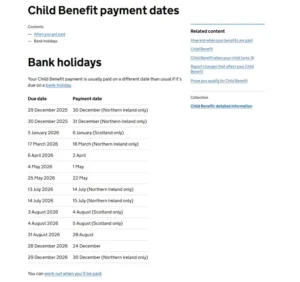
GOV.UK’s official Child Benefit bank holiday payment schedule confirms that payments due on 28 December 2026 will be made on 24 December, with a separate Northern Ireland adjustment for 29 December.
HMRC has also advised that local public holidays and banking arrangements can sometimes affect Child Benefit payment timing in Scotland and Northern Ireland.
For households relying on Child Benefit for regular childcare, food or transport expenses, checking the precise payment date can prevent an unexpected cash-flow shortage.
Are DWP Bank Holiday Payment Changes Different in Scotland?
Yes. Scotland has some different bank holidays and also operates a separate system for several devolved benefits.
This means claimants must distinguish between UK government benefits administered by DWP and payments administered by Social Security Scotland.
What Are the Important Scottish Bank Holidays?
The following dates are particularly relevant:
| Scottish bank holiday | Date | Expected impact |
| St Andrew’s Day | Monday 30 November 2026 | Relevant payments may move earlier |
| Christmas Day | Friday 25 December 2026 | Payment adjustment |
| Boxing Day substitute | Monday 28 December 2026 | Payment adjustment |
| New Year’s Day | Friday 1 January 2027 | Payment adjustment |
| 2 January substitute | Monday 4 January 2027 | Payment adjustment |
A DWP payment due on St Andrew’s Day would ordinarily be considered under the previous-working-day rule. Claimants should confirm their individual schedule.
When Will Social Security Scotland Make Christmas Payments?
Social Security Scotland has published its own anticipated payment dates.
These apply to specified devolved benefits, including Adult Disability Payment, Child Disability Payment, Carer Support Payment, Scottish Child Payment and Pension Age Disability Payment.
| Original payment date | Published anticipated payment date |
| Thursday 24 December 2026 | Wednesday 23 December 2026 |
| Friday 25 December 2026 | Wednesday 23 December 2026 |
| Monday 28 December 2026 | Wednesday 23 December 2026 |
| Friday 1 January 2027 | Thursday 31 December 2026 |
| Monday 4 January 2027 | Thursday 31 December 2026 |
This is a significant distinction.
Certain Social Security Scotland benefits due over Christmas are scheduled for Wednesday 23 December, rather than the Thursday 24 December date generally expected for DWP benefits.
Best Start Foods payments are not affected by the published Social Security Scotland bank holiday changes.
Claimants receiving a combination of UK and Scottish benefits should check the relevant organisation’s payment timetable separately.
Are Benefit Payment Changes Different in Northern Ireland?
Yes. Northern Ireland has additional bank holidays and some differences in how benefits are administered.
Universal Credit is normally paid twice monthly in Northern Ireland, rather than the standard monthly arrangement used elsewhere in the UK.
When the payment date falls on a weekend or bank holiday, it is normally moved to the previous banking day.
Northern Ireland also observes holidays such as St Patrick’s Day and the Battle of the Boyne, potentially creating additional payment adjustments throughout the year.
The Christmas 2026 HMRC Child Benefit exception is especially important because a payment due on 29 December is scheduled for 30 December for affected Northern Ireland claimants.
Our assessment is that households receiving benefits from more than one agency should check each payment independently.
A payment from DWP, HMRC or another administering authority should not automatically be expected on the same date as another benefit.
What Happened to DWP Payments During the August 2026 Bank Holiday?
The DWP’s last major nationwide bank holiday payment announcement concerned Monday 31 August 2026.
The government confirmed that affected payments would be made three calendar days earlier.
| Original date | Confirmed payment date | Difference |
| Monday 31 August 2026 | Friday 28 August 2026 | Three days earlier |
The arrangement applied across the United Kingdom, including Scotland, despite differences in regional summer bank holiday dates.
The DWP announcement included Universal Credit, the State Pension, PIP, Attendance Allowance, Carer’s Allowance, Disability Living Allowance, ESA, JSA, Income Support, Pension Credit and Industrial Injuries Compensation Scheme payments.
Minister for Social Security and Disability Sir Stephen Timms said:
We’re pleased to confirm that benefit payments due on the August bank holiday will be paid earlier.
The announcement was published on the official DWP government news page on 14 August 2026.
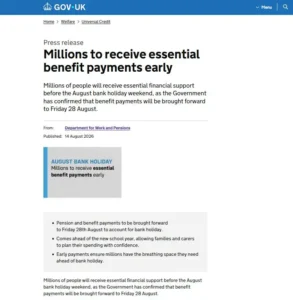
Department for Work and Pensions announcement published on 14 August 2026 confirming early benefit payments for the August bank holiday, including the revised payment date of 28 August.
This confirmed August arrangement provides a useful example of how DWP applies early payments, but it should not be presented as a new change taking place in October.
Will Getting Paid Early Increase the Amount of Benefits?
No. Bank holiday adjustments ordinarily change payment timing rather than benefit entitlement.
Someone who would normally receive £800 on 28 December but instead receives £800 on 24 December has not received additional financial support.
The payment has simply arrived four calendar days earlier.
It is not:
- An additional Universal Credit payment.
- A new DWP Cost of Living Payment.
- A bonus for receiving benefits.
- A permanent payment increase.
- An advance that automatically needs repaying.
- A separate Christmas benefit award.
For households affected by deductions, sanctions or changes in earnings, the normal benefit payment may still be lower than expected for unrelated reasons.
Claimants should check their payment statements before assuming that the amount has changed because of the holiday.
How Can Early DWP Payments Affect Household Budgets?

Our financial analysis identifies cash-flow management as one of the most important consequences of early benefit payments.
Although receiving money sooner may initially appear helpful, it creates a longer interval between the adjusted payment date and the next regular instalment if the following payment returns to its normal timetable.
For example, if a claimant receives a payment four days earlier than scheduled, the money needs to cover four additional calendar days before the following payment, assuming that next payment is unaffected.
Four days represent approximately 14.3% of a 28-day budgeting period.
That percentage is a mathematical comparison, not a DWP statistic or an estimate of the percentage of claimants affected.
Example: Managing an £1,200 Benefit Payment
Consider an illustrative household receiving £1,200 that must cover several regular expenses.
| Expense | Budget allocation | Percentage |
| Housing costs | £600 | 50% |
| Food and groceries | £300 | 25% |
| Gas, electricity and other bills | £180 | 15% |
| Transport and essential travel | £120 | 10% |
| Total | £1,200 | 100% |
This is an example budget, not a survey of UK benefit recipients.
If the household receives its payment before Christmas, it might be tempting to spend additional money on shopping, travel or celebrations.
However, that could leave insufficient money for housing or utility costs during January.
Our preferred approach is to allocate essential expenses as soon as the payment arrives and treat the remaining balance as the amount genuinely available for discretionary spending.
Our Editorial Ratings for Managing Early Payments
The following percentages are our editorial priority scores, based on their usefulness for reducing payment-related financial disruption. They are not claimant survey results, official DWP ratings or statistical probabilities.
| Financial action | Priority rating |
| Confirm the correct benefit payment date | 100% |
| Reserve money for rent and essential bills | 100% |
| Check upcoming Direct Debits | 95% |
| Keep a short-term emergency spending buffer | 90% |
| Check payment details with the correct agency | 90% |
An early benefit payment can be advantageous when it helps households meet essential commitments. The risk develops when money is spent earlier without adjusting the remainder of the monthly budget.
What Happens to Direct Debits When Benefits Arrive Early?
An early DWP payment does not automatically change the dates on which rent, mortgage payments, loan instalments or Direct Debits are due.
Direct Debit collection arrangements over bank holidays depend on the banking system, the payment mandate and the organisation collecting the money.
For example, an energy provider may collect a Direct Debit on the next available banking day when the normal collection date is a bank holiday.
However, the exact arrangement should be checked with the provider.
Claimants should avoid assuming that a benefit payment arriving early automatically means every outgoing payment will move.
If an essential payment date needs adjusting, contacting the relevant company before the collection date can sometimes help.
It may also be useful to understand how to cancel a Direct Debit where an incorrect or unauthorised collection is involved.
Cancelling a Direct Debit does not remove the underlying debt or contractual obligation, so changing payment dates is generally preferable to missing essential commitments.
What Should You Do If a DWP Payment Is Missing?
If an expected benefit payment does not arrive, the first step is to establish whether the payment is genuinely overdue.
Bank holidays can make payment dates confusing, particularly when multiple payments are involved.
Step 1: Check the Scheduled Payment Date
Review the latest benefit letter, payment notification or Universal Credit online account.
Make sure the original payment was actually due during the bank holiday period.
Step 2: Check the Bank Account
Look for the expected payment reference and amount.
Some banking apps display incoming payments differently, so the transaction history may provide more information than the available-balance display.
Step 3: Review Benefit Messages and Deductions
Universal Credit claimants should check their journal, payment statement and to-do list.
A payment may have been reduced or interrupted because of a separate claim issue rather than a bank holiday.
Step 4: Contact the Correct Payment Authority
The appropriate organisation depends on the benefit:
- Universal Credit: Contact the Universal Credit service through the online journal or helpline.
- PIP and other DWP benefits: Contact the office responsible for the claim.
- Child Benefit: Contact HMRC after checking the official schedule.
- Devolved Scottish benefits: Contact Social Security Scotland.
- Northern Ireland benefits: Use the relevant Department for Communities or benefits service.
For Disability Living Allowance enquiries, claimants should ensure they use the correct regional DLA contact number.
Step 5: Explain Any Immediate Financial Hardship
If a missing payment leaves a household without enough money for essentials, the urgency should be explained clearly when contacting the relevant benefit service.
Some households may also qualify for local authority emergency assistance, depending on their circumstances and where they live.
Can You Request an Advance Because of a Bank Holiday?
A bank holiday itself does not automatically create eligibility for an additional benefit advance.
Universal Credit offers different types of advances for different circumstances.
A first-payment advance may be available to an eligible claimant waiting for the first Universal Credit payment.
A Budgeting Advance may be available for certain qualifying one-off expenses, such as essential household equipment or moving costs.
However, a Universal Credit Budgeting Advance is repayable and cannot normally be used for ordinary monthly food, rent or utility bills.
The decision depends on eligibility, affordability and the type of expense.
Households experiencing financial difficulties should therefore consider the long-term impact of additional deductions before requesting repayable support.
How Can You Avoid DWP Bank Holiday Payment Scams?
Periods when the government changes payment dates can create opportunities for misleading messages and financial scams.
Fraudulent texts, emails and social media posts may claim that individuals must register to receive their early DWP payments.
Others might advertise a supposed Christmas benefit bonus or ask claimants to verify banking details using an unfamiliar website.
In normal circumstances, qualifying bank holiday adjustments are made automatically.
Claimants should be cautious about messages that:
- Ask for a fee to release an early payment.
- Request banking passwords or one-time security codes.
- Promise guaranteed extra DWP money without an official announcement.
- Direct users to unfamiliar websites to confirm payment details.
- Threaten immediate suspension unless a link is opened.
Official benefit accounts and government service websites should be used to check genuine payment information.
What Are the Next DWP Bank Holiday Payment Changes in 2027?
After New Year, several bank holidays during 2027 could affect benefit payment dates.
For England and Wales, the expected dates under the standard previous-working-day rule include:
| Bank holiday | Original date | Normally expected payment date |
| New Year’s Day | Friday 1 January 2027 | Thursday 31 December 2026 |
| Good Friday | Friday 26 March 2027 | Thursday 25 March 2027 |
| Easter Monday | Monday 29 March 2027 | Thursday 25 March 2027 |
| Early May bank holiday | Monday 3 May 2027 | Friday 30 April 2027 |
| Spring bank holiday | Monday 31 May 2027 | Friday 28 May 2027 |
| Summer bank holiday | Monday 30 August 2027 | Friday 27 August 2027 |
| Christmas substitute day | Monday 27 December 2027 | Friday 24 December 2027 |
| Boxing Day substitute day | Tuesday 28 December 2027 | Friday 24 December 2027 |
These are projections derived from the standard DWP payment rule, not individually confirmed announcements for every holiday.
Different holidays in Scotland and Northern Ireland may create additional changes.
For example, Scotland has a summer bank holiday on Monday 2 August 2027, while Northern Ireland observes St Patrick’s Day on Wednesday 17 March and the Battle of the Boyne holiday on Monday 12 July.
Claimants should check the bank holiday calendar relevant to their location and benefit provider.
What Is Our Assessment of the DWP Bank Holiday Payment Changes?
Our review of published government payment guidance highlights three important conclusions.
First, the early payment arrangements are designed to prevent routine benefit payments being disrupted by weekends or public holidays. They are not additional financial support.
Second, the timing can create practical difficulties for households whose income is already committed to regular expenses. An early payment may be helpful in the short term but must last until the next scheduled instalment.
Third, payment schedules should not be treated as identical across every benefit or region. The differences between DWP, HMRC, Northern Ireland arrangements and Social Security Scotland are particularly important around Christmas.
For Christmas 2026, the central dates to remember are 24 December for many expected DWP payments, 23 December for specified Social Security Scotland benefits and 31 December for relevant New Year payments.
The strongest financial planning approach is to confirm the date with the relevant paying authority, reserve essential expenses and avoid treating an early payment as additional income.
Frequently Asked Questions
Will DWP Pay Benefits Early at Christmas 2026?
Normally, yes. DWP benefits due between 25 and 28 December 2026 are expected to arrive on 24 December under the standard bank holiday rule.
Will Universal Credit Be Paid Before Christmas Eve?
For most affected DWP Universal Credit payments, Christmas Eve is the expected payment day. Different arrangements apply to some Scottish devolved benefits.
Will PIP Payments Arrive Early in December 2026?
PIP payments due during the Christmas bank holiday period would normally arrive on the previous working day. Payments scheduled for unaffected working days should remain unchanged.
Are Child Benefit Payments Changing at Christmas?
Yes. HMRC lists 24 December 2026 as the payment date for Child Benefit due on 28 December. Northern Ireland also has a separate adjustment for payments due on 29 December.
Will DWP Make an Extra Christmas Payment in 2026?
An early regular benefit payment is not an extra payment. Other forms of Christmas or winter assistance may have separate eligibility rules.
Will My January 2027 DWP Payment Be Early?
Payments normally due on Friday 1 January 2027 would usually arrive on Thursday 31 December 2026. Other January payment dates depend on the claimant’s schedule and location.
Do I Need to Apply for an Early DWP Bank Holiday Payment?
No. Normal bank holiday adjustments are generally automatic. Claimants should only need to contact the relevant service if there is a problem with the payment or claim.