PIP payments can be backdated, but a normal new Personal Independence Payment claim is not usually backdated to when the illness or disability first began. If the three-month qualifying period has already been satisfied, entitlement will generally start from the date the claim was registered.
If the qualifying period is completed later, entitlement may start from that later date. Back payments can also arise when a decision is changed after a mandatory reconsideration, tribunal appeal or historic DWP review exercise.
That distinction matters because the term “PIP backdated payment” can describe several very different situations.
When Can PIP Payments Be Backdated?
There are several circumstances in which a claimant may receive PIP arrears.
| Situation | Where Back Pay May Normally Start |
| New claim and three-month qualifying period already met | Date the PIP claim was registered |
| New claim where qualifying period is completed later | Date the qualifying period is satisfied |
| Successful mandatory reconsideration | Earlier effective date established by the revised decision |
| Successful tribunal appeal | Effective date determined by the decision |
| Historic DWP legal review | Potentially much earlier, depending on the court decision and review rules |
| Increase following a change in circumstances | Depends on the facts and effective-date rules |
The important point is that back payment does not automatically mean payment for the entire period in which someone has been disabled.
For most ordinary new claims, the date the claim was started is the key date.
Is PIP Automatically Backdated for Three Months?
No. This is one of the most common misunderstandings about PIP.
The three-month rule is primarily a qualifying-period rule, not an automatic three-month backdating rule.
Under the normal PIP rules, the functional effects of the claimant’s condition generally need to have affected them at the required level for at least three months and be expected to continue for at least another nine months.
For example, if someone has experienced qualifying difficulties for two years before starting a claim, the three-month qualifying period has already been satisfied. Their award could therefore normally begin from the date they register the claim.
It does not normally mean that DWP adds another three months of payments before the claim date.
If someone starts a claim before completing the three-month qualifying period, entitlement may instead begin when that qualifying period has been completed.
How Far Back Can a Normal PIP Claim Go?
A standard new PIP claim generally cannot be retrospectively extended for months or years simply because the claimant’s disability existed before they contacted DWP.
Suppose someone has experienced serious mobility difficulties since January but does not register a PIP claim until August.
If the qualifying conditions were already satisfied by August, the normal starting point would generally be the August claim date rather than January.
That is why delaying a claim can matter financially.
The length of time DWP takes to process the application does not normally remove entitlement for the waiting period where the claimant was entitled from the earlier effective date.
How Long Are PIP Claims Taking in 2026?
Processing times can change significantly.
DWP’s PIP statistics published in 2026 show that in April 2026 the median end-to-end clearance time for normal-rules new claims was 18 weeks, measured from registration to a decision.
That was higher than the 14-week median recorded in April 2025.
The same statistics reported a 13-week median from referral to the assessment provider to the final decision.
This means a successful claimant could potentially have several months of entitlement accumulated by the time the decision is made.
It should not, however, be assumed that every claim will take 18 weeks. Some are decided more quickly while others can take considerably longer.
What Is a PIP Back Payment?
A PIP back payment, often called PIP arrears, is money owed because entitlement applies to a period before regular payments begin.
Suppose a claimant registers an eligible PIP claim on 1 June and receives their decision several months later.
If the award is effective from 1 June, DWP may owe PIP for the period between 1 June and the point at which normal payments begin.
That accumulated money can result in a larger first payment or separate arrears payment.
Normal PIP payments are usually made every four weeks.
How Much PIP Can Someone Get in 2026/27?
The weekly PIP rates for the 2026/27 benefit year are:
| PIP Component | Standard Rate | Enhanced Rate |
| Daily living | £76.70 | £114.60 |
| Mobility | £30.30 | £80.00 |
PIP is tax-free, and entitlement is not reduced because the claimant has earnings or savings.
Someone receiving enhanced daily living and enhanced mobility therefore has a combined weekly award of £194.60.
The size of any back payment depends on:
- the effective entitlement date;
- the decision date;
- the components awarded;
- whether standard or enhanced rates apply;
- whether the period crosses an annual benefit-rate change;
- whether an earlier decision was subsequently revised; and
- any periods during which PIP was not payable.
What Does a PIP Back-Pay Calculation Look Like?
Consider a straightforward example.
A claimant:
- registers a PIP claim on 1 June 2026;
- has already experienced the qualifying difficulties for more than three months;
- receives a decision on 1 October 2026; and
- is awarded PIP from 1 June.
There are 122 days between those dates, or approximately 17.43 weeks.
Using the 2026/27 rates, a simple illustration would be:
| Award | Approximate Arrears for 122 Days |
| Standard daily living only | £1,336.77 |
| Standard daily living + standard mobility | £1,864.86 |
| Enhanced daily living + enhanced mobility | £3,391.60 |
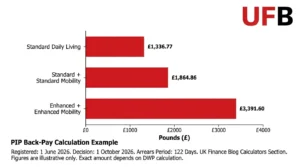
These figures are illustrative rather than a guarantee of the amount DWP would pay. The exact calculation depends on the effective dates and circumstances recorded on the claim.
Calculations become more complicated when the backdating period crosses the April annual benefit-rate change because different weekly rates can apply to different parts of the arrears period.
UK Finance Blog’s existing calculators and tools section can also be used alongside benefit calculations when planning household finances.
Can PIP Be Backdated After a Mandatory Reconsideration?
Yes.
A mandatory reconsideration, usually shortened to MR, asks DWP to reconsider a PIP decision.
This could involve:
- a claim that was refused;
- a daily living award that the claimant believes should be higher;
- a mobility decision;
- a reduction following an award review; or
- a decision to stop PIP.
If DWP changes the decision and decides that the claimant should have received more PIP from an earlier date, arrears may be payable for that earlier period.
The amount is based on what should have been paid compared with what was actually received.
How Long Does Someone Have to Request Mandatory Reconsideration?
The normal deadline is one month from the date of the PIP decision.
A late mandatory reconsideration can still be requested in certain circumstances. The claimant should explain why the request is late.
A request made within 13 months of the original decision may potentially be accepted where there are appropriate reasons for the delay.
The 13-month point should be treated as an important maximum limit for an ordinary late mandatory reconsideration rather than assuming that DWP will simply accept a request at any time.
Cases involving official error or other specialist revision rules can operate differently, so somebody dealing with a decision older than 13 months may need specialist welfare-rights advice rather than assuming there is no possible route at all.
What Do the Latest Mandatory Reconsideration Statistics Show?
The latest official figures give a more useful picture than some older statistics circulating online.
During the five years from May 2021 to April 2026, 28% of the 1.4 million completed PIP mandatory reconsiderations, excluding withdrawals, resulted in a change to the award.
For the quarter ending April 2026 specifically, the rate was 26%.
The outcome also varies depending on the type of decision being challenged. For initial PIP decisions following an assessment between January 2021 and December 2025, 16% of completed MRs resulted in an award change. For award reviews during the same period, the figure was 28%.
That is why a single claim that “around 60% of PIP mandatory reconsiderations succeed” would be misleading.
Can a Successful PIP Tribunal Appeal Create Back Pay?
Yes.
If mandatory reconsideration does not produce the correct outcome, an eligible claimant can normally appeal to the Social Security and Child Support Tribunal.
Where the tribunal changes the decision and determines that PIP should have been awarded from an earlier effective date, the resulting arrears can be substantial because the appeal process itself may take months.
The latest Ministry of Justice tribunal statistics provide useful context.
During January to March 2026, 67% of PIP cases that were cleared at a tribunal hearing were overturned in favour of the claimant.
That does not mean 67% of every PIP appeal submitted succeeds. It specifically refers to cases that reached a tribunal hearing during the period.
Is There Also a 13-Month Limit for a PIP Appeal?
A tribunal appeal should normally be made within one month of the mandatory reconsideration notice.
A late appeal can potentially be accepted, but the ordinary statutory extension is limited. In general, the tribunal can extend the deadline by up to another 12 months, producing a maximum normal period of 13 months from the relevant mandatory reconsideration decision.
There is specialist case law concerning extremely unusual situations beyond that period, but this should not be presented as a routine right to appeal whenever someone has missed the 13-month limit.
A claimant facing an exceptionally late appeal should consider specialist advice because tribunal jurisdiction and official-error rules can become legally complex.
What Was the MM Supreme Court PIP Case?
One of the biggest historic PIP back-payment issues involved a Supreme Court judgment commonly referred to as MM.
The Supreme Court handed down its judgment on 18 July 2019, following an Upper Tribunal decision dated 6 April 2016.
The case changed how DWP had to consider the meaning of “social support” for PIP Daily Living Activity 9, which covers engaging with other people face to face.
In particular, the decision affected how prompting could amount to social support and how far in advance that support could be provided.
This was especially important for some claimants with mental-health conditions who required another person to help them engage socially.
Why Did the MM Case Lead to Historic PIP Back Payments?
DWP subsequently carried out an administrative exercise to identify claims potentially affected by the judgment.
The exercise looked at entitlement from the date of the Upper Tribunal decision on 6 April 2016 and included certain claims decided before revised guidance was implemented on 17 September 2020.
DWP concentrated particularly on people whose Activity 9 score could have changed enough to affect their daily living award.
For affected cases, an increased award could generally be backdated to 6 April 2016, or to the date the claimant started receiving PIP if that was later.
How Much Did DWP Pay Through the MM Review?
DWP’s final report, updated in June 2026, shows how significant the exercise became.
For the group known as MM9b:
- around 326,000 cases were reviewed;
- around 47,000 payments were made;
- approximately £266 million in additional PIP was paid; and
- about another 2,400 people had been identified as due back payments where DWP had not been able to identify or contact a suitable payee.
The £266 million across around 47,000 payments gives a rough arithmetic average of approximately £5,660 per payment, although individual awards varied significantly and the DWP figures are rounded. It should not be treated as a typical entitlement.
For the separate MM9a timing issue:
- around 275,000 letters were issued;
- around 4,800 people requested a review;
- roughly 31,000 deceased or Special Rules cases were reviewed;
- around 220 payments were made; and
- approximately £1.3 million was paid.
Around 390 MM review decisions were also changed at mandatory reconsideration, producing approximately another £2.8 million in payments.
Has the MM Review Finished?
Yes. DWP’s final report states that the administrative exercise has ended.
The exercise was complete as at 17 November 2025, with the final report published in 2026.
However, this does not necessarily mean that someone who believes their historic claim was affected should assume nothing can now be done.
DWP states that although the exercise has been completed, claimants can still ask the department to conduct a review of their case if they believe they were affected by the MM judgment.
That makes the MM issue particularly important for claimants who had PIP decisions during the relevant period involving difficulty engaging with other people.
Could Backdated PIP Trigger Other Benefit Arrears?
Potentially.
PIP is not means-tested, but receiving a qualifying PIP component can affect entitlement to certain additions within older means-tested benefits.
One important example is the severe disability premium.
A claimant receiving the PIP daily living component may satisfy one of the qualifying-benefit conditions for the severe disability premium in legacy benefits such as income-related Employment and Support Allowance or Housing Benefit.
Other conditions must also be satisfied. For example, rules can depend on who lives with the claimant and whether another person receives a qualifying carer benefit for looking after them.
For 2026/27, the severe disability premium is £86.05 a week for a qualifying single claimant, with a higher figure potentially applying where both members of a couple qualify.
If a PIP daily living award is retrospectively established for an earlier period, it can therefore be worth checking whether another legacy benefit should also be recalculated for that period.
Historical rates, rather than the current £86.05 figure, would apply to historical entitlement periods.
Does PIP Back Pay Affect Universal Credit or Savings?
PIP itself is not means-tested.
A person’s income and savings do not determine how much PIP they receive.
However, a large lump-sum arrears payment may need to be considered separately when the claimant also receives means-tested support such as Universal Credit, Housing Benefit or Pension Credit.
The treatment of benefit arrears can involve specific capital-disregard rules, so a claimant should not automatically assume that a large payment is treated in exactly the same way as ordinary savings.
Someone who already receives Universal Credit and needs to query how a PIP arrears payment has been recorded can use the relevant Universal Credit contact options or their online journal.
How Is PIP Back Pay Actually Paid?
Benefits are normally paid into a bank, building society or credit union account.
PIP itself is usually paid every four weeks, and the decision letter should explain:
- the award;
- the effective date;
- the first payment date; and
- the claimant’s normal payment day.
If a payment date falls around a bank holiday, the date may change. Current changes can be checked against the latest DWP bank holiday payment dates.
A claimant who receives an unusually large payment should compare it with the award dates rather than assuming the amount represents their normal four-week payment.
What Happens If Someone Does Not Have a Bank Account?
The Government operates the Payment Exception Service for people who cannot open a bank account.
Depending on the arrangement, a person can receive a payment card or a voucher code by text or email and collect the money through a participating PayPoint outlet or Post Office.
Government guidance says each Payment Exception Service payment is limited to £100, but several payments can be collected together where more money is owed.
Payments must generally be collected within 90 days before they expire and need to be reissued.
Someone unable to open or manage an account should contact the office responsible for paying the benefit before assuming that a large PIP arrears payment cannot be made.
What Happens to Backdated Mobility Payments With Motability?
The position is more specific than simply saying that every backdated mobility award goes straight to Motability.
During an active Motability lease, the relevant qualifying mobility allowance is normally paid directly to Motability by the benefit payment provider.
A different issue can arise after an unsuccessful PIP reassessment.
If a claimant appeals, subsequently receives the enhanced mobility component and gets a backdated DWP payment covering a period in which they still had their Motability vehicle, Motability states that it may ask the claimant to repay outstanding lease payments for that period if they want to stay on or rejoin the Scheme.
Anyone in this position should therefore check both the PIP award dates and the Motability lease dates before treating the entire lump sum as disposable money.
What Happens When Someone Moves From DLA to PIP?
A DLA reassessment claim operates differently from a completely new PIP claim.
DWP’s April 2026 statistics state that PIP entitlement following a DLA reassessment generally starts around four weeks after the PIP decision rather than simply being treated like an ordinary new PIP claim from the initial registration date.
Anyone dealing with an existing DLA payment or reassessment issue can also check the appropriate DLA contact details.
Can an Existing PIP Award Be Backdated After a Review?
Potentially, but the effective-date rules depend on why the award changed.
During a scheduled award review, the claimant normally continues receiving PIP while DWP considers the case.
The eventual decision might:
- maintain the award;
- increase it;
- reduce it; or
- end entitlement.
If the claimant’s condition or daily living or mobility needs have changed, they should normally report the change rather than simply waiting for a scheduled review.
An increase is not automatically backdated to the first day the claimant believes their condition became worse.
The effective date depends on the particular circumstances and applicable benefit rules.
What Should Someone Do If Their PIP Back Payment Looks Wrong?
The first step is to compare the payment against the PIP decision.
The claimant should check:
- The effective date of entitlement
- The daily living rate
- The mobility rate
- Whether the award crosses an April uprating date
- What PIP had already been paid
- Whether the payment follows an MR or appeal
- Whether another benefit should also have changed
- Whether any period was subject to special payment rules
If the underlying PIP decision appears wrong, the claimant may need to request mandatory reconsideration rather than simply querying the bank payment.
Keeping the decision letter, mandatory reconsideration notice, tribunal decision and payment records together makes it much easier to identify any discrepancy.
Does the Same PIP Backdating Information Apply in Scotland?
Not entirely.
Scotland has replaced PIP with Adult Disability Payment (ADP) for Scottish claimants.
New disability-benefit applicants in Scotland have applied for ADP rather than PIP since the national rollout was completed in August 2022.
The transfer of existing Scottish PIP claimants to Social Security Scotland was completed by the end of June 2025.
Therefore, someone living in Scotland in 2026 should normally check the Adult Disability Payment rules rather than assuming that the DWP PIP process described here applies to their current claim.
Northern Ireland also administers PIP separately through the Department for Communities.
PIP Backdating Rules at a Glance
| Question | Answer |
| Is a new PIP claim automatically backdated three months? | No |
| Can entitlement normally start from the claim date? | Yes, if the qualifying conditions are already met |
| Can a late decision create arrears? | Yes |
| Can mandatory reconsideration create back pay? | Yes |
| Can a tribunal decision create back pay? | Yes |
| Normal MR deadline | One month |
| Ordinary maximum for a late MR | Usually 13 months from the original decision |
| Can historic court decisions create much older arrears? | Yes, in specific cases |
| Current normal new-claim median processing time | 18 weeks in April 2026 |
| PIP tribunal hearing overturn rate | 67% in Jan–Mar 2026 |
| Is PIP taxable? | No |
| Is PIP means-tested? | No |
| Is PIP usually paid every four weeks? | Yes |
Conclusion
PIP payments can be backdated, but normal PIP backdating usually starts from the effective date of entitlement rather than the date the claimant’s disability first began.
For a new claim where the three-month qualifying period has already been completed, that will normally mean entitlement from the date the claim was registered. If the qualifying period is completed later, a later start date may apply.
Mandatory reconsiderations and tribunal appeals can create larger arrears when an earlier decision is changed.
Historic legal cases can produce much more substantial payments, with the MM Supreme Court judgment ultimately leading DWP to pay hundreds of millions of pounds in additional PIP.
Claimants receiving a large back payment should also check whether it affects entitlement to legacy disability premiums, whether the award dates cross annual rate changes and whether any Motability arrangements apply.
Most importantly, a three-month qualifying period should not be confused with an automatic right to three months of PIP before a new claim.
Frequently Asked Questions
Is PIP automatically backdated for three months?
No. The three-month period is generally part of the PIP qualifying rules. It does not normally mean DWP automatically pays three months before the claim was made.
How far back can PIP normally be backdated?
For a standard new claim, entitlement will generally start from the registered claim date if the qualifying conditions were already met. A later date may apply if the three-month qualifying period had not been completed.
How long are new PIP decisions taking in 2026?
DWP recorded a median end-to-end clearance time of 18 weeks for normal new claims in April 2026. Individual claims can take more or less time.
Can a mandatory reconsideration result in PIP back pay?
Yes. If DWP changes the decision and establishes that the claimant should have received PIP, or a higher rate, from an earlier date, arrears can be paid.
How late can a PIP mandatory reconsideration be requested?
The normal deadline is one month. A late request may potentially be accepted where reasons are provided, but 13 months from the original decision is normally the maximum period for an ordinary late MR.
Can a tribunal award several months of PIP arrears?
Yes. If a tribunal decides that PIP should have been awarded from an earlier effective date, DWP can owe the difference for the relevant period.
What percentage of PIP appeals succeed?
For PIP appeals that reached and were cleared at a tribunal hearing between January and March 2026, 67% were overturned in favour of the claimant. This is not the same as saying 67% of every appeal submitted succeeds.
What was the MM PIP back-payment review?
It followed a Supreme Court judgment affecting how social support should be considered under Daily Living Activity 9. DWP reviewed hundreds of thousands of potentially affected historic claims and paid around £266 million to approximately 47,000 qualifying MM9b claimants.
Can someone still ask about the MM Supreme Court ruling?
Yes. Although DWP’s administrative exercise has ended, its final report says claimants can still ask DWP to review their case if they believe the MM judgment affected them.
Can backdated PIP increase other benefits?
Potentially. The daily living component can be a qualifying benefit for certain legacy disability premiums, including the severe disability premium, provided all other eligibility requirements were met.
Is PIP back pay taxable?
No. PIP is tax-free, including arrears of PIP.
Does PIP back pay count as ordinary savings?
PIP itself is not means-tested. However, benefit arrears can be subject to specific capital-disregard rules when another means-tested benefit is involved, so a large lump sum should be checked against the rules of that benefit.
What if the claimant does not have a bank account?
People who cannot open a bank account may be able to use the Government’s Payment Exception Service, allowing benefit payments to be collected through participating Post Office or PayPoint locations.
What happens to backdated enhanced mobility PIP with a Motability vehicle?
If the payment covers a period in which the claimant retained a Motability vehicle after their qualifying allowance stopped, Motability may ask for outstanding lease payments for that period if the claimant wants to stay on or rejoin the Scheme.
Does this apply to PIP claimants in Scotland?
Most current Scottish disability claims are now handled through Adult Disability Payment rather than PIP. The transfer of existing Scottish PIP claimants was completed by the end of June 2025.