The Revolut credit card is becoming an increasingly interesting option for consumers who want convenient borrowing, app-based financial management, flexible repayments and rewards on everyday spending.
However, its availability is considerably more limited than Revolut’s international banking presence might suggest.
As of October 2026, Revolut credit cards are available in six countries, but the UK is not one of them.
British customers can access Revolut debit cards and, following a recent expansion, selected customers can apply for personal loans. A UK credit card remains a forthcoming product without a confirmed launch date.
Our Revolut credit card review examines the actual lending arrangements available overseas, including the application process, credit limits, representative APR, repayment options, fees, rewards and international spending costs.
We have also assessed the latest UK banking developments and compared Revolut’s proposition with the requirements of a conventional UK credit card.
The financial distinction matters. A card that offers sophisticated spending controls and attractive rewards is not necessarily the cheapest borrowing option. Interest charges, missed-payment penalties and exchange fees can substantially reduce the value of any benefits.
For UK consumers, the immediate question is whether to use Revolut’s existing debit card for everyday and international spending, or choose an established credit card provider for borrowing and statutory purchase protection.
Revolut Credit Card Review 2026: What Are the Key Features?
| Feature | Details |
| Available in the UK | No |
| Available countries | Brazil, Ireland, Lithuania, Poland, Spain and United States |
| UK launch date | Not confirmed |
| Application | Through the Revolut app in eligible markets |
| Credit limit | Individually assessed, with different limits by country |
| Advertised Irish limit | Up to €10,000 |
| Irish representative APR example | 17.99% variable APR |
| Introductory interest offer in Ireland | 0% for six months on qualifying purchases and balance transfers |
| Rewards | RevPoints, subject to plan and programme conditions |
| Card options | Physical and virtual credit cards |
| Repayments | Full balance, eligible instalments or revolving repayments |
| Foreign transactions | Fees depend on the issuing country, plan and transaction |
| UK card offering | Debit cards |
| Credit assessment | Required for credit card applications |
These figures are not universal Revolut credit card terms. The €10,000 limit and 17.99% representative APR example relate specifically to Ireland and should not be interpreted as the terms of a future British credit card.
Is Revolut a Credit Card or a Debit Card?
Revolut offers both credit and debit cards internationally, but whether a customer can obtain a credit card depends on their country of residence.
For UK personal customers, Revolut currently offers debit cards. A debit card normally spends money already available in the customer’s account, while a credit card provides access to a borrowing facility that must be repaid under a credit agreement.
This difference affects how the card operates, the costs involved and the legal protections available.
| Comparison | Revolut UK Debit Card | Revolut Credit Card in Eligible Markets |
| Source of funds | Available account balance | Approved borrowing facility |
| Interest on purchases | No borrowing interest | May apply to unpaid balances |
| Credit limit | No credit facility | Lender-approved limit |
| Credit assessment | Normally not required for a standard debit card | Required |
| Monthly repayments | Not applicable | Required when credit is used |
| Rewards | Depends on plan and eligibility | May include credit card rewards |
| UK Section 75 protection | No | Not applicable to UK customers currently |
| Main financial risk | Exchange fees and spending available funds | Debt accumulation, interest and late charges |
From our financial assessment, treating a debit card as equivalent to a credit card is one of the most significant misunderstandings surrounding Revolut.
Both types may use Visa or Mastercard payment networks, and both can support convenient international transactions. However, the payment-network logo does not determine whether the customer is borrowing money.
The question of whether debit or credit is more suitable also depends on the purchase itself. Our analysis of the financial risks of using debit cards highlights why borrowing costs and purchase protection deserve attention alongside convenience.
Is the Revolut Credit Card Available in the UK in 2026?
No. UK residents cannot currently apply for a Revolut credit card through a standard UK Revolut account.
Revolut’s official UK eligibility information confirms that the credit card product remains unavailable in Great Britain.
However, the company’s lending strategy has changed significantly during 2026.
On 26 October 2026, Revolut began introducing unsecured personal loans to selected UK customers. These loans range from £2,000 to £25,000, with advertised interest rates between 6.9% and 29.3%, depending on eligibility and the lending assessment.
These rates belong to the personal loan product, not to a Revolut credit card.
Revolut UK chief executive Francesca Carlesi has also confirmed that the company intends to introduce credit cards in the near future.
Discussing the company’s broader UK ambitions, Carlesi said the objective was:
“to become effectively the primary bank of choice for everybody in the UK”
This statement reflects Revolut’s wider strategy of developing beyond payments into personal lending and comprehensive banking services.
For consumers, the development makes the prospect of a UK credit card more credible than before. Nevertheless, there is still no confirmed application opening date, interest rate, rewards structure or published UK credit agreement.
Our assessment is that consumers should distinguish between an announced product intention and a product that is available to apply for.
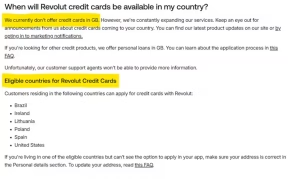
Revolut’s official UK eligibility page confirming that credit cards are currently unavailable in Great Britain while identifying countries where applications are supported.
Revolut Credit Card Available Countries: Where Can Customers Apply?
Revolut currently identifies six countries where eligible residents can apply for its credit cards.
| Country | Credit Card Availability | Important Consideration |
| Brazil | Available | Local lending and eligibility requirements apply |
| Ireland | Available | Credit limits, introductory terms and Irish stamp duty apply |
| Lithuania | Available | Local credit assessments and product conditions apply |
| Poland | Available | Local currency, affordability and contractual terms apply |
| Spain | Available | Local borrowing and repayment conditions apply |
| United States | Available | Credit eligibility and product terms depend on the US offering |
| United Kingdom | Not available | No UK Revolut credit card application |
| Australia | Not available | Personal loans are offered separately |
| Other unsupported markets | Not generally available | Check the latest country-specific eligibility information |
Living temporarily in an eligible country or holding money in that country’s currency does not automatically establish credit card eligibility.
Applicants typically need to satisfy the residence, identity, income and creditworthiness requirements of the country where they are applying.
For example, a British citizen permanently residing and working in Ireland may potentially qualify under Irish conditions. In contrast, a UK resident visiting Ireland on holiday would not become eligible simply by using a Revolut account there.
The practical lesson is that credit card availability depends primarily on the applicant’s qualifying residence and lending assessment, not their nationality or the currency displayed in the app.
Revolut Credit Card Apply: How Does the Application Process Work?
In supported markets, Revolut allows eligible customers to apply through its mobile application. Ireland provides one of the clearest examples of the current application process.
Step 1: Check Your Eligibility
For an Irish Revolut credit card, applicants must meet requirements including:
- Being at least 18 years old.
- Being a resident of the Republic of Ireland with an eligible registered address.
- Meeting employment and qualifying income-payment requirements.
- Having an Irish or UK telephone number registered with Revolut.
- Being an active Revolut customer for at least 30 days.
- Having complete and accurate account information.
- Having no negative Revolut balance or overdue third-party commitments.
Meeting these requirements does not guarantee approval.
Step 2: Open the Revolut App
Eligible customers can open the application and select the Home section.
Below the account balance, select Accounts, then Add new and Credit.
If the credit card option is available, select Credit Card to begin the application.
A customer whose registered country is not supported should not expect to see the same application option.
Step 3: Complete the Credit Application
Applicants may be asked to provide or confirm information about their employment, income, expenses and existing financial commitments.
Revolut assesses this information alongside relevant credit data and its lending policies.
The purpose is to establish whether the applicant can reasonably afford the proposed borrowing.
Step 4: Wait for the Lending Decision
Revolut indicates that many Irish applications receive a decision quickly.
Some require manual underwriting or additional documents. In these cases, the company states that applicants will be notified of its decision within three business days.
An instant decision should not be confused with guaranteed acceptance.
Step 5: Review the Credit Agreement
An approved applicant should examine the offered credit limit, interest rate, repayment obligations, penalties and any promotional conditions.
The approved amount may be lower than the amount initially requested.
Step 6: Activate the Card
Once the agreement has been accepted, eligible customers can choose a physical or virtual credit card.
Virtual cards may allow purchases before a physical card arrives.
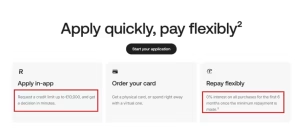
Official Revolut credit card application features showing in-app applications, credit limits, virtual cards and flexible repayment options.
What Is the Revolut Credit Card Limit?
The Revolut credit card limit is the maximum borrowing amount a lender approves for the customer.
It is not a standard amount that every applicant receives.
In Ireland, Revolut currently advertises the ability to request a credit limit of up to €10,000. The actual approved limit depends on the application and underwriting decision.
The main assessment factors may include income stability, existing debt commitments, monthly expenditure, credit history and repayment affordability.
For example, consider three hypothetical applicants.
| Applicant Profile | Financial Circumstances | Potential Lending Assessment |
| Applicant A | Stable income, limited debt and strong repayment history | May support a comparatively higher limit |
| Applicant B | Moderate income and several existing credit commitments | Could result in a more restricted limit |
| Applicant C | Irregular income and recent missed payments | Greater risk of a low limit or rejection |
These are illustrative profiles, not Revolut approval predictions.
Can You Increase the Revolut Credit Card Limit?
The answer depends on the country.
In Ireland, Revolut’s current guidance states that customer-requested increases are not available through the app. Customers can, however, reduce their limits under the applicable conditions.
Other markets, including the United States, have different credit-limit management features.
This is another reason why international Revolut credit card information should not be applied universally.
Is the Credit Limit the Same as the Spending Limit?
No.
A credit limit is the borrowing facility approved by the lender. A spending limit is a control that restricts how much can be spent through a particular card.
For example, a cardholder might have a €5,000 approved credit limit but set a much lower card spending control for personal budgeting.
Lowering an optional spending control does not automatically reduce the underlying credit agreement.
Our view is that customers should choose a credit limit based on repayment affordability rather than treating the maximum available borrowing as an invitation to spend.
What Are the Main Revolut Credit Card Benefits?
Revolut’s main proposition combines borrowing with financial management inside an existing banking application.
The strongest benefits relate to digital accessibility, repayment flexibility and rewards, although their value depends on individual spending habits.
1. Convenient Digital Account Management
Customers with eligible credit cards can monitor transactions, view statements and arrange repayments through the Revolut app.
This may be particularly useful for people who already use Revolut for everyday financial management.
The benefit is organisational rather than purely financial: having borrowing information visible alongside other accounts can make it easier to understand outstanding commitments.
2. Physical and Virtual Credit Cards
Revolut supports virtual credit cards in eligible markets, allowing approved customers to begin using their borrowing facility without waiting for physical delivery.
Physical card availability and designs depend on the plan and market.
Virtual functionality is especially convenient for online transactions and digital-wallet payments.
3. RevPoints Rewards
Certain Revolut credit card purchases can earn RevPoints, subject to the customer’s plan and programme conditions.
In Ireland, the advertised earning rates for selected paid plans include:
| Revolut Plan | Advertised Irish Credit Card Earning Rate |
| Plus | 1.5 RevPoints per €10 |
| Premium | 1.5 RevPoints per €4 |
| Metal | 1 RevPoint per €1 |
| Ultra | 1.5 RevPoints per €1 |
RevPoints may be redeemable for eligible airline miles, gift cards or travel-related rewards.
However, RevPoints are not equivalent to a guaranteed percentage cashback rate. Their practical value depends on the redemption option, programme conditions and any subscription fees associated with the plan.
4. Flexible Repayment Options
Eligible Irish credit card customers can choose between paying the full amount due and using available revolving repayment arrangements.
Certain purchases can also be converted into instalments.
The flexibility can be valuable for managing short-term cash flow, but revolving balances and instalment arrangements may generate interest.
5. Introductory Interest-Free Offers
The Irish credit card currently advertises 0% interest on qualifying purchases and balance transfers for up to six months, subject to meeting minimum repayments and promotional conditions.
This can reduce short-term borrowing costs for customers who clear the relevant balance within the introductory period.
It should not be mistaken for permanently interest-free borrowing.
6. Spending Controls and Notifications
Card-management features can help customers monitor spending and respond quickly to suspicious transactions.
From a financial management perspective, these tools can be useful for reducing the risk of unnoticed transactions or uncontrolled discretionary spending.

Official Revolut credit card benefits showing RevPoints rewards, plan-based benefits and flexible repayments.
How Much Interest Does a Revolut Credit Card Charge?
Interest is one of the most important considerations in any credit card review.
A low advertised fee or attractive rewards programme does not automatically make a credit card inexpensive, particularly if the cardholder regularly carries unpaid balances.
Revolut Credit Card Representative APR
In Ireland, Revolut currently publishes a representative credit card example using a 17.99% variable APR.
The example assumes a single €1,500 purchase repaid over 12 months.
| Financial Detail | Official Irish Example |
| Initial purchase | €1,500 |
| Variable annual interest rate | 13.34% |
| APR | 17.99% |
| Repayment period | 12 months |
| Total interest cost | €110.58 |
| Government stamp duty included | €30 |
| Total amount repayable | €1,640.58 |
The combined difference between the purchase amount and total repayment is €140.58, comprising the stated €110.58 credit cost and €30 stamp duty.
This is a published representative example, not a personalised borrowing quote.
UK applicants should not use 17.99% as an assumed future British Revolut credit card APR. No UK-specific representative credit card APR has been confirmed.
What Happens If You Only Pay the Minimum?
Revolut’s Irish statement guidance specifies a minimum monthly payment of 2.5% of the statement balance or €10, whichever is greater, subject to the amount actually outstanding.
For an illustrative €2,000 statement balance, 2.5% equals €50.
Paying €50 may satisfy the minimum repayment obligation, but it does not clear the remaining €1,950. Interest may continue to accrue on the outstanding borrowing, subject to the credit agreement and applicable promotional terms.
Repeated minimum repayments can therefore increase the total cost and extend the repayment period.
Our financial assessment favours paying the full statement balance wherever affordable, rather than using minimum repayments as a routine long-term strategy.
How Does the Interest-Free Period Work?
Under the ordinary Irish purchase grace-period rules, cardholders generally need to pay their full statement balance by the due date and avoid carrying an unpaid balance from the previous month.
Once an unpaid balance is carried forward, purchase interest can apply and restoring the ordinary grace period may require full repayments for two consecutive months.
Promotional 0% terms operate under separate conditions.
Cash withdrawals and cash-like transactions do not benefit from the ordinary purchase grace period.
What Are the Revolut Credit Card Fees?
Revolut credit card charges vary by market and transaction type.
Ireland provides a useful illustration of the types of fees customers should consider.
| Fee Type | Published Irish Credit Card Terms |
| Credit card administration fee | No administration fee |
| Annual government stamp duty | €30 |
| Late payment fee | Up to €10 under the applicable terms |
| Cash withdrawal fee | 2% or €5, whichever is greater |
| Foreign exchange fees | Depend on plan and transaction |
| Credit card instalment setup | No separate setup fee, although interest applies |
| Replacement card | Depends on plan and circumstances |
An important distinction is that the €30 annual charge is government stamp duty, rather than a standard Revolut subscription fee.
Cardholders may also pay for an optional Revolut plan. A paid plan should therefore be evaluated separately from the credit agreement.
The cheapest arrangement for one customer may not be suitable for another. Someone who travels frequently and uses several plan benefits may extract more value than a customer who only wants a credit card for occasional domestic purchases.
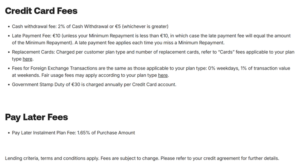
Revolut’s official Irish credit card fees, including cash withdrawal charges, late payment penalties and annual government stamp duty.
Using Revolut Card Abroad: What Fees Should UK Customers Expect?
One of the strongest reasons UK customers consider Revolut is its international spending functionality.
However, using a Revolut card abroad is not automatically free in every circumstance.
UK personal customers are currently using debit cards, so the following charges relate to Revolut’s UK card and exchange arrangements rather than a UK Revolut credit card.
Revolut Foreign Exchange Fees by Plan
| UK Plan | Monthly Exchange Allowance | Additional Fair Usage Fee | Weekend Exchange Fee |
| Standard | £1,000 | 1% above allowance | 1% |
| Plus | £3,000 | 0.5% above allowance | 0.5% |
| Premium | No fair usage exchange limit | None | None |
| Metal | No fair usage exchange limit | None | None |
| Ultra | No fair usage exchange limit | None | None |
The listed percentages concern additional exchange charges. Revolut uses its own variable exchange rate, and the applicable rate and any other exchange fee should be checked before a transaction.
Standard and Plus customers should also remember that the fair usage allowance is shared across applicable currency and other exchanges.
Example: Spending £600 Abroad on a Weekend
Suppose a UK Standard customer spends the equivalent of £600 in another currency and requires Revolut to convert the funds during the weekend charging period.
Assume the customer has not previously used their monthly exchange allowance.
The illustrative charges would be:
| Transaction Detail | Amount |
| Foreign spending equivalent | £600 |
| Fair usage excess fee | £0 |
| Weekend exchange charge at 1% | £6 |
| Illustrative total including weekend charge | £606 |
This simplified example excludes any other applicable exchange-rate effects, merchant conversion charges or transaction-specific costs.
A comparable weekday conversion within the monthly allowance would avoid that particular 1% weekend surcharge.
From our assessment, frequent international travellers should compare their total monthly foreign spending with Revolut’s plan limits before paying for a higher subscription.
What Happens If You Exceed the Exchange Allowance?
Suppose a Standard customer has already exchanged £900 during the current allowance period.
They then make another qualifying exchange equivalent to £400 on a weekday.
Only £100 remains within the fair usage allowance, leaving £300 subject to the additional 1% charge.
The illustrative excess fee would therefore be £3.
This demonstrates why checking cumulative exchange activity matters more than examining each transaction in isolation.
Should You Pay in Pounds or the Local Currency?
When a foreign payment terminal offers a choice between GBP and the local currency, paying in the local currency is generally preferable if you want Revolut to perform the conversion.
Choosing sterling may allow the merchant or its payment provider to apply its own exchange rate through dynamic currency conversion.
That rate may be less competitive, even when the customer has a favourable Revolut plan.
Does Revolut Charge for ATM Withdrawals Abroad?
Revolut’s UK debit card has separate ATM withdrawal allowances.
| Plan | Monthly Withdrawal Allowance Before Revolut Fees |
| Standard | £200 or five withdrawals, whichever comes first |
| Plus | £200 |
| Premium | £400 |
| Metal | £800 |
| Ultra | £2,000 |
After the allowance is exceeded, Revolut applies a withdrawal charge of 2% or £1, whichever is greater.
Foreign exchange charges and fees imposed by ATM operators may apply separately.
These debit card withdrawal rules must not be confused with cash advance charges on an overseas Revolut credit card.
For a detailed comparison of another digital banking provider’s overseas fees, the Monzo charges for spending abroad are relevant to customers choosing a travel payment card.
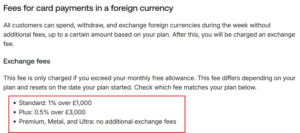
Official Revolut UK foreign exchange limits and weekend fees across Standard, Plus, Premium, Metal and Ultra plans.
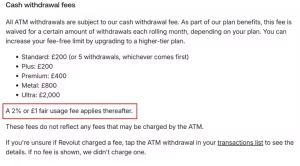
Revolut UK cash withdrawal allowances and charges for customers using their debit cards at ATMs.
Is the Revolut Credit Card Safe?
Revolut’s credit card services operate through regulated financial arrangements in the markets where they are offered.
For example, Irish credit cards are provided by Revolut Bank UAB, which is authorised and regulated by the Bank of Lithuania and the European Central Bank, with applicable Irish consumer protection oversight.
However, the safety of a financial product includes more than whether its provider is regulated.
Customers should consider card security, unauthorised transaction handling, repayment risks, complaint procedures and the relevant legal protections in their issuing country.
Revolut offers digital card controls and transaction monitoring features, but customers must still use appropriate account security practices and review unfamiliar transactions promptly.
Our analysis of Revolut’s banking safety and fraud protections considers the wider account-security issues that matter to UK consumers.
Does the Revolut Debit Card Offer Section 75 Protection?
No.
A UK Revolut debit card does not provide Section 75 protection under the Consumer Credit Act.
For qualifying purchases made with an eligible UK credit card, Section 75 can provide legal protection where the cash price of an item or service is more than £100 and no more than £30,000.
Debit card customers may instead be able to pursue a chargeback claim under card-scheme rules.
Chargeback is not the same statutory protection as Section 75.
For major purchases, travel bookings or transactions involving a risk of supplier failure, this difference can materially affect the customer’s financial position.
Anyone considering frequent cash access from a borrowing facility should also understand credit card withdrawal charges and their consequences.
Can a Revolut Credit Card Help Build Your Credit Score?
A credit card can contribute to a customer’s credit history where the lender reports relevant information to credit reference agencies or registries.
However, whether Revolut reports particular data, and how it affects an individual, depends on the country and credit reporting system.
For customers in eligible countries, responsible repayment behaviour may support a healthy borrowing record over time. Missed payments, arrears or excessive debt can have the opposite effect.
For British residents, there is no Revolut UK credit card currently available to use for building a UK credit history.
A Revolut debit card is not an equivalent credit-building product.
Customers specifically seeking credit-building opportunities may instead consider available UK credit cards, including products covered in our Zable credit card assessment.
Our view is that the most important measure of a credit-building card is not the size of its limit, but whether the borrower can reliably repay the balance and minimise interest.
Revolut Credit Card vs Traditional UK Credit Cards: Which Is Better?
There is no universal winner because the products currently serve different markets.
A Revolut credit card may suit an eligible overseas customer looking for integrated banking and borrowing. A UK resident requiring credit today must consider providers operating in the British credit card market.
| Feature | Revolut Credit Card | Established UK Credit Card |
| Available to UK residents | No | Yes, subject to eligibility |
| In-app account management | Yes in eligible markets | Commonly available |
| Credit building in UK | Not currently through a UK Revolut card | Possible with responsible use and credit reporting |
| Promotional 0% offers | Available in selected markets | Available on selected UK cards |
| UK Section 75 protection | No UK-issued product currently | Available on qualifying purchases |
| Rewards | RevPoints and market-specific benefits | Cashback, points, travel rewards or other benefits |
| Credit limits | Country-specific lending assessment | Lender-specific affordability assessment |
| Balance transfers | Market-specific | Available through selected UK cards |
For a customer who wants to transfer an existing expensive card balance, the best solution may be a specialised UK balance-transfer product rather than a general rewards card.
Comparing the best balance transfer credit cards can help establish whether introductory interest savings outweigh transfer fees.
For customers who mainly want international spending and budgeting features without borrowing, the existing Revolut debit card may be sufficient.
Our Revolut versus Monzo comparison explores the differences between these digital banking services for UK account holders.
What Are the Disadvantages of the Revolut Credit Card?
Despite its benefits, the Revolut credit card proposition has several limitations that borrowers should understand.
- Limited international availability: Although Revolut operates across numerous markets, its credit cards are restricted to selected countries. UK customers currently cannot apply.
- Interest on outstanding balances: The convenience of digital borrowing does not eliminate the cost of carrying debt.
- Country-specific credit terms: An attractive Irish promotion does not establish the terms customers would receive in another country.
- Potential rewards costs: Higher rewards may require a paid plan, and the value of points depends on redemption choices.
- Cash advance charges: Using credit cards to withdraw cash can generate immediate interest and additional fees.
- Credit limit uncertainty: Applicants cannot assume they will receive the maximum advertised limit.
- Repayment responsibility: Minimum payments, automated reminders and app notifications do not remove the need to budget for debt repayment.
- Exchange costs: Weekend currency conversion, fair usage thresholds and cash withdrawal charges may reduce the value of overseas spending benefits.
Our examination of common problems experienced by Revolut users provides additional context on operational limitations, customer support and account-management concerns.
From a financial perspective, borrowing costs remain the main disadvantage of any credit card when customers cannot repay their balances in full.
Revolut Credit Card Review: Our Percentage Ratings for 2026
Our editorial assessment focuses on the features and published terms of the Irish Revolut credit card, one of the markets where its pricing and functionality can be evaluated in detail.
These ratings are our analytical judgements, not customer satisfaction statistics or the results of a hands-on card test.
| Assessment Category | Weight | Editorial Rating |
| Digital account management and accessibility | 25% | 90% |
| Repayment flexibility | 25% | 85% |
| Fee and borrowing-cost transparency | 20% | 70% |
| Rewards and additional benefits | 15% | 75% |
| International spending value | 15% | 70% |
| Weighted overall rating for the Irish proposition | 100% | 80% |
The weighted result is 79.5%, rounded to 80%.
Digital Account Management: 90%
The integration of card controls, statements, transaction visibility and repayment functions is a compelling feature.
It is especially relevant to customers who already manage their finances primarily through mobile applications.
The rating reflects the breadth of documented functionality, not independently measured app reliability.
Repayment Flexibility: 85%
The ability to manage full repayments, revolving balances and eligible instalment arrangements adds flexibility.
Nevertheless, customers need to assess the interest implications carefully.
Fee Transparency: 70%
Published borrowing examples and fee schedules provide valuable information.
However, differences across national markets, paid plans and transaction types make the overall cost less straightforward than a single headline percentage suggests.
Rewards and Benefits: 75%
RevPoints can enhance the value of qualifying purchases, particularly for customers who already use the relevant Revolut plan benefits.
However, rewards are not guaranteed cash savings, and plan subscriptions affect the net value.
International Spending: 70%
Revolut has established strengths in international payment functionality.
However, weekend exchange charges, plan restrictions and the costs applicable to credit card cash withdrawals require careful consideration.
Overall Editorial Rating: 80%
Our 80% editorial rating represents the product proposition assessed under published Irish terms, not a global score for every Revolut credit card.
For UK customers, we separately rate current credit card availability at 0%, because there is no UK credit card application available as of 28 October 2026.
The distinction prevents the features of an overseas product being presented as something British customers can already obtain.
Who Should Consider a Revolut Credit Card?
A Revolut credit card may appeal to an eligible resident in a supported country who prefers a single application for everyday finances and borrowing.
It could be appropriate for someone with a predictable income, an established repayment budget and a preference for digital card controls.
Rewards may provide additional value for customers already using qualifying Revolut plans.
However, customers who regularly carry substantial debt should compare the applicable APR and total repayment cost before prioritising rewards.
Similarly, UK residents seeking immediate credit access should consider currently available British credit cards rather than waiting for a product without an announced launch date.
Our broader assessment suggests that the most suitable card depends on the primary financial objective.
| Financial Objective | More Relevant Option |
| Everyday spending without borrowing | Debit card |
| Building a UK credit history | Eligible UK credit-building card |
| Avoiding interest on existing card debt | Suitable balance-transfer offer |
| Financing a planned purchase | Compare purchase credit cards, loans and total borrowing cost |
| Travelling frequently | Compare foreign exchange and cash withdrawal terms |
| Earning rewards | Compare net reward value after annual or subscription costs |
| Using Revolut credit in an eligible overseas market | Assess the local Revolut credit agreement |
When Will Revolut Launch a Credit Card in the UK?
Revolut’s recent expansion into UK personal loans provides the clearest evidence of its growing consumer lending ambitions.
The company’s October 2026 announcement indicates that credit cards are planned, but an exact launch timetable has not been published.
Before a UK Revolut credit card can be meaningfully assessed, several important details will need to be confirmed.
These include the representative APR, credit limit range, eligibility requirements, annual charges, introductory offers, repayment structure and any rewards programme.
The company will also need to explain how the new credit card integrates with existing Revolut plans and customer account features.
Our assessment is that Revolut’s existing digital infrastructure could make credit card account management convenient. Yet the eventual product’s competitiveness will depend primarily on borrowing costs, protections and suitability rather than app functionality alone.
UK customers should therefore monitor official product announcements without assuming that overseas promotional terms will be replicated.
Final Verdict: Is the Revolut Credit Card Worth It in 2026?
The Revolut credit card offers an interesting combination of modern financial management, flexible borrowing arrangements and rewards in the countries where it is available.
Our review identifies particular strengths in its digital account functionality, accessible repayment controls and integration with existing financial services.
However, the benefits should be assessed against actual borrowing costs. A six-month introductory offer, generous-looking credit limit or rewards programme is only valuable when the customer understands the repayment conditions and can afford the resulting obligations.
For UK residents, the immediate conclusion is straightforward: the Revolut credit card is not yet available, despite the company’s confirmed plans to expand into the British credit card market.
Customers who need borrowing facilities now should compare established UK credit cards based on representative APR, eligibility, interest-free offers and purchase protections.
Those interested primarily in overseas spending may find that Revolut’s existing debit card already provides the functionality they need, provided they account for exchange allowances, weekend charges and ATM limits.
Our overall editorial assessment of the published Irish credit card proposition is 80%, while the practical availability rating for UK credit card applicants remains 0%.
Ultimately, Revolut’s future success in the British credit card market will depend less on how quickly customers can apply through an app and more on whether its credit terms deliver competitive, transparent and responsible borrowing.
Frequently Asked Questions About Revolut Credit Cards
Can I Apply for a Revolut Credit Card in the UK?
No. As of 28 October 2026, Revolut does not offer credit card applications to UK residents. A future launch has been discussed but no confirmed date has been published.
Is Revolut a Credit Card in the UK?
No. The standard Revolut cards currently issued to UK personal customers are debit cards. Revolut offers genuine credit cards in selected overseas markets.
Which Countries Have Revolut Credit Cards?
The officially listed eligible countries are Brazil, Ireland, Lithuania, Poland, Spain and the United States. Applications remain subject to residency and lending requirements.
How Much Credit Can Revolut Give You?
The amount depends on the issuing country and the applicant’s financial assessment. In Ireland, Revolut advertises credit limits of up to €10,000, but individual approved limits may be lower.
Does the Revolut Credit Card Have an Annual Fee?
The answer depends on the market. In Ireland, there is no credit card administration fee, but a €30 annual government stamp duty applies. Optional paid plan charges are separate.
What Is the Revolut Credit Card APR?
Revolut publishes a 17.99% variable APR representative example for Ireland. Other markets have different terms, and no UK Revolut credit card APR has been announced.
Does Revolut Offer an Interest-Free Credit Card?
In Ireland, Revolut currently advertises a six-month 0% introductory offer on qualifying purchases and balance transfers, provided the applicable conditions are met. This is not a permanent 0% borrowing facility.
Can a Revolut Credit Card Be Used Abroad?
Yes, eligible cards may be used internationally where supported by the payment network and issuer. Foreign exchange, cash advance and other charges depend on the country, plan and transaction.
Does Revolut Charge Foreign Transaction Fees?
UK Revolut debit card customers may face exchange fees after plan allowances are exceeded and additional weekend charges on applicable currency conversions. The specific rates vary by subscription level.
Can I Withdraw Cash Using a Revolut Credit Card?
Cash withdrawals may be available according to the issuing market’s rules. In Ireland, the stated credit card cash withdrawal fee is 2% or €5, whichever is greater, with cash advance interest potentially applying.
Can I Use a Revolut Credit Card to Build My Credit Score?
Potentially, in eligible markets where relevant credit information is reported. UK customers cannot currently obtain a Revolut credit card for UK credit-building purposes.
Is the Revolut Credit Card Better Than a Traditional Bank Card?
It depends on the customer’s country, borrowing needs and repayment habits. Revolut’s digital management features may appeal to some users, but interest rates, fees and statutory purchase protections should take priority in any financial comparison.