
Nationwide mortgage rates in October 2026 vary significantly depending on whether someone is buying their first home, moving property, remortgaging or switching an existing mortgage deal.
Based on the latest published mortgage product information, Nationwide offers selected two-year fixed remortgage rates from 5.09%, five-year fixed remortgage rates from 5.11%, and existing-customer fixed rates from 4.89%, subject to eligibility, loan-to-value and product fees.
Our financial analysis shows that choosing the lowest advertised interest rate does not always deliver the lowest borrowing cost. Deposit size, arrangement fees, mortgage duration and the ability to switch products all influence the eventual repayment amount.
We have examined Nationwide’s published mortgage ranges, lending features and the wider UK mortgage market to explain which options may represent better value for different borrowers in 2026.
What Are the Current Nationwide Mortgage Rates in October 2026?
Nationwide’s published mortgage ranges include two-year, three-year, five-year and ten-year fixed-rate products, alongside tracker mortgages linked to the Bank of England base rate.
The following table provides a snapshot of selected rates from the mortgage product guide effective 30 September 2026.
| Borrower category | Two-year fixed | Five-year fixed | Product fee |
| First-time buyer | 5.21% | 5.10% | £999 |
| Home mover | 5.04% | 5.06% | £999 |
| Remortgaging from another lender | 5.09% | 5.11% | £999 |
| Existing Nationwide customer switching | 4.89% | 4.97% | £999 |
Rates are selected examples at up to 60% LTV. The £999-fee new-borrower products generally apply to mortgage loans of £25,000 to £299,999, while existing-customer switch products have separate lending limits. These are not guaranteed rates for every applicant.
For larger qualifying mortgage loans of £300,000 or more, some new-borrower products have a £1,499 fee and a rate approximately 0.05 percentage points lower than the corresponding £999-fee product.
For example, a qualifying home mover borrowing at 60% LTV could access a two-year fixed rate of 4.99% with a £1,499 product fee under the published range.
Our assessment: Nationwide’s pricing is particularly worth checking for existing customers approaching the end of a mortgage deal.
Nevertheless, borrowers should compare offers from other lenders rather than assuming a loyalty rate is always cheapest.
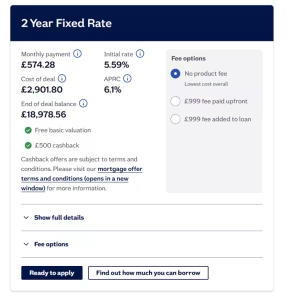
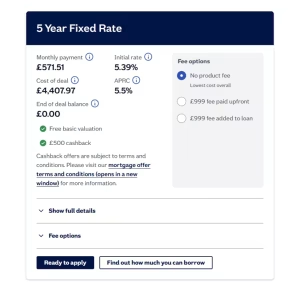
Nationwide’s official mortgage rate comparison tool showing available two-year and five-year fixed products, initial interest rates, product fees and estimated monthly repayments for a selected borrower profile.
What Are Nationwide’s Two-Year Fixed Mortgage Rates?
A two-year fixed-rate mortgage keeps the contractual interest rate unchanged throughout the initial two-year deal period.
This can appeal to borrowers who value predictable monthly repayments but do not want to commit to a five-year or ten-year fixed period.
For new borrowers remortgaging to Nationwide, selected two-year fixed rates published for October 2026 include:
| Loan-to-value | Rate with £999 fee | No-fee rate |
| Up to 60% | 5.09% | 5.46% |
| Above 60% to 75% | 5.26% | 5.52% |
| Above 75% to 80% | 5.34% | 5.63% |
| Above 80% to 85% | 5.37% | 5.63% |
| Above 85% to 90% | 5.49% | 5.80% |
| Above 90% to 95% | 5.74% | 5.84% |
These figures apply to borrowers switching from another lender under the specified remortgage range. Higher-fee products, loan-size restrictions and special eligibility conditions may apply.
Advantages of a two-year fixed mortgage
A two-year deal provides payment certainty for a relatively short period. Borrowers may be able to move onto a different mortgage product sooner if market interest rates become more favourable.
However, there is no guarantee that rates will fall. Someone choosing a two-year fixed deal during October 2026 must consider the possibility of having to refinance at a higher rate in 2028.
Nationwide’s published two-year fixed products also carry early repayment charges during their deal period, normally declining from 2% in the first year to 1% in the second year, subject to the individual mortgage agreement.
What Are Nationwide’s Five-Year Fixed Mortgage Rates?
Five-year fixed mortgages provide a longer period of repayment certainty.
Our comparison indicates that several Nationwide five-year products are priced below their corresponding two-year deals, although this varies according to borrower category and LTV.
For new customers remortgaging to Nationwide, the published five-year rates include:
| Loan-to-value | Rate with £999 fee | No-fee rate |
| Up to 60% | 5.11% | 5.31% |
| Above 60% to 75% | 5.23% | 5.41% |
| Above 75% to 80% | 5.39% | 5.49% |
| Above 80% to 85% | 5.39% | 5.50% |
| Above 85% to 90% | 5.40% | 5.53% |
| Above 90% to 95% | 5.69% | 5.79% |
A five-year fix may be suitable for households that prioritise reliable monthly budgeting or expect to remain in their property for several years.
However, borrowers considering an early house move, substantial mortgage overpayments or refinancing should evaluate the early repayment charges carefully.
For Nationwide’s published five-year fixed products, charges generally begin at 5% in the first year and reduce annually, reaching 1% in the fifth year.
Our analysis suggests that borrowers should compare the total cost over the fixed period, not simply choose the longest deal with the lowest advertised rate.
How Much Are Nationwide Mortgage Rates for First-Time Buyers?
Nationwide offers mortgages for first-time buyers with deposits as low as 5%, subject to lending criteria and affordability.
A deposit representing 5% of the purchase price normally means borrowing the remaining 95%, resulting in a 95% LTV mortgage.
The published first-time buyer fixed-rate range includes the following examples:
| Maximum LTV | Two-year fixed | Five-year fixed |
| 60% | 5.21% | 5.10% |
| 75% | 5.28% | 5.23% |
| 90% | 5.47% | 5.35% |
| 95% | 5.79% | 5.69% |
These examples use £999-fee products for the relevant loan-size bands. Different rates apply to fee-free products and qualifying loans of £300,000 or more.
For someone buying a £300,000 property with a £30,000 deposit, the mortgage required would be £270,000.
That represents 90% LTV.
By contrast, putting down £60,000 would reduce the mortgage to £240,000, representing 80% LTV.
A higher deposit may improve access to lower mortgage rates, although the overall benefit must be balanced against the need to retain sufficient emergency savings.
Nationwide Helping Hand Mortgage
Nationwide’s Helping Hand programme is designed to help eligible first-time buyers borrow more than may be available through a standard affordability assessment.
Under the scheme, qualifying applicants may be able to borrow up to six times their income through selected five-year or ten-year fixed mortgage products.
Availability extends to eligible borrowers at up to 95% LTV, but income, affordability and other lending conditions apply.
Borrowing six times an applicant’s income is not an automatic entitlement.
First-time buyer cashback
Nationwide also offers £500 cashback to qualifying first-time buyers on completion.
Eligible buyers of energy-efficient homes may qualify for an additional Green Reward, depending on the property’s characteristics and the applicable terms.
Our assessment is that cashback should be considered alongside mortgage fees and interest charges rather than treated as the main reason to choose a particular mortgage product.
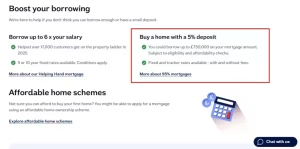
Nationwide’s official first-time buyer mortgage page highlighting 5% deposit mortgages, Helping Hand borrowing eligibility and the £500 first-time buyer cashback benefit.
What Are Nationwide’s Remortgage Rates for Existing Homeowners?
Remortgaging involves moving a mortgage from an existing lender to Nationwide, generally to secure a new interest rate or adjust the borrowing arrangement.
For example, a homeowner whose fixed mortgage with another bank is approaching expiry could consider Nationwide alongside their present lender’s renewal offer.
Our review identifies three important considerations.
Mortgage valuation
The property valuation determines the LTV band used when assessing available mortgage products.
A borrower with a £200,000 outstanding mortgage on a property worth £400,000 has 50% LTV and may qualify for mortgage products within the 60% LTV band.
If the property’s value declines, that same borrower could find themselves in a higher LTV category, potentially affecting available interest rates.
Remortgage incentives
Nationwide’s published remortgage products include a free standard valuation and a choice of free standard legal fees or £500 cashback, subject to the offer terms.
Borrowers should compare the practical value of these benefits, including whether legal work outside the standard scope generates additional charges.
Additional borrowing
Remortgaging to increase a mortgage balance may involve different lending restrictions.
For example, Nationwide’s published criteria distinguish between like-for-like remortgages and applications that increase borrowing.
The availability of 95% LTV remortgage products should not be interpreted as permission to borrow additional money up to 95% of the property’s value.
In the published range, 95% LTV remortgages are generally restricted to like-for-like borrowing.
Are Nationwide’s Existing Customer Mortgage Rates Better?
One important finding from our assessment is that existing Nationwide customers may have access to mortgage switch rates that differ from those offered to people moving their mortgage from another lender.
Selected published existing-customer fixed rates include:
| Loan-to-value | Two-year fixed | Five-year fixed |
| Up to 60% | 4.89% | 4.97% |
| Above 60% to 75% | 4.95% | 5.11% |
| Above 85% to 90% | 5.38% | 5.30% |
| Above 90% to 95% | 5.69% | 5.64% |
Rates shown are selected existing-customer products with a £999 fee, not personalised offers.
At 60% LTV, for instance, the listed two-year existing-customer switch rate of 4.89% was 0.20 percentage points below the 5.09% equivalent new-customer remortgage product.
However, this does not establish that Nationwide’s existing-customer product beats every competing lender.
When can existing members switch?
Nationwide normally allows eligible borrowers to arrange a new fixed-rate mortgage when they have fewer than four months remaining on their current deal.
If the replacement deal begins when the existing fixed period ends, borrowers can generally avoid an early repayment charge.
Switching immediately before the existing deal ends may still result in charges.
There is generally no new affordability assessment for an eligible straightforward product switch, although the process differs if the borrower wants to increase borrowing or make other substantial mortgage changes.
We recommend checking the precise deal end date, available switch rates and potential charges before submitting an application.
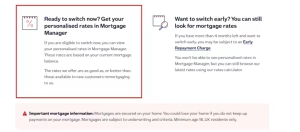
Nationwide’s official existing-customer switching page explaining how Mortgage Manager displays personalised rates and how members can arrange a replacement mortgage deal.
What Are Nationwide’s Tracker Mortgage Rates?
Nationwide also provides tracker mortgage products with interest rates directly linked to changes in the Bank of England base rate.
As of October 2026, Bank Rate stands at 3.75%, following the Monetary Policy Committee’s September decision.
Under Nationwide’s published range, selected two-year tracker products include:
| Borrower category | Initial tracker rate | Product fee |
| First-time buyer, 60% LTV | 4.17% | £999 |
| Home mover, 60% LTV | 4.09% | £999 |
| Remortgage, 60% LTV | 4.17% | £999 |
For example, Nationwide’s 4.17% tracker represents Bank Rate of 3.75% plus a margin of 0.42 percentage points.
If Bank Rate increased by 0.25 percentage points, the tracker rate would normally increase to 4.42%, assuming the agreed margin remained unchanged.
The reverse would apply if Bank Rate fell by the same amount.
Tracker products therefore offer potential savings when variable rates remain favourable, but they expose borrowers to payment increases.
The published Nationwide tracker products have no early repayment charge. This can be particularly useful for borrowers who may want to refinance before the tracker period expires.
Our analysis suggests that trackers deserve consideration alongside fixed products, but only when borrowers have sufficient flexibility in their household budget to absorb potential rate increases.
How Much Would a Nationwide Mortgage Cost Each Month?
Mortgage repayments depend on the amount borrowed, interest rate, mortgage term and repayment type.
To demonstrate the financial impact, we modelled a £250,000 repayment mortgage over 25 years, assuming the stated annual interest rate remained unchanged for the calculation.
| Interest rate | Estimated monthly repayment |
| 4.17% | £1,343 |
| 4.89% | £1,446 |
| 5.09% | £1,475 |
| 5.11% | £1,478 |
| 5.46% | £1,529 |
| 6.00% | £1,611 |
| 6.49% | £1,686 |
Illustrative capital-and-interest repayments, rounded to the nearest pound. Product fees, insurance, other costs and future changes in interest rates are excluded.
The difference between a 5.09% mortgage and a 6.49% mortgage amounts to approximately £212 per month on this example.
Over twelve months, that represents approximately £2,544 in payment differences, although the comparison also involves different principal repayment amounts.
Borrowers can test their individual deposit, interest rate, repayment period and potential overpayments using a UK mortgage repayment calculator.
How does a 1% interest rate increase affect repayments?
Consider the same £250,000 mortgage over 25 years.
At an interest rate of 5%, monthly repayments would be approximately £1,461.
At 6%, repayments increase to approximately £1,611.
That is an increase of roughly £149 each month.
At 7%, repayments would rise further to around £1,767.
This demonstrates why affordability should be assessed against a range of potential future borrowing costs rather than only the current introductory mortgage rate.
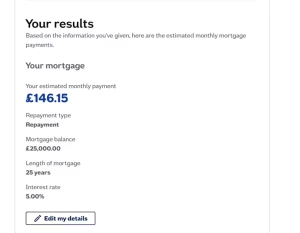
Nationwide’s official mortgage repayment calculator showing the impact of a change in interest rates on estimated monthly mortgage payments.
Are Nationwide Mortgages Cheaper With a Product Fee?
Nationwide offers mortgage products with different arrangements for product fees.
Some mortgages charge £999, while selected larger-loan products carry fees of £1,499. Other mortgage products are available without a product fee.
A lower mortgage rate is not necessarily cheaper once those fees are included.
Our analysis illustrates this using two published Nationwide remortgage options for borrowing £250,000 at 60% LTV over a 25-year repayment term.
| Mortgage feature | Fee-paying option | Fee-free option |
| Two-year initial fixed rate | 5.09% | 5.46% |
| Product fee | £999 | £0 |
| Monthly payment | £1,475 | £1,529 |
| Approximate interest over 24 months | £24,950 | £26,791 |
| Interest plus upfront product fee | £25,949 | £26,791 |
Under these assumptions, the fee-paying option costs approximately £842 less over two years in interest and the product fee combined.
This calculation accounts for the reducing mortgage balance during the two-year period. It excludes other costs and assumes the £999 fee is paid upfront rather than added to the loan.
For smaller mortgages, the lower interest rate might not generate enough savings to justify a substantial arrangement fee.
Nationwide allows some product fees to be added to the mortgage balance, but interest will then be charged on the additional borrowing.
Our assessment is that borrowers should compare both repayment amounts and remaining mortgage balances at the end of the fixed period when deciding between fee-paying and fee-free products.
Why Have Nationwide Mortgage Rates Increased in 2026?
Nationwide mortgage rates have been affected by wider movements in UK wholesale borrowing costs.
During August 2026, Nationwide announced reductions to selected fixed mortgage products. However, subsequent increases in market funding costs contributed to higher rates across parts of the mortgage market during September and October.
Industry data published in early October showed average UK fixed mortgage rates around:
- Two-year fixed mortgages: 5.98%.
- Five-year fixed mortgages: 6.00%.
These are market averages, not Nationwide-specific figures.
Bank of England interest rates
The Bank of England maintained its base rate at 3.75% in September 2026.
Its Monetary Policy Committee voted six to three to maintain the rate, with three members favouring an increase to 4%.
The next scheduled decision is 5 November 2026.
The Bank of England’s September monetary policy announcement also highlighted inflationary pressures and uncertainty around energy prices.
Why fixed rates can change without a base rate decision?
Fixed mortgage prices depend significantly on financial market expectations and wholesale funding conditions, including swap rates.
If lenders face higher costs to secure fixed-rate funding, mortgage products can become more expensive even while Bank Rate remains unchanged.
For that reason, borrowers should not assume that Nationwide will wait for the next Bank of England announcement before changing its mortgage rates.
How Does Nationwide Compare With Other Mortgage Lenders?
Nationwide competes with several major UK mortgage providers, including HSBC, Halifax, Santander, NatWest and Barclays.
Our review of the October 2026 remortgage market indicates that Nationwide’s 5.09% two-year fixed and 5.11% five-year fixed products at 60% LTV were comparable with selected HSBC products charging the same £999 arrangement fee.
However, the relative ranking of lenders changes across deposit bands, loan sizes and fixed-rate durations.
For example, a lender offering a slightly higher rate but a lower product fee may provide better overall value for a borrower with a modest outstanding mortgage.
A comparison should also account for mortgage eligibility, property type, incentive payments, legal arrangements, early repayment charges and the rate applied after the introductory period.
Our editorial assessment of Nationwide mortgages
We assessed the mortgage offering against four criteria: published rate competitiveness, charges, borrower accessibility and product flexibility.
| Assessment category | Editorial score |
| Rate competitiveness | 80% |
| Product fees and charges | 74% |
| Borrower options and accessibility | 82% |
| Mortgage flexibility | 85% |
| Overall assessment | 80% |
These are our indicative editorial scores, not Nationwide performance statistics, independently measured customer satisfaction ratings or the results of an expert survey. The overall score is weighted using 35% for rates, 25% for fees, and 20% each for accessibility and flexibility, rounded to the nearest percentage point.
Nationwide scores positively in our evaluation for providing fixed and tracker mortgages, low-deposit lending options, existing-customer switching facilities and a selection of fee-free deals.
The main disadvantages are that some of its lower fixed rates require a product fee, its cheapest advertised products are not available to all borrowers and fixed-rate early repayment charges can restrict flexibility.
What Happens When a Nationwide Fixed Mortgage Ends?
When a Nationwide fixed or tracker deal reaches the end of its introductory period, the mortgage will normally move onto the reversion rate stated in the customer’s mortgage agreement unless a replacement product is arranged.
Nationwide’s published Standard Mortgage Rate was 6.49% variable in October 2026.
This is significantly higher than some of its selected existing-customer fixed rates.
However, the appropriate reversion rate depends on the individual mortgage and product history. Some borrowers have different contractual arrangements, including Base Mortgage Rate products.
Our analysis indicates that borrowers should begin reviewing refinancing options several months before an introductory rate expires.
For someone approaching the end of a fixed period, important checks include their outstanding balance, property valuation, available new interest rates and whether an early repayment charge would apply.
An existing member should also consider whether any Nationwide member benefits and Fairer Share eligibility apply to their wider banking relationship. Such benefits are conditional and should not outweigh the long-term mortgage cost comparison.
Can Nationwide Mortgage Borrowers Make Overpayments?
Nationwide provides overpayment flexibility across many of its residential mortgage products.
Under the published fixed-rate range, borrowers can generally overpay up to 10% of the initial mortgage balance annually without an early repayment charge, subject to the product terms.
Tracker mortgage products may offer greater flexibility.
For example, a borrower with a £250,000 starting balance could have a 10% annual penalty-free allowance equivalent to £25,000 under an eligible product.
However, the precise allowance, definition of the relevant balance and potential consequences for monthly payments should be confirmed against the individual mortgage agreement.
Overpaying reduces the outstanding principal and can lower the amount of interest charged over the remaining mortgage term.
Our view is that borrowers should prioritise retaining sufficient emergency savings before making substantial voluntary mortgage overpayments.
How Can Borrowers Apply for a Nationwide Mortgage?
Nationwide offers mortgage applications directly and through mortgage intermediaries.
Step 1: Calculate the deposit and LTV
Establish the property price, available deposit and amount required.
The resulting LTV helps identify which mortgage pricing bands may apply.
Step 2: Review borrowing affordability
Assess household earnings, regular expenditure, credit commitments and any foreseeable financial changes.
Nationwide’s borrowing calculator can provide an initial indication, although this is not a formal mortgage offer.
Step 3: Compare mortgage products
Compare fixed and tracker deals, including interest rates, product fees, cashback, lending criteria and charges for exiting early.
Step 4: Obtain a Decision in Principle
A Decision in Principle provides an initial indication of potential borrowing based on the information supplied and the lender’s assessment.
It does not guarantee final mortgage approval.
Step 5: Submit the full application
The applicant will normally need identity documents, evidence of income, details of employment, financial commitments and information about the property.
Self-employed applicants may need tax calculations, business accounts or other evidence of earnings.
Step 6: Complete the mortgage process
Nationwide will assess the application, property valuation and supporting information before deciding whether to issue a formal mortgage offer.
A suitable solicitor or conveyancer then handles the relevant legal stages of the property transaction.
Importantly, Nationwide states that the mortgage rate can only be secured after the application has been submitted and any required upfront fees paid.
Is Nationwide a Good Mortgage Lender in 2026?
Our assessment is that Nationwide deserves consideration among major UK mortgage lenders, particularly for existing borrowers seeking a product switch and first-time buyers considering longer fixed-rate products.
The building society provides a broad range of mortgage options, including loans with smaller deposits, alternative product-fee structures and tracker deals.
Nevertheless, the most appropriate mortgage depends on the borrower’s circumstances.
A first-time buyer with a 5% deposit will not normally qualify for the same pricing as a homeowner with 40% equity.
Similarly, a customer who expects to move property in two years may have different priorities from someone intending to stay in their home for ten years.
Our financial evaluation therefore favours comparing total mortgage costs, repayment flexibility and affordability over simply selecting the lowest advertised percentage.
Final Thoughts
Nationwide mortgage rates in October 2026 provide a range of choices for first-time buyers, home movers, remortgagers and existing customers.
Our review indicates that existing borrowers may find particularly attractive fixed-rate switching options, while first-time buyers can benefit from 5% deposit mortgages, potential Helping Hand borrowing and eligible cashback incentives.
However, no single Nationwide mortgage rate is best for every borrower.
The most important decision is whether the initial interest rate, product charges, fixed-period duration and future repayment risks align with the borrower’s financial position.
Before applying, borrowers should check the current product terms, obtain a personalised mortgage illustration and compare suitable alternatives across the wider market.
Frequently Asked Questions
What is the lowest Nationwide mortgage rate in October 2026?
Under the published range, an eligible existing customer could obtain selected fixed rates from 4.89% at 60% LTV with a £999 fee. New-customer rates depend on the borrowing category and product conditions.
Are Nationwide mortgage rates going down in 2026?
Nationwide reduced selected rates earlier in 2026, but mortgage funding costs increased later in the year. Further reductions are possible but cannot be guaranteed.
Does Nationwide offer a 95% mortgage?
Yes. Nationwide offers selected mortgages up to 95% LTV, allowing eligible buyers to purchase with a 5% deposit.
Can Nationwide mortgage rates be negotiated?
Nationwide normally offers rates through published or personalised products rather than individual interest-rate negotiation. Borrowers may improve eligibility for different products by reducing their LTV or changing other borrowing parameters.
Can I switch my Nationwide mortgage before it expires?
Yes. Existing customers may arrange a replacement deal before expiry, although an early repayment charge may apply depending on when the new deal starts.
Are Nationwide tracker mortgages cheaper than fixed mortgages?
Some published tracker rates are initially lower than fixed-rate alternatives. However, repayments can rise if Bank Rate increases, so the tracker may not remain cheaper over the full deal period.
Does Nationwide charge for early mortgage repayment?
Early repayment charges can apply to fixed-rate mortgages when borrowers repay or switch before the contractual deal ends. The charge depends on the product and remaining fixed period.
Is a two-year or five-year Nationwide mortgage better?
A two-year fix offers an earlier opportunity to refinance, while a five-year fix provides longer payment certainty. The better option depends on total costs, future plans and tolerance for interest-rate risk.