The Zable credit card is one of the more interesting UK credit-building cards in 2026 because it combines an app-first experience, soft-search eligibility checking, virtual-card access and no foreign transaction fee with lending aimed partly at people who may not qualify for the cheapest mainstream credit cards.
But there is an important catch.
Zable is not automatically cheap credit.
Depending on the product offered, the representative APR can range from 29.9% variable on Zable+ to 48.9% variable on the standard Zable credit card. Zable also has a balance-transfer version offering up to six months at 0%, although that is significantly shorter than many mainstream balance-transfer deals.
After analysing Zable’s current products, fees, eligibility rules, customer feedback and competing cards, our overall assessment is:
Zable is strongest as an app-based credit-building and everyday spending card for people who value accessibility, instant account management and fee-free overseas purchases.
It is much less attractive for somebody intending to carry a large balance for a long period, particularly if they receive the standard 48.9% representative APR.
Our Zable Credit Card Rating
| Category | Our Rating |
| Overall | 4.3/5 |
| Credit-building features | 4.5/5 |
| Application and eligibility process | 4.6/5 |
| App and account management | 4.7/5 |
| Overseas spending | 4.6/5 |
| Fees | 4.4/5 |
| Cost of carrying a balance | 3.0/5 |
| Balance-transfer proposition | 3.1/5 |
| Rewards and cashback | 2.5/5 |
| Suitability for people with weaker credit | 4.4/5 |
Review updated: 7 October 2026.
Credit-card rates, limits and promotional terms can change. Applicants should always check the personalised offer and Summary Box before accepting credit.
What Is the Zable Credit Card?
Zable is an app-focused consumer credit brand operated by Lendable Ltd, a UK lender authorised and regulated by the Financial Conduct Authority.
Its credit cards are designed around relatively simple mobile management.
Cardholders can use the Zable app to:
- See spending in real time
- Receive transaction notifications
- Make repayments
- Manage recurring repayments
- Freeze their card
- Change their PIN
- Monitor their available balance
- Check their credit score
- See potential credit-limit progress
- Access card information
- Manage a virtual card.
- Zable is particularly visible in the credit-building part of the UK card market.
That does not mean every Zable applicant has bad credit.
People with a limited credit history, younger credit files, past credit problems or simply a preference for an app-based card may all consider it.
A particularly useful distinction, however, is that pages describing a Zable travel credit card, virtual credit card, credit card for bad credit and credit card for no credit history do not necessarily represent completely separate card products.
They describe different ways in which the Zable card range can be used.
The core comparison should therefore focus on the actual Zable card propositions.
Which Zable Credit Cards Are Available?
As of October 2026, the main Zable card range can be broken down into three propositions.
| Zable Card | Representative APR | Main Feature | Credit Limit | Annual Fee | Foreign Transaction Fee |
| Zable+ | 29.9% variable | Lower APR and higher potential limit | Up to £4,000 | £0 | £0 |
| Zable+ Balance Transfer | 34.9% variable purchase APR | Up to 6 months at 0% on transferred balances | Personalised | £0 | £0 |
| Zable Credit Card | 48.9% variable | Credit building | Personalised and potentially reviewed over time | £0 | £0 |
All three also share important digital features including rapid eligibility decisions and the potential for same-day spending through a digital card.
The distinction between these cards matters.
Someone searching simply for “Zable credit card APR” could find a 29.9% figure on one Zable page and 48.9% elsewhere.
Those figures do not necessarily contradict each other.
They can relate to different Zable products and personalised eligibility outcomes.
1. Zable+ Credit Card
Check the Zable+ Credit Cards Here
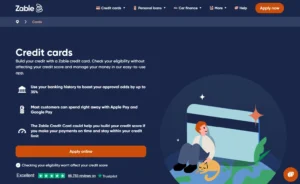
The Zable+ card is currently the most attractive general Zable product from a borrowing-cost perspective.
Its representative example is:
29.9% representative APR variable, based on assumed borrowing of £1,200.
Credit limits can reach up to £4,000, subject to eligibility.
That puts Zable+ considerably closer to mainstream credit-builder pricing than the standard Zable card.
For someone who qualifies for Zable+, the combination of:
- 29.9% representative APR
- No annual fee
- No foreign transaction fee
- Potential limit up to £4,000
- Virtual-card access
- Apple pay and Google pay
- App-based repayments
makes it a competitive proposition.
However, the important words are subject to eligibility.
An applicant should not assume that seeing the 29.9% representative rate means that this is the card or rate they will personally receive.
2. Zable+ Balance Transfer Credit Card
Check the Zable balance-transfer Credit Cards Here
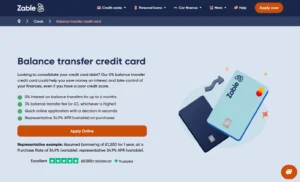
The Zable balance-transfer credit card currently offers:
- 0% interest on qualifying balance transfers for up to six months.
- A 3% balance-transfer fee applies, subject to a minimum £3 fee.
Its representative purchase rate is currently 34.9% variable.
Suppose somebody transfers £3,000.
A 3% fee would add:
£90
That means approximately £3,090 would need to be cleared.
To repay that amount completely within six months, the borrower would need to pay roughly:
£515 per month.
On a £5,000 transfer, the 3% fee would be £150.
The resulting £5,150 would require repayments of roughly:
£858.33 per month over six months.
This illustrates the main weakness of the Zable balance-transfer card.
Six months is not a long interest-free period.
Our comparison of the best balance transfer credit cards in the UK found mainstream deals extending as far as 38 months at 0% in October 2026.
Zable therefore should not be viewed as the market leader for the longest balance-transfer period.
Its advantage may instead be relevant to applicants who cannot qualify for some mainstream balance-transfer products and receive a workable personalised Zable offer.
A borrower should calculate whether the entire transferred balance can realistically be cleared within six months.
If not, the rate applying after the promotional period becomes much more important.
3. Standard Zable Credit Card
Check the standard Zable Credit Cards Here
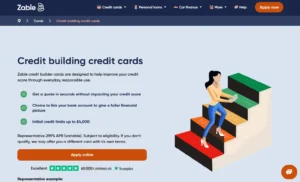
The standard Zable credit card is positioned more directly around improving or establishing credit history.
Its current representative example is:
- 48.9% APR variable, based on assumed borrowing of £1,200.
- That is a high borrowing rate.
- It does not necessarily make the card a bad product.
- It changes how the card should ideally be used.
Someone who puts £50 or £100 of ordinary monthly spending on the card and clears the statement balance completely can use a credit-building card very differently from somebody who repeatedly carries £1,000 of debt from month to month.
The standard Zable card makes most financial sense when used as a payment and credit-building tool rather than long-term borrowing.
What Is Good About the Zable Credit Card?
Several parts of Zable’s proposition stand out.
Soft Eligibility Check Before Applying
One of the most useful features is the ability to check eligibility without immediately creating a hard search on the applicant’s credit report.
The initial eligibility check is a soft search.
Applicants can potentially see:
- Whether they are pre-approved
- Their possible APR
- Their potential credit limit.
Only after accepting the offer and signing the credit agreement does Zable perform the hard search associated with the full application.
That is preferable to blindly making several full credit-card applications.
Repeated unsuccessful hard applications can make an already weak credit profile more difficult to manage.
Open Banking Can Give Zable More Information
Zable allows applicants to connect their bank account through Open Banking.
This can give the lender more information about the applicant’s current finances rather than relying exclusively on the traditional credit file.
Zable says connecting a bank account can increase approval odds by up to 35% in some circumstances.
Its eligibility information also says linking a bank account could produce an average credit-limit increase of more than £500 for qualifying customers during the application process.
Neither outcome is guaranteed.
But it is one of the more distinctive elements of Zable’s underwriting process.
This can potentially matter for people whose credit file does not fully reflect their present financial position.
No Annual Fee
Zable currently charges no annual fee across its core card range.
For a credit-building card this is important.
There is little reason to pay an annual membership fee merely to establish repayment history when several no-fee alternatives exist.
No Foreign Transaction Fee
Another strong feature is no Zable foreign transaction fee on ordinary overseas card spending.
Transactions are converted into pounds using the applicable Mastercard exchange rate.
Many standard UK cards charge close to 3% for non-sterling transactions.
On £1,000 of overseas card purchases, a 3% foreign transaction charge would cost approximately £30.
Zable’s £0 foreign transaction fee therefore gives it a genuine travel advantage.
However, this does not mean everything abroad is fee-free.
Cash withdrawals are different.
Fast Virtual Card Access
Most eligible customers can access their virtual card quickly after approval rather than waiting for the plastic card to arrive.
It can be added to:
Apple Pay or Google Pay.
That makes the card potentially usable on the same day.
Zable says the physical card normally arrives within approximately five to seven days.
Useful App Controls
The app is arguably one of Zable’s strongest features.
Real-time spending information is particularly valuable with a credit-building card because the objective is not merely to obtain credit.
The objective is to control it.
Being able to see spending immediately can help prevent the common problem where small purchases accumulate into an unexpectedly large statement.
What Are the Main Drawbacks?
The biggest disadvantages become clearer when Zable is compared with the wider market.
The Standard 48.9% APR Is Expensive
A 48.9% representative APR is materially higher than many mainstream cards.
Even within the specialist credit-building market, competitors advertise lower representative rates.
That does not matter much if a qualifying purchase is repaid during the applicable interest-free period.
It matters enormously if a substantial balance is carried for months.
Zable should therefore not be treated as inexpensive revolving credit simply because the card itself has no annual fee.
Six Months Is a Short Balance-Transfer Period
The balance-transfer card has a useful 0% feature but six months is short relative to the wider UK market.
Mainstream balance-transfer deals currently extend well beyond two years and in some cases beyond three years.
A borrower capable of repaying £3,000 at £515 a month may find six months sufficient.
Someone who can afford only £100-£150 per month clearly needs a very different repayment timeframe.
Cash Withdrawals Are Expensive
Zable charges:
3% of the cash withdrawal, with a minimum £3 fee.
That minimum makes very small withdrawals disproportionately expensive.
For example:
| Cash Withdrawal | Zable Fee | Fee as % of Cash Withdrawn |
| £20 | £3 | 15% |
| £50 | £3 | 6% |
| £100 | £3 | 3% |
| £200 | £6 | 3% |
Zable currently permits physical-card ATM withdrawals of up to £300 per day.
Cash withdrawals are also reported to credit-reference agencies.
For routine cash requirements, using a debit card is usually preferable.
Our explanation of withdrawing cash from a credit card covers why credit-card cash advances can become particularly expensive.
Late Payments Can Cost Up to £12
If at least the required minimum payment is not made by the due date, Zable says a late fee of up to £12 may be charged.
The bigger issue is not necessarily the £12.
A late payment may also appear in the customer’s credit history.
That is particularly counterproductive for somebody who opened the card specifically to improve their credit profile.
Can Zable Really Build Your Credit Score?
Potentially, yes.
But simply owning a Zable card does not automatically improve a credit score.
What matters is how the account is operated.
Credit-building normally depends on behaviour such as:
- Paying on time
- Remaining within the credit limit
- Avoiding persistent high balances
- Keeping overall borrowing manageable
- Avoiding repeated unsuccessful applications
- Maintaining the account consistently.
Late payments, missed payments or excessive borrowing can have the opposite effect.
This is why we see the Zable card primarily as a credit-management tool.
Someone could use the card for a regular £50 subscription or £100 of ordinary spending, allow the statement to generate, and then repay the statement balance completely.
That establishes repayment activity without deliberately carrying expensive debt.
There is no reason to pay large amounts of interest purely because somebody believes interest payments themselves build credit.
They do not.
Does Zable Offer Interest-Free Purchases?
Zable offers the potential for a 35-day interest-free period when the customer pays their full statement balance by the required payment date.
This point is easy to overlook.
The high representative APR does not mean every purchase automatically results in interest.
A cardholder using the available interest-free arrangement and clearing the statement completely may avoid purchase interest.
By contrast, somebody making only minimum repayments can remain in debt for considerably longer and pay much more interest.
For most people using Zable for credit building, paying the statement balance in full is therefore the strongest strategy where affordable.
How Much Is the Minimum Zable Payment?
The minimum payment depends on the account.
Zable says it will normally be the greater of:
£5, or
the applicable interest charged plus 1% or 2% of the statement balance excluding interest.
The exact amount is shown on the monthly statement.
Zable also displays a recommended payment.
For many cards this is around 5% of the credit limit or £20, whichever is higher, although account terms can vary.
Paying only the contractual minimum may keep the account current, but it is rarely the cheapest way to clear expensive credit-card borrowing.
Can You Increase a Zable Credit Limit?
This is an area where some third-party information about Zable can be misleading.
Customers currently cannot simply request a higher credit limit whenever they want.
Zable automatically reviews eligible accounts.
If a higher limit becomes available, it contacts the customer.
For many accounts these reviews can take place monthly.
Starter Card customers become eligible for the automatic review process after six months.
If an offered increase is accepted, the account will generally not be reviewed again for another three months.
Customers can, however, ask for their credit limit to be reduced.
That difference is worth understanding.
Responsible use can increase the chance of becoming eligible for a larger limit, but there is no guarantee that using the card for a specific number of months will produce an increase.
Is Zable Good for Bad Credit?
Zable can be a strong card to check if somebody has poor or limited credit.
That is different from saying approval is guaranteed.
Zable specifically markets cards for people with weaker credit and uses information beyond a simple consumer-facing credit score.
A soft-search eligibility checker also means someone can establish whether an offer may be available before proceeding to a hard application.
However, consumers with credit problems should compare the cost of any offer carefully.
A high acceptance probability does not make high-interest borrowing affordable.
Anyone considering borrowing a larger fixed amount should also compare alternatives rather than assuming a credit card is automatically appropriate.
Our analysis of borrowing with bad credit explains why total repayment and affordability can be more important than simply finding the lender most likely to approve an application.
Can You Get Zable With No Credit History?
Potentially.
Zable markets its product to people with limited or no established credit history as well as those rebuilding previous credit problems.
A thin credit file and a damaged credit file are not the same thing.
Someone aged 20 who has never borrowed may have little information for lenders to analyse.
Someone aged 40 with several missed payments and defaults has a very different credit profile.
Yet both could struggle with conventional credit scoring.
Zable’s use of additional financial information may be helpful in this area, but each application remains subject to affordability and eligibility checks.
What Do You Need to Apply for Zable?
Zable’s general eligibility information currently states applicants need to:
- Be aged over 18
- Live in the UK
- Not already have a Zable credit card
- Receive monthly income of more than £800.
Additional identity, affordability and credit checks apply.
The eligibility checker normally asks for information such as:
- Name
- Address
- Date of birth
- Mobile number
- Email address
- Income information.
Applicants may then be offered the opportunity to connect their bank account.
Meeting minimum criteria does not guarantee approval.
How Does the Zable Eligibility Checker Work?
The process is straightforward.
Step 1: Complete the Soft Check
Use the Zable eligibility checker and enter the required personal and financial information.
The initial check should not affect the credit score.
Step 2: Review the Offer
If pre-approved, the applicant can see relevant information about the potential card.
Pay particular attention to:
APR, credit limit and the specific card being offered.
Do not assume that the headline rate on an advert will necessarily be your rate.
Step 3: Decide Whether to Continue
Only continue if the borrowing terms make sense.
A representative APR does not mean every customer receives that rate.
Under UK financial-promotion rules, a representative APR generally needs to be the rate or lower expected for at least 51% of agreements arising from the promotion.
The other customers can potentially receive different terms.
Step 4: Complete the Application
Accepting the offer and proceeding with the credit agreement results in the full credit assessment and hard search.
Step 5: Access the Card
Many approved customers can access their virtual card quickly.
The physical card follows by post.
Is Zable Good for Travel?
Check the Zable travel Credit Cards Here
Travel is one area where Zable performs surprisingly well.
The Zable travel credit card proposition includes:
- No foreign transaction fee on card purchases
- MasterCard currency conversion
- No requirement to notify zable before travelling
- Apple pay and Google pay support
- Instant spending notifications
- Virtual-card access where eligible.
For somebody whose alternative card charges around 3% for non-sterling spending, that is valuable.
Spending £2,000 abroad on a card charging 3% would create approximately £60 of foreign transaction fees.
Zable would not levy that foreign transaction charge.
However, withdrawing cash abroad still attracts the normal 3% Zable cash fee, minimum £3, and the ATM operator may impose separate charges.
The card also cannot be used in certain restricted countries.
We would therefore rate Zable highly for foreign purchases, but not as a preferred card for overseas ATM withdrawals.
Is the Zable Virtual Credit Card Good?
Check the Zable’s virtual Credit Cards Here
Zable’s virtual-card functionality is one of the more compelling parts of the service.
Approved eligible customers can potentially start spending before the plastic card arrives.
The Zable virtual credit card works with Apple Pay and Google Pay, allowing contactless purchases through a compatible phone or device.
This is useful for:
- Online subscriptions
- Ecommerce purchases
- Everyday contactless payments
- People waiting for the physical card
- Travellers who prefer mobile wallets.
A virtual card does not change the underlying borrowing economics.
Spending on the virtual card remains credit-card borrowing and should be managed exactly as carefully as physical-card spending.
Is Zable Safe and Legitimate?
Yes, Zable is a legitimate UK consumer-finance brand.
Zable is brought to customers by Lendable Ltd, which is authorised and regulated by the Financial Conduct Authority under firm reference number 720261.
Customers also receive the normal protections associated with qualifying UK credit-card purchases.
One particularly valuable protection is Section 75 of the Consumer Credit Act.
For qualifying purchases costing more than £100 and up to £30,000, the credit provider can have joint liability with the supplier if there is a breach of contract or misrepresentation.
That is different from debit-card chargeback protection.
The distinction is explored in more detail in our coverage of debit-card versus credit-card purchase protection.
Section 75 is subject to conditions, so it should not be assumed that every transaction is automatically covered.
What Do Zable Customers Think?
Independent ratings provide a more balanced picture than customer-review scores alone. Fairer Finance reviewed Zable in Autumn 2026 and awarded it an overall Fairer Finance Score of 57.67%.
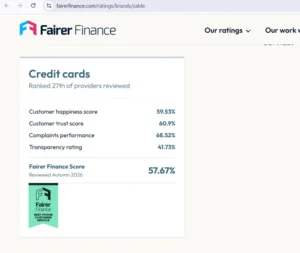
Zable Fairer Finance rating Autumn 2026 showing customer happiness, trust, complaints and transparency scores
Fairer Finance’s Autumn 2026 assessment shows Zable performing strongest for complaints handling, at 68.52%, followed by customer trust at 60.9% and customer happiness at 59.53%. Transparency was notably weaker at 41.73%, bringing the overall Fairer Finance Score to 57.67%.
We also looked beyond product marketing to see what customers were actually saying.
When checked in October 2026, Zable’s UK Trustpilot profile was showing approximately:
4.8 out of 5
from more than:
66,000 reviews.
Around 91% of displayed ratings were five-star, while approximately 2% were one-star.
Those figures will naturally change as new reviews are submitted.
The recurring positive themes are more useful than the headline score alone.
Customers frequently mention:
- Straightforward applications
- Quick decisions
- The ease of the mobile app
- Convenient repayment management
- Fast access to a virtual card
- The ability to keep track of spending
- Opportunities to rebuild credit.
The recurring criticisms include:
- Initial limits being lower than some applicants expected
- Difficulties associated with some declined transactions
- Individual payment or transfer problems
- Preference from some customers for more traditional telephone support.
A very high review score should not be treated as evidence that the card is financially suitable for every applicant.
Customer service quality and borrowing cost are two different considerations.
Zable vs Other Credit-Building Credit Cards
The best way to judge Zable is to place it against its direct competitors.
Credit Builder Comparison 2026
| Card | Representative APR | Typical/Starting Limit | Main Strength |
| Zable+ | 29.9% | Up to £4,000 | Low Zable APR, no foreign fee, app |
| Tesco Bank Foundation | 29.9% | £200–£1,500 | CreditView and Clubcard points |
| Barclaycard Forward | 33.9% | £50–£1,200 | Rate-reduction promise and 0% introductory periods |
| Capital One Classic | 34.9% | £200–£4,000 | Flexible limits and established credit-builder proposition |
| Vanquis Credit Builder | 37.9% | £250–£2,500 | Cashback with selected retailers |
| Aqua Classic | 39.9% | £250–£1,500 | Credit-building tools and app |
| Standard Zable | 48.9% | Personalised | App-based credit building and no foreign transaction fee |
Rates and available limits are subject to eligibility and can change.
This table shows why it is important to distinguish Zable+ from the standard Zable card.
At 29.9%, Zable+ compares favourably with several specialist credit-building products.
At 48.9%, the standard Zable card is considerably more expensive if a balance is carried.
Zable vs Capital One Classic
Capital One Classic currently advertises a 34.9% representative APR with starting limits between £200 and £4,000.
It also says customers may receive up to two credit-limit increases per year.
Capital One therefore looks stronger than the standard Zable card purely on headline borrowing cost.
Zable+, however, has a lower representative APR at 29.9%.
Zable additionally stands out for zero foreign transaction fees.
Our choice: Zable+ where available; Capital One is a compelling alternative to compare against the standard 48.9% Zable offer.
Zable vs Aqua Classic
Aqua Classic currently advertises a 39.9% representative APR with initial limits from £250 to £1,500.
Aqua has established credit-building tools, including Aqua Coach.
Compared with the standard Zable card, Aqua’s representative APR is lower.
Compared with Zable+, Zable has the lower headline rate and potentially higher limit.
Our choice: Zable+ on price; Aqua deserves consideration against standard Zable.
Zable vs Tesco Bank Foundation
Tesco Bank Foundation currently has one of the strongest headline rates in this specialist comparison:
29.9% representative APR.
Starting limits run from around £200 to £1,500.
Users can also access Tesco Bank CreditView and potentially earn Clubcard points from eligible spending.
Zable+ matches the 29.9% representative APR while offering a potential limit of up to £4,000 and no foreign transaction fees.
Our choice: close. Tesco may appeal to regular Tesco shoppers, while Zable+ is especially attractive for app-first management and overseas spending.
Zable vs Barclaycard Forward
Barclaycard Forward currently advertises:
- 33.9% representative APR
- A £50–£1,200 personalised limit
- Six months at 0% on purchases
- Aix months at 0% on balance transfers
- 2.9% balance-transfer fee
- Potential interest-rate reductions for maintaining repayments.
Barclaycard says the interest rate can fall by three percentage points after the first year when payments are maintained and another two percentage points after the second year.
That creates a particularly interesting competitor to Zable.
Zable+ begins with the lower representative APR.
Barclaycard Forward provides stronger introductory purchase features.
Our choice: depends on the personalised offer and intended use.
Zable vs Vanquis
Vanquis Credit Builder currently advertises a 37.9% representative APR and personalised limits of approximately £250 to £2,500.
It also provides cashback with selected retailers.
Again, Zable+ looks stronger on headline APR.
Vanquis looks stronger than standard Zable on headline borrowing cost.
For balance transfers, Vanquis can also provide materially longer introductory periods than Zable to qualifying applicants.
Our choice: Zable+ for straightforward credit building; compare Vanquis carefully if offered only standard Zable or if transferring debt.
Which Zable Card Is Best?
Our ranking is straightforward.
1. Zable+ – Best Overall Zable Card
Rating: 4.6/5
Best combination of:
- 29.9% representative APR
- Up to £4,000 credit limit
- No annual fee
- No foreign transaction fee
- Digital-card access
- App management.
This would be our preferred Zable option for an eligible applicant.
2. Zable+ Balance Transfer – Best for Short-Term Debt Transfer
Rating: 3.8/5
Useful if someone:
- Qualifies for the card
- Has existing card debt
- Can comfortably clear it within six months.
The short 0% period prevents it competing directly with the UK’s longest balance-transfer deals.
3. Standard Zable Credit Card – Best for Credit Building When Better Zable Offers Are Unavailable
Rating: 3.9/5
The app, fee structure and credit-building features are good.
The 48.9% representative APR is the concern.
This card is therefore much better suited to modest spending followed by full repayment than persistent revolving borrowing.
Is Zable Good for Self-Employed People and Entrepreneurs?
This is worth addressing because personal and business borrowing are frequently confused.
Zable is fundamentally a personal consumer credit card, not a specialist business credit card.
A freelancer, contractor, company director or entrepreneur may personally qualify for Zable, but that does not turn the account into business finance.
It does not provide the proposition somebody would normally seek from a dedicated business card, such as employee cards, company-level credit facilities or specialist accounting integrations.
From the conversations that regularly arise around founders and self-employed finances, one of the most useful distinctions is between building the individual’s personal credit profile and obtaining credit for the business itself.
Zable potentially helps with the first.
It should not automatically be used as a substitute for the second.
Who Should Consider a Zable Credit Card?
Zable is particularly worth checking for someone who:
- Wants to build or rebuild credit
- Wants to check eligibility before creating a hard search
- Prefers app-based account management
- Wants a virtual card quickly
- Frequently spends abroad
- Wants no annual fee
- May benefit from open banking being considered
- Can normally repay their statement balance completely.
Zable+ becomes especially competitive if the applicant qualifies for its 29.9% representative proposition.
Who Should Probably Look Elsewhere?
Zable may be less suitable for somebody who:
- Intends to carry a substantial balance for years
- Qualifies for a mainstream card below zable’s APR
- Wants significant cashback or airline rewards
- Needs a long 0% balance-transfer period
- Routinely withdraws cash on a credit card
- Needs a specialist business credit card
- Already has expensive debt and is relying on additional credit to meet everyday bills.
Someone already borrowing to repay other borrowing may need a debt-management solution rather than another credit account.
How We Would Use Zable for Credit Building?
If the objective were purely to establish stronger repayment history, we would keep the strategy simple.
Suppose the credit limit is £1,000.
Rather than treating that as £1,000 of additional income, the cardholder could put approximately £50-£150 of planned monthly spending on the card.
They could then:
- Allow the purchases to appear on the statement
- Keep the account well within its limit
- Ensure the statement balance is repaid by the due date
- Avoid ATM withdrawals
- Avoid unnecessary additional credit applications
- Review the credit report periodically.
- The purpose is to demonstrate consistent repayment behaviour.
- The purpose is not to generate interest charges.
Our Final Verdict on the Zable Credit Card
The Zable credit card is one of the stronger app-first credit-building propositions in the UK, but the quality of the deal depends heavily on which Zable card the applicant is actually offered.
That distinction changes our assessment significantly.
Zable+ at 29.9% representative APR: very competitive within the specialist credit-building market.
Zable+ Balance Transfer at 34.9% representative purchase APR: useful for borrowers who can take advantage of the six-month 0% transfer window, but much shorter than leading mainstream deals.
Standard Zable at 48.9% representative APR: useful as a potential credit-building tool, but expensive for persistent borrowing.
The strongest parts of Zable are its app, soft-search eligibility process, digital card, automatic account monitoring, lack of an annual fee and zero foreign transaction fee on purchases.
The weakest points are the potentially high APR, the short balance-transfer offer and the cost of ATM withdrawals.
For somebody intending to spend modestly and repay in full, the headline APR becomes much less important.
For somebody planning to carry debt, it becomes one of the most important numbers in the entire comparison.
That is ultimately how we would judge Zable.
Do not ask only: “Can I get a Zable card?”
Ask:
“Which Zable card am I being offered, what is my actual APR and credit limit, and can I use it without turning short-term flexibility into expensive long-term debt?”
For the right applicant, particularly one qualifying for Zable+, the answer can make Zable a very solid credit-building card.
For someone offered the 48.9% standard card who expects to maintain a large balance, several lower-rate alternatives deserve comparison first.
Frequently Asked Questions
Is Zable a Good Credit Card?
Zable can be a good credit-building card, particularly if an applicant qualifies for Zable+. Its app, £0 annual fee, £0 foreign transaction fee and soft eligibility checker are strong features, although borrowing can become expensive if a balance is carried.
What Is the Zable Credit Card APR?
Zable currently advertises different rates across its range. Zable+ has a 29.9% representative APR, the balance-transfer card has a 34.9% representative purchase APR, and the standard Zable credit card is advertised at 48.9% representative APR. Personalised terms can differ.
What Credit Limit Does Zable Give?
Limits depend on the applicant. Zable+ currently advertises credit limits of up to £4,000. Receiving the maximum is not guaranteed.
Does Zable Check Your Credit Score?
The initial eligibility check uses a soft search and should not affect the credit score. A hard search is carried out after the applicant accepts the offer and signs the credit agreement.
Can Zable Improve My Credit Score?
Responsible use may help build credit history. Paying on time and staying within the limit can help, while missed payments and excessive borrowing can damage the credit profile.
Does Zable Charge an Annual Fee?
No. Zable currently advertises no annual fee across its card range.
Does Zable Charge Foreign Transaction Fees?
Zable currently charges no foreign transaction fee on ordinary card purchases abroad. Mastercard’s applicable exchange rate is used. Cash withdrawals still carry Zable’s normal ATM fee.
How Much Does Zable Charge for Cash Withdrawals?
Zable charges 3% of the withdrawal with a minimum charge of £3. Physical-card ATM withdrawals are currently limited to £300 per day.
Can I Get a Zable Card With Bad Credit?
Potentially. Zable accepts applications from people with weaker credit profiles, but approval is never guaranteed. Using the eligibility checker first avoids immediately creating a hard credit search.
Can I Use Zable Immediately?
Many eligible approved customers can access a virtual card shortly after approval and add it to Apple Pay or Google Pay. The physical card normally follows in approximately five to seven days.
Does Zable Offer Balance Transfers?
Yes. Zable currently offers up to six months at 0% on qualifying balance transfers, with a 3% transfer fee subject to a £3 minimum. The standard purchase rate applies separately.
Can I Request a Zable Credit-Limit Increase?
Not directly under Zable’s current process. Zable automatically reviews eligible accounts and contacts customers when an increase becomes available.
Is Zable Better Than Capital One?
It depends on the product offered. Zable+ currently has a lower representative APR than Capital One Classic, while Capital One Classic’s 34.9% representative APR is substantially below the standard Zable card’s 48.9%.
Is Zable Better Than Aqua?
Zable+ currently has a lower representative APR than Aqua Classic. The standard Zable card has a higher representative APR. Applicants should compare their personalised offers rather than choosing solely by brand.
Is Zable Worth It in 2026?
For people wanting to build credit, manage everything through an app and avoid foreign transaction fees, Zable is worth checking. Zable+ is particularly competitive. The standard 48.9% card requires more caution if the balance will not be repaid in full.