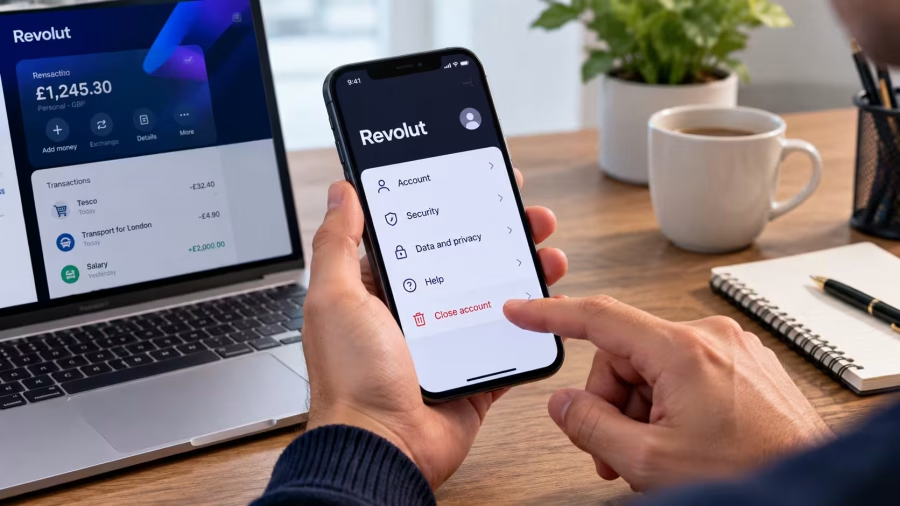
Is Revolut safe? Yes, Revolut is generally a legitimate and secure financial provider for UK customers, and its position improved significantly after Revolut Bank UK Ltd became a fully licensed UK bank in March 2026.
Eligible deposits held with the UK bank are now protected by the Financial Services Compensation Scheme (FSCS) up to £120,000 per eligible person.
However, banking regulation does not eliminate scams, account restrictions, data-security incidents or customer-service problems.
We analysed official regulatory information, independent financial reviews, consumer satisfaction surveys and fraud-complaint statistics to understand how reliably Revolut protects customers’ money.
Our assessment considers everyday banking, savings, international payments, business transactions and investment risks.
The central finding is that Revolut offers strong digital banking features, but customers should understand which Revolut entity holds their funds before treating every balance as a protected bank deposit.
Is Revolut Safe to Use in the UK in 2026?
Yes. Revolut Bank UK Ltd is authorised by the Prudential Regulation Authority (PRA) and regulated by both the PRA and the Financial Conduct Authority (FCA).
This is a major development because Revolut previously operated much of its UK personal-account business through an electronic-money institution rather than a conventional deposit-taking bank.
On 11 March 2026, the PRA permitted Revolut Bank UK Ltd to exit its banking mobilisation phase and operate as a fully authorised UK bank.
For customers whose accounts have transferred to Revolut Bank UK Ltd, eligible deposits now receive the same statutory FSCS deposit-protection limit available at other authorised UK banks.
Nevertheless, our analysis identifies five separate factors that determine whether Revolut is suitable for an individual customer:
- Banking regulation: Whether the account is provided by an authorised UK bank.
- Deposit protection: Whether the balance qualifies for FSCS compensation.
- Fraud prevention: How effectively security controls reduce unauthorised access and scams.
- Customer support: How effectively disputes, account restrictions and complaints are resolved.
- Financial suitability: Whether Revolut provides the services required for everyday banking or business operations.
These factors should be assessed together rather than assuming that regulatory authorisation makes every transaction risk-free.
Our Revolut Safety Rating for 2026
Based on our editorial assessment, we rate Revolut 82% overall, equivalent to approximately 4.1 out of 5.
| Assessment Category | Editorial Rating | Weight |
| UK regulation and authorisation | 95% | 30% |
| Deposit protection and account structure | 80% | 25% |
| Digital security and fraud controls | 76% | 15% |
| Complaints and customer support | 54% | 15% |
| App features and practical convenience | 91% | 15% |
| Overall weighted rating | 82% | 100% |
These percentages represent our editorial judgements, not measured probabilities of avoiding fraud, independent security-audit results or outcomes from an original customer survey.
Revolut performs particularly well on regulatory status and digital convenience. Its weaker area is the historical volume of fraud complaints and concerns over how some customer disputes have been handled.
Our verdict: Revolut is a strong option for international spending, everyday payments and digital money management. For substantial savings or critical business funds, customers should verify deposit protection and maintain access to another banking provider.
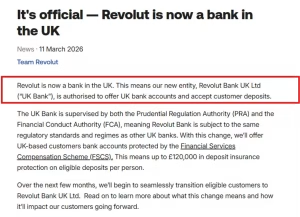
Revolut confirmed its full UK banking launch on 11 March 2026, marking a major change in the protection available to eligible UK customers.
Is Revolut a Real Bank or Just a Financial App?
Revolut is a financial services group that provides banking, payments, foreign exchange, savings and investment-related services through different legal entities.
The distinction matters because not all financial services inside one app necessarily receive identical regulatory protection.
Revolut Bank UK Ltd
Revolut Bank UK Ltd is a fully authorised UK bank.
Its Financial Services Register reference number is 981170.
It is subject to UK banking supervision, including prudential requirements and relevant conduct-of-business rules.
Eligible deposits held directly with this banking entity qualify for FSCS protection.
Revolut Ltd
Revolut Ltd has historically provided UK electronic-money accounts.
Electronic-money firms must follow safeguarding requirements designed to separate relevant customer funds from the firm’s own operating money.
However, safeguarding is not identical to FSCS deposit protection. Money held under an e-money arrangement does not automatically receive the £120,000 bank-deposit guarantee.
As Revolut has been migrating eligible customers to its UK banking entity, customers should check which arrangement applies to their account.
How Can Customers Check Their Revolut Account Status?
Customers can verify their account through the Revolut app.
- Open Revolut and navigate to the account details shown from the Home screen.
- Check whether the account information identifies Revolut Bank UK Ltd.
- Review the applicable account terms and FSCS information.
- Alternatively, open the profile section and check the legal entity displayed towards the bottom of the page.
- Contact Revolut through its official in-app support if the account status is unclear.
Customers should not rely solely on a Revolut-branded debit card or the app’s appearance to establish the legal protection of their money.
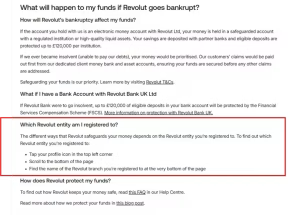
The legal entity providing a Revolut account determines whether balances are covered by FSCS deposit protection or electronic-money safeguarding.
Is Money Safe in Revolut With FSCS Protection?
Money held in an eligible deposit account with Revolut Bank UK Ltd qualifies for FSCS protection up to £120,000 per eligible depositor, per authorised bank.
The standard UK deposit protection limit increased from £85,000 to £120,000 on 1 December 2025.
This protection applies if the authorised bank fails and cannot repay eligible deposits.
It does not mean customers are automatically reimbursed for every scam, mistaken transfer, investment loss or unauthorised transaction.
Which Revolut Products Are Protected?
| Revolut Product | Main Protection Arrangement |
| Revolut Bank UK personal current account | Eligible deposits protected up to £120,000 |
| GBP and foreign-currency balances in the UK bank account | Eligible deposits included within the applicable bank limit |
| Legacy Revolut Ltd e-money balance | Safeguarding rather than normal FSCS bank-deposit protection |
| Eligible Revolut Pro balances held with Revolut Bank UK | Included within the applicable Revolut Bank protection arrangements |
| Joint bank account | Each eligible account holder has an individual protection entitlement |
| Savings held through partner banks | FSCS protection depends on the underlying authorised bank |
| Stocks and investment accounts | Separate investment rules; capital losses are not guaranteed |
| Cryptocurrency holdings | No ordinary FSCS bank-deposit protection |
| Revolut Business | Depends on the legal entity, account arrangement and business eligibility |
This table illustrates why customers should not assume every product displayed in Revolut carries the same protection.
What Happens if Revolut Bank Goes Bankrupt?
If Revolut Bank UK Ltd becomes insolvent, eligible deposits are protected up to the applicable FSCS limit.
For example, suppose a customer holds:
- £80,000 in an eligible current account.
- £50,000 in another eligible deposit account with the same authorised bank.
The combined balance is £130,000.
Under the standard £120,000 deposit-protection limit, £120,000 would be covered, while the remaining £10,000 would fall outside that standard limit.
Eligible deposits with genuinely separate authorised banks may have separate FSCS entitlements.
A special temporary-high-balance scheme can also protect qualifying funds of up to £1.4 million for six months following certain major life events, such as the sale of a main home, subject to the scheme’s conditions.
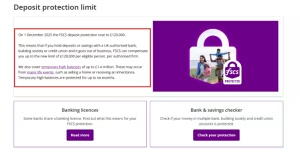
The FSCS protects eligible deposits up to £120,000 per person, per authorised firm, with separate rules for qualifying temporary high balances.
Is Revolut Safe From Hackers and Online Scams?
Revolut provides several security controls intended to protect accounts, cards and financial transactions.
Our review found that its strongest practical advantage is the degree of control customers can exercise from their mobile devices.
However, security features reduce risk rather than eliminate it.
Which Security Features Does Revolut Offer?
1. Biometric authentication
Customers can use supported biometric authentication, such as fingerprint or facial recognition, to help protect account access and sensitive actions.
2. Real-time transaction monitoring
Automated systems monitor transactions and can identify potentially suspicious activity.
Customers may receive warnings or have certain payments delayed or blocked for additional checks.
3. Instant card freezing
Customers can freeze a card through the app when it is missing, stolen or suspected of being compromised.
This reduces exposure to further card transactions while the problem is investigated.
4. Disposable virtual cards
Revolut offers disposable virtual-card functionality, subject to availability and transaction eligibility.
After use, the card details change, reducing the risk that previously exposed details can be reused for another payment.
5. Wealth Protection
Additional biometric verification can be enabled for selected withdrawals or transfers, giving customers greater control over higher-risk movements of money.
6. Street Mode
Street Mode is a location-aware security feature introduced in December 2025.
Customers can establish trusted locations and transfer limits. Transfers above those limits from outside trusted locations may face a security delay and additional authentication.
At launch, Revolut described a one-hour delay with a further identity check in such circumstances. The precise available settings should be confirmed in the current app.
This is particularly relevant to criminals attempting to force a customer to transfer money after stealing or gaining access to a phone.
Are Revolut’s Security Features Enough?
Our assessment is that Revolut offers a competitive collection of digital security controls.
However, customers can still be deceived into authorising payments themselves.
For example, a fraudster could impersonate an investment adviser, delivery company, bank employee or business supplier and convince a customer to transfer money voluntarily.
Biometric login does not automatically prevent a payment that the legitimate customer has been manipulated into approving.
We therefore recommend enabling the available security features and independently verifying payment instructions, particularly when transferring substantial amounts.
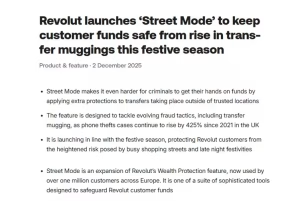
Revolut’s Street Mode adds location-based controls and additional verification to certain transfers outside trusted locations.
Does Revolut Have a Problem With Fraud Complaints?
Fraud complaints remain one of the strongest reasons to assess Revolut cautiously, notwithstanding its improved regulatory status.
An investigation published by Which? in October 2025 identified Revolut as the firm with the highest number of fraud and scam complaints escalated to the Financial Ombudsman Service during the periods examined.
The findings raise legitimate questions about customer outcomes and dispute handling.
What Do the Fraud Complaint Statistics Show?
The following figures cover complaints referred to the Financial Ombudsman Service between 1 January and 31 August 2025.
| Provider | APP Fraud Complaints | Complaints Upheld |
| Revolut | 1,875 | 30% |
| Barclays | 1,161 | 31% |
| Monzo | 1,063 | 41% |
| HSBC | 1,037 | 34% |
| Santander | 884 | 27% |
Authorised push payment fraud occurs when criminals deceive someone into transferring money to a fraudulent recipient.
Revolut recorded more complaints in this category than the other providers listed.
However, the percentage upheld requires careful interpretation.
A 30% uphold rate means the Ombudsman found in favour of consumers in 30% of the relevant resolved complaints. It does not mean 30% of every Revolut transaction was fraudulent or that 30% of all fraud claims were rejected incorrectly.
What About Other Types of Fraud?
The same investigation examined complaints involving other types of scams and fraud.
| Provider | Other Fraud Complaints | Complaints Upheld |
| Revolut | 1,333 | 37% |
| Monzo | 1,160 | 31% |
| Barclays | 991 | 28% |
| HSBC | 652 | 26% |
| Lloyds | 633 | 33% |
These statistics demonstrate why Revolut’s fraud-dispute record deserves scrutiny.
Nevertheless, they represent historical reporting periods rather than a measurement of Revolut’s fraud performance after becoming a fully licensed UK bank in March 2026.
Complaint volumes should also be interpreted alongside customer numbers, transaction volumes, differences in customer behaviour and the age of the underlying cases.
Has Revolut Improved Its Fraud Prevention?
Revolut has publicly described investments in financial-crime monitoring, specialist teams and automated fraud prevention.
The company reported preventing more than £600 million in potential customer fraud during 2024.
This is a company-reported prevention figure, not an independently established reduction in all fraud losses.
Our assessment recognises these prevention efforts while also giving significant weight to the independent complaints record.
For a fuller examination of account restrictions, fees and customer concerns, the major problems Revolut customers should understand provide additional context.
Was Revolut Involved in a Data Security Incident in 2026?
Yes. In October 2026, Reuters reported an incident in which criminals impersonating an Italian government authority caused personal data relating to approximately 680 Revolut customers to be disclosed.
The incident reportedly included 55 affected customers in France.
Revolut stated that its internal systems had not been compromised and attributed the incident to the fraudulent use of a government-associated email address.
The company’s Western Europe chief executive, Béatrice Cossa-Dumurgier, said Revolut would cover qualifying costs for affected customers needing replacement identity documents.
This incident is relevant when assessing information-security processes because it demonstrates that risks can arise from impersonation, social engineering and failures to verify requests, not only from direct hacking.
It should not, however, be described as evidence that criminals gained unrestricted access to all Revolut accounts or stole customer deposits.
Our assessment: Customers should distinguish between account-security controls, personal-data handling and financial compensation protections. These are related but separate aspects of financial safety.
What Do Leading Financial Experts Say About Revolut?
To avoid relying only on Revolut’s own promotional claims, we examined published assessments from independent personal finance journalists and consumer banking specialists.
Their findings reveal a distinction between Revolut’s impressive product features and the separate question of customer protection.
1. Jo Thornhill — Personal Finance Journalist, Forbes Advisor
In a Revolut review verified in September 2026, personal finance journalist Jo Thornhill’s published editorial assessment states:
“Low cost and user-friendly, Revolut is among the top digital-only financial providers for regular travellers and sending money overseas.”
The review recognises Revolut’s usefulness for international transactions and its improved position following full UK banking authorisation.
Our interpretation: Revolut is an appealing option for travellers and customers managing international payments, but convenience should not be mistaken for unlimited protection against every financial risk.
2. Kate Steere — Banking and Fintech Editor, Finder
Kate Steere provided a firsthand account of using Revolut’s banking app in Finder’s review.
She wrote:
“I sometimes struggle to work out exactly how to make a basic transaction like sending a payment.”
Her published account also describes a positive experience contacting customer support about an unfamiliar transaction.
Our interpretation: Revolut’s broad collection of features can offer substantial convenience, but its interface may not be equally intuitive for everyone.
This matters when customers need to act quickly during a suspected fraudulent transaction.
3. Chiara Cavaglieri — Banking Expert, Which?
Banking specialist Chiara Cavaglieri has examined UK bank performance, customer satisfaction and fraud-related consumer protection.
When discussing how customers can obtain better banking services while reducing reliance on one provider, she wrote:
“Spreading your money across multiple current accounts can also ensure you aren’t left high and dry”
The statement forms part of her broader recommendation to avoid depending on a single provider when technical problems arise.
Our interpretation: Maintaining access to more than one bank is sensible for people receiving salaries, operating businesses or handling important payments.
What Does the Combined Expert Evidence Suggest?
The published reviews do not establish that Revolut is either completely safe or fundamentally unsafe.
Instead, they indicate that:
- Revolut is particularly competitive for international spending and digital account management.
- App convenience does not guarantee that every banking process will be effortless.
- The ability to contact support and recover from account problems matters.
- The quality of regulatory protection must be distinguished from the quality of customer service.
- Holding access to a secondary bank can reduce disruption during outages or account reviews.
Taken together, these considerations support a positive but qualified assessment.
What Do Customers Think About Revolut?
Customer satisfaction provides additional information, although it should not be treated as direct evidence of financial security.
In Which?’s banking research published in 2026, Revolut received an 83% customer score.
The underlying customer survey was conducted in September 2025, before Revolut’s full UK banking launch.
In Finder’s February 2026 banking satisfaction research, 97% of surveyed Revolut customers said they would recommend the provider.
These figures measure different aspects of customer experience and were produced using different research methodologies.
They are therefore not directly comparable.
| Assessment | Reported Result | What It Measures |
| Which? customer score | 83% | Customer satisfaction and willingness to recommend |
| Finder customer recommendation | 97% | Share of surveyed customers willing to recommend |
| Our editorial safety assessment | 82% | Weighted qualitative assessment of regulation, deposit protection, fraud controls, service and convenience |
Importantly, none of these percentages represents the probability of a Revolut account being hacked, a bank failing or a customer recovering money from a scam.
Can Revolut Freeze or Restrict a Customer’s Account?
Yes. Revolut can temporarily restrict an account or particular transactions when it needs to carry out security, identity or regulatory compliance checks.
This is not unique to Revolut. Regulated financial institutions must comply with requirements relating to anti-money laundering, customer identification and financial crime prevention.
Potential triggers include:
- Unusual transaction activity.
- Requests to verify the source of funds.
- Incomplete identity or tax-residency information.
- Suspicious account access.
- Additional checks relating to transfers or recipients.
- Failure to provide requested documentation.
A restriction does not automatically mean that the customer has committed wrongdoing.
However, it may interrupt transfers, card payments or access to funds while checks are completed.
What Should Customers Do if Revolut Restricts Their Account?
Customers should follow the requests presented through official Revolut channels.
They may need to provide identity documents, transaction records, invoices or other relevant information.
For business payments, records of contracts, customer invoices and the commercial purpose of unusually large transfers may be useful.
We also recommend maintaining a separate account for essential direct debits, household expenses or urgent business obligations.
This is particularly important where a delayed payment could affect employees, suppliers or a mortgage.
Will Revolut Refund Customers Who Are Scammed?
Whether a customer receives a refund depends on the payment type, circumstances and applicable consumer protection rules.
It is important to distinguish FSCS deposit protection from fraud reimbursement.
FSCS protection principally addresses the failure of an authorised financial institution, whereas scam reimbursement rules may apply when customers are deceived into sending payments.
What Are the UK APP Scam Reimbursement Rules?
The mandatory reimbursement framework introduced on 7 October 2024 generally protects eligible victims of qualifying authorised push payment scams conducted over UK Faster Payments.
Under the framework:
- The maximum mandatory reimbursement amount is generally £85,000 for eligible claims.
- Firms generally aim to reimburse qualifying claims within five business days.
- A longer assessment period may apply in certain circumstances, subject to a maximum of 35 business days.
- Firms may apply an excess of up to £100, but not to customers considered vulnerable under the relevant rules.
- Exclusions and eligibility requirements apply.
The rules can also extend to qualifying small businesses and charities within the relevant eligibility thresholds.
Not every card payment, international transfer, cryptocurrency transaction or civil dispute qualifies.
Across the industry, the Payment Systems Regulator reported that 88% of the money lost to in-scope APP scams was reimbursed over the 18 months from October 2024 to March 2026.
This is an industry-wide figure, not Revolut’s individual reimbursement rate.
Customers who believe their complaint has been handled unfairly may be able to escalate it to the Financial Ombudsman Service after receiving a final response or when the applicable complaint-handling deadline has passed.
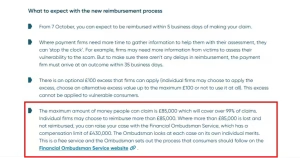
UK payment-scam reimbursement rules provide separate protections from the FSCS bank-deposit guarantee, with different eligibility requirements and compensation limits.
Is Revolut Safe for Large Amounts of Money?
Revolut can provide an appropriate place for substantial eligible bank deposits, provided customers understand the relevant compensation limits.
However, we would not recommend concentrating all personal or business liquidity in one provider without considering operational risk.
For an individual holding £20,000, the key questions may concern account access, everyday payments and banking suitability.
For somebody holding £150,000, deposit protection becomes a more significant consideration because the standard £120,000 FSCS limit may not cover the entire balance at one authorised institution.
For a company making £250,000 in monthly supplier payments, continuity of service and transfer controls become especially important.
The appropriate approach depends on whether the money is held as a bank deposit, safeguarded e-money, partner-bank savings or another financial product.
Customers holding more than the relevant compensation limit should consider spreading eligible deposits across separately authorised institutions.
Is Revolut Safe for Savings Accounts?
Revolut offers savings products, but customers must identify the underlying deposit-taking institution.
Certain UK savings accounts are provided through partner banks rather than directly by Revolut Bank UK Ltd.
For example, Revolut identifies ClearBank as the underlying bank for certain GBP savings products.
Eligible deposits with the underlying bank are subject to that institution’s FSCS protection arrangements.
If a customer already holds deposits directly with the same partner bank, those balances may count towards the same £120,000 limit.
The relevant savings account information should identify the partner bank and the applicable protection arrangements.
Customers should also check whether a quoted savings rate is promotional, variable, subject to a balance threshold or linked to a paid subscription.
Revolut Savings protection depends on the underlying partner bank, and customers should verify both the deposit provider and the applicable FSCS limit.
Is Revolut Safe for International Transfers and Travelling?
Revolut is particularly attractive to customers who travel regularly, receive overseas payments or exchange currencies.
Its multicurrency functionality allows customers to manage spending and currency conversion through one application.
However, low-fee marketing should not be interpreted as a guarantee that every transaction is free.
What Are the Currency Exchange Fees?
Revolut’s published UK fee structure provides different allowances depending on the account plan.
| Account Plan | Additional Fair-Usage Fee | Weekend Exchange Fee |
| Standard | 1% above £1,000 monthly allowance | 1% |
| Plus | 0.5% above £3,000 monthly allowance | 0.5% |
| Premium | No additional fair-usage fee | No additional weekend fee |
| Metal | No additional fair-usage fee | No additional weekend fee |
| Ultra | No additional fair-usage fee | No additional weekend fee |
Other transaction fees, transfer charges and account conditions may apply.
Consider a customer converting £1,000 during a weekend.
A 1% weekend exchange fee would add £10 to the transaction, before considering any other applicable charges.
Customers should review the conversion screen before authorising significant international transfers.
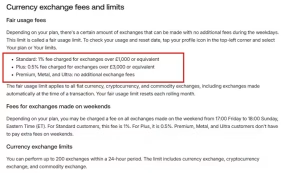
Revolut’s exchange fees and fair-usage limits vary by subscription tier, with Standard and Plus customers facing potential additional charges.
Is Revolut Safe for Business Owners and Entrepreneurs?
Revolut can be useful for businesses managing international transactions, supplier payments, multiple currencies and employee spending.
However, business customers should assess more than the convenience of the app.
Our analysis suggests that business owners should examine three main areas.
1. Business Deposit Protection
The protection available depends on the legal entity providing the account, whether eligible deposits are held with an authorised bank, and whether the business qualifies for the relevant compensation scheme.
Business owners should not assume that the protection attached to a personal Revolut Bank UK account necessarily applies in exactly the same way to every Revolut Business product.
2. Payment Continuity
Companies depending on international suppliers or frequent client payments should consider the possibility of temporary compliance reviews.
Maintaining a backup banking relationship can prevent a single restricted account from interrupting trading.
3. Fraud and Payment Authorisation
For businesses, a single fraudulent supplier invoice can result in a substantial loss.
Companies should independently verify changes to beneficiary details and consider internal approval procedures for high-value payments.
Businesses comparing their options may find it helpful to review the best business bank accounts in the UK, particularly when comparing international transfers, account fees and operational features.
Is Revolut Safer Than Monzo, Starling or Wise?
Revolut competes with several digital banking and international payment providers.
However, they do not all operate under identical regulatory models.
| Provider | UK Banking Position | Main Consideration |
| Revolut | Fully licensed UK bank, with customer migration considerations | Strong international features; verify specific account and product protection |
| Monzo | Authorised UK bank | Established UK current-account services and FSCS deposit protection |
| Starling | Authorised UK bank | UK banking services and FSCS-protected eligible deposits |
| Wise | UK electronic-money/payment services rather than a UK deposit-taking bank | International transfers and safeguarding arrangements |
Each provider has different strengths.
Our analysis suggests Revolut is especially attractive for customers who frequently need foreign exchange, multicurrency balances and international transfers.
Monzo and Starling are also credible choices for everyday UK banking.
For a detailed comparison of fees, account features and banking suitability, the differences between Revolut and Monzo are particularly relevant.
Customers prioritising deposit protection and account security can also examine whether Monzo is safe for UK banking.
No provider should be described as completely immune to fraud or technical disruption.
How Can Customers Make Their Revolut Accounts Safer?
Even with regulated banking services and advanced security technology, account holders remain an important part of fraud prevention.
We recommend the following precautions:
- Enable biometric security: Use the strongest available account authentication settings.
- Activate additional transfer protection: Consider Wealth Protection and Street Mode where available.
- Freeze missing cards immediately: Do not delay when a card or phone may have been compromised.
- Verify new recipients: Confirm bank details independently before sending substantial payments.
- Keep devices updated: Install legitimate security and banking app updates promptly.
- Review account notifications: Investigate unfamiliar payments or login attempts.
- Confirm deposit eligibility: Check which legal entity and authorised bank holds each balance.
- Maintain another bank account: Keep enough accessible funds elsewhere for essential payments.
- Protect identity documents: Never provide sensitive documents to an unverified caller or website.
- Report suspicious activity quickly: Use official Revolut support and the relevant fraud-reporting channels.
What Are the Main Advantages and Disadvantages of Revolut?
| Advantages | Disadvantages |
| Fully authorised UK banking entity | Historical fraud-complaint concerns |
| FSCS protection for eligible bank deposits | Not every Revolut product has identical protection |
| Convenient international payments | Some currency exchange charges apply |
| Biometric authentication and card controls | Accounts may be temporarily restricted for compliance checks |
| Multicurrency features | No traditional branch network |
| Virtual cards and security tools | Customer support may not suit everyone |
| Budgeting and spending controls | Cryptocurrency and investment losses are not covered by ordinary bank-deposit protection |
| Personal and business services | Business account eligibility and protection must be checked separately |
Is Revolut Worth Trusting in 2026?
Revolut’s position as a UK financial provider has improved substantially following its full banking authorisation in March 2026.
The introduction of eligible FSCS-protected UK bank accounts addresses one of the most significant concerns historically raised about its UK operations.
Its strong digital functionality, international payment capabilities and expanding security controls make it a credible choice for many customers.
Nevertheless, the historical fraud-complaint data, account restrictions and more recent information-security incident demonstrate why customers should remain cautious.
Our overall editorial rating: 82%.
We consider Revolut suitable for everyday spending, international transfers and many ordinary banking needs, provided customers understand their account’s legal structure and applicable protections.
For customers with substantial savings, high-value business transactions or essential payment obligations, maintaining a secondary banking relationship remains a sensible risk-management measure.
Frequently Asked Questions
Is Revolut safe to keep money in?
Yes, eligible deposits held with Revolut Bank UK Ltd qualify for FSCS protection up to £120,000 per eligible person. Other products and legacy account arrangements may have different protections.
Is Revolut safer now that it is a bank?
Its full UK banking authorisation has strengthened the regulatory framework and deposit protection available to eligible customers. However, scams and account-access risks remain.
Is Revolut safe from hackers?
Revolut offers biometric authentication, fraud monitoring, virtual cards and additional transfer controls. These reduce security risks but cannot guarantee protection against every attack.
Can Revolut steal or keep my money?
Revolut is a regulated financial provider and must comply with applicable financial laws. Accounts may be restricted for legitimate compliance reasons, but customers retain complaint and potential redress rights.
Is Revolut safe for salary payments?
A qualifying Revolut Bank UK current account can be used for salary payments. Keeping an additional bank account may help avoid disruption if access to the main account is temporarily restricted.
Is Revolut safe for large deposits?
Eligible deposits with Revolut Bank UK are covered up to the applicable £120,000 FSCS limit. Larger balances require careful consideration of protection limits and account structure.
Is Revolut safe for business banking?
It can be suitable for many business payment needs, but the relevant legal entity, FSCS eligibility, account restrictions and operational requirements should be checked before relying on it for critical business funds.