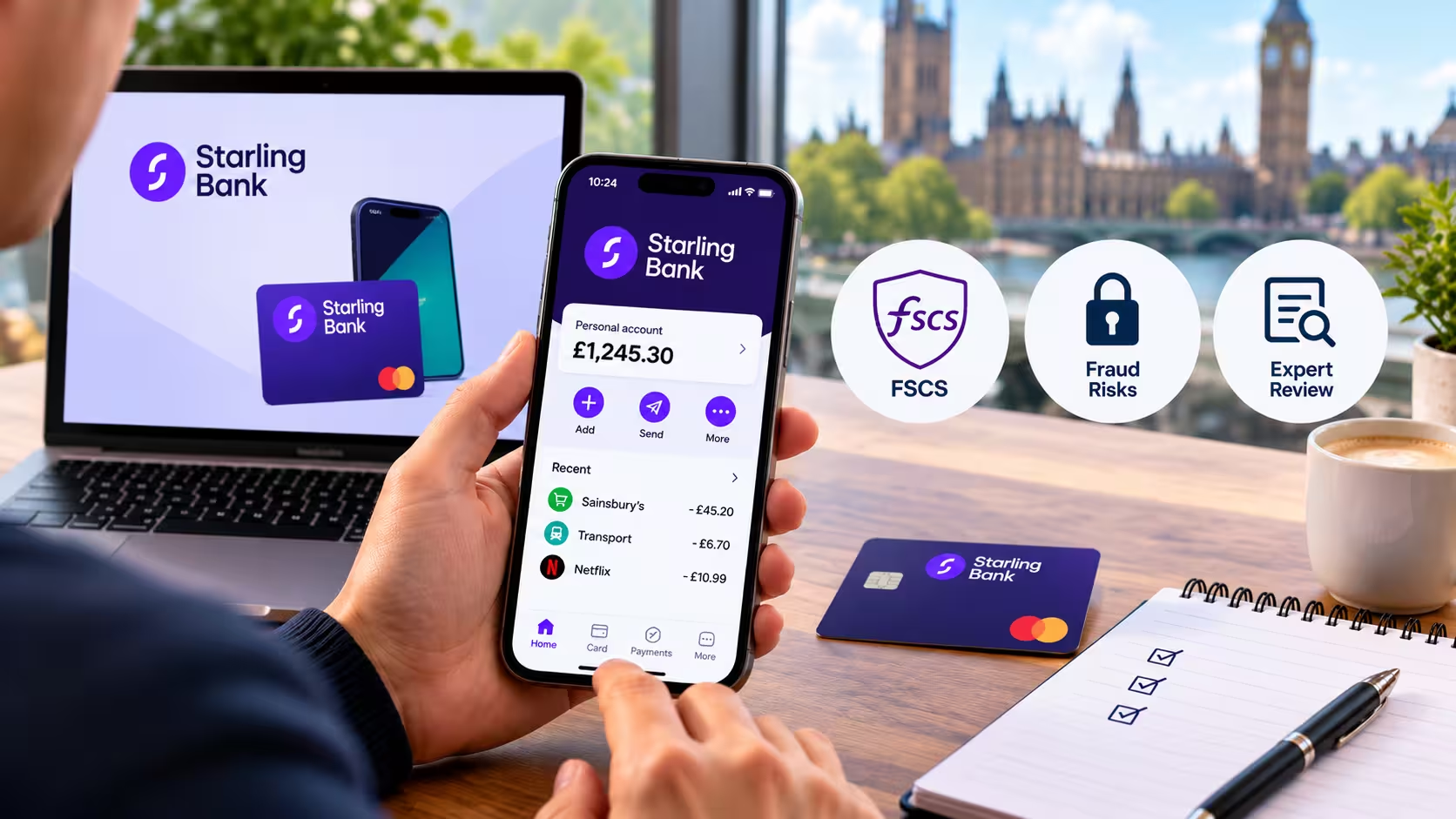
Yes. Starling Bank is a legitimate, fully licensed UK bank regulated by the Financial Conduct Authority (FCA) and Prudential Regulation Authority (PRA). Eligible customer deposits are protected by the Financial Services Compensation Scheme (FSCS) up to £120,000 per person, per authorised bank.
However, being a regulated bank does not mean every payment is risk-free, every customer complaint is resolved satisfactorily or every account balance receives unlimited protection.
Starling has established itself as a major competitor to traditional high-street banks, offering mobile banking, personal and business accounts, budgeting tools and digital security controls.
Its financial performance also provides useful evidence of business stability. For the financial year ending 31 March 2026, Starling Group reported £217.1 million in pre-tax profit, its fifth consecutive profitable year.
Nevertheless, its regulatory history raises questions that should not be ignored. In October 2024, the FCA announced a £28.96 million penalty against Starling for significant weaknesses in financial crime controls.
We analysed regulatory findings, published financial statements, independent customer research, security features and banking considerations relevant to individuals, freelancers and business owners.
Our conclusion is that Starling offers substantial protections for ordinary UK banking, but customers should understand its limitations, particularly around fraud, account restrictions and deposit balances exceeding statutory protection.
Is Starling Bank Safe to Use in the UK in 2026?
Starling is considered a credible UK banking provider because it operates under the same core banking regulatory framework that applies to major authorised UK banks.
Unlike a financial application that solely provides electronic-money services, Starling Bank Limited is authorised to accept customer deposits.
Its regulatory information includes:
| Banking information | Verified details |
| Registered company | Starling Bank Limited |
| Company registration number | 09092149 |
| FCA firm reference number | 730166 |
| Banking status | Fully licensed UK bank |
| Primary regulators | FCA and PRA |
| FSCS deposit protection | Up to £120,000 per eligible depositor |
| Personal banking | Available |
| Business banking | Available |
| Physical high-street branch network | No |
| Customer support | 24/7 |
| Latest financial year reviewed | Year ending 31 March 2026 |
Starling’s registration means the bank must comply with applicable capital, liquidity, governance and consumer protection requirements.
The PRA supervises the safety and soundness of banks, while the FCA oversees conduct standards and relevant consumer protections.
This gives customers substantially more legal protection than simply storing money with an unregulated financial service.
Nevertheless, regulatory approval should not be interpreted as confirmation that Starling can never experience a financial, operational or security problem.
Our editorial assessment: Starling’s banking authorisation provides a strong foundation for customer protection. Its status as a digital-only bank does not make it inherently less legitimate than a traditional bank.
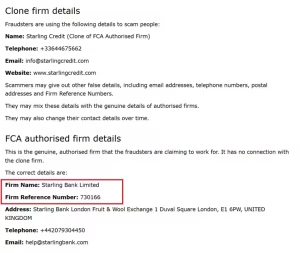
Starling Bank Limited is authorised by the Prudential Regulation Authority and regulated by the FCA and PRA under firm reference number 730166. Show the firm’s entry on the official FCA Financial Services Register.
Our Starling Bank Safety Rating for 2026
Based on our assessment of banking regulation, deposit protection, financial performance, security controls and customer outcomes, we assign Starling an overall editorial safety rating of 86%, equivalent to approximately 4.3 out of 5.
| Safety assessment category | Editorial rating | Weight |
| Banking authorisation and regulatory framework | 95% | 25% |
| FSCS protection and deposit arrangements | 95% | 25% |
| Digital security and fraud-prevention features | 85% | 20% |
| Published financial performance | 85% | 15% |
| Regulatory track record and complaint handling | 60% | 15% |
| Overall weighted rating | 86% | 100% |
These scores are editorial judgements based on the available evidence, rather than results from a commissioned security audit or representative customer survey.
The weighted result is 86.25%, rounded to 86%. The regulatory track record is marked down because of the seriousness of the FCA’s findings, despite Starling’s positive customer satisfaction results.
Starling performs particularly well in the areas that matter to customers concerned about bank insolvency: its authorised banking status, statutory deposit protection and reported profitability.
Our lower assessment of regulatory history reflects past financial crime compliance failures and the importance of monitoring how the bank improves its controls.
Our Overall Verdict
Starling is a credible option for everyday banking, salary payments, household bills, digital payments and many small-business transactions.
For customers with substantial savings or businesses dependent on uninterrupted access to working capital, we favour maintaining a second banking relationship and ensuring balances remain within appropriate deposit protection limits.
Is Money Safe in Starling Bank Under FSCS Protection?
One of the most important reasons Starling can be considered a relatively secure place for eligible deposits is its membership of the Financial Services Compensation Scheme.
From 1 December 2025, the standard FSCS bank deposit protection limit increased from £85,000 to £120,000 per eligible person, per authorised institution.
This change is especially relevant because older articles about Starling continue to refer to the previous £85,000 limit.
The higher limit applies to eligible deposits held with Starling Bank Limited, subject to scheme rules.
If the bank were to fail and become unable to repay customers, the FSCS could compensate qualifying depositors up to the applicable limit.
Customers can verify the updated limit through the official FSCS deposit protection information.
How Much Money Is Protected in Starling?
| Eligible money held with Starling | Standard FSCS protection | Amount above standard limit |
| £10,000 | £10,000 | £0 |
| £50,000 | £50,000 | £0 |
| £100,000 | £100,000 | £0 |
| £120,000 | £120,000 | £0 |
| £150,000 | £120,000 | £30,000 |
| £200,000 | £120,000 | £80,000 |
These figures assume one eligible individual depositor, with no other eligible deposits included under the same banking authorisation and no special temporary-high-balance entitlement.
For example, someone holding £150,000 in qualifying Starling accounts would normally have £120,000 protected under the standard FSCS limit.
The remaining £30,000 would be outside that standard protection, although special circumstances may provide additional coverage.
A critical distinction is that the FSCS protection limit applies to the eligible depositor and authorised bank, not separately to every account.
Are Starling Current Accounts and Savings Accounts Protected Separately?
Not under separate standard FSCS limits when the deposits are held with the same authorised bank.
Suppose someone holds:
- £70,000 in a Starling current account.
- £40,000 in another eligible Starling deposit account.
- £30,000 in a further eligible Starling savings account.
The combined balance would be £140,000.
Normally, £120,000 would fall within the standard deposit protection limit, with £20,000 exceeding it.
Moving money between multiple accounts within the same authorised institution does not create additional deposit protection.
This principle also matters when customers compare savings accounts across different banks.
Having two accounts with genuinely different banking licences can provide separate eligible FSCS entitlements. The distinction is explained further when considering Cash ISAs with different providers.
Are Starling Joint Accounts Protected?
Yes, qualifying joint accounts can receive protection based on each eligible account holder’s entitlement.
For example, two people holding a joint Starling account could potentially receive combined standard FSCS protection of up to £240,000, assuming each has sufficient unused entitlement under the same banking licence.
However, each person’s share of the joint balance must be considered alongside other qualifying deposits they hold individually with Starling.
What Happens If You Temporarily Hold More Than £120,000?
The FSCS provides additional protection for certain qualifying temporary high balances.
These can arise following major events such as:
- Selling a main residential property.
- Receiving an inheritance.
- Certain redundancy or retirement payments.
- Divorce settlements.
- Compensation for certain personal injuries.
Qualifying temporary high balances can receive protection up to £1.4 million for a period of six months, subject to the detailed eligibility conditions.
This does not mean that every large deposit qualifies automatically.
The source of the money and the timing of the deposit are important.
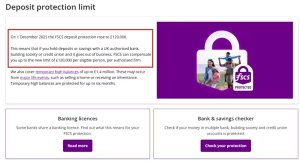
The FSCS increased standard deposit protection to £120,000 from 1 December 2025, with additional protection for certain qualifying temporary high balances. Capture the current deposit limit from the official FSCS website.
What Happens If Starling Bank Goes Bust?
Although bank failures are relatively uncommon, assessing the consequences of a potential failure is an important part of choosing where to hold savings or business cash.
If Starling became insolvent, the statutory compensation process would be relevant to customers with eligible deposits.
The FSCS would establish eligible balances and arrange compensation under the applicable rules.
For straightforward protected deposits, the scheme normally aims to return money within seven working days, although complex claims may take longer.
The process generally does not require customers to pay a company to recover their protected deposits.
Our assessment is that customers should distinguish between two questions:
Could Starling fail? No bank is completely immune from financial failure.
Would eligible customers automatically lose their protected savings? No. FSCS protection exists specifically to compensate eligible depositors when an authorised bank fails.
This is why keeping balances within the applicable limit can substantially reduce financial exposure.
How Financially Stable Is Starling Bank in 2026?
One of the most useful ways to evaluate Starling’s financial position is to examine its latest published results rather than relying only on customer reviews or app ratings.
In May 2026, Starling Group published results covering the financial year ending 31 March 2026.
The figures show continued profitability, growth in customer deposits and investment in its banking technology activities.
Starling Group Financial Performance: 2025 vs 2026
| Financial measure | FY2025 | FY2026 | Change |
| Pre-tax profit | £223.4 million | £217.1 million | -2.8% |
| Group revenue | £940.0 million | £887.4 million | -5.6% |
| Customer deposits | £12.1 billion | £12.7 billion | +5.0% |
| Group platform accounts | 5.3 million | 6.2 million | +17.0% |
| Average customer deposit balance | £3,931 | £4,241 | +7.9% |
These are reported group-level figures, which should not be confused with a standalone credit rating or regulatory capital assessment of Starling Bank Limited.
Why Did Starling’s Profits Decline?
Starling’s reported pre-tax profit decreased from £223.4 million to £217.1 million.
That represents a reduction of approximately 2.8%.
Revenue also declined by about 5.6%, with the group referring to a softer interest-rate environment.
These reductions deserve attention, but they do not establish that the bank is financially distressed.
A profitable bank may experience changes in earnings because of interest rates, lending margins, operating expenses or strategic investment.
The more useful question is whether profitability, liquidity, capital and asset quality remain sufficient to support banking operations.
Starling’s fifth consecutive profitable year is a favourable indicator, but not a guarantee against future losses.
Are Starling’s Customer Deposits Growing?
Yes.
Customer deposits increased from approximately £12.1 billion to £12.7 billion during the period.
The increase of around 5% indicates that the reported deposit base expanded despite lower group revenue.
The average customer deposit balance also rose.
For a deposit-taking bank, an established and diversified customer deposit base is relevant to funding stability, although deposit totals alone do not prove the quality or resilience of its funding.
Does Starling Have Enough Capital?
The group’s 2026 annual report highlighted a capital surplus exceeding £525 million above regulatory requirements as of May 2026.
This was higher than the reported surplus exceeding £400 million in the previous year.
The figures suggest a strengthened reported capital buffer.
However, a surplus figure should not be treated as a guarantee that a bank cannot fail. Investors and depositors must also consider asset quality, liquidity, future losses and regulatory developments.
Raman Bhatia, Starling Group’s Chief Executive Officer, said when announcing the 2026 results:
“We have delivered a fifth consecutive year of profitability while continuing to invest in the business”
His statement reflects the group’s management assessment of its performance.
Our interpretation is that Starling’s financial results provide meaningful evidence of continued commercial viability, while the decline in profit and revenue reinforces the importance of monitoring future results rather than assuming growth will always continue.
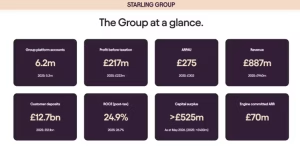
Starling Group’s 2026 annual report highlights £217.1 million in pre-tax profit, £887.4 million in revenue and £12.7 billion in customer deposits. Capture the financial highlights from the official 2026 annual report.
Has Starling Bank Been Fined by the FCA?
Yes.
An assessment of Starling’s safety would be incomplete without discussing its regulatory enforcement history.
On 2 October 2024, the Financial Conduct Authority announced that it had fined Starling Bank Limited £28,959,426 for serious financial crime compliance failings.
The findings concerned weaknesses in financial sanctions screening and failures to comply with restrictions on opening accounts for high-risk customers.
The FCA identified several significant issues.
Starling’s financial crime control arrangements had not developed sufficiently quickly alongside the bank’s rapid customer growth.
Its automated financial sanctions screening had been inadequate for an extended period.
The bank also opened more than 54,000 accounts for approximately 49,000 high-risk customers between September 2021 and November 2023, despite restrictions agreed with the regulator.
Therese Chambers, the FCA’s joint executive director of enforcement and market oversight at the time, described the deficiencies in particularly strong terms:
“Starling’s financial sanction screening controls were shockingly lax.”
This was a serious regulatory finding and should not be dismissed merely because Starling is popular with customers.
Does the FCA Fine Mean Starling Is Unsafe?
Not automatically.
The penalty related to financial crime controls and the bank’s compliance with regulatory requirements. It was not an announcement that Starling had become insolvent or that eligible customer deposits had lost FSCS protection.
Nevertheless, ineffective controls over financial crime can expose a bank to regulatory, operational and reputational risks.
Our analysis distinguishes between three different issues:
- Deposit protection: Eligible deposits remain protected under applicable FSCS rules.
- Regulatory compliance: The FCA found significant historical weaknesses that required remediation.
- Current customer security: Today’s fraud-prevention arrangements must be assessed using more recent evidence rather than assuming that either the historical failings or subsequent improvements tell the entire story.
Starling accepted the findings and announced measures intended to strengthen its compliance framework.
The FCA also acknowledged remediation work, including improvements to sanctions screening, compliance oversight and financial crime resources.
This is a positive development, although customers should not interpret remediation activity as proof that every future compliance risk has been eliminated.
The full regulatory findings are available through the FCA’s official Starling Bank enforcement announcement.
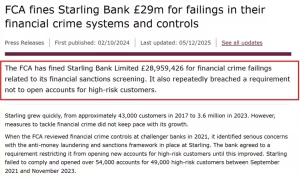
The FCA imposed a £28,959,426 penalty on Starling Bank in 2024 for financial crime control deficiencies. Capture the headline, publication date and penalty details from the FCA announcement.
Is Starling Bank Safe From Hackers, Scams and Fraud?
Starling provides multiple security controls designed to reduce unauthorised access, suspicious transactions and fraudulent card use.
These include biometric authentication, real-time payment notifications, card controls and additional verification for relevant online transactions.
However, security features are only one part of banking safety.
A customer can use a technically secure banking application and still be persuaded by a criminal to authorise a fraudulent transfer.
1. Biometric Login
Starling supports fingerprint or facial recognition on compatible devices.
Biometric authentication reduces reliance on repeatedly entering credentials and can make unauthorised account access more difficult.
However, customers still need to protect their devices, passcodes and recovery information.
2. Instant Card Freezing
Customers can freeze their Starling debit cards through the banking app.
This feature is particularly useful when a card is misplaced, stolen or suspected of being compromised.
Card controls also allow customers to manage relevant payment methods and functions, including contactless payments, online transactions and ATM withdrawals.
3. Real-Time Transaction Notifications
Starling provides notifications about account activity.
These can help customers identify unfamiliar transactions quickly.
For example, an unexpected card payment may become visible immediately through an app notification rather than being discovered during a monthly statement review.
The effectiveness of this feature depends partly on customers keeping notifications enabled and reviewing unusual activity.
4. Additional Online Payment Authentication
Starling supports additional authentication for certain online card purchases through security mechanisms such as 3D Secure.
Where required, customers may need to approve a transaction inside the banking app.
This can make some fraudulent card transactions harder to complete.
5. Scam Intelligence
Starling has introduced an AI-powered Scam Intelligence tool intended to help customers identify warning signs in potential scams.
A customer considering an online purchase can upload a relevant screenshot for analysis.
The tool can identify potential concerns, such as suspicious advertising patterns or unusually low prices.
However, AI-driven fraud detection is not infallible.
The absence of a warning does not establish that a merchant or transaction is legitimate, and using Scam Intelligence does not guarantee reimbursement if a scam occurs.
6. Call Verification
Bank impersonation fraud remains a serious threat.
Starling offers a call-status verification feature that helps customers establish whether an incoming call claiming to be from Starling is genuine.
Customers should independently verify suspicious contact through the official app rather than trusting a telephone number displayed on their screen.
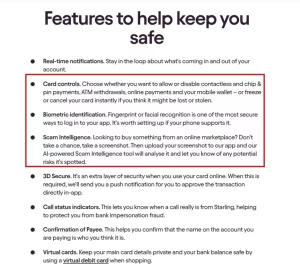
Starling provides app-based card controls, biometric authentication and fraud-prevention features. Capture the relevant security features from Starling’s official Mobile Banking Security or Card Controls webpage.
Will Starling Refund Money If You Are Scammed?
Potentially, but the answer depends on how the loss occurred and whether it falls within the relevant reimbursement rules.
A common misunderstanding is that FSCS protection and fraud reimbursement are the same thing.
They are not.
FSCS Protection vs Fraud Reimbursement
| Situation | Relevant protection |
| Starling fails and cannot repay eligible deposits | FSCS deposit compensation |
| Criminal makes an unauthorised payment | Unauthorised payment refund rules |
| Customer is tricked into making a UK bank transfer | Potential APP fraud reimbursement |
| Customer transfers money to a legitimate but disappointing investment | Not automatically protected against investment losses |
| Customer sends money to the wrong recipient | Payment recovery and complaint arrangements; refund not guaranteed |
| Starling app temporarily becomes unavailable | Operational support and complaint procedures, not ordinary FSCS compensation |
What Are the UK APP Fraud Reimbursement Rules in 2026?
Authorised Push Payment fraud occurs when someone is tricked into transferring money to a criminal.
UK mandatory reimbursement protections introduced on 7 October 2024 apply to qualifying scams involving Faster Payments and CHAPS.
The principal rules include:
- A maximum mandatory reimbursement amount of £85,000 per eligible claim.
- Reimbursement normally within five business days.
- Up to 35 business days for more complex investigations.
- A possible excess of up to £100, subject to applicable exceptions.
- Additional protections for eligible vulnerable consumers.
- Eligibility requirements and exclusions that must be considered.
The rules generally cover individuals, microenterprises and qualifying charities, rather than automatically extending to every large commercial organisation.
Claims also need to be reported within the applicable timeframe.
This protection is separate from the £120,000 FSCS deposit limit.
For example, a customer with £20,000 in Starling who is tricked into sending £8,000 to a fraudster cannot claim FSCS compensation simply because they have been scammed.
Instead, they would need to report the incident and have it assessed under the relevant payment and fraud reimbursement rules.
The distinction matters for entrepreneurs because invoice interception, supplier impersonation and fraudulent payment instructions can involve substantial business funds.
What Do Starling Bank’s Customer Reviews and Satisfaction Results Show?
Independent survey results provide another useful perspective on whether customers are satisfied with Starling’s services.
However, customer satisfaction should not be confused with deposit safety or the effectiveness of fraud controls.
Personal Banking Customer Satisfaction
The independent service-quality survey published in August 2026 reported the following Great Britain results:
| Customer satisfaction measure | Starling | Position |
| Overall service recommendation | 76% | 2nd |
| Online and mobile banking recommendation | 83% | 2nd |
| Overdraft service recommendation | 72% | 3rd |
The overall service result placed Starling behind Monzo, which achieved 79%, and ahead of several major banking competitors in that survey.
These percentages represent surveyed customers who said they were very or extremely likely to recommend the relevant service.
They are not fraud prevention success rates or measurements of bank solvency.
How Does Starling Perform in Independent Banking Reviews?
Which? also reported a Starling customer score of 86% in its 2026 banking comparison.
That is a separate survey and scoring methodology, so it should not be directly equated with the 76% recommendation figure from the regulatory service-quality survey.
Starling was also identified as a Which? Recommended Provider for the seventh consecutive year.
These results indicate strong customer approval of the bank’s everyday services.
However, a favourable overall rating does not mean every customer has received satisfactory treatment.
For a more complete assessment, complaint handling data should be considered alongside positive feedback.
Does Starling Have Many Customer Complaints?
Starling publishes complaints data under regulatory reporting requirements.
For the period between 1 October 2025 and 31 March 2026, the bank reported the following information for its banking and credit card category.
| Complaints measure | Reported result |
| Complaints opened | 15,223 |
| Complaints closed | 14,362 |
| Complaints opened per 1,000 accounts | 3.09 |
| Complaints closed within three days | 18.76% |
| Complaints upheld | 44.49% |
The figures require careful interpretation.
A complaint upheld by a bank generally indicates that it accepted the customer’s complaint, wholly or partly, under the relevant reporting definition.
It does not establish that 44.49% of all Starling customers experienced problems.
Similarly, the total number of complaints should not be interpreted as the number of confirmed fraud incidents.
Complaint rates should ideally be compared using equivalent reporting periods, product categories and customer-base measures.
Our interpretation is that Starling’s complaint record deserves attention despite its positive customer satisfaction rankings.
Customers should consider how the bank handles problems, rather than assessing its safety solely by looking at app features or promotional reviews.
Is Starling Bank Safe for Small Businesses and Entrepreneurs?
Starling can be a suitable banking provider for freelancers, sole traders, digital businesses and many UK limited companies.
Its business banking proposition includes digital payments, accounting integrations, expense-management tools and access to banking services through the app.
For entrepreneurs, however, the meaning of banking safety extends beyond data encryption or statutory deposit protection.
A small business may need reliable access to funds for salaries, VAT payments, suppliers and other operating expenses.
Even a temporary account restriction can create difficulties when payment deadlines are approaching.
This is why our assessment of business banking considers operational resilience as well as financial protection.
Is a Starling Business Account Protected by FSCS?
Eligible business deposits can qualify for FSCS protection up to £120,000.
However, the way protection applies depends partly on the legal structure of the business.
| Business structure | General FSCS treatment |
| Sole trader | Personal and sole trader deposits with the same authorised bank are generally combined |
| Limited company | Eligible company deposits can receive separate protection from the director’s personal deposits |
| Limited liability partnership | A qualifying LLP can be treated as a separate depositor |
| Ordinary partnership | Special partnership rules apply; multiple partners do not automatically receive a separate £120,000 limit each for the business account |
| Multiple accounts held by one company | Normally aggregated under the same authorised bank |
This distinction is particularly important for sole traders.
Suppose an entrepreneur holds £80,000 in a personal Starling account and £70,000 in a Starling sole trader account.
Because the sole trader is not a separate legal person from the owner, the qualifying balances would generally be combined for deposit protection purposes.
The combined £150,000 would exceed the ordinary £120,000 limit by £30,000.
A limited company is different because it normally has a distinct legal identity from its shareholders and directors.
An eligible company could therefore have its own deposit protection entitlement while a director separately holds qualifying personal deposits.
What Should Businesses Consider Before Using Starling as Their Main Account?
From a business cash-management perspective, we would examine five practical areas.
- Payment continuity: Can the company continue paying suppliers and staff if access to its main banking application is disrupted?
- Deposit concentration: Does the business routinely hold cash reserves above the applicable FSCS limit?
- Internal payment controls: Are employees and directors using suitable authorisation and access arrangements?
- Fraud exposure: Does the business independently verify changes to supplier banking details?
- Cash handling: Does the company require frequent physical cash deposits or branch services?
These issues can be more consequential to an entrepreneur than the bank’s advertised monthly fee.
For example, Starling’s business account generally has no standard monthly account fee, but cash deposits through the Post Office are subject to charges.
Businesses handling significant physical cash should calculate the full cost and check applicable deposit limits.
Companies evaluating their wider banking requirements can compare Starling with other providers in our assessment of business bank accounts in the UK.
What Do Business Customers Think?
Starling’s published August 2026 independent SME service-quality results showed:
| Business banking measure | Starling result |
| Overall service recommendation | 83% |
| Online and mobile banking recommendation | 87% |
The results indicate that Starling remains competitive among surveyed small and medium-sized business customers.
A customer identified as Derek, whose testimonial was published on Starling’s business banking website in January 2026, stated:
“A great decision to move our Business Banking to Starling, transition was really simple with no issues.”
This is a customer testimonial selected and published by Starling, rather than an independently sampled review.
It offers an example of a positive account-switching experience but should not be treated as proof that all business customers receive the same service.
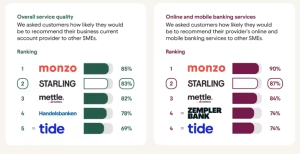
In the August 2026 independent SME banking survey, 83% of surveyed Starling business customers recommended its overall service, while 87% recommended its online and mobile banking. Capture the official published business service-quality results.
Can Starling Bank Freeze or Restrict Your Account?
Yes.
Like other regulated banks, Starling may temporarily restrict an account where it identifies potential financial crime, unusual transactions, security concerns or the need for additional verification.
An account restriction does not automatically mean the customer has committed wrongdoing.
Banks have legal responsibilities to investigate certain activities and prevent their services from being misused.
However, restrictions can be disruptive.
For example, a freelancer who receives an unusually large payment from a new overseas customer might be asked to provide information about the transaction.
A business making payments significantly different from its usual activity may also trigger additional monitoring.
These examples illustrate possible review circumstances, not a claim that Starling routinely restricts accounts for these specific transactions.
What Should You Do If Starling Restricts Your Account?
- Contact Starling through its official banking app or verified customer support number.
- Ask whether additional identity, transaction or business information is required.
- Provide genuine supporting documents such as invoices or contracts when requested through an official channel.
- Keep records of the restriction, communications and important payment deadlines.
- Do not provide credentials to third-party services claiming they can remove account restrictions.
- Consider a formal complaint if the restriction or its handling appears unreasonable.
There may be circumstances where the bank cannot disclose full details of an investigation.
Customers who remain dissatisfied can use Starling’s formal complaints procedure and, where eligible, escalate unresolved disputes to the Financial Ombudsman Service.
For business owners, the broader lesson is straightforward: maintaining a properly funded second business banking arrangement can help reduce dependence on one provider.
Is Starling Safer Than Monzo or Revolut?
Starling, Monzo and Revolut are important competitors in the UK’s app-based banking market.
All three now have UK-authorised banking operations, but their services, account structures, regulatory histories and customer experiences are not identical.
Revolut Bank UK became fully operational as a UK bank in March 2026. During the transition, customers have needed to check which legal entity provides their account because older electronic-money arrangements do not carry the same deposit protections as eligible UK bank accounts.
Starling’s UK personal and business deposit accounts are provided within an established authorised banking structure.
Starling vs Monzo vs Revolut: Safety Comparison
| Feature | Starling | Monzo | Revolut |
| Fully authorised UK banking entity | Yes | Yes | Yes |
| Eligible UK bank deposits covered by FSCS | Yes | Yes | Yes |
| Standard eligible deposit protection | Up to £120,000 | Up to £120,000 | Up to £120,000 |
| Biometric authentication | Yes | Yes | Yes |
| In-app security controls | Yes | Yes | Yes |
| Physical high-street branch network | No | No | No |
| Business banking | Yes | Yes | Yes |
| Important consideration | Historical FCA enforcement and account access | Fraud and customer-service outcomes | Verify applicable UK account entity and protection |
This table is a comparison of broad arrangements rather than a definitive security ranking.
The same FSCS limit does not mean that the providers have identical financial strength or complaint-handling performance.
Someone whose primary concern is everyday UK banking might reasonably compare Starling with Monzo.
Customers focused on international transfers and foreign-currency services may also want to assess Revolut’s features and protections.
Our analysis of whether Revolut is safe in the UK examines its banking arrangements and fraud-related considerations.
For a wider assessment of features, customers can also compare Revolut and Monzo before selecting a primary or secondary banking provider.
Is Starling Safe for Large Savings Balances?
Starling can hold substantial balances, but depositors need to distinguish between the amount a bank permits them to hold and the amount protected by FSCS.
A bank account accepting £200,000 does not mean the entire £200,000 is automatically insured against bank failure.
For an eligible individual, the ordinary deposit protection limit remains £120,000 per authorised institution.
People holding large amounts for a house deposit, retirement, business transaction or inheritance should therefore assess whether additional deposit diversification is appropriate.
Example: Holding £250,000 in Bank Deposits
Suppose someone has £250,000 they want to keep in eligible bank deposits.
They might consider splitting the money across three separately authorised banks.
| Bank | Example deposit |
| Starling | £100,000 |
| Bank B | £100,000 |
| Bank C | £50,000 |
| Total | £250,000 |
Assuming all three institutions have genuinely separate banking licences and all deposits qualify, this arrangement could keep the full £250,000 within ordinary FSCS deposit protection limits.
The example is illustrative rather than a recommendation of particular providers.
Accrued interest and other accounts held with the same authorised firms should also be considered.
Our assessment is that spreading significant deposits between separately authorised institutions can be more useful for managing bank-failure exposure than relying only on positive customer reviews or a bank’s recent profitability.
How Can You Make Your Starling Account More Secure?
Customers can reduce avoidable banking risks by following a few practical measures.
Secure Your Device and Banking App
Use a strong phone passcode, enable biometric access where supported and install software updates promptly.
Avoid sharing security credentials or allowing another person unrestricted access to a device containing banking apps.
Check New Payment Recipients
Verify bank details independently when paying a new supplier, transferring a large amount or receiving an unexpected request to change payment instructions.
Business owners should be particularly cautious of email messages announcing changes to supplier account details.
Keep Transaction Notifications Enabled
Review unexpected payments immediately and contact the bank through official channels if unfamiliar activity appears.
Use Card Controls
Freeze cards promptly when they are lost and consider disabling payment methods that are not regularly needed.
Maintain a Backup Banking Option
A second bank account can help with everyday payments during an outage or temporary account-access problem.
This provides operational resilience but should not be confused with additional FSCS protection unless the second bank operates under a separate eligible banking authorisation.
Avoid Bank Impersonation Scams
Starling says it will not ask customers to move money to a supposedly secure account or disclose their PIN or password.
A genuine banking security process does not require transferring savings to a stranger’s account.
Customers uncertain about a call should end the conversation and independently contact the bank using its official app or verified website.
Who Should Consider Starling Bank?
Starling can be particularly suitable for customers who want a modern current account with strong app functionality and established UK banking protections.
Our assessment suggests it may appeal to:
- Everyday UK customers: People receiving salaries, paying bills and managing day-to-day finances through their phones.
- Freelancers: Individuals who want an accessible business banking arrangement with digital tools.
- Small limited companies: Businesses conducting predominantly electronic transactions and using accounting software.
- Frequent travellers: Customers interested in app-based controls and competitive overseas card spending arrangements, subject to current account terms.
- Customers wanting a secondary bank: People seeking an alternative banking provider for payment continuity and deposit diversification.
However, Starling may be less suitable as the only banking provider for businesses requiring extensive branch facilities, frequent large cash deposits or complex banking services outside its current product range.
Final Verdict: Is Starling Bank Safe and Reliable in 2026?
Yes, Starling Bank is generally a safe and legitimate option for eligible UK customers, with strong statutory protections and a credible record of commercial profitability.
Its authorisation by the PRA, regulation by the FCA and participation in the FSCS provide the same core statutory banking safeguards applicable to other fully authorised UK banks.
The rise in deposit protection to £120,000 from December 2025 is particularly reassuring for customers holding moderate to substantial savings balances.
Its financial results also provide meaningful evidence of continuing operations and profitability.
Nevertheless, our review identifies important reservations.
The 2024 FCA penalty revealed serious historical financial crime control deficiencies. Customer complaints and the possibility of restricted account access also demonstrate why everyday banking convenience should not be confused with an absence of operational risk.
Our overall editorial rating: 86/100 — Strong Banking Protection.
We consider Starling a credible choice for personal banking and many small businesses, especially where customers value mobile banking functionality, budgeting tools and straightforward payment management.
For larger deposits and business-critical funds, our preference is to combine suitable FSCS coverage with more than one reliable banking relationship.
No bank can guarantee complete freedom from fraud, operational disruption or financial difficulty.
The better approach is to choose a properly authorised institution, understand which risks are legally protected and manage the remaining exposure through sensible financial planning.
Frequently Asked Questions
Is Starling Bank a Real Bank?
Yes. Starling Bank Limited is a fully licensed UK bank authorised by the PRA and regulated by the FCA and PRA.
Is Starling Bank Safe for Savings?
Eligible Starling deposits receive FSCS protection up to £120,000 per depositor, per authorised bank. Higher balances may require additional protection arrangements.
What Happens If Starling Bank Goes Bankrupt?
Eligible customers can receive compensation from the FSCS, normally up to £120,000 under the standard deposit protection scheme, with special rules for certain qualifying balances.
Is Starling Bank Safer Than Monzo?
Both are authorised UK banks with FSCS protection for eligible deposits. Their financial performance, customer service and regulatory histories should be compared separately.
Has Starling Bank Ever Been Fined?
Yes. The FCA imposed a £28,959,426 penalty in 2024 concerning financial crime control failings and breaches of regulatory restrictions.
Can Starling Bank Freeze Your Money?
Starling may restrict account access during security, fraud, compliance or verification checks. Customers should contact the bank through official channels for assistance.
Is Starling Bank Safe for Business Accounts?
Yes, eligible business deposits can receive FSCS protection. Sole traders and limited companies have different rules for how business and personal balances are treated.
Does Starling Refund Fraudulent Transactions?
Eligible unauthorised payments and qualifying APP scam losses may be reimbursed under the relevant UK rules. Refunds depend on the circumstances and applicable conditions.
How Much Money Can You Safely Keep in Starling?
The standard FSCS protection limit is £120,000 per eligible depositor, per authorised bank. This is a compensation limit, not necessarily the maximum balance the account can hold.
Is Starling Bank Financially Stable in 2026?
Starling Group reported £217.1 million in pre-tax profit for FY2026 and £12.7 billion in customer deposits. These are favourable indicators, although financial performance cannot guarantee future stability.
Is Starling Bank Good for International Travel?
Starling offers competitive overseas card-spending features, but customers should check current withdrawal limits, account terms and any charges imposed by foreign ATM operators.
Can I Trust Starling With My Salary?
Starling is an authorised UK bank suitable for ordinary salary deposits and bill payments. Customers should still secure their accounts and consider a second payment option for emergencies.