
Nationwide ISA rates currently range from 3.30% AER on its 1 Year Triple Access ISA to 4.70% AER on its 5 Year Fixed Rate Cash ISA.
As of 1 October 2026, Nationwide offers four fixed-term Cash ISA options alongside its limited-access Triple Access ISA. The fixed rates start at 4.50% for one year and rise to 4.70% for five years, while the Triple Access ISA offers greater flexibility but at a lower variable rate.
The highest rate is not automatically the most suitable account. Nationwide’s fixed ISAs impose substantial early-access charges and cannot normally be topped up after opening, whereas the Triple Access ISA allows withdrawals but cuts the rate substantially after the fourth withdrawal.
This guide looks at the current Nationwide ISA rates, how much interest they could generate, withdrawal penalties, ISA transfers, tax rules and how Nationwide compares with the wider Cash ISA market.
What Are the Current Nationwide ISA Rates?
Nationwide currently advertises the following Cash ISA rates:
| Nationwide Cash ISA | Current rate | Rate type | Access |
| 1 Year Fixed Rate Cash ISA | 4.50% AER | Fixed | Early closure charge |
| 2 Year Fixed Rate Cash ISA | 4.55% AER | Fixed | Early closure charge |
| 3 Year Fixed Rate Cash ISA | 4.65% AER | Fixed | Early closure charge |
| 5 Year Fixed Rate Cash ISA | 4.70% AER | Fixed | Early closure charge |
| 1 Year Triple Access ISA | 3.30% AER | Variable | Up to 3 withdrawals without rate reduction |
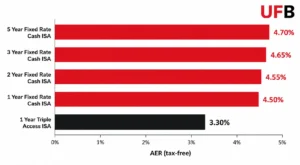
These are tax-free Cash ISA rates. Nationwide’s current fixed-rate issues came into effect on 26 August 2026, while the Triple Access ISA currently pays 3.30% AER variable.
Rates and product availability can change, so savers should check Nationwide’s current terms immediately before applying.
How Do Nationwide Fixed Rate Cash ISAs Work?
Nationwide’s Fixed Rate Cash ISA is designed for savers with a lump sum they can leave largely untouched for between one and five years.
The rate is guaranteed for the selected term. If someone opens a five-year ISA at 4.70%, for example, Nationwide cannot subsequently reduce that fixed rate while the account remains open.
There is an important funding restriction, however.
The Fixed Rate Cash ISA has to be funded during the application. Additional money cannot be added after the account has been opened.
It can be funded using money from a Nationwide account or through an ISA transfer. Nationwide says that someone wanting to use both methods will need to open two separate ISAs.
This is an important distinction from some easy-access or variable-rate Cash ISAs that allow repeated deposits throughout the tax year.
How Much Could You Earn With Nationwide ISA Rates?
The amount earned depends on the amount deposited, the term selected and whether the money remains invested until maturity.
Nationwide provides official examples based on £1,000 deposits. Applying the same assumptions proportionately to a £20,000 deposit gives an illustration of the potential returns:
| ISA term | AER | £20,000 starting balance | Approx. balance at maturity | Approx. interest |
| 1 year | 4.50% | £20,000 | £20,900.00 | £900.00 |
| 2 years | 4.55% | £20,000 | £21,861.40 | £1,861.40 |
| 3 years | 4.65% | £20,000 | £22,921.80 | £2,921.80 |
| 5 years | 4.70% | £20,000 | £25,163.00 | £5,163.00 |
The figures assume the account remains open for the complete term and interest is retained within it. Nationwide calculates interest daily and normally credits it annually as well as at maturity.
A higher total return from the five-year account does not necessarily mean it is preferable. The saver is committing the money for substantially longer and taking the risk that better savings rates could become available elsewhere during that period.
What Is the Nationwide 1 Year Triple Access ISA Rate?
Nationwide’s more flexible Cash ISA is its 1 Year Triple Access ISA, currently paying 3.30% AER tax-free variable.
The account permits up to three withdrawals during its one-year term without reducing the headline rate.
A fourth withdrawal changes matters significantly.
After four or more withdrawals, Nationwide currently reduces the rate to 1.05% AER tax-free variable for the remainder of the term. Because it is a variable-rate account, Nationwide can also change either rate in accordance with the account terms.
For £1,000 left in the account for a year without withdrawals, Nationwide illustrates interest of £33 at the present rate.
That would equate to approximately £660 of interest on £20,000 over one year, assuming the 3.30% rate remained unchanged and the saver did not trigger the lower withdrawal rate.
The account therefore provides considerably more access than Nationwide’s fixed-rate ISAs, but the current headline rate is also substantially lower.
What Happens If You Withdraw From a Nationwide Fixed ISA Early?
This is one of the most important details to understand before choosing a Nationwide fixed-term ISA.
Money cannot simply be partially withdrawn from the current Fixed Rate Cash ISA. To access the funds early, the saver has to close the account, after which an early-access charge applies.
The current penalties are:
| Fixed ISA | Early-access charge |
| 1 year | 60 days’ interest |
| 2 years | 120 days’ interest |
| 3 years | 180 days’ interest |
| 5 years | 300 days’ interest |
Nationwide warns that an early closure could result in the saver receiving less than the amount originally deposited if there is insufficient earned interest to cover the charge.
There is no early-access charge when an account is cancelled within 14 days of opening.
This means the five-year rate should not be selected solely because 4.70% is the highest Nationwide ISA rate. A saver who may require the money before maturity needs to weigh the extra interest against a potential charge equivalent to 300 days’ interest.
Are Nationwide ISA Rates Competitive?
Nationwide’s fixed rates are competitive among major high-street savings providers, although they are not necessarily the highest rates available anywhere in the market.
MoneyWeek’s Cash ISA comparison, last updated on 25 September 2026, showed market-leading rates around 4.85% for one-year fixed ISAs, 5.00% for two-year products and 5.01% for three-year fixes. By comparison, Nationwide currently pays 4.50%, 4.55% and 4.65% respectively for those terms.
That makes comparison important.
Someone choosing Nationwide may value its branch network, £1 minimum opening deposit and ability to manage eligible accounts through Nationwide, but another provider could potentially offer a higher rate.
Readers comparing building societies can also look at current Yorkshire Building Society ISA rates, where easy-access, limited-access and fixed options provide a useful comparison with Nationwide’s product structure.
The market can change quickly, so a rate comparison made several weeks before opening an account may already be outdated.
Should You Choose the 1, 2, 3 or 5 Year Nationwide ISA?
Choosing the term is primarily a question of access rather than simply finding the biggest percentage.
The difference between Nationwide’s current one-year and five-year rates is only 0.20 percentage points: 4.50% compared with 4.70%.
Someone fixing £20,000 for five years gets a higher guaranteed rate, but also accepts a much longer commitment and a 300-day-interest early closure charge.
The one-year account provides less rate certainty over the long term, but the money reaches maturity much sooner.
The two- and three-year products occupy the middle ground.
A saver could also use more than one ISA and create different maturity dates rather than committing all available savings to the same term. UK rules now allow adults to subscribe to multiple Cash ISAs, although the annual ISA limits still apply.
UK Finance Blog has a separate explanation of having two Cash ISAs with different providers, including how the annual allowance works when subscriptions are divided between accounts.
How Much Can You Put Into a Nationwide Cash ISA in 2026/27?
For the 2026/27 tax year, the overall adult ISA subscription allowance is £20,000.
That £20,000 can be divided between eligible ISA types and providers. It is not a separate £20,000 allowance for every Cash ISA opened.
For example, someone could place £10,000 into a Nationwide Fixed Rate Cash ISA and £10,000 into a Cash ISA with another provider.
Interest generated inside the ISA does not use additional allowance.
Similarly, transferring money that was subscribed in previous tax years through the proper ISA transfer process does not mean that old balance suddenly counts as a new current-year subscription. Nationwide explicitly distinguishes ISA transfers from new deposits when explaining the allowance.
Are the Cash ISA Rules Changing in April 2027?
Yes. This is a particularly important content point for anyone considering ISA arrangements beyond the current tax year.
From 6 April 2027, the Cash ISA subscription limit for people under 65 will fall to £12,000 per tax year.
People aged 65 or over will retain a £20,000 Cash ISA subscription limit, while the overall ISA limit will remain £20,000. HMRC published the detailed measure on 17 September 2026.
The change relates to new subscriptions. It does not mean that existing Cash ISA balances above £12,000 suddenly cease to be tax-free.
For someone under 65, the position therefore changes as follows:
| Tax year | Maximum Cash ISA subscription | Overall ISA allowance |
| 2026/27 | Up to £20,000 | £20,000 |
| 2027/28 | £12,000 | £20,000 |
The 2027 reforms also introduce restrictions on transfers from non-Cash ISAs into Cash ISAs for affected under-65 investors, making correct ISA planning more important from the next tax year.
Can You Transfer an Existing ISA to Nationwide?
Yes. Nationwide accepts transfers into its Cash ISA range, subject to the product conditions.
Using the formal ISA transfer process matters because withdrawing the money personally and then redepositing it can affect its ISA status or use current-year allowance.
Nationwide says a Cash ISA transfer can take up to 15 working days, while transfers from other types of ISA can take up to 30 working days. Transfers involving notice periods may take longer.
Existing ISA money can therefore potentially be moved into a Nationwide fixed-rate product without using the same amount of current-year allowance again, provided the transfer is completed correctly.
People transferring from another fixed account should first check whether their existing provider imposes an exit penalty.
Can You Have More Than One Nationwide Cash ISA?
Yes.
Nationwide allows customers to hold more than one of its qualifying Cash ISA products through what it calls a portfolio cash ISA.
Instead of treating each eligible product as a completely separate ISA wrapper, Nationwide groups the products together within its portfolio structure.
This can allow a saver, for example, to use different Nationwide ISA products for different purposes while still needing to remain within the applicable annual subscription rules.
Some older or specialist Nationwide ISAs can operate differently, so individual product terms should still be checked.
Can New Customers Open a Nationwide Fixed Rate ISA Online?
Not currently in every case.
Nationwide says existing customers can open and manage the Fixed Rate Cash ISA through its banking app, internet bank or branch, subject to eligibility.
However, someone who is new to Nationwide currently needs to apply for the Fixed Rate Cash ISA in a Nationwide branch.
That is a practical difference worth considering when comparing Nationwide with app-only or online-only ISA providers.
The minimum amount for Nationwide’s current Fixed Rate Cash ISA is just £1.
What Happens When a Nationwide Fixed ISA Matures?
At the end of the fixed term, Nationwide says the money will normally move into an instant-access Cash ISA unless alternative instructions are provided.
Nationwide contacts customers before maturity and explains the available options and applicable interest rate.
Customers may be able to reinvest into another Nationwide fixed ISA, move the money to another eligible account or transfer it to another ISA provider.
Nationwide also operates a rate guarantee for certain ISA maturity reinvestments: where the applicable fixed rate changes between Nationwide contacting the customer and maturity, qualifying customers can receive the better rate if they provide their maturity instructions within the required period.
This makes the maturity notice worth checking rather than allowing a fixed account to roll over without reviewing the new rate.
Is Money in a Nationwide Cash ISA Protected?
Eligible deposits are protected by the Financial Services Compensation Scheme.
The standard deposit protection limit is currently £120,000 per eligible person, per authorised firm.
There is an important Nationwide-specific point following the integration of Virgin Money.
Nationwide states that eligible money held across Nationwide and Virgin Money accounts is covered within the same £120,000 limit per eligible person, rather than providing a separate £120,000 limit under each brand. Joint eligible deposits can receive combined protection of up to £240,000.
Someone with a large amount accumulated across old ISAs should therefore look at the underlying authorised institution rather than assuming different brand names automatically provide separate FSCS limits.
Is a Nationwide Cash ISA Better Than a Normal Savings Account?
The main advantage of a Cash ISA is that interest remains tax-free.
A standard savings account can sometimes offer a higher headline rate, but interest outside an ISA can count towards taxable savings income once applicable allowances have been exhausted.
Whether the ISA wrapper produces an actual tax advantage therefore depends partly on the saver’s tax position, the amount saved and the rates available.
The comparison becomes increasingly relevant for people holding large cash balances or generating significant savings interest.
A saver should therefore compare the after-tax return of a normal savings account with the tax-free ISA return rather than looking only at the headline percentages.
There is also a longer-term benefit to building ISA savings. Money already accumulated within the ISA wrapper can continue to retain its tax-efficient status, subject to ISA rules, even when annual subscription limits change in later years.
Which Nationwide ISA Might Suit Different Savers?
The 1 Year Fixed Rate Cash ISA at 4.50% provides the shortest fixed commitment and may appeal to someone who wants a guaranteed return without locking the money away for several years.
The 2 Year Fixed Rate ISA at 4.55% extends the guarantee while only adding 0.05 percentage points to the one-year rate.
The 3 Year Fixed Rate ISA at 4.65% provides a stronger rate but comes with a 180-day-interest early-access charge.
The 5 Year Fixed Rate ISA at 4.70% offers Nationwide’s highest current ISA rate, but also carries the longest commitment and a 300-day-interest early-access charge.
The 1 Year Triple Access ISA at 3.30% variable may be more appropriate where access is important. The trade-off is a lower rate, and making four or more withdrawals currently drops the rate to 1.05% for the remainder of the term.
There is therefore no single Nationwide ISA that is automatically suitable for every saver.
What Should You Check Before Opening a Nationwide ISA?
Before committing money, check the current AER, whether the rate is fixed or variable, the length of the term, withdrawal restrictions, early-access charges, remaining ISA allowance, transfer eligibility, whether additional deposits are permitted, FSCS exposure and whether the account can be opened through the preferred banking channel.
For fixed accounts in particular, emergency savings generally need to remain accessible elsewhere because closing the ISA early can incur a sizeable interest penalty.
Savers should also compare Nationwide against the wider Cash ISA market. A familiar provider or convenient branch network can be useful, but even a difference of several tenths of a percentage point becomes meaningful on larger balances.
Are Nationwide ISA Rates Worth Considering in 2026?
Nationwide currently offers a straightforward Cash ISA range spanning limited access and one-, two-, three- and five-year fixed terms.
Its highest current ISA rate is 4.70% AER tax-free on the five-year Fixed Rate Cash ISA, followed by 4.65% for three years, 4.55% for two years and 4.50% for one year. The Triple Access ISA currently pays 3.30% variable.
The fixed rates provide certainty, but access conditions are important. Early closure charges range from 60 days’ interest for the one-year ISA to 300 days’ interest for the five-year product.
Nationwide is also not automatically the highest-paying provider. Current market comparisons show some competing fixed Cash ISAs paying higher rates, which makes checking alternatives worthwhile before committing a lump sum.
For the 2026/27 tax year, the £20,000 ISA allowance remains available. Savers should also plan for the major rule change from 6 April 2027, when the Cash ISA subscription limit will fall to £12,000 for those under 65 while remaining £20,000 for those aged 65 and over.
Frequently Asked Questions
What Is the Highest Nationwide ISA Rate?
The highest current Nationwide Cash ISA rate is 4.70% AER tax-free, available on its five-year Fixed Rate Cash ISA.
What Is Nationwide’s 1 Year ISA Rate?
Nationwide currently pays 4.50% AER tax-free fixed on its one-year Fixed Rate Cash ISA.
What Is Nationwide’s 2 Year ISA Rate?
The current two-year Fixed Rate Cash ISA pays 4.55% AER tax-free.
What Is Nationwide’s 3 Year ISA Rate?
Nationwide currently offers 4.65% AER tax-free fixed for its three-year Cash ISA.
What Is Nationwide’s 5 Year ISA Rate?
The current five-year Fixed Rate Cash ISA pays 4.70% AER tax-free, making it Nationwide’s highest advertised Cash ISA rate at present.
Does Nationwide Have an Easy-Access ISA?
Its current actively marketed flexible alternative is the 1 Year Triple Access ISA, paying 3.30% AER variable. Up to three withdrawals can be made without triggering the lower rate; four or more reduce the current rate to 1.05% for the rest of the term.
Can I Put £20,000 Into a Nationwide Cash ISA?
For 2026/27, an adult can currently subscribe up to £20,000 across eligible ISAs, subject to how much allowance has already been used elsewhere. From 6 April 2027, the Cash ISA limit falls to £12,000 for people under 65.
Can I Transfer an Existing ISA to Nationwide?
Yes. Eligible ISA transfers are accepted. Nationwide says Cash ISA transfers can take up to 15 working days, while transfers involving other ISA types can take up to 30 working days.
Are Nationwide ISA Rates Fixed?
The one-, two-, three- and five-year Fixed Rate Cash ISA rates are fixed for their respective terms. The 1 Year Triple Access ISA rate is variable and can change.
Is Nationwide Covered by FSCS Protection?
Yes. Eligible deposits are protected, although Nationwide states that Nationwide and Virgin Money balances share the same £120,000 per-person FSCS limit.
Rates checked on 1 October 2026. Savings rates and product availability can change. UK Finance Blog provides general financial information rather than personalised financial, tax or investment advice.