
A 15 month pension transfer delay is far outside what most UK savers should normally expect when moving a straightforward pension.
The issue attracted attention after consumer group Which? revealed the case of John Wilson, 61, from Fife, who was trying to consolidate three pension pots. Two transfers were completed within a few months, but the third took 15 months to resolve.
The case matters because it exposes a significant gap between what is technically permitted under parts of the pension transfer framework and what modern electronic transfers can actually achieve.
Latest industry figures suggest that uncomplicated digital transfers can often be completed in around 10 days, while the Financial Conduct Authority has found that additional checks can push some transfers into several months.
However, a 15-month wait should not be treated as normal simply because pension transfers can legitimately require anti-scam checks, disinvestment or additional information.
For anyone currently waiting, the key questions are not simply “How long has it taken?” but where exactly is the transfer stuck, why has it stopped moving, and who is responsible for the next action?
Readers following wider retirement developments can also see UK Finance Blog’s Pensions & Retirement coverage.
Why Are 15 Month Pension Transfer Delays Being Discussed?
The headline originates from research published by Which? on 26 March 2026.
Which? surveyed 1,360 members between October and November 2025. Of those, 101 had attempted to transfer a pension during the previous three years.
Among that smaller transfer group, 28% described the process as difficult or fairly difficult, 10% said their transfer took more than three months and up to six months, while another 10% said they eventually abandoned the process altogether.
That sample-size detail is important.
The frequently reported statement that “one in ten savers gave up” does not mean 10% of every UK pension saver or 10% of all UK pension transfers failed. It relates specifically to the 101 Which? respondents who said they had attempted a transfer.
The most striking case involved John Wilson.
He was consolidating three pensions, but one defined contribution transfer remained unresolved for 15 months. According to Which?, the initial explanation was that investments in the existing pension needed to be sold before the money could be transferred.
Disinvestment itself is normal when a pension is being transferred as cash. What made this case exceptional was how long the entire process subsequently took.
How Long Does a Pension Transfer Normally Take in 2026?
There is no single timeframe covering every pension transfer.
A modern electronic defined contribution transfer between compatible providers can be dramatically quicker than a defined benefit transfer, an overseas transfer or a case requiring additional scam checks.
The latest available benchmarks demonstrate the difference.
| Transfer evidence | Reported timeframe | What it actually measures |
| Origo, 12 months to 30 June 2026 | 10 days | Average simple electronic transfer |
| Origo, same period | 11 days | Overall average including more complex transfers |
| FCA review | Within 10 days | More than three-quarters of sampled firms where no additional checks were needed |
| FCA review | 41–80 days | Average range for half of firms where additional checks were required |
| Which? case study | 15 months | Exceptional individual DC transfer case |
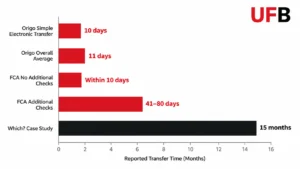
Origo’s latest figures covering the 12 months to 30 June 2026 put the average straightforward transfer at approximately 10 days, while the overall figure including more complicated cases was around 11 days. Simple transfers account for nearly 90% of activity through its transfer service.
That makes the difference between the industry benchmark and a 15-month wait enormous.
It also demonstrates why the old six-month figure frequently quoted in articles should not be interpreted as a normal service standard.
Does a Pension Provider Really Have Six Months to Transfer a Pension?
This is where many explanations become too simplistic.
MoneyHelper states that pension transfers can often take two to six weeks, while a provider can have up to six months to action certain transfer requests.
The statutory framework under the Pension Schemes Act 1993 also contains six-month completion periods for qualifying statutory transfer rights.
But six months should not be read as permission for every provider to routinely take six months.
The FCA does not impose one universal number of days for every regulated pension transfer.
Instead, FCA rules require relevant firms to execute transfer requests within a reasonable time, while the Consumer Duty requires firms to support customers in pursuing their financial objectives without creating unreasonable barriers.
The distinction matters.
A complicated transfer taking longer because genuine information or safeguarding checks are required is very different from a straightforward transfer sitting untouched in an administrative queue.
What Does the FCA Say About Pension Transfer Delays?
The FCA’s pension transfer review provides one of the clearest pictures of where time is being lost.
The regulator examined 18 life insurers administering more than 12 million individual personal pension policies. Those firms had received nearly one million pension transfer requests during the period examined.
Where no extra checks were required, more than three-quarters of firms completed transfers within 10 days, with the shortest reported average being five days.
The picture changed substantially when additional checks were required.
Half of the firms took an average of 41 to 80 days, while the remaining firms reported averages ranging from 26 days to as much as 160 days.
Interestingly, amber scam flags were applied to fewer than 2% of transfer requests received by most firms, while most firms stopped fewer than 1% of transfers.
This suggests that genuine safeguarding cases can explain some lengthy transfers, but they cannot automatically explain every prolonged delay.
The FCA also found that digital transfers were normally faster than paper-based processes.
Why Can Pension Transfers Take Months Instead of Days?
Several separate stages can create a delay, and identifying the precise stage is more useful than repeatedly asking both providers for a generic update.
A pension may first need to be disinvested. The existing provider may then need identity documents, confirmation of the receiving scheme, evidence relating to employment or overseas residency, information from an adviser or confirmation that valuable guarantees will not accidentally be surrendered.
Legacy pension books can create additional complications because records may sit across old administration systems.
Manual transfers can also involve forms, signatures, postal correspondence and repeated requests between the ceding and receiving providers.
The FCA found that firms themselves identified increased transfer volumes, customer responses, third-party information requests and additional scam checks among the main challenges affecting transfer times.
That is why two pension transfers initiated on the same day can finish months apart.
Can Anti-Scam Checks Delay a Legitimate Pension Transfer?
Yes, although the rules exist for an important reason.
Under the pension transfer safeguarding framework, providers and trustees must consider whether warning signs indicate that a saver could be transferring money into a scam.
A serious red flag can prevent a statutory transfer from proceeding.
An amber flag can require the member to attend a Pension Safeguarding Guidance appointment through MoneyHelper before the transfer continues. Examples can include unusually high or unclear charges, high-risk investments, overseas investments or other features creating concern.
The problem identified by both government and industry is that legitimate transfers can sometimes become caught in these processes.
A June 2026 DWP assessment acknowledged that safeguarding appointment waiting times had increased from roughly two weeks to six weeks, while additional checks connected with the overseas investment flag had contributed to longer transfers.
That is a much more specific explanation for some delays than simply saying that “providers need to conduct security checks”.
Are the Pension Transfer Rules Being Changed?
Potentially, but several important reforms remained proposals as of September 2026 rather than final rules.
The Department for Work and Pensions opened a consultation on 9 June 2026 proposing amendments to the Conditions for Transfers Regulations.
The consultation closed on 21 July 2026, and the government said it would publish its response subsequently.
Among the measures described by The Pensions Regulator were a possible list of trusted low-risk destination schemes, removal of the overseas investment amber flag where other protections are sufficient, and a 12-month exemption designed to prevent some savers being repeatedly sent to MoneyHelper safeguarding appointments.
The FCA has separately consulted on changes to the journey for people transferring defined contribution pensions without advice.
That consultation closed in February 2026, but its latest published position says responses are still being analysed and a policy statement will follow where appropriate.
It would therefore be premature to describe these proposals as rules that already govern every transfer.
What Does The Pensions Regulator Say About Unnecessary Delays?
The balance between security and speed is particularly important.
Gaucho Rasmussen, Executive Director of Enforcement and Legal at The Pensions Regulator, addressed the issue directly when discussing the government’s proposed transfer reforms in July 2026.
“Pension transfers should not be delayed unnecessarily.”
His wider message was that trustees still need strong controls capable of identifying fraud, but legitimate transfers should move promptly where schemes are clearly safe.
That distinction should sit at the centre of any assessment of a delayed transfer: scam prevention is necessary, but it does not make unexplained administrative inactivity acceptable.
What Should Someone Do If a Pension Transfer Has Been Delayed for Months?
Once a transfer moves substantially beyond the provider’s published service standard, the saver should stop relying solely on telephone assurances and establish a written audit trail.
1. Ask the existing provider for the exact current transfer stage and the date the last action took place. Request confirmation of anything still outstanding and who must supply it. Ask whether investments have already been sold and, if so, where the transfer value is currently held.
Contact the receiving provider separately to establish what it has received. Keep copies of forms, emails, call dates and promised completion dates.
If there is no satisfactory explanation, make a formal written complaint identifying both the delay and any measurable financial loss. If the complaint remains unresolved, use the appropriate pension or financial complaints route.
MoneyHelper confirms that consumers can ask for compensation where a pension problem causes financial loss or significant inconvenience.
Evidence is therefore important.
For example, if investments were sold several months before the money reached the receiving scheme, records showing the exact disinvestment and completion dates could become relevant when assessing whether the delay caused a quantifiable loss.
Can Compensation Be Paid for a Delayed Pension Transfer?
Potentially.
Compensation is not automatic simply because a transfer took longer than expected. The circumstances, responsibility for the delay and evidence of loss all matter.
However, The Pensions Ombudsman has dealt with cases where transfer administration resulted in substantial losses.
In one published case involving “Mrs F”, delayed information meant a cash equivalent transfer value had to be recalculated. The member estimated a loss of about £87,000. Following the dispute-resolution process, the trustees ultimately offered £60,000, which she accepted.
That does not establish a standard compensation rate. It demonstrates why a saver should document actual consequences rather than complain about elapsed time alone.
Potential issues can include lost investment opportunity, unnecessary charges, a changed transfer value or other directly evidenced financial consequences.
Which Ombudsman Handles a Pension Transfer Complaint?
The answer depends on what the complaint is actually about.
Complaints concerning a pension scheme or pension provider can fall within The Pensions Ombudsman, while complaints about regulated financial advice are generally handled by the Financial Ombudsman Service after the firm has first had an opportunity to respond.
This distinction can save substantial time.
Someone complaining that their adviser gave unsuitable transfer advice has a different dispute from someone alleging that a scheme administrator unnecessarily delayed moving the pension.
There is also another “15-month” pensions figure currently appearing online which should not be confused with the original transfer story.
In June 2026, the DWP told Parliament that some Pensions Ombudsman cases could wait around 15 months to be allocated at assessment stage, with more complex adjudication cases reaching up to 18 months.
The average time from case creation to closure across cases closed in 2025/26 was eight months.
That is an Ombudsman workload figure, not an average pension transfer time.
Can a Delayed Transfer Leave Pension Money Out of the Market?
It can, depending on how the transfer is structured.
Some transfers take place “in specie”, where investments themselves are moved. Others are cash transfers, requiring the existing investments to be sold before proceeds are sent to the new pension.
A saver whose investments have already been sold may therefore spend part of the transfer period holding cash rather than being exposed to their previous investments.
This can work either positively or negatively depending on market movements, so a delay does not automatically create a loss.
But if compensation is later requested, the dates matter. Someone should establish when assets were sold, when cash became available, when it was transmitted and when the receiving provider invested it.
These facts are much more useful than simply saying that the transfer took several months.
Should People Stop Consolidating Their Pensions Because Transfers Can Be Delayed?
No general conclusion can be made from one 15-month case.
Pension consolidation can simplify administration, potentially reduce charges and make retirement savings easier to monitor. However, transferring can also mean losing valuable guarantees, protected pension ages, guaranteed annuity rates or other scheme-specific benefits.
That is why speed should never be the only consideration.Changes to pension taxation are also affecting longer-term retirement planning.
Anyone looking at pension arrangements ahead of April 2027 may find UK Finance Blog’s coverage of the inherited pensions tax rules from 2027 useful when considering the broader treatment of retirement wealth.
Defined benefit pensions require particular care. Where safeguarded benefits being transferred are worth more than £30,000, regulated financial advice is normally required before the transfer can proceed.
Will Pensions Dashboards Cause More Transfer Delays?
They could increase demand, but the public launch date is often reported incorrectly.
The statutory 31 October 2026 deadline is the date by which schemes and providers within scope must be connected to the pensions dashboards ecosystem. It is not the date on which every member of the public receives access to the MoneyHelper Pensions Dashboard.
The Pensions Dashboards Programme confirmed on 17 September 2026 that public launch is currently expected during the 2027/28 financial year.
When dashboards eventually make forgotten pension pots easier to find, consolidation activity could increase.
Providers therefore face a practical challenge: ensure the transfer infrastructure can cope with higher demand without turning a ten-day electronic process into another 15-month ordeal.
Are 15 Month Pension Transfer Delays Normal?
No.
The latest evidence points in the opposite direction.
Straightforward electronic transfers are averaging around 10 days through Origo. FCA evidence shows the majority of sampled firms can also complete transfers requiring no extra checks within roughly that timeframe.
Legitimate complications can extend a transfer significantly. Scam checks, missing documentation, legacy schemes, protected benefits, manual processes, third parties and disinvestment can all play a role.
But 15 months remains an exceptional delay, not a normal benchmark.
Anyone approaching that territory should establish a written timeline, identify where the money and paperwork currently sit, ask the responsible provider to explain the delay precisely and use the formal complaints process when the explanation or progress is inadequate.
Frequently Asked Questions
Is 15 months too long for a pension transfer?
For an ordinary defined contribution transfer, 15 months is exceptionally long compared with current industry averages. Complex circumstances can justify extra time, but a delay of this length warrants a detailed written explanation.
What is the average pension transfer time in 2026?
The latest Origo figures covering the 12 months to 30 June 2026 put straightforward transfers at around 10 days and the overall average at around 11 days.
Can a pension transfer legally take six months?
Certain statutory pension transfer rules contain six-month periods, but this is not a target for routine transfers. FCA-regulated firms must also complete relevant requests within a reasonable time.
Why would a pension transfer be stopped?
A transfer can be stopped where red flags suggest a serious scam risk. Amber flags can instead pause the process while the saver obtains prescribed MoneyHelper safeguarding guidance.
Can someone claim compensation for a pension transfer delay?
Potentially, particularly where provider error or maladministration caused an evidenced financial loss or significant inconvenience. Compensation depends on the circumstances rather than the length of the delay alone.
Are pension transfer rules changing in 2026?
The DWP consulted on amendments during June and July 2026, while the FCA has separately consulted on reforms to non-advised DC transfer journeys. As of September 2026, important parts of those reforms remain proposals rather than final rules.