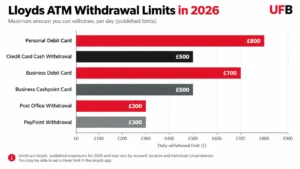
The maximum withdrawal from an ATM with a standard Lloyds Bank personal debit card is currently £800 per day.
That £800 is a daily cash limit rather than a guaranteed amount that every individual cash machine will dispense in one transaction. The ATM operator can impose a smaller transaction limit.
There is also an important distinction between debit and credit cards. A standard Lloyds debit card normally has an £800 daily cash-machine limit, while Lloyds currently states that its credit-card cash-machine limit is £500 per day.
Customers should therefore check which card they are using before relying on a £500 or £800 figure.
According to Lloyds’ current payment limits, cash-machine withdrawals and cashback can share the same £800 daily allowance.
| Lloyds Card or Withdrawal Method | Current Published Limit |
| Standard personal Lloyds debit card | Up to £800 per day |
| Lloyds credit card at a cash machine | Up to £500 per day, subject to available credit and account limits |
| Lloyds Business Debit Card | Up to £700 per card per day |
| Business Cashpoint Card | Up to £500 per day |
| Post Office withdrawal | Up to £300 per day; counts towards the wider daily cash limit |
| Selected PayPoint withdrawal | Up to £300; counts towards the £800 daily limit |
| Cashback | Cash-machine or cashback withdrawals are subject to the £800 daily limit |
| Branch withdrawal | Larger amounts possible, subject to balance, branch cash availability and security checks |
What Is the Lloyds ATM Withdrawal Limit in 2026?
For most standard Lloyds personal current-account customers, the current ATM withdrawal limit is £800 per day.
Lloyds’ dedicated debit-card information confirms that customers holding a Lloyds Bank debit card can withdraw £800 per day from cash machines.
Older information can still appear online quoting a £500 debit-card limit. Some older Lloyds pages themselves also contain that figure.
The dedicated current cash-withdrawal and payment-limit information should therefore be given more weight than older pages.
Customers wanting to compare this figure with other banks can check current UK ATM withdrawal limits.
Is the £800 Lloyds Limit Per Transaction or Per Day?
The £800 figure is a daily limit.
It does not mean every cash machine must dispense £800 in one transaction.
For example, an independent ATM could limit individual withdrawals to £250. A customer with the full £800 daily allowance remaining might therefore need several transactions:
| Withdrawal | Amount |
| First withdrawal | £250 |
| Second withdrawal | £250 |
| Third withdrawal | £250 |
| Fourth withdrawal | £50 |
| Total | £800 |
Changing cash machines does not normally create another £800 allowance.
If £500 has already been withdrawn from one ATM, moving to another bank’s ATM would normally leave £300 of the Lloyds daily allowance rather than starting a fresh £800 limit.
When Does the Lloyds Daily Withdrawal Limit Reset?
Lloyds describes the £800 restriction as a daily cash withdrawal limit, but its current public payment-limit information does not specify an exact clock time at which that allowance refreshes.
It would therefore be misleading to guarantee that a customer can withdraw another £800 at exactly 00:01.
Someone planning two large withdrawals on consecutive days should allow for the daily limit to refresh and contact Lloyds through secure messaging if the exact timing is important.
What is clear is that using another cash machine during the same day does not create a second allowance.
Why Do Some Websites Say the Lloyds Limit Is £500?
There are two main reasons.
First, older Lloyds material can still contain previous debit-card figures.
Second, Lloyds does currently have a £500 cash-machine limit for credit cards, which can easily be confused with its £800 standard personal debit-card limit.
The distinction is:
| Card | What Happens When Cash Is Withdrawn? | Daily ATM Limit |
| Lloyds debit card | Money comes from the current account | Normally £800 |
| Lloyds credit card | Customer borrows money from the credit-card account | £500 |
| Business Debit Card | Money comes from the business account | £700 per card |
| Business Cashpoint Card | Cash withdrawal from business account | £500 |
The £500 figure is therefore not necessarily wrong. It may simply relate to a different Lloyds product.
What Is the Lloyds Credit Card ATM Withdrawal Limit?
Lloyds currently states that its daily credit-card cash-machine limit is £500.
This should not be confused with the £800 standard personal debit-card limit.
The amount a credit-card customer can actually withdraw can also be restricted by:
- Available credit
- The account’s cash allowance
- Existing balance
- Fraud or security controls
- The ATM operator’s transaction limit
A £5,000 credit limit does not automatically mean £5,000 can be withdrawn as cash.
Lloyds explains the £500 ATM limit and associated costs in its official credit-card cash transaction guidance.
The broader costs and risks are also covered in more detail when withdrawing cash from a credit card.
What Counts as a Lloyds Credit Card Cash Transaction?
A credit-card “cash transaction” covers considerably more than taking banknotes from an ATM.
Lloyds currently lists examples including:
- Cash-machine and over-the-counter cash withdrawals
- Buying foreign currency
- Sending certain money orders or wire transfers
- Buying coins or banknotes
- Buying digital currency
- Paying government or court fines, enforcement penalties, fees or costs
- Online trading such as share dealing or investments
- Purchasing or topping up electronic money
- Topping up payment cards
- Certain mobile-wallet or account-service transactions
These categories matter because cash transactions can attract different fees and interest from ordinary purchases.
However, customers should not assume that every cash-like transaction uses part of the £500 daily ATM allowance. Lloyds describes £500 specifically as its daily cash-machine limit. The treatment of other cash transactions should be checked against the individual credit-card terms.
Interest Starts Immediately
Cash transactions work differently from most ordinary credit-card purchases.
Lloyds states that interest is charged from the date the cash transaction is added to the account.
There is therefore normally no purchase-style interest-free period simply because the statement will be paid later.
A Cash Transaction Fee Can Apply
Lloyds says a cash transaction will also likely carry a fee.
Depending on the card and provider, the fee can be up to 5% of the amount withdrawn, potentially with a minimum charge.
The customer’s own statement, Summary Box and account terms should be checked because the exact charge can differ between products.
Does Section 75 Cover Cash Withdrawn From a Lloyds Credit Card?
No. Lloyds specifically confirms that once money has been withdrawn using a credit card, the cash is not protected by Section 75 of the Consumer Credit Act 1974.
That distinction can matter with a large purchase.
For example, where a qualifying £1,000 item is bought directly from a retailer using a credit card, Section 75 protection may potentially apply, subject to the usual legal requirements.
If £1,000 is instead withdrawn as cash from the credit card and then handed to the retailer, the purchase does not receive the same Section 75 protection through that credit-card transaction.
Where possible, paying a seller directly by credit card can therefore offer stronger consumer protection than withdrawing cash first.
Do Post Office Withdrawals Count Towards the £800 Lloyds Limit?
Yes.
A Lloyds personal current-account customer can normally withdraw up to £300 per day at a Post Office using a debit card and PIN.
That £300 is not an additional allowance on top of the £800 cash limit.
For example:
| Transaction | Amount |
| Post Office withdrawal | £300 |
| Remaining cash-machine allowance | £500 |
| Total potential withdrawal | £800 |
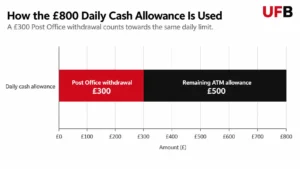
Lloyds explicitly states that after withdrawing £300 at a Post Office, only another £500 would normally be available from a cash machine on the same day.
Does PayPoint Share the Same Lloyds Cash Limit?
Yes.
Selected PayPoint stores allow eligible Lloyds customers to withdraw up to £300 over the counter using a debit card and PIN.
These withdrawals count towards the £800 daily cash limit.
A customer withdrawing £300 through PayPoint would therefore normally have £500 remaining for cash-machine withdrawals that day.
PayPoint provides another method of obtaining cash; it does not increase the overall daily allowance to £1,100.
Do Banking Hub Withdrawals Count Towards the Limit?
Yes, eligible counter withdrawals through Banking Hubs can also form part of the daily cash allowance.
Lloyds states that Post Office or Banking Hub withdrawals can be up to £300 per day and count towards the wider £800 cash-machine limit.
The £800 figure is therefore better understood as a daily cash-access limit across several non-branch channels, rather than an allowance that applies only to a Lloyds-branded ATM.
Can Lloyds Customers Get Cashback at Supermarkets?
Yes. Lloyds currently says customers can request up to £100 cashback at most supermarkets, although individual retailers can have their own limits.
There is an important catch.
Lloyds’ payment-limit information groups cash machines or cashback together under an £800 daily limit.
Cashback should therefore not be treated as an extra £100 that can always be added after already withdrawing £800 from an ATM.
For example, a customer taking £700 from an ATM would generally have only £100 of the published cash-machine/cashback allowance remaining.
Can You Withdraw £1,000 From a Lloyds ATM?
Normally, no.
A £1,000 withdrawal would exceed the standard £800 personal debit-card daily limit.
Having £5,000 or £10,000 sitting in the current account does not automatically increase the card’s ATM limit.
Someone needing £1,000 or more can instead consider a branch withdrawal or, where the money is being used to pay another person or business, an electronic bank transfer.
Can You Withdraw £2,000 or More From Lloyds?
Potentially, but a branch is generally more appropriate than an ATM.
Lloyds’ current guidance says customers can withdraw cash at Lloyds, Halifax or Bank of Scotland branches, subject to:
- The available account balance
- How much cash that branch holds
- Identification requirements
- Supporting documentation
- Fraud or scam-prevention checks
Lloyds’ personal banking terms also indicate that customers wanting to withdraw more than £2,000 should normally give at least 24 hours’ advance notice.
There is therefore no simple rule saying that every Lloyds branch will immediately hand over any requested amount.
What Happens When Withdrawing a Large Amount in a Lloyds Branch?
Large branch withdrawals can involve significantly more checking than an ordinary £100 ATM transaction.
Lloyds’ official cash-withdrawal guidance says availability can be limited and that customers may be asked for identification and supporting documentation.
The bank may also ask questions about the purpose of the withdrawal.
For example, staff could ask:
- What the cash is being used for
- Who is receiving the money
- Whether the customer has been instructed to withdraw it by somebody else
- Whether invoices or other supporting documents are available
- Whether another payment method would be safer
These questions form part of Lloyds’ fraud and scam-prevention procedures.
They do not necessarily mean that the bank believes the customer has done anything wrong.
Why Might Lloyds Suggest a Bank Transfer Instead?
A £5,000 transfer to a known supplier may be easier to trace and potentially safer than carrying £5,000 in banknotes.
Lloyds therefore says staff may discuss other secure ways of making a payment where a large cash withdrawal raises concerns.
For most personal accounts, Lloyds currently publishes a Faster Payment limit of up to £25,000, although individual account limits can vary.
For very large payments, CHAPS may also be available subject to the bank’s current terms and fee.
Can Lloyds Refuse or Delay a Large Cash Withdrawal?
A large withdrawal can be delayed if the branch does not have enough cash immediately available or if fraud and security checks need to be completed.
Lloyds specifically states that larger withdrawals can require identification and documentation confirming their purpose.
A customer intending to collect several thousand pounds should therefore contact the branch in advance rather than assume the full amount will automatically be available over the counter.
Where a transaction is legitimate but Lloyds’ decision or handling of the withdrawal remains unresolved, the customer can use Lloyds’ formal complaints process.
What Can a Customer Do If Lloyds Will Not Release a Legitimate Withdrawal?
The first step should normally be to ask the branch or Lloyds to explain what additional information is required.
If the issue cannot be resolved, a formal complaint can be raised with Lloyds.
Its current complaints process says the bank aims to resolve complaints as quickly as possible and normally sends a final response by eight weeks where the issue has not already been settled.
If the customer remains unhappy with Lloyds’ final response, the complaint may be referred to the Financial Ombudsman Service, subject to eligibility and the applicable time limits.
Lloyds states that customers generally have six months from its final response to refer an eligible complaint to the Ombudsman.
The Ombudsman would consider the individual circumstances rather than simply assuming that either the customer or bank was automatically correct.
What If a Customer Needs Extra Support During a Large Withdrawal?
Fraud checks can be stressful, particularly for older customers, people with disabilities, customers affected by illness or people who need additional help managing financial decisions.
Customers can tell Lloyds about support they need.
Its current accessibility and support services include branch support, accessibility options and arrangements for customers who need help managing their banking.
A legitimate fraud check and accessibility support are separate issues. Customers can still ask for reasonable assistance with communication or the branch process while security checks are taking place.
Can the £800 Lloyds ATM Limit Be Increased?
Lloyds currently publishes £800 as the standard personal debit-card daily cash-machine limit.
Unlike some banks, Lloyds does not currently advertise a general self-service option allowing standard personal customers to increase that ATM limit to £1,000, £1,500 or another figure through the app.
Customers who believe a different restriction has been applied to their account can contact Lloyds through secure messaging or other official support channels.
Someone needing considerably more than £800 will normally have better options than repeatedly attempting larger ATM transactions.
Can Someone Withdraw £800 Today and Another £800 Tomorrow?
The Lloyds restriction is expressed as a daily limit.
That means withdrawals on different days can fall within separate daily allowances once the limit has refreshed, assuming:
- Sufficient money is available
- The card is unrestricted
- No previous withdrawals have used part of that day’s allowance
- The transaction passes Lloyds’ security checks
- The ATM itself can dispense the requested amount
This can make splitting a non-urgent £1,600 cash requirement across separate days an option.
However, customers should not rely on a specific midnight reset time because Lloyds does not currently publish an exact reset hour on its main payment-limit page.
Is a Bank Transfer Better Than Withdrawing a Large Amount of Cash?
Frequently, yes.
Suppose a customer needs to pay £1,500 for a legitimate purchase.
Trying to obtain that money through an ATM would exceed the £800 daily limit.
Possible alternatives include:
| Method | Potential Advantage |
| Faster Payment | Can transfer substantially more than £800 without handling physical cash |
| Branch withdrawal | Suitable where physical cash is genuinely required |
| Debit-card payment | Avoids carrying cash if the seller accepts cards |
| Two separate daily withdrawals | May work where cash is genuinely required and the payment is not urgent |
| CHAPS | Can be appropriate for particularly large payments |
Electronic payments can also produce a clearer transaction record than handing over physical cash.
Customers should still verify who they are paying, particularly if somebody is pressuring them to move money urgently.
Can You Withdraw Cash From a Lloyds ATM Without a Card?
Lloyds supports digital wallets such as Apple Pay and Google Pay for contactless payments, but its current personal banking guidance does not advertise a NatWest-style app-generated cash code allowing customers to routinely withdraw money from an ATM without their debit card.
Current Lloyds cash-machine guidance continues to focus on card and PIN access.
Customers should therefore not assume that adding a Lloyds card to a phone automatically enables contactless ATM withdrawals.
This is different from tapping a phone or watch at a retailer to make a normal contactless payment.
How Does the LINK ATM Network Affect Lloyds Withdrawals?
Lloyds customers are not limited to Lloyds-branded cash machines.
The UK’s LINK cash-machine network connects virtually every UK ATM to LINK-enabled cards.
Using another participating cash machine does not create a new Lloyds allowance, however.
The £800 Lloyds daily account limit continues to apply regardless of whether the cash is taken from:
- A Lloyds Cashpoint
- Another bank’s ATM
- A supermarket cash machine
- An independent LINK-connected ATM
The individual machine may also impose a lower per-transaction limit or charge a fee.
Cash remains widely used despite the growth of contactless and mobile payments.
LINK reports that £76.7 billion was withdrawn from LINK ATMs during 2025, while the average ATM withdrawal was just over £92.
By the end of 2025, LINK reported 42,403 UK cash machines, including more than 33,000 free-to-use machines.
This context is useful because the average withdrawal is far below Lloyds’ £800 ceiling. The maximum limit is mainly relevant to customers making unusually large cash withdrawals.
Why Might a Lloyds ATM Withdrawal Be Declined?
An ATM withdrawal can fail even when the customer has not intentionally exceeded the £800 limit.
Daily Cash Allowance Already Used
Earlier ATM, Post Office, PayPoint, Banking Hub or cashback transactions may have reduced the amount still available.
The ATM Has a Smaller Transaction Limit
A cash machine could allow only £200 or £250 at a time even where Lloyds would permit a larger daily total.
Insufficient Available Balance
Pending payments can make the available balance lower than the headline account balance.
Card Security Restriction
A frozen card, incorrect PIN attempts or another account restriction can prevent cash withdrawals.
Fraud Controls
An unusual withdrawal pattern, very large attempted transaction or unexpected location can trigger additional security checks.
Repeatedly trying different machines after a security decline is unlikely to solve an account-level restriction.
Are Lloyds Cash Withdrawals Free in the UK?
Lloyds does not charge customers for withdrawing money from Lloyds, Halifax or Bank of Scotland cash machines in the UK.
Another ATM operator can impose its own fee.
Where a charge applies, the cash machine should display it before the withdrawal is completed so the customer can decide whether to continue.
What Are the Lloyds ATM Fees Abroad?
Foreign ATM charges depend on the current account held.
Lloyds currently states that holders of several accounts, including Club, Silver, Gold, Platinum, Premier, Student and Graduate accounts, do not pay Lloyds debit-card fees when shopping or withdrawing cash abroad.
Different rules can apply to Classic and Basic accounts, and a foreign ATM operator may impose its own charge regardless of whether Lloyds charges one.
Customers should also be careful when an overseas ATM offers to convert the transaction into pounds.
Choosing pounds can allow the ATM operator to determine the exchange rate through dynamic currency conversion. Selecting the local currency generally leaves the conversion to the card network and Lloyds under the applicable account terms.
Does Lloyds Use the Same £800 Limit Abroad?
Lloyds does not currently publish a lower standard debit-card withdrawal limit simply because the card is being used overseas.
A foreign ATM may nevertheless have a much smaller per-transaction maximum.
For example, the customer’s Lloyds allowance could theoretically be £800 while the overseas machine dispenses only the equivalent of £200 per transaction.
Fees and limits are separate issues.
What Is the Lloyds International Debit Card ATM Limit?
Lloyds International currently publishes different ATM limits depending on the card’s account currency:
| International Debit Card | ATM Limit |
| Sterling | £800 |
| US dollar | $750 |
| Euro | €750 |
These limits relate to Lloyds International products and should not be confused with the standard UK personal debit-card rules.
What Is the Bottom Line on the Maximum Withdrawal From an ATM With Lloyds?
For a standard Lloyds Bank personal debit card, the maximum ATM withdrawal is normally £800 per day in 2026.
The most important distinction is between debit cards and credit cards.
A Lloyds debit card generally has an £800 daily cash limit, while Lloyds’ current credit-card guidance puts the daily cash-machine limit at £500.
Post Office, PayPoint, Banking Hub and cashback withdrawals can also use part of the daily debit-card allowance.
Customers needing more than £800 should consider whether the money genuinely needs to be taken as physical cash. Branch withdrawals, debit-card payments and bank transfers can all be more practical for larger sums.
For branch withdrawals, Lloyds can ask for identification, supporting evidence and information about the purpose of the transaction as part of fraud and scam prevention. Amounts above £2,000 may also require advance notice.
Credit-card cash withdrawals require particular caution because they can attract a cash transaction fee, begin accruing interest immediately and do not provide Section 75 protection for items subsequently bought with the withdrawn cash.
Frequently Asked Questions
How Much Can I Withdraw From a Lloyds ATM Per Day?
Most standard Lloyds personal debit-card customers can currently withdraw up to £800 per day.
What Is the Lloyds Credit Card ATM Limit?
Lloyds currently states that the daily credit-card cash-machine limit is £500, subject to the account’s available credit and other restrictions.
When Does the Lloyds ATM Withdrawal Limit Reset?
Lloyds publishes the restriction as a daily limit but does not currently specify an exact public reset time. Customers needing another large withdrawal immediately on the following day should confirm the timing with Lloyds rather than assuming it resets at precisely midnight.
Can I Withdraw £1,000 From a Lloyds ATM?
Normally not in one day with a standard personal debit card because the published daily limit is £800. A branch withdrawal or bank transfer may be more appropriate.
Can I Withdraw £500 Twice From Lloyds?
Not normally on the same day with a standard personal debit card. Two £500 withdrawals would total £1,000 and exceed the £800 daily limit.
Can I Withdraw £300 at the Post Office and £800 From an ATM?
No. Lloyds states that a £300 Post Office withdrawal counts towards the same daily cash allowance, normally leaving £500 available through cash machines that day.
Does Supermarket Cashback Count Towards the Lloyds Withdrawal Limit?
Yes. Lloyds publishes cash-machine withdrawals and cashback under an £800 daily limit. Its current debit-card guidance also says customers can request up to £100 cashback at most supermarkets.
Can Lloyds Ask Why Someone Is Withdrawing Their Own Money?
Yes. For larger branch withdrawals Lloyds says it may ask questions, request supporting documentation and confirm the purpose of the transaction as part of its fraud and scam-prevention procedures.
What Can Someone Do If Lloyds Refuses a Legitimate Withdrawal?
The customer can first ask what identification, documentation or security checks are outstanding. If the issue cannot be resolved, a formal complaint can be made to Lloyds and an eligible unresolved complaint can subsequently be referred to the Financial Ombudsman Service.
Does Lloyds Offer Cardless ATM Withdrawals?
Lloyds’ current personal banking guidance does not advertise an app-generated cardless cash-code service. Apple Pay and Google Pay are supported for contactless payments, but customers should not assume this means a phone can replace the debit card for ATM cash withdrawals.
Does Using Another Bank’s ATM Give Another £800 Allowance?
No. The £800 is an account-level daily limit. Using another cash machine does not normally reset it.
Does Section 75 Apply If Cash Is Withdrawn From a Credit Card?
No. Lloyds confirms that money withdrawn using a credit card is no longer protected by Section 75. Paying a qualifying supplier directly with the credit card can provide different protection.
How Much Can a Lloyds Business Customer Withdraw?
A Lloyds Business Debit Card currently has a daily ATM limit of £700 per card, while a Business Cashpoint Card has a £500 daily limit.
Disclaimer: This article provides general financial information and does not constitute personalised financial, legal or investment advice. Banking limits, charges and security procedures can change, so customers planning an unusually large withdrawal should check their account and Lloyds’ current official terms before acting.