
Revolut and Monzo are now competing much more directly than they were only a few years ago.
Both offer UK current accounts, savings, joint accounts, budgeting features, premium subscriptions and business banking. But they remain quite different once foreign currency, borrowing, cash deposits, investments and business use are compared properly.
For most people, there is no universal winner.
Monzo is generally stronger for everyday UK banking, particularly for people who want their salary, household bills, savings, borrowing and budgeting organised around one main current account.
Revolut is generally stronger for international use, especially for customers who regularly exchange currencies, travel, receive or send money internationally, trade individual shares or use crypto-related services.
The comparison changed substantially in 2026 because Revolut Bank UK Ltd became a fully licensed UK bank in March. Eligible money held with Revolut Bank UK can now receive FSCS deposit protection, while Revolut also supports the Current Account Switch Service.
However, the differences between Monzo and Revolut now go much deeper than the question of whether one is a “real bank”.
Revolut vs Monzo at a Glance
| Feature | Monzo | Revolut |
| Free personal account | Yes | Yes |
| UK banking licence | Yes | Yes – Revolut Bank UK launched in 2026 |
| FSCS protection | Up to £120,000 on eligible deposits | Up to £120,000 on eligible Revolut Bank UK deposits |
| Paid personal plans | Extra £3, Perks £9, Max from £19 | Plus £3.99, Premium £7.99, Metal £14.99, Ultra £55 |
| Normal overseas card spending | No Monzo foreign transaction fee | Currency conversion subject to plan rules |
| Currency accounts | Limited | Major strength |
| Budgeting | Excellent | Very good |
| Joint accounts | Yes | Yes |
| Arranged overdrafts | Yes, subject to eligibility | Not currently a core UK personal-current-account feature |
| Personal loans | Yes | UK availability more limited |
| Credit card / flexible borrowing | Monzo Flex | Credit products vary by Revolut market |
| Cash deposits | Yes | No – UK cash deposits discontinued in February 2026 |
| Cheque deposits | Yes | More limited |
| Savings | Yes | Yes |
| Individual stock trading | No – mainly ready-made investment funds | Yes |
| Crypto trading | No comparable native platform | Yes |
| Personal card network | Mastercard | Visa or Mastercard |
| Business banking | Lite, Pro and Team | Basic, Grow, Scale and Enterprise |
| Freelancer option | Monzo Business | Revolut Pro or Revolut Business |
| Best suited to | UK everyday banking | Travel, FX and broader financial services |
The important qualification for Revolut is that its UK banking migration has been phased. Customers should check their statements or account documentation to establish which Revolut entity holds their money and what protection applies.
Is Monzo or Revolut Better in 2026?
For somebody earning a salary in pounds, paying UK household bills and wanting detailed budgeting alongside access to an overdraft or personal loan, Monzo is probably the more natural primary bank.
For somebody travelling frequently, earning or spending in several currencies, sending international payments, buying individual shares or using crypto, Revolut provides the broader toolkit.
There is also a third option that is often overlooked: using both.
A customer could receive their salary and pay bills through Monzo while using Revolut specifically for foreign currencies, travel, investments or international transfers.
That becomes particularly sensible once the actual fees and limits are examined rather than relying on phrases such as “fee-free travel card”.
Revolut vs Monzo Personal Account Fees
Both providers have free accounts alongside optional paid subscriptions.
Monzo Plans
Monzo currently markets the following main personal plans:
| Monzo Plan | Monthly Cost | Main Focus |
| Free | £0 | Everyday banking |
| Extra | £3 | Budgeting and credit insights |
| Perks | £9 | Rewards, higher savings rates and travel-related allowances |
| Max | £19 | Perks plus insurance |
| Max with Family | £23 | Max benefits with eligible family cover |
Monzo Extra adds functionality including connected accounts, virtual cards, advanced roundups, custom categories and additional credit insights.
Perks adds rewards and subscription-style benefits, while Max includes more substantial insurance products.
Revolut Plans
Revolut’s current UK personal plans are:
| Revolut Plan | Monthly Cost |
| Standard | Free |
| Plus | £3.99 |
| Premium | £7.99 |
| Metal | £14.99 |
| Ultra | £55 |
Higher plans raise ATM allowances, improve RevPoints earning rates, remove certain FX restrictions and add subscriptions, insurance and travel benefits.
For example, current fee-free Revolut ATM allowances range from £200 or five withdrawals per rolling month on Standard to £2,000 per rolling month on Ultra.
What Perks Do Monzo and Revolut Actually Include?
This is an area where a vague statement such as “premium plans include perks” is not particularly useful.
The actual brands and services matter because a £10 subscription only represents genuine value if the customer would otherwise have paid for it.
Monzo Perks and Max
Monzo Perks currently includes benefits such as:
- An annual Railcard
- An annual Uber One membership
- A weekly Greggs treat
- One Vue cinema ticket each month
- YouTube Premium Lite
- Higher savings rates
- Discounted investment fees
- Three fee-free cash deposits each month
Monzo Max includes the Perks benefits and adds products including:
- Worldwide personal travel insurance
- Worldwide mobile-phone insurance
- UK and European breakdown cover
- Discounted airport lounge access
The insurance policies have eligibility requirements, exclusions and conditions, so the headline retail value should not be treated as guaranteed savings.
Monzo also provides merchant-specific cashback offers. The percentage and participating retailers can change, so customers should check the offers currently activated in their app rather than assuming a permanent cashback rate.
Revolut Premium, Metal and Ultra Perks
Revolut’s paid plans have become considerably more subscription-heavy.
Its UK partner-benefit catalogue currently includes brands such as:
- Financial Times
- WeWork
- Uber One
- MasterClass
- NordVPN
- Headspace
- Sleep Cycle
- Freeletics
- Picsart
- The Athletic
- ClassPass
- Perplexity
- Tinder
- Chess.com
The precise subscription level available can depend on the Revolut plan.
Metal, for example, currently lists benefits including Financial Times Standard Digital, monthly WeWork credit, MasterClass access, NordVPN Plus, Headspace, Sleep Cycle Premium, Freeletics, Picsart, The Athletic, ClassPass, Perplexity, Tinder Gold and Chess.com.
Ultra goes further and currently includes benefits such as higher-value subscriptions, unlimited airport-lounge access across more than 1,600 lounges and 3GB of global eSIM data each month.
RevPoints vs Monzo Cashback
Revolut’s loyalty system is called RevPoints.
Current earning rates range from approximately:
| Revolut Plan | RevPoints Rate |
| Standard | 1 point per £10 |
| Plus | 1 point per £10 |
| Premium | 1 point per £4 |
| Metal | 1 point per £2 |
| Ultra | 1 point per £1 |
RevPoints can be redeemed against products such as airline miles, accommodation and other Revolut travel benefits.
That is fundamentally different from Monzo’s merchant cashback approach.
Revolut is therefore stronger for someone wanting a centralised loyalty currency, while Monzo’s cashback may appeal more to somebody who prefers direct retailer-specific offers.
Which Is Better Abroad: Revolut or Monzo?
This is more complicated than saying Revolut is the travel account.
Monzo does not normally add its own foreign transaction fee when its debit card is used for purchases abroad. Mastercard’s conversion mechanism applies.
Revolut instead gives customers extensive currency-management functionality and applies limits according to the account plan.
For Revolut Standard:
- Up to £1,000 per rolling month can normally be exchanged before its 1% fair-usage fee.
- Standard can incur an additional 1% weekend exchange fee.
- Fiat currencies, crypto and commodities can contribute to the relevant fair-usage calculation.
Plus raises the fair-usage allowance to £3,000 and reduces the applicable fair-usage and weekend percentages to 0.5%.
Premium, Metal and Ultra currently have no additional fair-usage exchange limit or weekend exchange charge.
Anyone considering Monzo primarily for overseas use can compare the site’s Monzo fees abroad breakdown, which covers its UK, EEA and non-EEA rules in greater detail.
The Weekend FX Trap
One of the easiest Revolut charges to overlook is currency conversion outside normal FX market hours.
Revolut’s UK travel material describes the weekend market-closure period as approximately 5pm Friday to 6pm Sunday.
There is, however, an unusual detail worth knowing: Revolut’s current UK help material and some of its UK editorial pages are not entirely consistent about whether that reference window is expressed in UK time or Eastern Time.
For that reason, the safest practical rule is simple:
If using Standard or Plus, check the fee displayed by Revolut immediately before confirming a weekend exchange.
The app’s transaction preview is more reliable than assuming an old article’s timezone definition remains unchanged.
Worked Example: Converting and Sending £2,000 to Spain
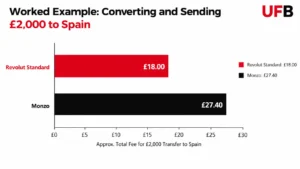
Suppose a customer wants to convert £2,000 into euros and send the money to a Spanish euro account on a weekday.
Revolut Standard
If the customer has not already used any of their monthly exchange allowance:
- First £1,000: within allowance
- Remaining £1,000: subject to 1% fair-usage fee
- Additional FX cost: approximately £10
The final amount received still depends on the rate presented in Revolut.
Monzo
International-payment pricing can depend on the destination currency and whether Monzo processes the route itself or through a third party such as Wise.
Monzo now supports international transfers to dozens of currencies and says more than half of its international bank transfers arrive within seconds, although some currencies may still require a Wise account.
The correct comparison is therefore not simply:
“Which bank has the lower percentage fee?”
It is:
How many euros will actually reach the recipient after the exchange rate and every applicable transfer fee are included?
That final-recipient figure is what customers should compare immediately before authorising a large transfer.
Which Is Faster for International Transfers?
Transfer speeds depend heavily on the currency, recipient bank, transfer route and compliance checks.
Revolut’s current payment terms say many international transfers outside the EEA or in non-EEA currencies normally take around 0–2 business days, although some routes may take longer.
SEPA Instant transfers can arrive almost immediately where supported.
Monzo says more than half of its international bank transfers currently arrive within seconds, while some routes are handled with Wise or other international-payment infrastructure.
Older comparisons sometimes describe Monzo transfers as taking “up to four days” and Revolut as universally taking one or two days. That is now too simplistic.
Mid-Market Rate vs Interbank Rate
The terms are also often used as though they mean exactly the same thing.
A mid-market rate normally describes the midpoint between prevailing buy and sell rates in the currency market.
An interbank rate broadly refers to rates used within wholesale currency markets between financial institutions.
Revolut describes its business FX pricing as using an interbank rate plus applicable fees, while Wise commonly describes its pricing around the mid-market rate.
For an ordinary customer, the important number remains the final conversion quote shown before the transfer is approved.
Revolut vs Monzo ATM Withdrawals
Revolut Standard currently allows £200 or five fee-free withdrawals per rolling month, whichever comes first.
After the allowance, Revolut normally charges 2%, subject to a £1 minimum fee per withdrawal.
Monzo works differently because its fee-free allowance depends on location, account plan and whether Monzo qualifies as the customer’s main bank.
A standard Monzo customer who does not meet the main-bank criteria currently receives:
- £400 fee-free every 30 days in the UK and EEA
- £200 fee-free every 30 days outside the EEA
- 3% thereafter
Qualifying main-bank customers can receive unlimited fee-free Monzo withdrawals in the UK and EEA.
A separate daily cash-machine limit applies.
The site’s detailed Monzo cash withdrawal limit breakdown explains the distinction between the daily ATM cap and the rolling fee-free allowance.
Worked Example: Withdrawing €300 in Portugal
Suppose €300 converts to an illustrative £260.
Monzo Free Account
Portugal is within the EEA.
For a standard customer who has made no previous relevant ATM withdrawals:
- Withdrawal: £260 equivalent
- Fee-free allowance: £400
- Monzo ATM fee: £0
Revolut Standard
Assuming no previous withdrawals:
- Withdrawal: £260 equivalent
- Fee-free allowance: £200
- Excess: £60
- 2% of £60: £1.20
- Revolut withdrawal fee: approximately £1.20
An independent ATM owner can impose its own fee on either card.
The example demonstrates an important point: Revolut is not automatically cheaper every time cash is withdrawn overseas simply because it has stronger international branding.
Can You Pay Cash Into Monzo or Revolut?
This is now a significant difference.
Monzo Cash Deposits
Monzo personal customers can deposit cash through UK PayPoint locations and Post Offices.
Its current personal cash limit is £750 per month.
At PayPoint, customers can normally deposit up to £300 in one transaction. At a Post Office, the full £750 monthly allowance can potentially be deposited in one transaction.
Monzo normally charges £1 per cash deposit.
Perks, Max and Max Family customers currently receive three free cash deposits each calendar month.
Can Revolut Accept Cash Deposits?
No, not currently in the UK.
Revolut previously offered cash top-ups through a partner arrangement, but the service was retired.
UK Revolut cash deposits were discontinued from 13 February 2026.
Customers can instead add money through methods such as bank transfer, debit card, Apple Pay or Google Pay.
That makes Monzo materially more convenient for customers who still regularly receive physical cash.
What About Cheques?
Monzo also has the advantage for cheques.
Personal customers can currently deposit cheques of up to £500 through the Monzo app.
Larger cheques can be sent by post.
In-app cheque deposits can take up to three business days to appear.
That may sound like a minor difference, but it can matter to people receiving refunds, gifts, insurance payments or payments from organisations that still issue cheques.
Which Has Better Savings Rates?
Both providers now compete directly for savings balances.
Monzo’s current plan structure offers different savings rates according to the account tier, with higher rates available on Perks and Max.
Revolut currently advertises approximately:
| Revolut Plan | Instant Access Savings AER |
| Standard | 2.90% |
| Plus | 2.90% |
| Premium | 3.25% |
| Metal | 3.40% |
| Ultra | 4.00% up to £200,000, with a lower rate above that threshold |
These rates are variable.
It would be a mistake to subscribe to a £55 monthly account solely because the headline savings rate is higher.
The additional annual interest should be compared against the annual subscription cost and the genuine value the customer receives from the other Ultra benefits.
Is Revolut Now as Safe as Monzo?
The gap narrowed significantly in 2026.
Monzo Bank Limited is a fully authorised UK bank, and eligible deposits are protected under the Financial Services Compensation Scheme.
Revolut Bank UK Ltd became fully licensed in March 2026 and is authorised by the Prudential Regulation Authority and regulated by the FCA and PRA.
Eligible money held with Revolut Bank UK can also receive FSCS protection up to the applicable limit.
The important issue is the legal entity holding the money.
Revolut’s transition from its previous UK e-money structure has occurred in phases, so customers should check their own account documentation rather than assuming every historical Revolut balance automatically had bank deposit protection.
Which Gets Better Customer Reviews?
Trustpilot currently gives both companies strong scores.
In early September 2026, Revolut was around 4.7/5, while Monzo was approximately 4.6/5, although both ratings and review counts change constantly.
Trustpilot should not be the only measure used.
Fairer Finance Tells a Different Story
An interesting counterpoint comes from independent customer-experience organisation Fairer Finance.
Figures reported from its March 2026 comparison put:
- Monzo: 69.7%
- Revolut: 64.5%
That reverses the order seen on Trustpilot.
It demonstrates why a single review platform should not be treated as definitive evidence that one bank has universally better service.
The more useful comparison is whether the provider:
- Has a clear complaint process
- Gives customers practical ways to contact support
- Falls within relevant UK regulatory protections
- Allows eligible complaints to be escalated to the Financial Ombudsman Service
Which Is Better for Budgeting?
Monzo remains particularly strong for customers who want their current account to explain where their salary is going every month.
Its tools include:
- Pots
- Spending categories
- Salary organisation
- Bill management
- Roundups
- Connected accounts
- Custom categories
- Credit insights
Revolut also provides budgeting tools, spending analytics and recurring-payment management, but its interface has to accommodate a much larger collection of services including currencies, investments, crypto, rewards and travel.
That produces a different experience.
Someone wanting a highly focused UK current account may prefer Monzo.
Someone wanting a financial “super app” may prefer Revolut.
Pots vs Pockets: Similar Idea, Different Products
It is easy to assume that every Monzo Pot and every Revolut Pocket, savings product or investment “vault” is effectively the same thing.
It is not.
Some features simply separate money inside an account for budgeting.
Other Revolut products, such as Flexible Cash Funds where available, are investment products with a different legal structure and investment risk.
The memorable rule is:
A budgeting bucket and an investment fund may look similar inside an app, but they are not the same financial product.
Customers should always check whether money is held as a normal bank deposit, in a separate savings product or in an investment fund before comparing headline returns or protection.
Revolut vs Monzo Borrowing
Borrowing is one of Monzo’s clearer advantages for a typical UK personal customer.
Monzo Overdrafts
Eligible customers can apply for an arranged overdraft.
Rates vary according to the individual customer and eligibility assessment.
Opening the normal account and applying to borrow are separate decisions: acceptance for a current account does not guarantee acceptance for an overdraft.
Monzo Personal Loans
Monzo’s lending range has expanded.
Its current loan calculator now covers borrowing as high as £35,000, subject to eligibility, rather than the £25,000 maximum quoted in some older comparisons.
Customers can check indicative eligibility and see the offered interest rate before deciding whether to proceed.
Monzo Flex
Monzo Flex is now presented as a credit-card product rather than simply a basic BNPL service.
Monzo currently offers:
- Flex Purchase with limits potentially up to £10,000
- Flex Build with smaller limits aimed partly at customers building credit
- 0% payment in full
- A three-month 0% option for qualifying purchases under its applicable terms
- Longer borrowing subject to the customer’s personalised APR
Monzo has also been changing the eligibility conditions around its three-month interest-free feature, so existing customers should check their personalised Flex offer rather than relying on historic terms.
Does Revolut Have Pay Later or Personal Loans?
Revolut operates loans, credit cards and buy-now-pay-later products in a number of international markets.
Its 2025 annual report says credit products were available across multiple countries.
However, product availability varies by country, and Revolut’s current UK consumer proposition should not be described as having a Monzo-equivalent overdraft, personal-loan and Flex range unless that specific product is shown as available to the individual UK customer.
That distinction matters because a global Revolut product announcement does not automatically mean the same credit facility is available to UK residents.
What Is Monzo Pension?
Monzo has also moved beyond banking into pension consolidation.
Customers can use Monzo Pension to locate and combine qualifying pensions and invest through BlackRock funds.
Its current fee guidance states that Monzo charges an annual platform fee of 0.25%, reduced to 0.20% for certain eligible paid-plan customers, plus the relevant BlackRock management cost.
Older articles quoting a fixed 0.63% total cost should therefore be checked carefully because Monzo’s current published fee structure has changed.
The pension product strengthens Monzo’s proposition for somebody wanting everyday banking, borrowing, savings, investments and pension management in one ecosystem.
However, pension transfers can involve valuable guarantees, protected pension ages or other benefits that can be lost. A pension should not be transferred simply for app convenience without understanding the existing scheme.
Which Has Better Investments?
The providers target different investors.
Monzo Investments
Monzo Investments is built around ready-made funds rather than asking customers to select individual listed companies.
That may suit beginners who want a relatively simple diversified portfolio.
Revolut Investments
Revolut is substantially broader for self-directed trading.
Its current UK plan comparison advertises access to thousands of listed stocks, with commission-free monthly trading allowances increasing according to plan.
Current allowances range from:
- 1 trade on Standard
- 3 on Plus
- 5 on Premium
- 10 on Metal
- 10 on Ultra
Additional charges can apply after the allowance.
For somebody who wants to select individual companies, Revolut is the stronger option.
For somebody who wants a simpler ready-made portfolio, Monzo may be easier.
Revolut vs Monzo for Crypto
Revolut is the clear winner if native cryptocurrency functionality is required.
Monzo does not offer an equivalent in-app crypto investment platform.
Revolut supports crypto trading and can allow supported assets to be transferred to compatible external blockchain addresses.
Not every cryptocurrency or network is eligible for withdrawal, however.
Customers should check:
- Trading fees and spread
- Supported cryptocurrencies
- Supported blockchain networks
- Withdrawal minimums
- Network charges
- Custody arrangements
Cryptoassets are high risk and should not be confused with money held in an FSCS-protected bank deposit.
Revolut vs Monzo Card Network
There is also a small technical difference.
Monzo’s normal current-account debit card operates on Mastercard.
Revolut physical cards can be Visa or Mastercard, depending on the particular card and availability. Revolut also allows additional choice for certain virtual cards.
For most UK and international purchases, both networks have extremely wide acceptance, so this should rarely be a deciding factor.
Revolut Business vs Monzo Business
Business banking deserves more than a short freelancer paragraph because the two companies are competing increasingly aggressively for UK small-business customers.
Business Plan Prices
| Business Plan | Monthly Price |
| Monzo Lite | Free |
| Monzo Pro | £9 |
| Monzo Team | From £25 |
| Revolut Basic | £10 |
| Revolut Grow | £35 |
| Revolut Scale | £125 |
| Revolut Enterprise | Custom |
The current Revolut figures are particularly important because older comparisons and previous promotional material still show £30 for Grow and £90 for Scale.
Revolut’s live UK Business fee schedule currently lists £35 for Grow and £125 for Scale.
Revolut Business FX Allowances
Revolut Business is considerably stronger when a company regularly works across currencies.
Its current monthly FX allowances are:
| Revolut Business Plan | Monthly FX Allowance |
| Basic | £1,000 |
| Grow | £15,000 |
| Scale | £60,000 |
| Enterprise | Custom |
Above the allowance, Revolut currently charges 0.6%.
It also lists a 1% fee for exchanges outside standard FX market hours.
This can make a substantial difference to an importer, international agency, remote consultancy or e-commerce company receiving and paying several currencies each month.
Revolut Business ATM Limits
Revolut’s business debit-card ATM limits are currently:
| Plan | Maximum ATM Withdrawal |
| Basic | £3,000 per 24 hours |
| Grow | £5,000 per 24 hours |
| Scale | £10,000 per 24 hours |
| Enterprise | £10,000 unless otherwise agreed |
These are maximum withdrawal limits rather than free ATM allowances.
Revolut currently charges a 2% ATM fee on business withdrawals across the standard published plans.
Monzo Business Cash Deposits
Monzo has a major advantage for cash-taking UK businesses.
Current monthly cash limits are:
- Sole traders: £3,000 per calendar month
- Limited companies: £10,000 per calendar month
Monzo charges £1 per deposit.
PayPoint deposits are limited to £300 per transaction.
At the Post Office, a sole trader can deposit up to £3,000 in one transaction, while a limited company can deposit up to £4,000 per transaction, subject to the monthly account limit.
A café, tradesperson, salon or other business receiving physical cash may therefore find Monzo considerably more practical than Revolut.
Business Cheques
Monzo Business also supports cheque deposits.
Cheques of up to £500 can be deposited through the app, while larger cheques can be sent by post.
Accounting Integrations
Monzo Business supports integrations with:
- Xero
- FreeAgent
- Sage
- QuickBooks
These are available on applicable Pro and Team plans.
Revolut Business should no longer be described as supporting only Xero.
Its current integration directory includes accounting integrations such as:
- Xero
- FreeAgent
- QuickBooks
It also integrates with broader business software including e-commerce and automation platforms.
So the most accurate distinction is not simply “Monzo has accounting integrations and Revolut doesn’t”.
Instead:
Monzo is particularly strong for UK bookkeeping workflows, while Revolut combines accounting connectivity with a broader international payments and business-software ecosystem.
Which Business Account Wins?
Monzo Business may suit:
- UK sole traders
- Local limited companies
- Cash-taking businesses
- Businesses wanting Tax Pots
- Firms heavily using Xero, FreeAgent, Sage or QuickBooks
- Small teams wanting structured employee-access controls
Revolut Business may suit:
- International companies
- Importers and exporters
- Agencies billing foreign clients
- Companies holding several currencies
- Firms making frequent cross-border payments
- Businesses needing higher daily ATM limits
For companies with substantial international turnover, the £15,000 and £60,000 monthly FX allowances available on Grow and Scale can be particularly important.
Which Is Better for Freelancers?
A freelancer does not necessarily need the same account as a limited company with employees.
Revolut Pro sits alongside an eligible personal Revolut account and is aimed at freelancers and self-employed users.
Current Pro cashback varies by Revolut personal subscription, reaching as high as 1% on Ultra under the published plan comparison.
Monzo instead encourages normal commercial activity to be handled through Monzo Business.
For a UK self-employed tradesperson who wants invoicing, Tax Pots, accounting software and cash deposits, Monzo Business may be stronger.
For a consultant earning dollars, euros and pounds from international clients, Revolut’s currency infrastructure may provide the bigger benefit.
How Do Monzo and Revolut Make Money?
Understanding the revenue model helps explain why the two products have developed differently.
Monzo’s 2026 annual report separates its revenue broadly across areas including:
- Income associated with current-account balances
- Borrowing
- Payments
- Wealth, including savings and investments
- Subscriptions and other fees
Monzo reported approximately £1.7 billion of revenue for its 2026 financial year.
Revolut’s latest group reporting shows a more diversified mix across:
- Card payments
- Paid subscriptions
- Foreign exchange
- Interest income
- Wealth products
- Other services
Revolut reported approximately £4.5 billion of group revenue for 2025, including substantial income from card payments, subscriptions, FX, wealth and interest.
That helps explain the product philosophy.
Monzo remains heavily centred on becoming the customer’s primary UK banking relationship.
Revolut has increasingly built a broad international financial marketplace around currencies, cards, travel, trading, subscriptions and business payments.
Which Is Better for Joint Accounts?
Both provide joint accounts.
With Monzo, both people generally need eligible individual Monzo accounts before creating a joint account.
Revolut also offers joint accounts to eligible customers.
Monzo has an additional borrowing advantage because eligible joint customers may also be able to apply for a joint overdraft.
Opening a joint financial product can create a financial association between the people involved, which can matter when lenders assess future credit applications.
Which Is Better for Students?
For a UK university student who mainly spends pounds, splits bills and wants help budgeting a monthly income, Monzo is particularly attractive.
For an international student regularly travelling home, converting currencies or receiving overseas payments, Revolut may offer more useful international functionality.
Both also provide banking options for younger customers, subject to age and eligibility requirements.
Which Is Better for Expats and International Customers?
Revolut has the clearer advantage here.
Monzo’s UK current account is primarily designed for UK residents.
Revolut operates across substantially more countries, although the account, legal entity, product range and protections vary depending on the customer’s country of residence.
Someone permanently moving abroad should update their residency details rather than continuing to operate indefinitely from an old UK address.
What About Starling?
Someone choosing a digital bank does not have to restrict the comparison to Monzo and Revolut.
Starling remains another major UK app-based current-account provider.
Its current personal account has no monthly fee and includes features such as spending insights, cheque imaging and Post Office cash deposits.
In the latest published service-quality survey covering July 2025 to June 2026, Monzo ranked first for overall personal-current-account service quality at 79%, while Starling ranked second at 76%.
Someone primarily comparing app-based UK current accounts should therefore consider Monzo vs Revolut vs Starling, rather than assuming only two serious choices exist.
Can You Switch Your Main Bank to Monzo or Revolut?
Yes.
Both now support the Current Account Switch Service.
This is an important change because older Revolut comparisons often list the lack of CASS support as a disadvantage.
A full switch can normally transfer items such as:
- Remaining current-account balance
- Direct Debits
- Standing orders
- Salary arrangements
The old current account is normally closed as part of a full switch.
Customers should still review recurring debit-card subscriptions, Open Banking connections, digital wallets and investment services that may require separate action.
Can You Use Monzo and Revolut Together?
Yes.
In fact, this may be the strongest setup for some people.
| Purpose | Possible Choice |
| Salary | Monzo |
| Rent and household bills | Monzo |
| Budgeting | Monzo |
| Overdraft | Monzo |
| Cash deposits | Monzo |
| Cheques | Monzo |
| Foreign currency balances | Revolut |
| International transfers | Compare both |
| Travel card | Monzo or Revolut depending on use |
| Individual shares | Revolut |
| Crypto | Revolut |
| Backup debit card | Whichever is not the main account |
Keeping two providers also creates operational resilience.
If one app, card or account temporarily stops working, another payment method remains available.
Five-Question Monzo or Revolut Picker
A simple way to make the decision is to answer these five questions.
1. Is Most Income and Spending in Pounds?
Yes: Monzo gets a point.
No, several currencies are regularly used: Revolut gets a point.
2. Are Cash Deposits or Cheques Important?
Yes: Monzo.
No: Either.
3. Are Overdrafts, Loans or Flexible UK Consumer Credit Important?
Yes: Monzo.
No: Either.
4. Are International Currencies, Share Trading or Crypto Important?
Yes: Revolut.
5. Is the Account Mainly for Running Ordinary UK Household Finances?
Yes: Monzo.
No, it is primarily for travel or international finances: Revolut.
If the result is close, using both accounts for different purposes may be more practical than forcing one provider to handle everything.
Which Should Be Your Main Bank?
Choose Monzo if:
- Most income and spending is in sterling.
- Detailed budgeting matters.
- Pots and bill organisation are priorities.
- Cash or cheque deposits may be needed.
- An arranged overdraft or personal loan could be useful.
- The account will handle salary and household Direct Debits.
- Ready-made investments are preferable to individual share selection.
Choose Revolut if:
- Foreign currencies are regularly received or spent.
- International travel is frequent.
- Multiple currency balances are needed.
- Individual share trading matters.
- Crypto functionality is required.
- International business activity is important.
- Revolut Pro suits freelance work.
- Premium travel and subscription benefits will genuinely be used.
Consider Both if:
- Monzo’s budgeting tools are attractive but Revolut’s FX functionality is also useful.
- A second debit card is wanted for emergencies.
- International travel is frequent but most household finances remain UK-based.
- Each account can be given a clearly defined purpose.
Monzo vs Revolut: Final Verdict
The Revolut vs Monzo comparison is closer in 2026 than it has ever been.
Revolut becoming a fully licensed UK bank removed one of its biggest historical disadvantages. Eligible Revolut Bank UK deposits can now receive FSCS protection, while Revolut also supports CASS.
But the two providers have not become identical.
Monzo remains the stronger all-round UK household bank.
Its Pots, salary organisation, cash deposits, cheque support, overdrafts, personal loans, Flex credit and straightforward foreign debit-card spending make it particularly practical for someone wanting a single current account to run everyday finances.
Revolut remains the stronger international financial platform.
Its multiple currencies, foreign exchange tools, international transfers, individual share trading, crypto functionality, RevPoints, premium subscriptions and international business banking make it particularly attractive to customers whose finances cross borders.
Its business proposition is also considerably stronger than a simple freelancer account. Current Revolut Business plans provide FX allowances ranging from £1,000 to £60,000 per month and daily ATM limits of up to £10,000 on higher plans.
Monzo Business takes a different approach, combining conventional UK business banking with cash deposits, cheque deposits, invoicing, tax organisation, accounting integrations and team controls.
The biggest mistake is choosing from a headline such as “Monzo is best for budgeting” or “Revolut is best for travel”.
The better question is:
What actually happens to the money after payday?
For a UK employee receiving a salary in pounds and paying normal household bills, Monzo is likely to be the more practical main account.
For an international freelancer receiving dollars and euros, travelling regularly and investing through the same app, Revolut could be substantially more useful.
And for somebody wanting the strengths of both, keeping Monzo as the primary UK bank and Revolut for international spending, currencies and investments can be an entirely rational setup.
Frequently Asked Questions
Is Revolut Better Than Monzo?
Revolut is generally stronger for currencies, international use, individual stock trading and crypto. Monzo is generally stronger for normal UK banking, budgeting and borrowing.
Is Monzo or Revolut Better Abroad?
It depends on how the account is used. Monzo does not normally add a foreign transaction fee to debit-card purchases, while Revolut has stronger currency-management tools but Standard and Plus customers need to watch FX allowances and weekend charges.
Can I Deposit Cash Into Revolut?
Not currently in the UK. Revolut discontinued its UK cash-deposit service from 13 February 2026.
Can I Deposit Cash Into Monzo?
Yes. Personal customers can deposit up to £750 per month through PayPoint and the Post Office, subject to Monzo’s current limits and fees.
Can I Pay a Cheque Into Monzo?
Yes. Eligible cheques of up to £500 can be deposited through the Monzo app, with larger cheques accepted by post.
Does Revolut Have FSCS Protection?
Eligible deposits held with Revolut Bank UK Ltd can receive FSCS protection up to the applicable limit. Customers should confirm which Revolut entity currently holds their account.
Is Monzo FSCS Protected?
Yes. Eligible Monzo deposits receive FSCS protection up to the applicable depositor limit.
Does Revolut Support CASS?
Yes. Older comparisons saying Revolut cannot use the Current Account Switch Service are now outdated.
Which Is Better for a Small Business?
Monzo can be stronger for a UK business needing cash deposits, accounting tools and tax organisation. Revolut can be stronger for businesses frequently exchanging currencies or making international payments.
Which Accounting Software Works With Monzo Business?
Monzo lists integrations including Xero, FreeAgent, Sage and QuickBooks on eligible plans.
Which Accounting Software Works With Revolut Business?
Revolut Business supports integrations including Xero, FreeAgent and QuickBooks alongside other automation, HR and e-commerce integrations.
Which Has Better Rewards?
Revolut has the broader premium-subscription and RevPoints ecosystem. Monzo focuses more heavily on benefits such as Greggs, Railcard, Uber One, Vue, insurance and merchant cashback.
Does Monzo Offer Personal Loans?
Yes. Monzo’s current loan calculator covers eligible borrowing of up to £35,000, depending on the customer.
Does Monzo Have a Pension?
Yes. Monzo Pension allows eligible customers to consolidate and manage pensions invested through BlackRock. Fees and transfer suitability should be checked carefully before moving an existing pension.
Can I Have Monzo and Revolut at the Same Time?
Yes. Using Monzo for salary, household bills and budgeting while keeping Revolut for travel and foreign currencies can work well.
Is Starling Better Than Monzo or Revolut?
It depends on the required features. Starling is another strong app-based UK current account and may be worth comparing with both, particularly for customers wanting a more traditional banking-focused alternative.
Which Is Better Overall?
For ordinary UK salary-and-bills banking, Monzo has the practical advantage. For travel, foreign currencies and a broader range of international financial products, Revolut has the advantage.
Last checked: 8 September 2026.
Fees, savings rates, subscriptions, rewards, insurance, foreign-exchange allowances and account eligibility can change. Customers should check the provider’s current terms and the final fee or exchange-rate information displayed before completing a transaction.