
Withdrawing money from Trading 212 is usually straightforward once the money is available as withdrawable cash. In the Trading 212 app, the standard route is Menu → Manage funds → Withdraw funds → confirm password → select the account and amount → choose the payment method → confirm. Two-factor authentication must be enabled before a withdrawal request can be submitted.
The important detail is that selling an investment and withdrawing money are not the same process.
Someone who has just sold shares may first have to wait for the trade to settle. Trading 212 currently describes withdrawal settlement as normally taking around one to two business days for closed positions, after which an executed withdrawal can take up to three business days to reach the receiving account depending on the payment method and bank.
Trading 212 itself does not charge a withdrawal fee, although an intermediary or receiving bank could potentially impose its own charge.
The rules also depend on whether the money is held in an Invest account, Stocks and Shares ISA, CFD account or SIPP. Treating all four in exactly the same way is one of the main reasons withdrawal guides can become misleading.
Trading 212 Withdrawal Rules by Account Type
| Trading 212 account | Can money normally be withdrawn? | Important restriction |
| Invest | Yes | Investments may need to be sold and the proceeds settled first |
| Stocks and Shares ISA | Yes | Flexible ISA rules affect how withdrawn money can be replaced |
| CFD | Yes, from available funds | Margin supporting open positions cannot simply be withdrawn |
| SIPP | Only under pension-access rules | Normal withdrawal flow does not apply; pension age and tax rules apply |
Trading 212 also offers other products, including a Cash ISA in the UK, but this article concentrates primarily on investment-account withdrawals.
Trading 212 Invest Account
Money can be withdrawn from an Invest account when sufficient withdrawable cash is available.
If all the money is currently invested in shares or ETFs, some investments normally have to be sold first. The resulting proceeds can initially appear as unsettled cash. Settlement must then take place before that money becomes fully available for withdrawal.
This distinction matters because the balance visible in a Trading 212 portfolio is not necessarily the amount that can immediately be transferred to a bank account.
Trading 212 Stocks and Shares ISA
The basic withdrawal process for the Trading 212 Stocks and Shares ISA is similar to Invest, but the ISA wrapper introduces an important UK-specific rule.
Trading 212’s Stocks and Shares ISA is flexible. This means money withdrawn can potentially be replaced during the same tax year without automatically using the ISA allowance a second time. Trading 212 currently states that current-tax-year funds that are withdrawn can be re-deposited into the same or another eligible ISA, while previous-tax-year flexible withdrawals generally need to be returned to the same ISA from which they were withdrawn.
Government guidance also confirms the general principle that money withdrawn from a flexible ISA can be replaced within the same tax year without reducing the ordinary current-year allowance.
For the 2026/27 tax year, the overall adult ISA allowance is £20,000.
For example, suppose £15,000 of new money has been paid into a Trading 212 Stocks and Shares ISA during 2026/27 and £4,000 is later withdrawn.
Because the account is flexible, the replacement rules may allow that £4,000 to be returned during the same tax year rather than treating it as another £4,000 of ordinary ISA subscription.
This is especially important for investors who use several ISAs. The rules surrounding using more than one ISA in the same tax year can become more complicated once withdrawals, replacements and formal ISA transfers are mixed together.
Anyone moving a large accumulated ISA balance to another provider should distinguish between a withdrawal and a formal ISA transfer. Simply sending money to a current account is not the same as instructing an authorised ISA transfer.
Trading 212 CFD Account
CFD withdrawals require another distinction.
A CFD account uses margin. Some account funds can therefore be reserved to support open leveraged positions and cannot simply be treated as available cash.
Trading 212 explains that required margin changes according to open positions and market values. Margin is released when a relevant position is closed.
Someone may therefore see a substantial CFD account value but have a much smaller amount genuinely available to withdraw.
CFDs are also high-risk leveraged products. Trading 212 currently states that 77% of retail investor accounts lose money when trading CFDs with the provider.
Trading 212 SIPP
A SIPP cannot be treated like an Invest account.
Trading 212 explicitly excludes SIPP accounts from its ordinary withdrawal instructions.
Pension money is normally inaccessible until minimum pension age. Trading 212 currently states that SIPP access is generally available from age 55, rising to 57 from 2028, subject to exceptions such as qualifying serious ill health.
Trading 212 currently supports Uncrystallised Funds Pension Lump Sum, or UFPLS, withdrawals. A UFPLS normally means 25% of the amount withdrawn is tax-free and the remaining 75% is treated as taxable income. Trading 212 says a UFPLS request currently needs to be made through its support team. Taking a UFPLS also triggers the Money Purchase Annual Allowance rules.
Trading 212 does provide information about Flexi-Access Drawdown, but currently states that it does not provide Flexi-Access Drawdown on its platform.
That makes SIPP withdrawal a fundamentally different process from pressing the normal Withdraw Funds button.
How to Withdraw Money From Trading 212 Step by Step?
For an ordinary Invest or Stocks and Shares ISA withdrawal, the current process is:
- Open Trading 212 and tap the Menu
- Select Manage funds
- Choose Withdraw funds
- Confirm the account password
- Select the Trading 212 account and enter the amount to withdraw
- Select an eligible payment method and confirm the withdrawal
Two-factor authentication must already be activated.
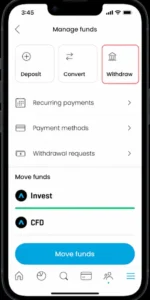
If the requested amount is not available, check whether some of the portfolio is still invested, whether a recent sale remains unsettled or whether payment-method verification is restricting the withdrawal.
How to Withdraw Money From a Trading 212 Pie?
Money invested through a Trading 212 Pie follows an additional step.
Choosing Withdraw inside a Pie does not immediately send money to a bank account. Instead, Trading 212 first releases money from the Pie into the main account’s cash balance.
Trading 212 states that existing free cash in the Pie is used first. If additional money is required, investments are sold.
There are currently three distribution approaches.
| Pie withdrawal method | What happens |
| By targets | Investments are sold according to the Pie’s target percentages |
| Self-balancing | More is sold from overweight slices and less from underweight slices |
| Custom | The investor chooses manually how much is sold from individual slices |
If the relevant market is closed, the sell orders have to wait for the market to reopen.
Once the Pie sale has completed and the resulting cash has settled, it can then become available for a normal account withdrawal.
Trading 212 also allows investments to be exported from a Pie. Once exported, the individual holding can be sold outside the Pie in the usual way.
How Long Does a Trading 212 Withdrawal Take?
The phrase “up to three working days” can be misleading when investments have only just been sold.
There can be two separate clocks:
| Stage | Typical position |
| Sell investment | Trade executes when the market and order conditions permit |
| Trade settlement | Commonly around 1–2 business days depending on the security and market |
| Money becomes withdrawable | After settlement |
| Withdrawal processed | Trading 212/payment provider processes the request |
| Money reaches bank | Often same/next business day on faster rails, but some payments can take 2–3 business days |
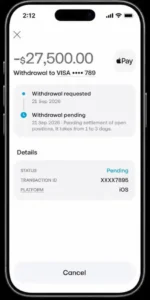
Trading 212’s Withdrawal Tracker currently classifies a withdrawal as Pending when it is waiting for closed positions to settle and says this usually takes one to two business days. Once a withdrawal is Executed, the money may still take up to three business days to appear, depending on the payment route.
The exact settlement period can also depend on where the investment trades.
Most US securities moved to T+1 settlement in May 2024, meaning settlement normally occurs one business day after the trade.
Most UK securities currently remain on a T+2 standard. The UK government intends to move the UK market to T+1 from 11 October 2027.
That is why a universal statement such as “Trading 212 takes three days to withdraw money” is not sufficiently precise.
Example Withdrawal Timeline
Suppose UK shares are sold on Monday.
If they follow a T+2 settlement cycle, the cash would ordinarily settle around Wednesday, assuming there are no market holidays or other complications.
The withdrawal can then move through Trading 212’s payment process.
Depending on the payment method and receiving bank, it could arrive later that day or over the following one to three business days.
The settlement period therefore occurs before the final banking withdrawal time.
Why Trading 212 May Send Money Back to the Original Payment Method?
This is one of the most misunderstood parts of Trading 212 withdrawals.
Payment-method restrictions exist partly because investment platforms need to comply with anti-money-laundering, fraud-prevention and payment-security requirements.
Trading 212 states that a customer can generally withdraw up to the amount previously deposited through a particular payment method. However, it also says these withdrawal limits can normally be removed by verifying all payment methods attached to the account.
That is more nuanced than saying money must always go back to the original card.
Even after payment methods have been verified, restrictions can remain. For example, a card issuer may permit money to be returned only up to the amount originally deposited and in the same currency, or a payment provider may not support incoming withdrawals to a particular card.
If an old payment method is still associated with the account, Trading 212 may also request evidence that it belongs to the customer.
A bank statement showing a Trading 212 transaction can be used for verification in some cases. Trading 212 says payment-method verification itself can take up to three business days.
This verification stage explains why some withdrawals take considerably longer than the headline payment-processing time.
Trading 212 Withdrawal Fees and FX Charges
Trading 212 does not currently charge a fee simply for processing a withdrawal. A receiving bank or payment intermediary could potentially impose its own charge.
It is important not to confuse that with Trading 212’s foreign-exchange fee.
For Invest, Stocks and Shares ISA and SIPP accounts, Trading 212 currently charges a 0.15% FX fee when an investment transaction requires currency conversion.
For example, selling a US-dollar investment from an ISA where the transaction requires conversion into pounds can create an FX charge as part of the trade.
That is a trading/currency-conversion cost rather than a standard withdrawal fee.
CFD accounts have their own FX charging rules. Trading 212 explains that an FX fee can apply when a CFD position involving another currency is closed.
Why Is a Trading 212 Withdrawal Pending, Delayed or Rejected?
Trading 212 now has a Withdrawal Tracker that provides more useful detail than simply showing a transaction as “pending”.
| Withdrawal status or problem | Likely meaning | What to check |
| Pending | Closed investments are waiting to settle | Allow around 1–2 business days where applicable |
| Under Review | Trading 212 is carrying out an internal check | Look for requests for verification or information |
| Processing | Payment provider is handling the withdrawal | Wait for the stated processing window |
| Partially Executed | Only part of the payment could be sent | Card/payment-provider payout limits may apply |
| Failed | Payment provider declined the transfer | Check expired cards or unsupported incoming payments |
| Rejected | Compliance or account restrictions may apply | Contact Trading 212 for the specific reason |
| Action Required | Additional information is needed | Respond to Trading 212’s verification request |
| Executed but missing | Trading 212 has sent the payment but it has not arrived | Contact Trading 212 after the stated banking period |
Trading 212 says that if a withdrawal has been marked as executed for more than three working days and still has not arrived, the customer can contact support for a proof-of-payment document. The receiving bank can then use that document to trace the transaction.
Verification problems are particularly important because a payment method can take up to three business days to verify, and Trading 212 may request additional documents.
Why Can’t the Full Trading 212 Balance Be Withdrawn?
A visible portfolio balance and withdrawable cash are not always the same thing.
Trading 212 identifies several situations where money that appears within an account may not immediately be withdrawable.
Free fractional shares received through promotions can remain locked for 30 days. Certain ISA cashback can remain locked for 12 months. Money may also still be invested in an open position or sitting as cash inside a Pie rather than the main free-cash balance.
A CFD account can additionally have money reserved as margin against open leveraged positions.
The amount shown as total account value should therefore not automatically be interpreted as the amount that can be transferred to a bank immediately.
Does Withdrawing Money From Trading 212 Trigger Tax?
The withdrawal itself is not normally the event that creates Capital Gains Tax.
For investments held outside an ISA, the important event is generally selling or otherwise disposing of the investment.
HMRC states that Capital Gains Tax may apply when shares outside an ISA are sold for a gain.
This means someone could sell shares in a Trading 212 Invest account, leave all the resulting cash on Trading 212 and still have created a taxable disposal.
Moving that already-realised cash from Trading 212 to a bank account does not create the capital gain for a second time.
For 2026/27, the Capital Gains Tax Annual Exempt Amount for an individual is £3,000.
For gains arising from 6 April 2026, the main individual CGT rates are currently 18% where the gain falls within the applicable basic-rate band and 24% above it. The actual calculation depends on taxable income, total gains, losses and individual circumstances.
What About a Trading 212 ISA?
Qualifying investments held inside an ISA are generally exempt from Capital Gains Tax, and gains made within the ISA do not normally need to be reported simply because investments are sold or cash is withdrawn.
The more relevant issue is preserving the ISA wrapper and understanding flexible withdrawal and replacement rules.
What About CFD Profits?
The tax treatment of derivatives such as CFDs can depend on the individual’s circumstances and the nature of the activity.
HMRC treats CFDs as derivative contracts and has detailed rules covering their treatment. Someone with significant CFD profits or unusual trading circumstances should not assume the tax position is identical to simply selling ordinary shares.
What About SIPP Withdrawals?
Money growing inside a SIPP follows pension tax rules rather than ordinary Invest-account CGT rules.
For Trading 212’s currently supported UFPLS withdrawal route, 25% of each withdrawal is normally tax-free and 75% is normally taxable as income. The first taxable pension withdrawal can also be subject to an emergency tax code.
Pension withdrawals should therefore not be grouped together with standard Invest or ISA withdrawals.
Trading 212 Withdrawal Speed vs Other UK Investment Platforms
The comparison becomes more useful when settlement time and bank-payment time are separated.
| Platform | Standard withdrawal charge | Typical timing once cash is available | If investments must be sold first |
| Trading 212 | £0 | Up to around 3 business days depending on payment route | Closed positions may need around 1–2 business days to settle |
| Freetrade | £0 standard withdrawal | Basic/Standard generally 2–3 working days, sometimes up to 5; Plus supports same-day withdrawals before its working-day cut-off | Cash must first become settled/withdrawable |
| Hargreaves Lansdown | £0 withdrawal | Settled cash requested before noon on a working day can normally arrive the same day; otherwise next working day | Shares normally around 2 working days to settle; funds around 4 |
| InvestEngine | £0 | Uninvested cash normally processed within 1 working day | ETF sale typically settles in 2 working days, followed by roughly 1 working day to the linked bank |
| Vanguard UK | £0 | Available cash generally reaches the bank in 1–3 business days | Vanguard says it can take 5 days or more where investments first need to be sold |
These times are not directly comparable in every situation. Platforms use different investment types, settlement systems and payment rails, and bank verification can add extra time.
The most useful comparison is therefore not simply “which platform says one day?” but how long the entire journey from invested asset to cleared bank balance takes.
Can Trading 212 Withdrawals Be Made at the Weekend?
A withdrawal request may be submitted outside normal market hours, but weekends can still affect when the process actually progresses.
Trading 212 defines its payment timeframes in business days, generally Monday to Friday, and states that public holidays can extend processing times.
If shares first need to be sold, a weekend creates another delay because the relevant exchange may be closed.
A Pie withdrawal requiring investment sales will similarly wait for the relevant markets to reopen before those orders can execute.
Can Profits Be Withdrawn From Trading 212?
Yes, provided those profits have been realised and become withdrawable cash.
An unrealised profit shown beside an open investment is not cash that can be transferred to a bank. The investment must normally be sold first.
After the sale, settlement may need to complete.
Payment-method verification rules can then determine which withdrawal destination is available.
The same principle applies to part of an investment. It is not necessary to close an entire Invest or ISA portfolio simply to withdraw a smaller amount, provided enough investments are sold to produce the required cash.
Final Thoughts
Learning how to withdraw money from Trading 212 is less about finding the Withdraw button and more about understanding what happens before and after it is pressed.
For Invest and Stocks and Shares ISA users, the main issue is whether sufficient settled cash is available. Someone who has just sold shares may have to wait for settlement before a withdrawal can progress.
The Trading 212 ISA adds another layer because its flexible status can allow eligible withdrawals to be replaced within the same tax year without automatically using the ISA allowance twice.
CFD accounts are different because open positions require margin, meaning total account value should not be confused with withdrawable cash.
SIPPs are different again. Normal Trading 212 withdrawal instructions explicitly exclude pension accounts, and accessing pension money is governed by minimum pension-age and taxation rules.
Payment-method verification is another major source of confusion. Trading 212 can limit withdrawals according to previous deposit methods until payment methods have been verified, and banks or card providers can impose additional restrictions.
Finally, tax is generally connected to what happened before the bank withdrawal. For an Invest account, selling an investment may create a taxable capital gain even if the cash remains on Trading 212. Moving that cash into a bank account is not normally what creates the gain.
Important: This article provides general UK financial and tax information and does not constitute personal investment, pension or tax advice. Platform terms, tax rules and individual circumstances can change.
Frequently Asked Questions
How Long Does It Take to Withdraw Money From Trading 212?
Once a withdrawal has reached Executed status, the receiving bank or payment provider can take up to three business days. If investments have only just been sold, allow additional settlement time first.
Can Money Be Withdrawn to a Different Bank Account?
Potentially, but Trading 212 applies payment-method verification and withdrawal limits. Verifying all payment methods can remove many restrictions, although card issuers and payment providers can still impose their own limits.
Is There a Minimum Trading 212 Withdrawal?
Yes. Trading 212 applies withdrawal minimums, but its current Help Centre directs customers to its live withdrawal-limits information rather than giving one universal figure in the help article. The amount displayed in the customer’s account or current Trading 212 terms should therefore be treated as authoritative.
Why Was a Trading 212 Withdrawal Rejected?
Trading 212 says rejected withdrawals can result from compliance or account-related restrictions. Failed withdrawals can also occur if a payment method does not accept incoming transfers, a card has expired or a payment provider is temporarily unavailable.
Can Trading 212 Profits Be Withdrawn Without Closing the Account?
Yes. An investor can sell enough investments to create the required withdrawable cash without closing the entire Trading 212 account.
Can Money Be Withdrawn Without Selling Shares?
Only existing available cash can normally be withdrawn. If all the account’s value is invested, sufficient investments need to be sold first.
Does Trading 212 Charge for Withdrawals?
Trading 212 currently charges no withdrawal-processing fee. A receiving bank or intermediary could potentially impose its own charge.
Is the Trading 212 ISA Flexible?
Yes. Trading 212 currently describes its Stocks and Shares ISA as flexible, allowing qualifying withdrawals to be replaced under the flexible ISA rules during the same tax year.