
The Nationwide £2500 deposit rule means customers can pay up to £2,500 in cash per day into an eligible Nationwide current account using a Nationwide cash machine.
However, that is no longer the only important limit Nationwide customers need to know about.
On 29 July 2026, Nationwide introduced a new £20,000 annual cash deposit limit covering personal current and savings accounts. For sole accounts, that £20,000 allowance applies across all of the customer’s eligible Nationwide personal accounts combined. Joint accounts are treated separately and receive their own £20,000 annual cash allowance.
That means there are now two very different rules operating at the same time:
| Nationwide cash deposit rule | Current limit |
| Cash paid into a Nationwide ATM | £2,500 per day |
| Annual cash deposits into sole personal accounts | £20,000 per year in total |
| Joint account annual cash limit | £20,000 per joint account |
| PayPoint cash deposit | £300 per day |
| Cheques through a Nationwide ATM | £50,000 per day |
| Maximum individual cheque through ATM | £2,000 |
There is also an important complication concerning branch deposits, which is explained below.
Information checked against Nationwide’s published guidance on 9 September 2026.
What Is the Nationwide £2500 Deposit Rule?
Nationwide allows eligible current-account customers to deposit up to £2,500 in cash each day using cash machines located inside or directly outside participating Nationwide branches.
The rule relates specifically to cash being paid in.
It should not be confused with the amount a customer can withdraw from an ATM. Cash withdrawals have their own limits depending on the Nationwide account and card being used. More generally, UK ATM withdrawal limits vary considerably between banks and account types.
Nationwide’s £2,500 ATM deposit limit also does not mean a customer can deposit £2,500 every day indefinitely.
Since 29 July 2026, cash deposits are also subject to Nationwide’s new £20,000 annual cash limit.
For example, someone depositing £2,500 through a Nationwide ATM eight times could reach £20,000. Once the relevant annual allowance had been exhausted, further cash could not simply continue being deposited at £2,500 per day.
What Changed on 29 July 2026?
The major change came on 29 July 2026, when Nationwide introduced a new limit on how much physical cash customers can pay into their personal accounts during a year.
The standard allowance is:
£20,000 in cash per year.
For accounts held solely in one person’s name, Nationwide calculates the £20,000 across that customer’s eligible personal current accounts and savings accounts combined.
Having several Nationwide accounts therefore does not normally multiply the sole-account allowance.
For example:
A customer has:
- £8,000 deposited into a FlexAccount
- £7,000 deposited into another personal current account
- £5,000 deposited into an eligible savings account
The combined cash deposits equal £20,000.
That customer’s sole-account annual cash allowance has therefore been used, even though the money was spread across three accounts.
Nationwide says the restriction applies regardless of where the qualifying physical cash is deposited.
2026 Is a Transitional Year
There is an important exception for the first year of the policy.
Nationwide says that, for 2026, only cash deposited between:
29 July 2026 and 31 December 2026
counts towards the new £20,000 limit.
The allowance then resets on 1 January 2027.
From that point, it resets on 1 January each year.
Therefore, cash that a customer deposited between January and 28 July 2026 is not retrospectively included in the first £20,000 calculation.
Can Someone Deposit the Full £20,000 at Once?
Nationwide’s annual-limit FAQ says it is possible to use the entire £20,000 allowance in one transaction.
However, doing that means no further cash can be paid in against that particular annual allowance until it resets on 1 January of the following year.
There is, however, an important practical issue.
Nationwide currently publishes conflicting information about how much cash can be deposited at a branch counter.
Its dedicated current-account payment page states that customers can pay:
£5,000 per account, per day
in cash at a Nationwide branch counter.
Meanwhile, Nationwide’s broader cash-deposit-limit and branch-banking pages say customers can deposit up to £20,000 at the counter, subject to their annual allowance.
Because those official pages currently give different operational figures, anyone intending to carry more than £5,000 in cash to a branch should confirm the limit with Nationwide or the relevant branch first.
The £20,000 annual limit itself is clear; the inconsistency concerns the amount that can currently be accepted through the branch-counter channel in one day or transaction.
What Are Nationwide’s Cash and Cheque Deposit Limits?
Nationwide offers several different ways of putting money into an account, and each should be treated separately.
| Deposit method | Published limit | Important point |
| Nationwide cash machine | £2,500 cash per day | Subject to annual cash allowance |
| Current-account branch counter | £5,000 per account/day on current-account help page | Other Nationwide pages currently state up to £20,000 |
| PayPoint | £300 per day | Available through more than 3,000 locations |
| Cheques through ATM | £50,000 per day | Maximum £2,000 per cheque |
| Bank transfer | Not part of the £2,500 cash-machine rule | Electronic rather than physical cash |
| Cheque by post | Available | Nationwide advises customers not to send cash through the post |
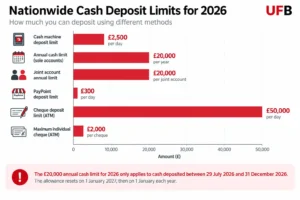
Nationwide confirms that its cash machines can accept up to £2,500 in notes each day and up to £50,000 in cheques per day, provided no individual cheque exceeds £2,000.
This distinction matters because the new £20,000 rule is specifically a cash deposit limit.
It should not be interpreted as a £20,000 annual limit on every form of money entering the account.
Bank transfers and cheque payments are separate payment methods.
Can Cash Be Deposited Through PayPoint?
Yes.
Nationwide now says customers can make cash deposits through more than 3,000 PayPoint locations, with a published limit of:
£300 per day.
This can be useful where there is no convenient Nationwide branch nearby, although someone with a large amount of physical cash would reach the annual allowance relatively slowly using only the £300 daily PayPoint facility.
Cash paid through PayPoint still needs to be considered in relation to the customer’s overall annual cash allowance.
Does a Joint Nationwide Account Get Another £20,000 Limit?
Yes.
This is one of the most important parts of the new rules.
For sole accounts, the £20,000 allowance belongs to the individual customer and is shared across their eligible personal current and savings accounts.
For a joint account, Nationwide says the £20,000 allowance applies to the joint account itself.
It is not £20,000 for each joint account holder.
For example, if two people hold one joint Nationwide account and one person deposits £12,000 in cash, only £8,000 remains available for cash deposits into that joint account during the same annual period.
If one account holder then paid in another £8,000, the other account holder could not deposit additional cash into that joint account until its limit resets.
However, that joint-account allowance is separate from the individual’s sole-account allowance.
A person could therefore potentially have:
- a £20,000 allowance across their sole personal accounts, and
- access to a separate £20,000 allowance on a joint account.
Nationwide expressly confirms that the joint allowance is additional to the customer’s sole-account limit.
What Happens With Power of Attorney or Third-Party Access?
Allowing another person to manage an account does not transfer the cash-deposit allowance to that person.
Nationwide says that where there is a:
- power of attorney;
- Third Party Mandate;
- Court of Protection order; or
- similar arrangement,
the £20,000 allowance belongs to the account holder, not the attorney or person administering the account.
That prevents someone managing several people’s finances from having all of those deposits attributed to their own personal allowance.
How Does the Rule Work for Children’s Accounts?
It depends on who legally holds the account.
Nationwide says that where an account is in the child’s name, or is a Child Trust Fund, cash paid in counts towards the child’s annual cash-deposit allowance.
If the child is only the beneficiary and the account itself belongs to an adult, the cash is instead counted against the account holder’s allowance.
Parents or guardians depositing significant amounts of cash should therefore check the legal structure of the particular children’s savings product rather than assuming every child-related account is treated identically.
Do Virgin Money Accounts Count Towards the Nationwide Limit?
Not currently.
Nationwide’s published guidance specifically states that the new cash-deposit limit does not currently apply to Virgin Money accounts.
That means a Nationwide customer’s £20,000 personal cash allowance should not automatically be interpreted as including cash deposits into Virgin Money accounts.
Customers should nevertheless check the rules of the Virgin Money account itself, as separate cash-deposit restrictions can apply.
Does the Limit Apply to Nationwide Business Savings?
Nationwide also states that the new limits do not currently apply to business savings accounts.
This distinction is important for sole traders and small-business owners because depositing business takings into a business product is not necessarily governed by the same rules as depositing personal cash into an ordinary Nationwide current or savings account.
The account’s own terms still need to be checked.
Why Has Nationwide Introduced a £20,000 Cash Limit?
Nationwide says the change was introduced to help protect customers against potential fraud and financial crime.
The move also fits into a wider tightening of cash-deposit controls across British banking.
The Financial Conduct Authority has highlighted the money-laundering risks associated with cash-deposit services, particularly through the Post Office.
The regulator says criminal abuse of cash-deposit channels has historically allowed large amounts of money to enter the banking system and has pushed banks and building societies to strengthen transaction monitoring, verification and deposit controls.
Importantly, there is not one universal FCA cash-deposit limit that every bank must use.
Banks take different approaches according to their own products, customer profiles, transaction channels and financial-crime controls.
That is why Nationwide can use £20,000 while NatWest, Barclays, TSB, HSBC and Lloyds operate different combinations of branch, machine and Post Office restrictions.
Will Nationwide Ask Where a Large Cash Deposit Came From?
It can.
Nationwide’s current-account guidance says that when someone deposits a large amount of cash, staff may ask:
- where the money came from;
- how the customer normally uses the account; and
- for additional documentation demonstrating the source of the funds.
Being asked these questions does not automatically mean Nationwide believes the money is illegal.
Banks and building societies have obligations to understand unusual account activity and take reasonable measures against fraud and money laundering.
Someone depositing cash generated by a legitimate transaction should therefore be prepared to explain the source and, where necessary, provide appropriate supporting evidence.
What If Someone Needs to Deposit More Than £2,500?
The £2,500 restriction applies to the Nationwide cash-machine route, not necessarily to every method of putting money into the account.
A customer with more than £2,500 could potentially use a branch counter, provided the transaction is within the applicable annual allowance and any operational branch restrictions.
For very large amounts, contacting the branch before travelling is sensible, particularly because Nationwide’s current official pages presently show both £5,000 and £20,000 branch-counter figures.
Where the money does not need to be handled as physical cash, an electronic bank transfer may also avoid the practical cash-machine restriction.
The source of the funds and the receiving account’s normal terms can still be relevant.
What Happens After the £20,000 Annual Limit Is Reached?
For a sole-account customer, reaching £20,000 means the annual cash allowance across their relevant personal current and savings accounts has been exhausted.
Nationwide says the customer will not be able to make another cash deposit under that allowance until it resets.
For the initial 2026 period, the reset is on:
1 January 2027.
After that, the limit resets each 1 January.
Moving to a different Nationwide sole account does not create another £20,000 personal allowance because Nationwide aggregates the customer’s eligible sole accounts.
A joint account, however, has its own separate £20,000 limit.
How Does Nationwide Compare With Other UK Banks?
Nationwide is not the only major UK provider imposing tighter restrictions on physical cash.
However, comparisons need to distinguish between overall personal limits and limits that apply only through specific channels such as a Post Office or deposit machine.
| Provider | Current published personal cash rules |
| Nationwide | £20,000 annual limit across sole personal current and savings accounts. £2,500/day through Nationwide ATM. £300/day PayPoint. |
| Barclays | £20,000 overall annual personal cash-deposit limit. Post Office deposits are additionally limited to £10,000 annually. |
| NatWest | Post Office/CDM limit of £3,000/day and £24,000 over a rolling 12 months. Branch-counter annual limit is published separately at £50,000. |
| HSBC | Post Office: £3,000/day and £20,000 per calendar year. HSBC says these limits do not apply to branch deposits. |
| Lloyds | No published limit for cash paid over a staffed branch counter; separate machine/Post Office limits include £2,995 per calendar month and £20,000 per calendar year. |
| TSB | Post Office: £1,500/day and £10,000 over a rolling 12 months across personal accounts. TSB says an increased allowance may be considered in specific cash-salary circumstances. |
Barclays introduced its £20,000 annual personal cash limit from 1 July 2024, applying it across personal accounts. Cash paid through the Post Office also counts towards the overall allowance.
NatWest currently publishes a £3,000 daily and £24,000 rolling annual limit for cash deposited through its Post Office and Cash & Deposit Machine channels. Its branch-counter guidance also publishes a higher £50,000 rolling annual figure.
HSBC allows up to £3,000 per day and £20,000 per calendar year through the Post Office, but expressly says those restrictions do not apply to HSBC branch deposits.
Lloyds currently states no limit for cash paid over a staffed branch counter, although it retains separate restrictions for machines, Post Offices, Banking Hubs and other cash channels.
TSB’s Post Office limit is considerably lower at £1,500 per day and £10,000 over a rolling 12-month period for personal customers.
The comparison shows why statements such as “UK banks only allow £20,000 cash a year” can be misleading. Each provider structures its rules differently.
Is Depositing £2,500 in Cash Suspicious?
Not automatically.
£2,500 is an amount Nationwide expressly allows through its eligible cash machines in a day.
However, the existence of a published limit does not mean every transaction below that limit is exempt from normal financial-crime monitoring.
A bank can consider the pattern of deposits, the source of the funds, the customer’s expected account activity and other relevant circumstances.
Similarly, depositing more than £2,500 through an available branch service does not automatically mean the transaction is suspicious.
The key issue is whether the activity can be reasonably understood and, where necessary, supported by evidence.
Does the £2,500 Rule Include Cheques?
No.
Nationwide publishes a separate ATM cheque allowance.
Customers can currently deposit up to:
£50,000 in cheques per day
through eligible Nationwide cash machines, although an individual cheque cannot exceed £2,000.
The £2,500 figure therefore refers specifically to cash, not cash plus cheques combined.
Does the £20,000 Limit Include Bank Transfers?
The restriction is described by Nationwide as an annual cash deposit limit.
Electronic transfers are a different payment method.
Nationwide itself lists bank transfers separately from branch cash, cash-machine deposits and cheques when explaining how customers can pay money into current accounts.
The new rule should therefore not be read as saying that only £20,000 in total can enter a Nationwide account each year.
It relates to physical cash deposits.
The Bottom Line
The Nationwide £2500 deposit rule is still in place in 2026, but it is only one part of Nationwide’s current cash-deposit policy.
Customers can deposit up to £2,500 in cash per day through a Nationwide cash machine, but since 29 July 2026, most personal customers must also consider the new £20,000 annual cash limit.
For sole accounts, £20,000 is shared across the customer’s eligible Nationwide current and savings accounts.
Each joint account has a separate £20,000 allowance shared between the people named on it.
PayPoint has a much smaller £300 daily cash limit, while cheques follow separate rules.
Anyone depositing a particularly large amount should also be prepared for Nationwide to ask where the cash came from and potentially request documentation.
One point currently requires extra care: Nationwide’s official pages show inconsistent branch-counter figures, with its current-account help page stating £5,000 per account per day, while broader branch and annual-limit pages refer to deposits of up to £20,000.
Customers intending to pay in more than £5,000 should therefore check directly with Nationwide before visiting a branch.
FAQs
What is the Nationwide £2500 Deposit Rule?
Customers can deposit up to £2,500 in cash per day through participating Nationwide cash machines.
Is Nationwide Limiting Cash Deposits to £2,500 a Year?
No. £2,500 is the daily ATM cash limit. Nationwide introduced a separate £20,000 annual cash-deposit limit on 29 July 2026.
When Did Nationwide’s £20,000 Cash Limit Start?
It started on 29 July 2026. Only cash deposited between 29 July and 31 December counts for the first 2026 allowance.
When Does Nationwide’s Cash Deposit Limit Reset?
It resets on 1 January each year. The first reset will be 1 January 2027.
Can Someone Deposit £20,000 at Nationwide in One Transaction?
Nationwide’s annual-limit page says the entire £20,000 allowance can be used in one transaction, although its separate pages currently publish conflicting branch-counter limits. Customers planning a deposit above £5,000 should confirm arrangements first.
Is the £20,000 Nationwide Limit Per Account?
For sole accounts, no. It is £20,000 across the customer’s eligible personal current and savings accounts combined.
Do Joint Nationwide Accounts Get £40,000 Because There Are Two People?
No. A joint account gets one £20,000 annual cash allowance shared between both account holders.
Is a Joint Account’s £20,000 Allowance Separate From a Sole Account Allowance?
Yes. Nationwide says the joint-account allowance is additional to the customer’s own £20,000 sole-account allowance.
Can Nationwide Ask Where Cash Came From?
Yes. Nationwide says it may ask about the source of large cash deposits and can request supporting documentation.
Does the Nationwide Limit Include Cheques?
No. Nationwide publishes separate cheque limits, including up to £50,000 per day through eligible cash machines with a £2,000 maximum per cheque.