
Yes, you can have two Cash ISAs with different providers and pay into both during the same tax year. Since 6 April 2024, UK ISA rules have allowed adults to subscribe to more than one ISA of the same type, including multiple Cash ISAs.
The important restriction is the annual ISA allowance. In the 2026/27 tax year, the combined amount of new money paid across all of an individual’s ISAs must normally remain within the overall £20,000 ISA allowance.
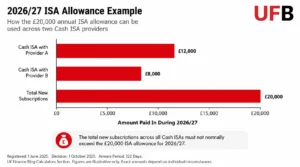
This means someone could, for example, put £12,000 into a Cash ISA with one bank and £8,000 into another Cash ISA with a different provider. They would have used the full £20,000 allowance without breaking the rules.
There are, however, several details worth understanding. Different providers can impose their own account restrictions, ISA transfers are treated differently from new subscriptions, and using separate banking brands does not necessarily mean savings receive separate Financial Services Compensation Scheme protection.
Can You Have 2 Cash ISAs With Different Providers in the Same Tax Year?
Yes. An adult can have two or more Cash ISAs with different providers and contribute to them during the same tax year.
This was not always the case.
Before 6 April 2024, ISA rules generally restricted savers to subscribing to only one ISA of each type during a tax year. The rules were simplified from the beginning of the 2024/25 tax year, allowing multiple subscriptions to ISAs of the same type.
That means someone could now have:
- a Cash ISA with Provider A;
- another Cash ISA with Provider B; and
- potentially additional Cash ISAs elsewhere.
The number of accounts is not the main restriction. The amount of new money subscribed during the tax year is what needs to be monitored.
For 2026/27, the overall adult ISA allowance remains £20,000.
How Does the £20,000 ISA Allowance Work With Two Providers?
Having two Cash ISAs does not provide two separate £20,000 allowances.
The £20,000 allowance belongs to the individual rather than to each ISA account.
For example:
| Cash ISA | Amount Paid In During 2026/27 |
| Cash ISA with Provider A | £12,000 |
| Cash ISA with Provider B | £8,000 |
| Total new subscriptions | £20,000 |
This is within the current overall allowance.
However, paying £15,000 into Provider A and another £15,000 into Provider B would mean £30,000 of new subscriptions and would normally exceed the annual limit.
The same £20,000 overall limit is also shared with other adult ISA types.
Someone who puts £7,000 into one Cash ISA, £5,000 into another and £8,000 into a Stocks and Shares ISA would have subscribed £20,000 in total.
A Lifetime ISA has additional rules, including its own £4,000 annual subscription limit, so it should not be treated in exactly the same way as an ordinary Cash ISA.
Why Did the Cash ISA Rules Change in April 2024?
The change introduced from 6 April 2024 made ISAs considerably more flexible.
Under the previous system, someone who had already paid into one Cash ISA during a tax year could face restrictions on paying new money into another Cash ISA.
That could make changing provider difficult when a better interest rate appeared halfway through the tax year.
The newer rules allow savers to subscribe to multiple Cash ISAs without having to move everything into a single account.
This creates more opportunity to use different providers for different purposes.
Someone might keep part of their money in an easy-access Cash ISA while putting another portion into a fixed-rate ISA offering a higher return.
Savers comparing account structures and rates can also look at the latest information on Yorkshire Building Society ISA rates, which illustrates how easy-access, limited-access and fixed Cash ISAs can offer very different combinations of rates and flexibility.
Is It Better to Have One Cash ISA or Two Cash ISAs?
Neither approach is automatically better. It depends on how much money someone is saving, the interest rates available and how quickly they may need access to their cash.
| Factor | One Cash ISA | Two Cash ISAs With Different Providers |
| Tracking allowance | Simpler | Requires more monitoring |
| Access to different rates | Limited to one provider’s product | Can use different providers and rates |
| Easy access and fixed saving | May require compromise | Can split money between account types |
| FSCS diversification | Concentrated with one institution | Can improve diversification if banking licences differ |
| Account management | One login or app | Usually two accounts to manage |
| Fixed-term laddering | Less flexible | Easier to use different maturity dates |
| Transfers | Simpler | More accounts to coordinate |
For someone saving only a relatively small amount, using one competitive Cash ISA may be simpler.
Two providers become more attractive when someone wants to combine different interest rates, access conditions or fixed terms.
Why Might Someone Use Two Different Cash ISA Providers?
There are several practical reasons.
One is interest rates. Provider A may offer the best easy-access ISA while Provider B offers a more attractive fixed rate.
Another is access. Someone might keep £5,000 available for emergencies while fixing the remaining £15,000 for a period where withdrawals are restricted.
A third consideration is deposit protection.
For people who have accumulated substantial ISA savings over many years, spreading money between genuinely separate authorised institutions can reduce the amount exposed to a single bank or building society.
Using multiple providers can also make it easier to construct a Cash ISA ladder.
Cash ISA Laddering
ISA laddering involves splitting savings between accounts with different maturity dates.
For example, someone with £20,000 available during 2026/27 could place:
£10,000 into a one-year fixed Cash ISA with Provider A
and:
£10,000 into a two-year fixed Cash ISA with Provider B
The first amount becomes available sooner, while the second can continue earning its fixed rate for longer.
The saver can then reconsider the first £10,000 when that account matures rather than having the entire £20,000 locked away for the same period.
Whether this strategy is worthwhile depends on available interest rates, withdrawal penalties and the individual’s need for access.
Does Having Two Providers Give You More FSCS Protection?
Potentially, but this needs to be checked carefully.
The standard Financial Services Compensation Scheme deposit protection limit is currently £120,000 per eligible person, per authorised firm.
The limit increased from £85,000 to £120,000 on 1 December 2025.
The crucial point is that FSCS protection is linked to the authorised institution or banking licence rather than simply the brand name shown on an account.
Suppose someone has £100,000 with Bank A and £100,000 with Bank B.
If the two banks have completely separate banking licences, each balance could potentially fall within a separate £120,000 standard FSCS limit.
But if Bank A and Bank B are simply different brands operating under the same authorised institution, the balances may be combined for FSCS purposes.
In that situation, having accounts carrying two different brand names does not automatically provide £240,000 of standard protection.
Anyone deliberately splitting large amounts for FSCS purposes should therefore check the authorised institution behind each provider rather than relying on the names or logos.
How Can You Open a Second Cash ISA With Another Provider?
Opening the second ISA is generally similar to opening the first.
1. Check How Much ISA Allowance Is Left
Before depositing anything, calculate how much new money has already been subscribed across all ISAs since 6 April.
If £13,000 has already been contributed during 2026/27, for example, normally only £7,000 of the £20,000 overall allowance remains.
2. Compare the Second Provider’s Account Terms
Look at the interest rate, whether it is fixed or variable, withdrawal restrictions, minimum deposit and whether transfers from existing ISAs are accepted.
Also check whether the provider has its own restrictions.
ISA legislation may permit multiple accounts, but providers are not required to offer every possible arrangement. A provider might restrict customers to one account of a particular issue or impose its own funding conditions.
3. Complete the New ISA Application
The second provider will normally require personal details and information necessary to establish eligibility.
Identity and residency checks may also be required even if the person already holds an ISA somewhere else.
From a customer’s perspective, Provider B cannot simply rely on the verification previously carried out by Provider A.
4. Decide Whether the Money Is New or Being Transferred
This distinction is important.
Money being newly deposited from a current account or ordinary savings account will normally count towards the current year’s ISA subscription allowance.
Money already inside an ISA can instead potentially be moved using the formal ISA transfer process.
5. Keep Your Own Contribution Record
With multiple providers, neither bank necessarily has a complete picture of how much has been contributed elsewhere.
Someone using several ISAs should therefore keep their own running total.
A simple record might show:
| Date | Provider | New Subscription | Running Total |
| 10 April | Provider A | £5,000 | £5,000 |
| 2 June | Provider B | £3,000 | £8,000 |
| 15 September | Provider A | £4,000 | £12,000 |
| 5 January | Provider B | £8,000 | £20,000 |
This greatly reduces the risk of accidentally exceeding the annual allowance.
Does Transferring a Cash ISA Count Towards the £20,000 Allowance?
An authorised ISA transfer is different from paying new money into an ISA.
Money already held within the ISA system from an earlier subscription can generally be transferred between providers without using the current year’s annual allowance again.
For example, suppose someone has £40,000 accumulated in Cash ISAs from previous tax years.
They could transfer that £40,000 to a new Cash ISA provider using the official ISA transfer process and separately make £20,000 of qualifying new subscriptions during 2026/27.
The £40,000 transfer is not the same thing as making £40,000 of new 2026/27 contributions.
This distinction becomes particularly important for people with large ISA balances built up over many years.
Should You Withdraw the Money Yourself Before Moving an ISA?
Usually not.
If the intention is to retain the money’s ISA status, the transfer should normally be arranged through the receiving ISA provider.
Simply withdrawing money into a current account and then depositing it into another ISA can have different consequences.
Unless the relevant flexible ISA rules apply, the new deposit may count as another subscription and the withdrawn money may no longer retain its previous ISA treatment.
For example, withdrawing £20,000 from an old non-flexible Cash ISA and then personally depositing that £20,000 into a different ISA is not necessarily equivalent to transferring it directly between ISA providers.
The official transfer process is therefore important.
Can You Transfer Only Part of a Cash ISA?
The ISA reforms introduced greater flexibility around partial transfers.
This can be useful when someone wants to leave part of their savings with an existing provider but move another portion to a better rate elsewhere.
However, the receiving and existing providers must support the relevant transfer arrangement, and fixed-term products may impose interest penalties or other restrictions.
Someone considering a transfer should therefore check both accounts’ terms before giving instructions.
Do Two Cash ISAs Have to Be the Same Type?
No.
Two accounts can both qualify as Cash ISAs while having completely different access conditions.
For example, someone could hold:
Provider A: Easy-access Cash ISA
Provider B: Two-year fixed-rate Cash ISA
The easy-access account could hold emergency or short-term savings, while the fixed account could be used for money that is unlikely to be needed during the term.
Another combination could involve a flexible Cash ISA with one provider and a limited-access account elsewhere.
The ISA tax wrapper is what makes both accounts Cash ISAs; the interest rate and withdrawal structure do not need to match.
What Mistakes Should You Avoid With Two Cash ISA Providers?
The most common problem is likely to be losing track of contributions.
Exceeding the £20,000 Allowance
A saver might deposit £14,000 into Provider A and then forget about that contribution when opening Provider B several months later.
The £20,000 limit applies across the individual’s relevant ISAs rather than resetting with every new account.
Assuming Transfers Are New Contributions
Money moved correctly through the ISA transfer system should not simply be added to the contribution total as though it were new savings.
Otherwise someone with substantial previous-year ISA balances could mistakenly believe they have exceeded their allowance.
Withdrawing Instead of Transferring
Taking the money out personally can produce a different result from an ISA transfer.
This can be particularly problematic with non-flexible ISAs.
Assuming Different Brands Mean Different FSCS Limits
The brand name is not enough.
Two apparently separate savings providers can sometimes operate under the same authorised institution or banking licence.
Ignoring Provider-Specific Restrictions
The tax rules allowing multiple Cash ISAs do not force every bank or building society to let customers open unlimited accounts.
Account terms still matter.
Confusing Additional Permitted Subscriptions With Ordinary ISA Contributions
“Additional permitted subscriptions” has a specific ISA meaning, principally relating to additional ISA allowance available following the death of a spouse or civil partner.
It is not the rule that allows an ordinary saver to open a second Cash ISA with another provider.
For most people opening two Cash ISAs, the relevant rules are simply the multiple-ISA subscription rules and the overall annual allowance.
Will Having Two Cash ISAs Create Extra Tax-Return Work?
Normally, no.
Interest earned within a valid Cash ISA remains tax-free, and ISA interest does not normally need to be declared on a Self Assessment tax return.
Using two providers therefore does not mean someone needs to calculate and report the interest from each ISA to HMRC every year.
The additional administration is mainly practical rather than tax-related.
Savers need to keep track of how much new money they have subscribed, remember different maturity dates and manage separate online accounts or banking apps.
Are Cash ISA Rules Changing From April 2027?
Yes, and the change is particularly important for people considering how to arrange larger cash savings now.
The government has announced that from 6 April 2027, the annual Cash ISA subscription limit will be reduced to £12,000 for under-65s, within an overall ISA allowance that remains £20,000.
Government Budget documents state that people over 65 will continue to be able to save up to £20,000 a year into Cash ISAs.
The overall ISA allowance itself is due to remain £20,000.
This means the current 2026/27 tax year is different.
During 2026/27, someone can still potentially use the full £20,000 overall ISA allowance for eligible Cash ISA subscriptions.
From 2027/28, an under-65 saver subject to the new limit would not normally be able to place the entire £20,000 annual allowance into Cash ISAs.
Importantly, the new annual limit does not mean existing Cash ISA balances above £12,000 suddenly lose their tax-free status. The restriction concerns new annual subscriptions rather than forcing people to withdraw previously accumulated ISA savings.
Does the 2027 Change Make Two Providers More Useful?
Potentially, although opening several accounts will not increase the new Cash ISA subscription limit.
For example, once the £12,000 under-65 Cash ISA limit applies, putting £6,000 into Provider A and £6,000 into Provider B would use the full £12,000 Cash ISA subscription limit.
Opening a third Cash ISA would not create another allowance.
Where multiple providers can still be useful is in deciding how the available cash allowance is invested.
A saver might split money between different fixed terms before the rules change, or use one provider for easy access and another for a fixed rate.
Someone using the full available 2026/27 allowance might also decide to secure different fixed-term rates now rather than placing the entire amount into a single maturity date.
Interest rates can move in either direction, however, so splitting fixed terms should be viewed as a cash-management strategy rather than a way of guaranteeing better returns.
Is It Safe to Keep Large Amounts Across Several Cash ISAs?
Cash ISAs can provide a relatively straightforward way of keeping savings tax-free, but the ISA wrapper itself does not create unlimited protection against a provider failing.
Someone with large accumulated balances should consider which authorised firms actually hold the money.
For instance, a saver with £200,000 accumulated across previous tax years might prefer to spread the balance across genuinely separate FSCS-authorised institutions rather than keeping all £200,000 under one banking licence.
The current standard FSCS limit of £120,000 per eligible person, per authorised firm means this distinction can be significant.
Splitting money solely according to brand names is not sufficient. The underlying authorisation should be checked.
Is Having Two Cash ISAs With Different Providers Worth It?
For many savers, it can be.
The post-April 2024 ISA rules make it possible to choose accounts according to their individual features rather than feeling tied to one Cash ISA provider for the entire tax year.
Two providers might make sense where one offers better instant access while another offers a stronger fixed rate. They can also make fixed-term laddering easier and potentially help with FSCS diversification where the providers genuinely operate under separate banking licences.
The main disadvantage is administration.
The saver becomes responsible for keeping a reliable record of subscriptions across multiple accounts and making sure the combined annual limits are not exceeded.
For someone who values simplicity, one competitive Cash ISA may therefore remain perfectly adequate.
For someone who wants greater flexibility over rates, access and deposit diversification, two Cash ISAs with different providers can be a practical option.
Final Thoughts
So, can you have 2 Cash ISAs with different providers? Yes.
The rules introduced from April 2024 allow adults to subscribe to multiple Cash ISAs during the same tax year, including accounts with separate banks or building societies.
For 2026/27, the key figure is the £20,000 overall ISA allowance. It is shared across the individual’s qualifying ISA subscriptions rather than applying separately to every account.
Using two Cash ISA providers can provide greater flexibility over interest rates, access and fixed terms. It can also improve FSCS diversification when the accounts are genuinely held with separate authorised institutions.
However, savers need to monitor their own subscriptions carefully and should remember that two different bank names do not necessarily mean two different FSCS banking licences.
The rules are also due to change from 6 April 2027, when the government plans to introduce a £12,000 annual Cash ISA limit for under-65s while retaining the £20,000 overall ISA allowance.
Disclaimer: This article provides general financial information and does not constitute personalised financial, investment, tax or legal advice. ISA rules, provider terms, interest rates and protection limits can change, so current rules should be checked before making financial decisions.
Frequently Asked Questions
Can You Have 2 Cash ISAs in the Same Tax Year?
Yes. Since 6 April 2024, adults can subscribe to multiple Cash ISAs during the same tax year. The combined subscriptions must remain within the applicable annual ISA limits.
Can I Put £20,000 Into Each of Two Cash ISAs?
No. The £20,000 ISA allowance for 2026/27 is an overall individual allowance, not £20,000 per account. Putting £20,000 into each provider as new subscriptions would normally mean contributing £40,000 and exceeding the annual allowance.
Can I Have a Cash ISA With Two Different Banks?
Yes. There is no general requirement for multiple Cash ISAs to be held with the same bank. Different providers may also offer different rates, access arrangements and fixed terms.
Does Opening a Second Cash ISA Affect My Credit Score?
Normally, opening a Cash ISA should not affect a credit score in the same way as applying for borrowing because a Cash ISA is a savings product rather than credit. Providers may still carry out identity, residency and anti-fraud checks when opening the account.
Can I Transfer Money Between My Two Cash ISAs Later?
Potentially, yes. ISA transfers should normally be arranged through the receiving provider so the funds retain their ISA status. Whether a particular transfer can be made will also depend on the products’ terms, including any fixed-term restrictions or exit penalties.
Do Both Cash ISAs Need to Be With Different Providers?
No. ISA rules permit multiple Cash ISA subscriptions, but individual providers decide which accounts they allow customers to hold. Someone could therefore potentially have several Cash ISAs with the same provider, different providers or a mixture of both, subject to the relevant product terms.
Can I Have an Easy-Access ISA and a Fixed Cash ISA at the Same Time?
Yes. They can both be Cash ISAs even though one provides easy access and the other locks money away for a fixed period. Contributions across the accounts still count towards the relevant annual limits.
What Happens if I Accidentally Pay Too Much Into My ISAs?
Someone who believes they have exceeded their ISA subscription allowance should avoid trying to correct the position by randomly withdrawing money from accounts. ISA errors can require specific corrective treatment, so the saver should contact the relevant provider and, where necessary, HMRC for guidance.