If you need a larger amount of cash, you may be wondering: how much cash can I withdraw from an ATM in the UK?There is no single cash-machine withdrawal limit that applies to every bank account.
For many standard UK current accounts, the daily ATM limit is somewhere between £250 and £800, although some premium accounts have standard limits of £1,000 and certain banks allow eligible customers to increase their limits further.
The amount you can actually withdraw depends on your bank, account type, debit-card settings, available balance and the cash machine being used.
ATM limits are also different from branch withdrawal limits. If several thousand pounds is required, a bank branch, Banking Hub or alternative payment method may be more practical.
What Are the Key ATM Withdrawal Limits in the UK?
The most important points are:
- Many standard UK accounts allow approximately £250 to £800 per day from ATMs.
- HSBC Premier has a standard £1,000 daily limit.
- Barclays Premier customers can have a standard limit of up to £1,000 and may be able to set a higher limit.
- Individual ATMs can impose their own transaction limits below the bank’s daily allowance.
- Using several different ATMs does not normally reset the daily account limit.
- Large branch withdrawals may trigger security questions, but there is no universal FCA rule requiring a fraud interview simply because a withdrawal exceeds £2,500.
- ATM limits are normally determined by the account and card, not by whether the customer receives a pension or is over 60.
- Overseas ATM withdrawals can involve foreign-exchange and cash-withdrawal charges even when UK withdrawals are free.
How Much Cash Can I Withdraw From an ATM?
For most UK debit-card customers, the maximum that can be withdrawn from cash machines is typically between £250 and £800 per day.
This is normally a daily card or account limit rather than a universal restriction imposed by all ATMs.
For example, Lloyds currently allows holders of its standard debit cards to withdraw up to £800 per day from cash machines.
Santander has a standard daily cash-machine withdrawal limit of £300.
HSBC’s limits vary by account. Its standard Bank Account has a £300 limit, Advance customers normally receive £500 and Premier customers have a standard £1,000 daily limit.
The amount available to an individual customer can be affected by the account they hold, their card settings, previous withdrawals that day and any restrictions applied by the cash-machine operator.
What Are the ATM Withdrawal Limits for Major UK Banks?
The following figures give an indication of current daily cash-machine limits in 2026.
| Bank or Account | Typical Daily ATM Withdrawal Limit |
| Barclays Personal Current Account | Normally up to £300 by default; adjustable up to £500 |
| Barclays Premier | Normally up to £1,000; adjustable up to £2,000 for eligible customers |
| Lloyds Bank | £800 |
| NatWest | £250–£750 depending on account |
| HSBC Bank Account | £300 |
| HSBC Advance | £500 |
| HSBC Premier | £1,000 |
| Nationwide | £500 for many current accounts |
| Nationwide FlexOne | £300 |
| Santander | £300 |
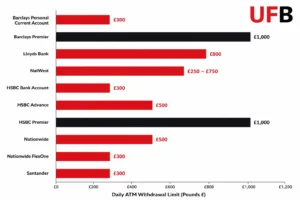
These limits should be treated as a guide rather than a guarantee.
Barclays
For personal current accounts, Barclays says the amount available without changing the setting is normally up to £300 per day. Customers can set their cash-withdrawal limit between £0 and £500.
Premier customers have a standard allowance of up to £1,000 and can potentially set the limit as high as £2,000.
Lloyds Bank
Lloyds currently allows debit-card holders to withdraw up to £800 per day from a cash machine.
NatWest
NatWest limits depend on account type.
Student, Graduate, Savings and Adapt accounts typically have lower limits, while Black accounts can have limits of up to £750 per day.
Customers may also be able to request an increased withdrawal limit in certain circumstances.
HSBC
HSBC currently uses different limits for different current accounts:
| HSBC Account | Standard Daily ATM Limit |
| Bank Account | £300 |
| Basic Bank Account | £300 |
| Advance | £500 |
| Premier | £1,000 |
| Private Banking | £1,000 |
| Global Money | £500 |
Nationwide
Many Nationwide current-account customers can withdraw up to £500 per day from cash machines.
FlexOne customers normally have a lower £300 daily cash-machine limit.
Santander
Santander’s standard daily cash-machine withdrawal limit is currently £300.
Customers can also choose to reduce their limit where required.
Is the ATM Withdrawal Limit Per Transaction or Per Day?
A bank’s daily withdrawal limit and an ATM’s transaction limit are two different things.
Suppose a customer’s bank allows £800 per day, but the individual ATM only permits £250 per transaction.
The customer might be able to withdraw:
| Transaction | Amount |
| First withdrawal | £250 |
| Second withdrawal | £250 |
| Third withdrawal | £250 |
| Fourth withdrawal | £50 |
| Total | £800 |
That would still remain within the £800 bank limit.
However, making repeated transactions or moving to another cash machine does not normally allow someone to exceed the overall daily withdrawal limit attached to their card or account.
Can I Withdraw £1,000 From an ATM?
It depends on the account.
Many standard UK bank accounts have limits below £1,000, so customers cannot normally take £1,000 out of a cash machine in one day.
Premium accounts can be different.
HSBC Premier has a standard £1,000 daily cash withdrawal limit, while Barclays Premier customers can also have a £1,000 standard limit and may be eligible to set a higher amount.
Even where the bank permits £1,000, the ATM itself might only dispense £250, £300 or £500 per transaction. Several withdrawals may therefore be required.
Can I Withdraw £2,000 From an ATM?
For most ordinary current accounts, withdrawing £2,000 directly from an ATM is unlikely to be possible because the amount exceeds the normal daily card limit.
There are exceptions.
Barclays Premier customers can potentially set their cash withdrawal limit as high as £2,000, although the individual cash machine may still prevent the entire amount being withdrawn in one transaction.
For most customers who require £2,000 or more, a branch withdrawal is likely to be more practical.
Nationwide, for example, says current-account customers can generally arrange larger branch withdrawals, although availability depends on the amount of cash held at the branch.
How Can I Withdraw a Large Amount of Cash?
Anyone requiring more than their normal ATM allowance has several options.
Visit a Bank Branch
Branches can normally provide substantially larger sums than cash machines.
However, branches do not necessarily keep unlimited amounts of physical cash available.
For example, NatWest advises customers withdrawing between £5,000 and £19,999 to ideally give at least 24 hours’ notice.
For withdrawals above £20,000, NatWest requires at least three business days’ notice.
The bank may also request identification, supporting paperwork or information about why the withdrawal is being made.
Ask for a Higher ATM Limit
Some banks allow customers to adjust cash-withdrawal limits through their banking app or by contacting the bank.
Barclays, for example, allows eligible personal customers to change their cash limit within the maximum available for their account.
NatWest also says it may increase withdrawal limits in certain circumstances.
Use a Bank Transfer
If the purpose of withdrawing thousands of pounds is to pay another person or business, carrying cash may not be the safest option.
A bank transfer can be more convenient and provides a clearer record of the transaction.
Extra care is particularly important where someone has unexpectedly requested cash for an investment, property repair, purchase or supposedly urgent payment.
Will a Large Cash Withdrawal Be Flagged by My Bank?
It can be, but there is no single amount that automatically causes every UK bank to block or flag a cash withdrawal.
Banks operate fraud-prevention and financial-crime controls. An unusually large withdrawal, a transaction inconsistent with normal account activity or circumstances suggesting that the customer could be the victim of a scam may result in additional questions.
A bank might ask what the money is being used for, request identification or ask to see supporting documents such as an invoice.
That does not necessarily mean the customer is suspected of doing anything wrong. Banks also question withdrawals because fraudsters sometimes persuade victims to take out cash and hand it over.
The procedure differs between banks and circumstances.
Is There an FCA £2,500 Cash Withdrawal Rule?
No universal FCA rule says that everyone withdrawing more than £2,500 must automatically undergo a formal “fraud interview”.
This claim has appeared on some financial websites, but it should not be confused with an FCA regulation.
Banks can apply their own anti-fraud and customer-protection procedures, including questioning customers about unusually large withdrawals.
For example, a bank may ask questions about a £3,000, £5,000 or larger withdrawal depending on its own procedures and the circumstances surrounding the transaction.
The important distinction is that bank security procedures are not the same thing as an FCA-mandated £2,500 interview threshold.
The FCA’s cash-access rules focus primarily on ensuring that consumers and businesses continue to have reasonable ways to withdraw and deposit cash in their communities.
Can Pensioners or People Over 60 Withdraw More Cash From an ATM?
There is generally no separate higher or lower ATM withdrawal limit simply because someone is a pensioner or is over 60.
The limit is normally determined by the person’s:
- Bank
- Current-account type
- Debit card
- Card settings
- Available balance
Receiving the State Pension or a private pension does not normally change the ATM limit by itself.
For example, a 68-year-old customer with an account carrying a £500 ATM limit would ordinarily have the same account limit as a younger customer holding the same account.
Banks may provide additional assistance to customers who need help accessing banking services, but that is different from imposing a pensioner-specific cash withdrawal limit.
Does Receiving a Pension Affect How Much Cash I Can Withdraw?
Normally, no.
A pension payment reaching a current account becomes part of the account’s available balance, but the account’s existing cash-machine limit still applies.
For example, if £900 of pension income has been paid into an account but the debit card has a £300 daily ATM limit, receiving the £900 does not automatically raise that limit to £900.
The customer may need several days, a branch withdrawal or another cash-access method if a larger amount is required.
What Are Banking Hubs and Can You Withdraw Cash From Them?
Banking Hubs have become increasingly important as traditional high-street bank branches have closed.
A Banking Hub is a shared physical banking location used by customers of several major banks rather than belonging to only one provider.
As of August 2026, 237 Banking Hubs are open across the UK, alongside more than 140 additional deposit services.
LINK had recommended 282 Banking Hubs by 28 August 2026, meaning the network is still expanding.
Most Banking Hubs provide a counter service operated through the Post Office. Depending on the customer’s bank, services can include withdrawing cash, paying cash in, checking balances and depositing cheques.
Representatives from individual banks also normally attend hubs on particular days to provide more account-specific assistance.
Banking Hubs are particularly useful in towns where the last traditional bank branch has closed.
Why Are Banking Hubs Increasing Across the UK?
The FCA’s access-to-cash rules came into force in September 2024.
Under these rules, designated banks and building societies must assess whether planned branch or cash-machine closures would create a significant gap in local access to cash.
Where a significant gap is identified, additional services may be required. These can include a Banking Hub, ATM, enhanced Post Office service or another cash facility.
The rules also mean that where an existing service is due to close and a replacement cash service is required, the necessary replacement should be available before the old facility disappears.
This does not guarantee that every community will receive its own bank branch or Banking Hub, but it creates a formal process for assessing whether residents and businesses still have reasonable access to physical cash.
Can I Get Cashback Without Buying Anything?
Yes. ATMs are no longer the only way to withdraw relatively small amounts of cash.
The UK’s cashback without purchase system allows customers to take money from their current account at participating retailers without having to buy anything.
Through LINK and participating PayPoint retailers, customers can generally withdraw up to £50.
One advantage is that the amount does not necessarily have to be a normal ATM denomination.
Someone who needs £12.50, for example, may potentially be able to request that precise amount at a participating retailer rather than withdrawing £20 from an ATM.
This can be particularly useful for people budgeting carefully or living in an area without a nearby free cash machine.
A separate Barclays-backed cash-at-the-till service has also allowed withdrawals of up to £100 per day at participating businesses. Availability depends on the retailer, so customers should not assume that every shop provides the facility.
Cash-at-the-till services are an alternative source of physical cash rather than a way of bypassing the customer’s wider account restrictions.
Can I Withdraw Cash From the Post Office?
Many major UK banks allow customers to access cash through participating Post Office branches.
Typically, a customer uses their debit card and PIN at the counter.
The amount available depends on the bank and account.
Post Office services can be particularly valuable in communities where the nearest traditional bank branch has closed.
Customers needing a substantial amount should check their bank’s Post Office limit first because it can differ from the amount available through an ATM or branch.
Do All UK ATMs Charge for Cash Withdrawals?
No.
A large proportion of UK cash withdrawals remain free when made with an eligible UK debit card.
However, some independently operated cash machines charge a withdrawal fee.
Where a machine charges, the fee should be shown before the transaction is confirmed. Customers can cancel the transaction and look for a free cash machine instead.
The cash-machine operator’s fee should not be confused with fees charged by the customer’s own bank, particularly when using a card overseas.
How Much Does It Cost to Withdraw Cash Abroad?
Using a UK debit card abroad can be more expensive than taking money from a cash machine at home.
Charges vary considerably between banks and accounts.
A conventional debit card may involve a foreign-currency conversion fee of around 3%, and some banks apply an additional overseas cash-withdrawal fee.
The overseas ATM owner may also charge its own fee.
For example, withdrawing the equivalent of £200 could potentially involve a percentage-based foreign-exchange charge plus a local ATM fee.
However, not every bank charges in the same way.
Some travel-focused or premium current accounts provide fee-free overseas withdrawals within specified limits. Others distinguish between withdrawals inside the European Economic Area and those made elsewhere.
Monzo is one example where location, account status and a rolling fee-free allowance affect the charge. Anyone using the bank can see the separate Monzo cash withdrawal limits and overseas ATM allowances before travelling.
Are EEA and Non-EEA ATM Withdrawals Different?
They can be.
There is no universal rule requiring every UK bank to treat EEA and non-EEA cash withdrawals identically.
Some providers offer favourable or fee-free treatment within the EEA while applying different allowances or fees elsewhere.
Other accounts simply charge a standard foreign-currency or overseas cash fee regardless of region.
Customers travelling abroad should therefore check four things before withdrawing money:
- Their daily ATM limit.
- Their bank’s foreign-exchange fee.
- Any separate overseas cash-withdrawal fee.
- The local ATM operator’s fee.
If the ATM asks whether the withdrawal should be processed in pounds sterling or the local currency, customers should also check the exchange rate being offered before accepting the conversion.
Can I Withdraw Cash From Another Bank’s ATM?
Usually, yes.
UK debit cards generally work at cash machines operated by other banks where the relevant card network is accepted.
However, using another bank’s cash machine does not normally create another daily withdrawal allowance.
If an account has a £500 daily cash limit and £400 has already been withdrawn from one machine, moving to another bank’s ATM would normally leave only £100 of the account-level allowance.
Why Won’t an ATM Let Me Withdraw My Full Limit?
Having a £500 or £800 daily withdrawal allowance does not mean that every cash machine will immediately dispense that amount.
Several factors can prevent the full withdrawal.
ATM Transaction Limit
The cash-machine operator can impose its own maximum for each transaction.
Earlier Withdrawals
Money already withdrawn that day normally counts towards the overall daily limit.
Available Balance
Pending card purchases, standing orders, direct debits or other transactions can make the available balance lower than the headline account balance.
Card Settings
Some banking apps allow customers to reduce their ATM limit for security or budgeting reasons.
Cash Availability
An ATM may be running low on notes or may not have the denominations required to complete the requested transaction.
Fraud Prevention
An unusual withdrawal can occasionally be declined by a bank’s transaction-monitoring system.
What Happens to My ATM Withdrawal Limit at Midnight?
Daily withdrawal limits normally reset according to the bank’s own processing rules.
For some banks this may happen around midnight, but customers should not automatically assume that a second full withdrawal allowance becomes instantly available at exactly 00:00.
Banks can operate different processing systems.
There is also an important distinction between a daily ATM limit and a rolling fee-free allowance.
For example, some digital banks provide a fixed daily withdrawal limit but separately calculate ATM fees over a rolling 30-day period.
Are Credit Card ATM Withdrawals Different?
Yes.
Taking cash from a credit card is fundamentally different from withdrawing money from a current account.
A debit-card withdrawal normally accesses money already held in the customer’s bank account.
A credit-card cash withdrawal is borrowing.
It can involve a cash-advance fee, immediate interest, a separate cash limit and potentially higher borrowing costs.
Interest on cash withdrawals can also start from the date of the transaction rather than benefiting from the interest-free period commonly available on purchases.
Anyone considering this option can read more about withdrawing cash from a credit card and the fees involved.
How Can I Check My Exact ATM Withdrawal Limit?
The most reliable limit is the one currently attached to the customer’s own account.
It can usually be found in the bank’s mobile app, online banking service, debit-card settings or account terms.
Customers planning an unusually large withdrawal should check immediately before attempting it because limits can change and some banks allow customers to adjust them.
Where several thousand pounds is required, contacting the bank beforehand is preferable to repeatedly trying cash machines.
What Is the Safest Way to Withdraw a Large Amount of Cash?
Anyone withdrawing a large amount should consider why physical cash is necessary in the first place.
Cash offers limited protection if it is lost, stolen or handed to a scammer.
A person who has been unexpectedly told to withdraw thousands of pounds should be particularly cautious if the request involves an investment, building work, courier, police officer, bank employee or someone claiming the money must be moved urgently.
Banks may ask additional questions precisely because cash withdrawals are sometimes used in scams.
If cash genuinely is necessary, arranging the withdrawal directly with the bank, carrying appropriate identification and giving advance notice can make the process easier.
What Is the Bottom Line on UK ATM Withdrawal Limits?
For most UK customers, £250 to £800 per day is a reasonable indication of the amount available through a normal debit card, although there are substantial differences between accounts.
Premium customers can have higher limits. HSBC Premier has a standard £1,000 limit, while eligible Barclays Premier customers may be able to set their limit as high as £2,000.
An ATM can still impose a smaller transaction restriction, so a customer may need several transactions even when their account permits a higher daily amount.
People requiring more cash can consider branch withdrawals, Post Office services, Banking Hubs and cashback without purchase.
Large withdrawals can also result in security questions. This is part of banks’ fraud-prevention procedures and should not be confused with claims that the FCA automatically requires an interview whenever someone withdraws more than £2,500.
Finally, customers travelling abroad should check their fees as well as their withdrawal limit, because foreign-exchange charges, overseas withdrawal fees and local ATM fees can substantially increase the cost.
Disclaimer: UK Finance Blog provides general financial information and does not provide personalised financial, investment, tax or legal advice.
Banking limits, fees and services can change, so customers should confirm current terms with their provider before making a significant withdrawal.
FAQs
How Much Money Can You Withdraw From an ATM in One Day?
Many UK current accounts have daily ATM limits of approximately £250 to £800. Some premium accounts offer £1,000 or more, while individual account settings can result in different limits.
Can I Withdraw £500 From an ATM at Once?
Possibly. The bank may permit £500 per day but the individual cash machine can impose a smaller transaction limit. More than one withdrawal may therefore be required.
Can I Make Multiple ATM Withdrawals in One Day?
Yes, provided the total remains within the card or account’s daily withdrawal limit and the ATM permits additional transactions.
Does Using Another ATM Reset My Withdrawal Limit?
No. A daily withdrawal allowance normally applies to the card or account rather than one particular cash machine.
How Much Cash Can I Withdraw Without Being Flagged?
There is no universal UK amount below which a withdrawal is guaranteed not to trigger a security check. Banks can question transactions based on the amount, account activity, suspected scams and other risk factors.
Do Banks Question Large Cash Withdrawals?
They can. A bank may ask what the money is being used for or request identification and supporting paperwork, especially for larger branch withdrawals. These checks are generally designed to prevent fraud and scams.
Is There a £2,500 FCA Cash Withdrawal Limit?
No universal FCA rule requires every customer withdrawing more than £2,500 to undergo a fraud interview. Individual banks can apply their own security procedures and may ask questions at different amounts.
Do Pensioners Have Different ATM Withdrawal Limits?
Normally, no. ATM limits are based primarily on the bank, account, debit card and card settings rather than the customer’s age or pension status.
Does My State Pension Affect My Cash Withdrawal Limit?
Receiving the State Pension does not normally increase or reduce the ATM limit attached to a current account. The normal card limit continues to apply.
Can I Withdraw Cash From a Banking Hub?
Customers of participating banks can generally access cash services at Banking Hubs, usually through a shared Post Office-operated counter. Available services and withdrawal limits depend on the customer’s bank.
Can I Withdraw Cash From a Shop Without Buying Anything?
Yes. Participating cashback-without-purchase locations allow customers to withdraw money at the till without making a purchase. LINK-supported services generally allow withdrawals of up to £50.
How Much Does an Overseas ATM Withdrawal Cost?
It depends on the bank and account. Some conventional debit cards charge a foreign-exchange fee of around 3%, potentially alongside a separate cash fee. The overseas ATM owner can also impose its own charge.
Can My Bank Increase My ATM Withdrawal Limit?
Some banks allow temporary or permanent changes, subject to account type and security checks. The option may be available through the banking app or by contacting the bank.
What Should I Do If I Need More Cash Than My ATM Limit?
Contact the bank and ask about a branch withdrawal or higher card limit. For smaller amounts, Post Office counters, Banking Hubs and cashback-without-purchase services may provide alternatives.
Do Cash Machines Charge Withdrawal Fees?
Many UK cash machines are free when using an eligible UK debit card, but some independent machines charge. Any operator fee should normally be displayed before the withdrawal is confirmed.